
Game review
AI: The Somnium Files
7.5 / 10
- Developer
- Spike Chunsoft Co., Ltd.
- Publisher
- Spike Chunsoft Co., Ltd.
- Released
- 17 September 2019
- Platforms
- Windows
- Genre
- Adventure
- Monetisation
- Paid, no in-app purchases found
- Players
- false
The short version
AI: The Somnium Files follows detective Kaname Date, who has an artificial eye linking him to an AI partner, as he hunts a serial killer by investigating crime scenes and diving into suspects' dreams in surreal 'Psync' sequences. Kotaro Uchikoshi's follow-up to the Zero Escape series earns some of the most enthusiastic plotting praise this lane has documented, with many longtime fans calling its branching, twist-heavy mystery his best-constructed work yet, resolving cleanly where his earlier series left ambiguity. But a dominant, specifically named complaint runs through nearly the entire corpus: extensive, near-constant sexual humor and female-character sexualization that a substantial share of even its most enthusiastic fans call genuinely uncomfortable rather than simply juvenile, creating real tonal whiplash against its more serious murder-mystery core.
Biggest strengths
- A genuinely clever, twist-heavy central mystery that reviewers across the board single out as some of the strongest plotting in the genre, with several longtime Zero Escape fans calling it Uchikoshi's best-constructed story to date
- A satisfying, conclusive resolution that answers its own questions directly, a specific and repeated point of praise from fans who found Zero Escape's endings more ambiguous by comparison
- Strong English voice acting that draws consistent praise even from the corpus's most disappointed reviewers
Biggest weaknesses
- A dominant, specifically named complaint running through nearly the entire corpus: extensive, near-constant sexual humor and objectification of female characters from the protagonist, which a substantial share of reviewers call genuinely uncomfortable rather than merely juvenile or anime-typical
- A slow, front-loaded pace with some reviewers reporting it takes roughly five hours before the central mystery genuinely picks up momentum
- Some Psync puzzle segments criticized as tedious "try everything" trial-and-error rather than genuine logical deduction, a step down in puzzle quality from the Zero Escape series according to several longtime fans
Who it's for: Fans of Zero Escape, Danganronpa and branching visual-novel mysteries who can tolerate heavy, near-constant sexual humor as part of the package.
Our recommendation: A strong recommendation for the mystery and plotting alone, especially for existing Uchikoshi fans — but go in aware that the humor's constant sexual framing bothers a meaningful share of even the game's biggest supporters, and decide for yourself whether that's a dealbreaker before buying.
7.5 / 10
What it is
AI: The Somnium Files follows Kaname Date, a detective with an artificial eye linking him to Aiba, an AI partner, as he investigates a string of gruesome murders by combining traditional point-and-click crime-scene inspection with "Psync" sequences — surreal, six-minute dream dives into suspects' subconscious minds to uncover hidden memories. Developed and published by Spike Chunsoft, it's the first major work from Kotaro Uchikoshi, creator of the acclaimed Zero Escape trilogy, following that series' conclusion. It released on 17 September 2019 at NZD 28.99.
Its review corpus, 4,452 in English, sits at a strong Very Positive 92% (4,100 to 352), and reading through it in depth reveals a game whose central mystery earns some of the most enthusiastic plotting praise this lane has documented — set against a specific, dominant tonal complaint that runs through nearly the entire corpus regardless of overall recommendation.
Plotting praise that reaches genre-defining territory
Longtime fans of Uchikoshi's earlier work are unusually effusive about this game's central mystery. "After Zero Time Dilemma I had low expectations coming into this... I can state that it is the best game by Uchikoshi I've ever played," writes one detailed reviewer, specifically praising that "the story is conclusive unlike Zero Escape series, it answers all the questions you have." Another reviewer frames the achievement in broader terms: "it would take a hundred M. Night Shyamalans to come up with a story like this... I was still blown away by the twists and turns and the clever writing, presented in a flow chart." A separate, more measured account acknowledges "a couple headscratchers and some really glaring holes in logic" while still crediting the game as "a bit more polished and slightly less serious version of Zero Time Dilemma" — high praise from a fanbase that holds Uchikoshi's prior work in exceptionally high regard.
A dominant, specifically named tonal complaint
Set against that plotting praise, this corpus contains an unusually consistent, specific complaint that cuts across both positive and negative reviews. "The one thing, in my opinion, that AI fails at horrifically: tone," writes one detailed, highly-upvoted critical review, elaborating on jarring shifts between serious murder-mystery stakes and constant sexual comedy. A separate, especially direct negative review states the problem in blunt terms: "pretty much every single man in this game (including the protagonist) desperately wants to [have sex with] every woman he comes across, including minors, and will not let you forget it." A third reviewer, a self-described longtime Zero Escape fan, goes further: "the entire game is an absolute mess in terms of tone, storytelling logic, and overemphasis on sex jokes. It's easily the worst game from Uchikoshi." Crucially, this complaint isn't confined to negative reviews alone — even reviewers giving an overall thumbs-up flag it directly: "you have to get over a mountain of ANIME CRINGE(tm) to get there," writes one positive review, calling the last quarter of the game "amazing" but conceding a real cost to reach it.
A game that rewards patience, according to its defenders
A meaningful contingent argues the tonal complaints, while fair, shouldn't be a dealbreaker if players push through. "AI: The Somnium Files was a game that I felt lukewarm about in the beginning, and obsessive about in the end," writes one reviewer, specifically encouraging skeptics to give it a chance despite an off-putting start. Another describes an almost identical arc: nearly returning the game at the two-hour mark for hitting "every single fan service and anime trope you can imagine," before ultimately being won over by where the story goes. That's a genuinely useful, repeated pattern worth naming for prospective buyers — a real share of this corpus reports the humor easing (though not disappearing) as the plot's stakes escalate, with the mystery's back half specifically singled out as the game's strongest material.
Puzzle quality: a step down for genre veterans
Beyond the tonal debate, several longtime Zero Escape fans raise a more mechanical complaint about the Psync sequences specifically. "The puzzles in this game is just a bunch of 'try everything' rather than using your logic," writes one reviewer, contrasting it with the more structured escape-room logic of Uchikoshi's earlier work. Another reviewer's frustration with a specific unskippable segment is blunt and widely echoed: "if I ever have to do another somnium minecraft puzzle with unskippable song and dance segments I will kill someone" — a specific, memorable complaint about one particular sequence's pacing rather than the Psync mechanic in general.
What the achievement data suggests about engagement
AI: The Somnium Files's achievement curve shows a smooth, gradual decline typical of a long, branching visual novel — 79.4% for the first achievement, descending steadily through the 40s and 30s for mid-game route-completion milestones, before falling to single digits only for the most obscure, alternate-ending-specific achievements. That's consistent with a story most buyers engage with substantially rather than abandoning early — corroborating the "took a while to get going, but I stuck with it" pattern that recurs throughout the positive reviews above.
Verdict
AI: The Somnium Files delivers a genuinely clever, well-resolved murder mystery that stands among the strongest plotting this lane has documented in the genre, and its praise from longtime Zero Escape fans is specific and well-earned. But its extensive, near-constant sexual humor is a real, dominant and specifically named problem across its own fanbase — not a minor quirk easily dismissed, but a consistent source of discomfort even among reviewers who ultimately recommend the game. Worth playing for the mystery, with clear eyes about what else comes with it.
Pros and cons
Pros
- A genuinely clever, twist-heavy central mystery that reviewers across the board single out as some of the strongest plotting in the genre, with several longtime Zero Escape fans calling it Uchikoshi's best-constructed story to date
- A satisfying, conclusive resolution that answers its own questions directly, a specific and repeated point of praise from fans who found Zero Escape's endings more ambiguous by comparison
- Strong English voice acting that draws consistent praise even from the corpus's most disappointed reviewers
- Distinctive, surreal "Psync" dream-diving sequences that add a genuinely different investigative mechanic on top of traditional point-and-click evidence gathering
- A branching, flowchart-based story structure that rewards replaying different investigative paths to piece together the full mystery
Cons
- A dominant, specifically named complaint running through nearly the entire corpus: extensive, near-constant sexual humor and objectification of female characters from the protagonist, which a substantial share of reviewers call genuinely uncomfortable rather than merely juvenile or anime-typical
- A slow, front-loaded pace with some reviewers reporting it takes roughly five hours before the central mystery genuinely picks up momentum
- Some Psync puzzle segments criticized as tedious "try everything" trial-and-error rather than genuine logical deduction, a step down in puzzle quality from the Zero Escape series according to several longtime fans
- At least one specific, widely-cited unskippable musical minigame segment drawing focused, repeated frustration
- A reproducible crash bug reported at a specific late-game story sequence, with reviewers recommending frequent manual saves as a workaround
Screenshots
-

AI: The Somnium FilesImage: Spike Chunsoft Co., Ltd. via Steam -

AI: The Somnium FilesImage: Spike Chunsoft Co., Ltd. via Steam -

AI: The Somnium FilesImage: Spike Chunsoft Co., Ltd. via Steam -
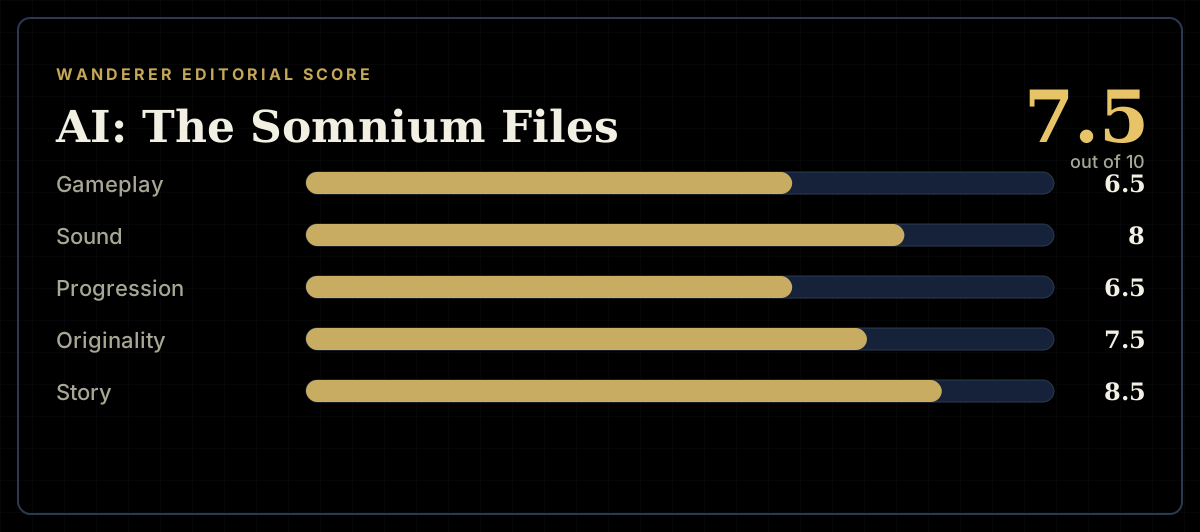
How the review scores each part of the gameWanderer Editorial -
The short versionWanderer Editorial