
Game review
Tribes of Midgard
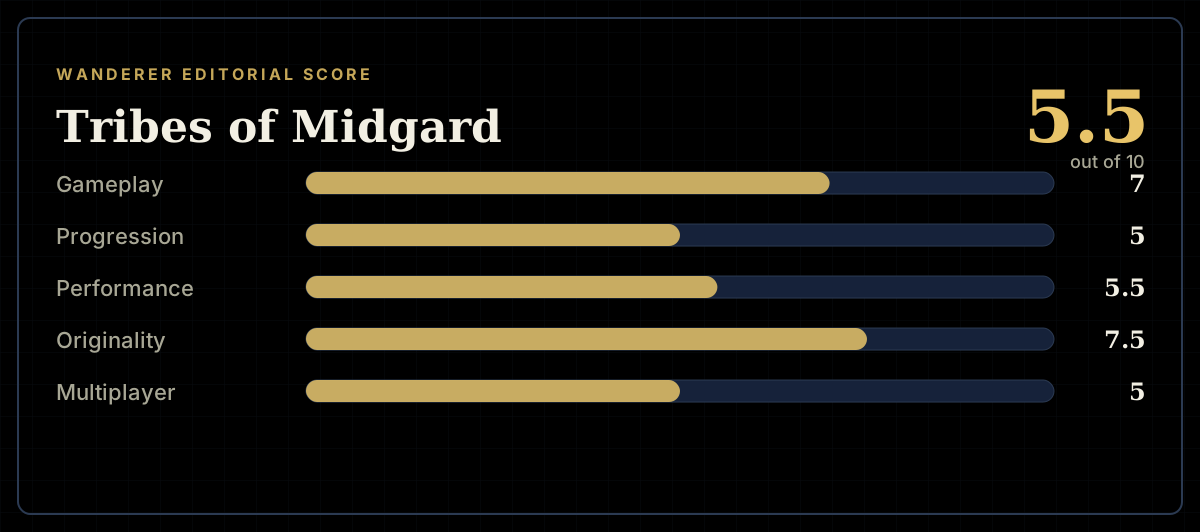
5.5 / 10
- Developer
- Norsfell
- Publisher
- Gearbox Publishing, 2K
- Released
- 27 July 2021
- Platforms
- Windows
- Genre
- Survival Action RPG
- Monetisation
- Free-to-play base access with a paid version and cosmetic purchases; requires an internet connection at all times, including solo play.
- Players
- Online co-op for 1-10 players is the central pillar; the game cannot be played offline even solo.
The short version
Tribes of Midgard's structure — defend your village from escalating waves of Norse mythological threats across a set number of in-game days, racing toward a final Ragnarök confrontation — earns real, specific praise as "weirdly brilliant" from reviewers who otherwise land on very different sides of recommending the game. Mostly Positive across more than 17,000 reviews reflects that genuine design achievement. What keeps this review cautious is a specific, oddly severe UI flaw independently reported by multiple players — an Abandon button placed directly beside the Exit button that permanently deletes a character and bans the account on misclick — alongside a mandatory always-online requirement that blocks solo play without an internet connection at all.
Biggest strengths
- A genuinely inventive core structure — day-by-day village defense against escalating Norse mythological threats building toward a climactic Ragnarök encounter — that reviewers across the spectrum credit as creatively distinctive.
- Real co-op scale, supporting up to ten players in a shared world, giving the tower-defense-adjacent structure genuine social weight.
- A striking, illustrated-comic-book visual style for enemies and bosses that stands out clearly in official promotional screenshots.
Biggest weaknesses
- A specific, independently repeated design flaw places an "Abandon" button directly beside the "Exit" button in the menu, permanently deleting a character and banning the account from that server on misclick with no adequate confirmation step.
- The game requires a persistent internet connection at all times, including for solo single-player sessions, a design choice at least one reviewer connects directly to the wider Stop Killing Games consumer-rights concern.
- Several reviewers describe the game running short on content once the core loop's structure has been learned, limiting long-term replay value.
Who it's for: Co-op survival fans drawn to a genuinely inventive, time-pressured seasonal structure, prepared for real content-depth limits after the core loop is learned and a specific interface hazard worth knowing about before playing.
Our recommendation: A distinctive co-op experience worth trying with friends; be extremely careful around the game's exit menu, and don't expect to play it without a live internet connection even alone.
5.5 / 10
A genuinely inventive structure, even critics agree
Tribes of Midgard's core design idea sets it apart from most survival games in its category, and the official screenshot shows exactly why: a towering, jagged ice giant looms over a battlefield already crowded with mounted riders, ranged attackers and a village under active assault, a resource counter and day tracker ("DAY 5") pinned to the top of the screen alongside the giant's own massive health bar. The store page frames the pitch plainly: "a vibrant blend of survival and action RPG for 1-10 players! Craft legendary items, grow your home base and embark on an epic journey through procedural realms to face towering creatures hell-bent on unleashing Ragnarök." What's notable is how even reviewers who ultimately don't recommend the game single out that structure specifically for praise. "This is a bizarre, bizarre case. The reason you're seeing this game everywhere, and the reason there are ANY positive reviews is that the design of this game is actually... weirdly brilliant," reads a January 2022 review — a genuinely rare kind of compliment, paid by a critic actively building toward a negative recommendation.
A specific, bizarre and severe interface hazard
What tempers that design praise is a specific, oddly severe usability flaw reported independently by multiple reviewers in nearly identical terms. "There's an abandon button right next to the exit button. If you happen to click that one by mistake it deletes your character and permabans you from the server so you can't even start over," reads a July 2023 review. A June 2023 review describes the same layout choice even more pointedly: "This game has one of the [worst] UI design[s] ever seen... have a button to permanently ban yourself on the place it's usually the 'quit' button." A March 2023 review lists the same specific complaint among a broader set of usability frustrations, describing it as a "baffling user experience decision." This isn't a subjective complaint about menu aesthetics — it's a specific, reproducible layout choice that multiple independent players describe causing real, irreversible progress loss through simple misclicks, and it's the kind of concrete, actionable warning worth knowing before opening the game's menu for the first time.
An always-online requirement with no solo exception
A second, distinct complaint concerns the game's connectivity requirements. "Literally 0 reason as to why this game is unplayable offline. Why not just disable the shop??? I play this game singleplayer anyways, but simply because I don't have an internet connection I cannot play," reads an October 2023 review, describing a mandatory online requirement even for entirely solo sessions. A September 2025 review connects this pattern to a broader, named consumer advocacy concern directly: "This is a living example of what Ross Scott and his movement are fighting for," referring to the Stop Killing Games campaign against games designed to become permanently unplayable once a publisher's servers stop supporting them. Whatever the original technical justification for the requirement, reviewers consistently frame it as an unnecessary restriction on a mode of play — solo, offline — that has no obvious dependency on live servers at all.
Support that's slowed, and a save-loss report
Two further complaints round out the picture. A June 2024 review reports the game as "practically abandoned now, updates are basically non-existent. Every 'update' is either a sale or a holiday event offering cosmetics," with no indication of further story or content development. Separately, a September 2022 review describes a specific, serious technical failure: being disconnected from a multiplayer session and returning to find the shared world had been lost entirely, with the game's own save browser still showing it as active despite being permanently inaccessible.
Why placement, not just presence, is the real design failure
It's worth being precise about why the Abandon-button complaint is a genuine design failure rather than simply "the game has a harsh permadeath feature players don't like." Plenty of survival and roguelike games build genuine, intentional permadeath or world-reset mechanics into their core design, and players who dislike that philosophy can reasonably choose a different genre. That's not what's being described here. The complaint isn't about the existence of an irreversible abandon option — it's specifically about its physical placement in the menu, sitting where a player's muscle memory expects the harmless, frequently-used Exit button to be. A deliberate, consequential action placed at the exact screen position most players instinctively click without close attention is a basic interface design error independent of whatever philosophy the underlying permadeath mechanic is trying to express. Multiple reviewers make exactly this distinction themselves, describing genuine enjoyment of the game's difficulty and stakes right up until a menu misclick, rather than objecting to permanent consequences as a concept.
What the free-to-play structure means for trying it safely
Given the entry price is free for the base access tier, one practical piece of advice follows directly from the concerns above: players curious about the core design but wary of either the menu hazard or the always-online requirement can reasonably try the free tier first, in a low-stakes session, specifically to get comfortable with the interface layout before committing real time to a character or world they'd be upset to lose. That doesn't resolve either underlying issue, but it does give a cautious prospective player a lower-risk way to evaluate whether Tribes of Midgard's genuinely distinctive core loop is worth the specific risks this review has documented, before deciding whether to invest further in the paid version or extended co-op sessions with friends.
Final verdict
Tribes of Midgard's core design remains genuinely inventive — a day-counting, escalating co-op siege structure that reviewers on both sides of the recommendation divide credit as creative and distinct. What keeps this score cautious is a combination of a specific, well-documented and unusually severe interface hazard capable of permanently destroying progress on a simple misclick, and an always- online requirement that offers no solo offline path despite no clear technical need for one. This is a strong pick for a group of friends willing to navigate its menus carefully; approach with real caution if you specifically want to play alone or without a reliable connection.
Pros and cons
Pros
- A genuinely inventive core structure — day-by-day village defense against escalating Norse mythological threats building toward a climactic Ragnarök encounter — that reviewers across the spectrum credit as creatively distinctive.
- Real co-op scale, supporting up to ten players in a shared world, giving the tower-defense-adjacent structure genuine social weight.
- A striking, illustrated-comic-book visual style for enemies and bosses that stands out clearly in official promotional screenshots.
- A free-to-play entry point lowers the barrier for groups of friends to try the co-op structure together.
Cons
- A specific, independently repeated design flaw places an "Abandon" button directly beside the "Exit" button in the menu, permanently deleting a character and banning the account from that server on misclick with no adequate confirmation step.
- The game requires a persistent internet connection at all times, including for solo single-player sessions, a design choice at least one reviewer connects directly to the wider Stop Killing Games consumer-rights concern.
- Several reviewers describe the game running short on content once the core loop's structure has been learned, limiting long-term replay value.
- A separate technical report describes a disconnect during a multiplayer session permanently destroying a shared world's save data.
Screenshots
-

Tribes of MidgardImage: Gearbox Publishing via Steam -

Tribes of MidgardImage: Gearbox Publishing via Steam -

Tribes of MidgardImage: Gearbox Publishing via Steam -
How the review scores each part of the gameWanderer Editorial -
The short versionWanderer Editorial