Game review
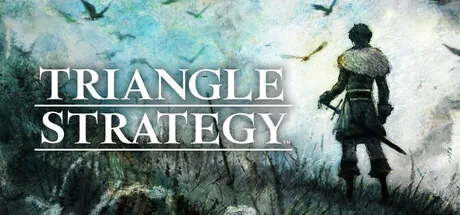
Triangle Strategy
8 / 10
- Developer
- Square Enix, Artdink
- Publisher
- Square Enix
- Released
- 4 March 2022
- Platforms
- Nintendo Switch, Windows, PlayStation 5, Xbox Series X|S, Meta Quest
- Genre
- Tactical RPG
- Monetisation
- Premium, one-off purchase. No DLC or in-game purchases on any platform at time of writing.
- Players
- Single-player only
The short version
Triangle Strategy pairs genuinely inventive tactical combat — height advantage, freezable and meltable terrain, flanking follow-ups — with a persuasion mechanic that lets the party vote on the story's biggest decisions and actually branches into different chapters and endings because of it. It is also a game whose own Steam reviews argue, repeatedly and specifically, that its ratio of cutscene to combat runs too far in the story's favour for a tactics RPG.
Biggest strengths
- Height advantage, destructible and transformable terrain (freezing water, melting ice into puddles, spreading lightning through them) give tactical positioning real depth beyond stat checks
- The Scales of Conviction persuasion mechanic lets party members vote on major story decisions and genuinely branches the campaign into different chapters, recruits and one of four endings
- Akira Senju's orchestral score, arranged across a four-disc soundtrack, is a genuine standout and a clear departure from how most tactics RPGs are scored
Biggest weaknesses
- A meaningful share of negative Steam reviews describe specific stretches of 20-30 minutes of dialogue between battles, with one review counting just three battles in four hours of play
- The persuasion and exploration loop between votes asks for a lot of town-wandering to gather conviction-boosting information, which some players found padded rather than rewarding
- At NZ$79.95 with a story-to-combat ratio this heavy, several reviewers explicitly framed the price against how little actual tactical combat that price buys per hour
Who it's for: Tactics RPG fans who grew up on Final Fantasy Tactics or Tactics Ogre and want genuinely novel terrain mechanics, plus anyone who wants a story where persuading party members actually changes what happens next. Less suited to players who came for wall-to-wall battles rather than a story-forward pace.
Our recommendation: One of the better tactics RPGs in years on mechanical terms, but go in knowing what a meaningful share of its own audience specifically warns about: long dialogue stretches between fights, sometimes running well past half an hour, in a genre normally paced around frequent combat.
8 / 10
Tomoya Asano, the producer behind Bravely Default and Octopath Traveler, built Triangle Strategy for players who grew up on Final Fantasy Tactics and Tactics Ogre and never quite got a proper successor to either. On the battlefield, that's exactly what it delivers. Off it, this is also a game whose own Steam audience keeps raising the same specific complaint: that its balance between story and combat leans hard enough toward story to change what kind of game this actually is for long stretches at a time. Both things describe the same release, and neither cancels the other out.
Height, terrain and genuine tactical improvisation
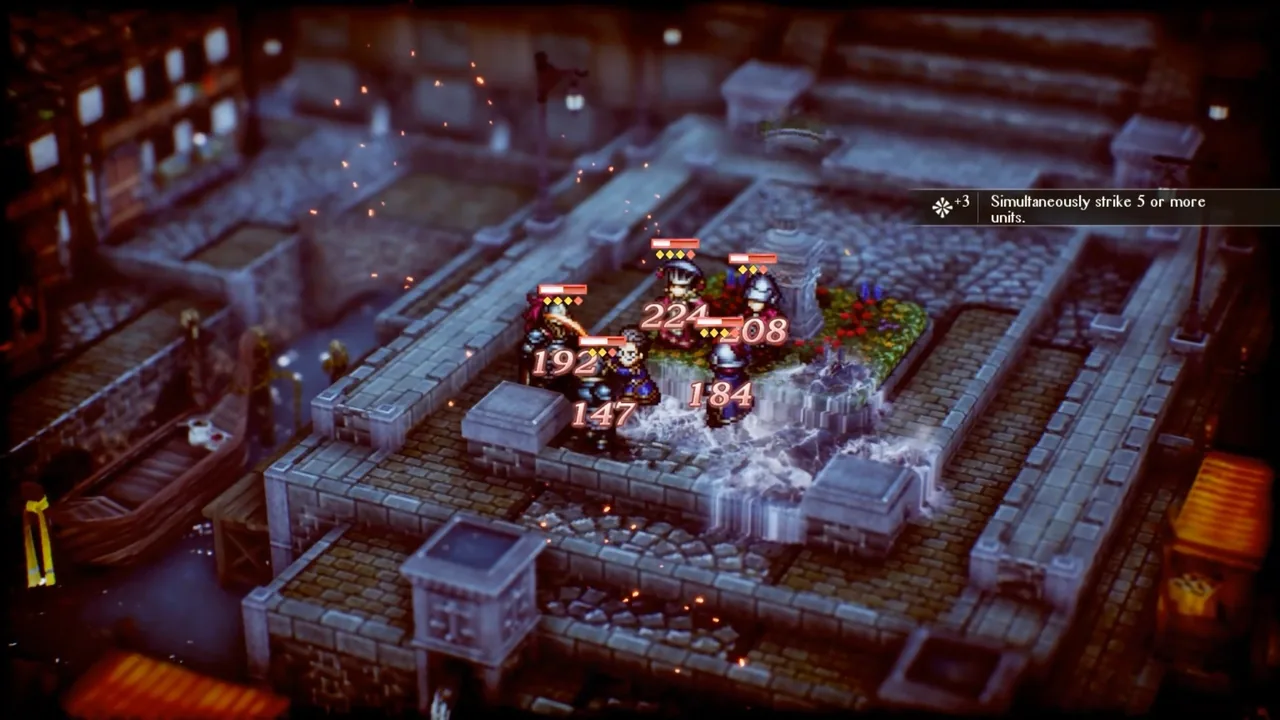
The combat is where Triangle Strategy earns its reputation. Elevation isn't cosmetic — attacking from higher ground adds real damage and extends attack range, and each unit's jump stat determines how much vertical terrain it can actually traverse, turning the map itself into a puzzle rather than a flat grid with obstacles on it. Layered on top of that is genuine environmental transformation: freezing spells turn water into ice that slows and blinds anyone standing on it, fire spells melt that ice back into a hazard, and lightning spreads through standing water to hit everyone in it at once. Flanking matters mechanically rather than just numerically — attacking from behind is an automatic critical hit, and an ally standing opposite an engaged enemy triggers a follow-up attack. None of these systems are individually unprecedented in the genre, but the combination, and how directly the game rewards reading the map before committing a unit, is a genuine step up from most tactics RPGs released this decade.
The Scales of Conviction actually branch the story
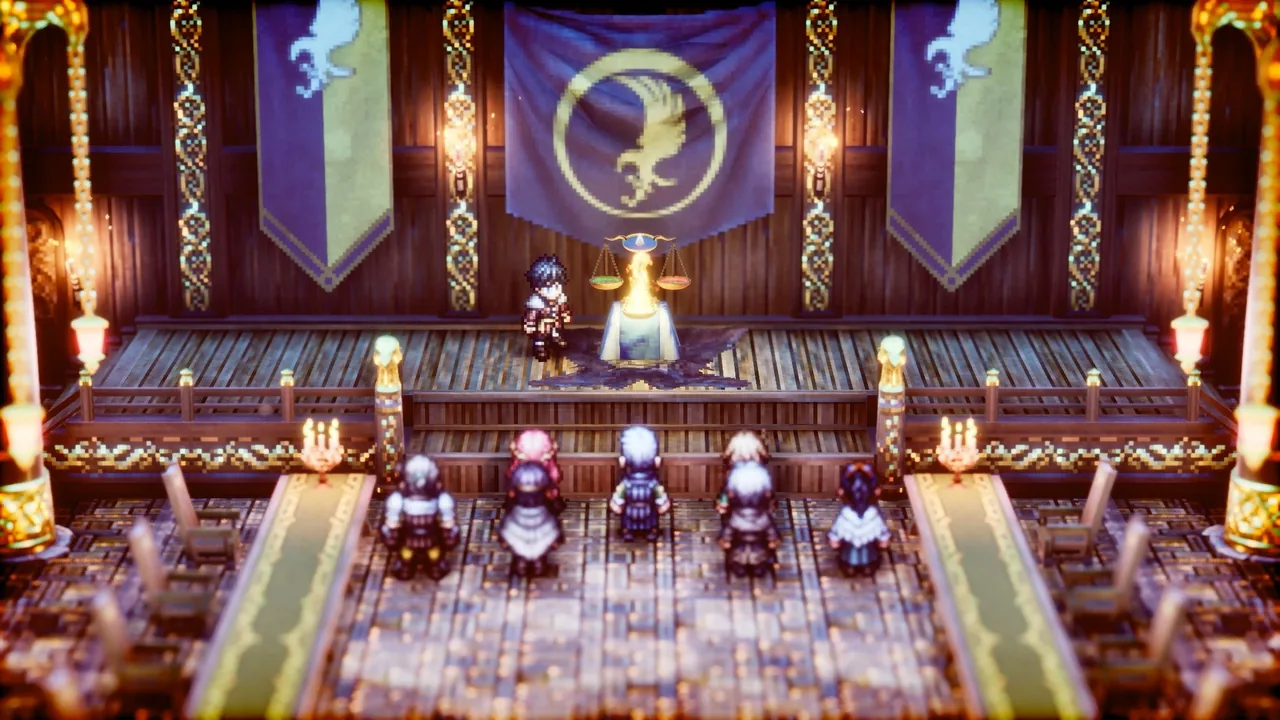
At several fixed points, the party votes on the campaign's biggest decisions using the Scales of Conviction — protagonist Serenoa doesn't get a vote himself, but can sway party members toward a preferred outcome using information gathered by exploring town hubs between chapters, and breaks ties if the vote lands even. This isn't a cosmetic dialogue-choice system: the vote's outcome genuinely branches the story into different chapters, different recruitable characters and, ultimately, one of three thematic endings (built around Morality, Utility or Liberty) or a fourth "Golden Route" true ending reserved for players who hit every correct story flag along the way. Getting that fourth ending stretches the campaign to 21 chapters against 19 for the other three, and it's a genuinely rare case of a JRPG's branching narrative actually branching, rather than reconverging onto the same handful of scenes regardless of what a player picked.
The dialogue-to-battle ratio its own players keep flagging
Set against those two strengths is the specific complaint that shows up across a meaningful share of this game's negative Steam reviews: how much of it is dialogue. One review describes three battles across four hours of play and calls the game "more of a visual novel with occasional battles." Another counts roughly thirty minutes of uninterrupted cutscene between individual fights and calls the pacing "mind-numbing." A third, a self-described Final Fantasy Tactics fan who came in wanting exactly this kind of game, put over half the campaign's length down to exposition and reading rather than combat. This isn't a handful of impatient outliers — it's a specific, recurring account from players who otherwise liked or wanted to like the tactical layer, and it's worth taking as seriously as the praise for the combat system itself. The persuasion loop compounds it: raising Conviction between votes means exploring town hubs for optional dialogue and information, and that exploration is exactly the kind of content the pacing complaints are usually about.
Presentation built for a story-forward pace
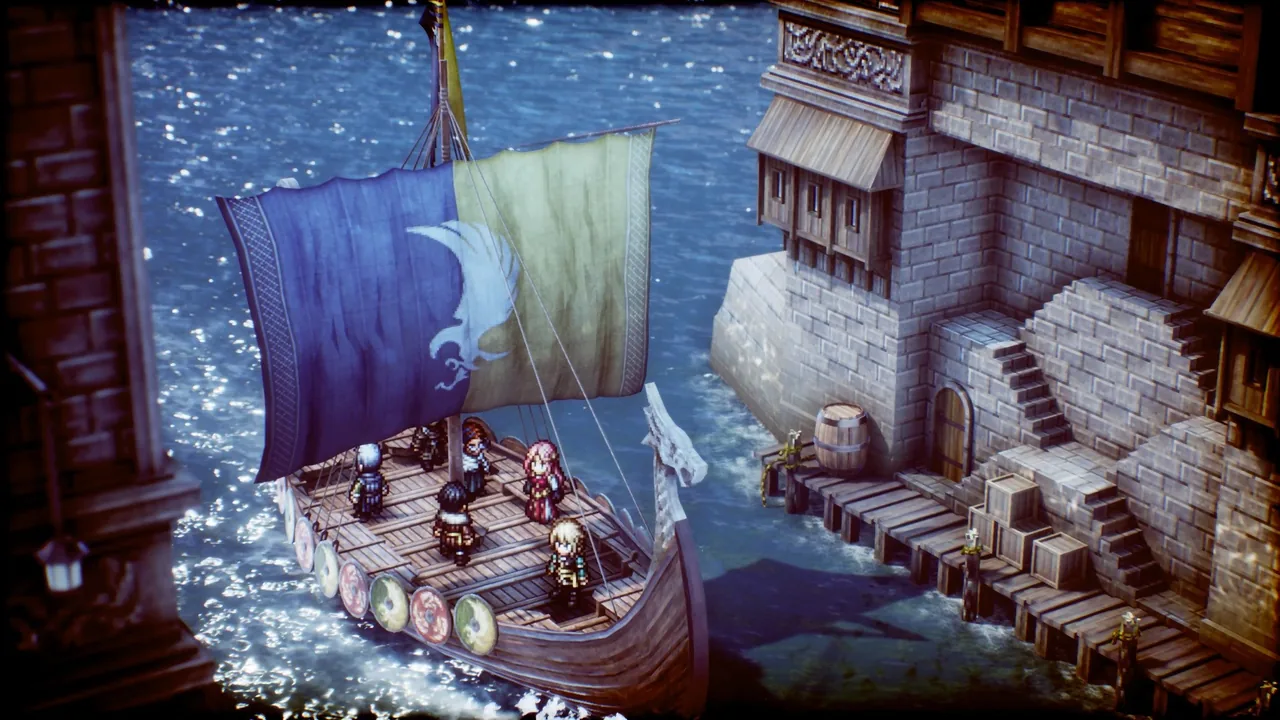
Whatever the pacing costs the game with some players, the presentation is built to carry a dialogue-heavy campaign. The HD-2D-adjacent art style renders pixel character sprites over detailed, painterly environments, and critics consistently singled it out alongside the combat as one of the game's clear strengths. Akira Senju's orchestral score — a four-disc soundtrack recorded with more than sixty performers, an unusual scale for a tactics RPG — leans classical rather than following the genre's usual synth-and-strings tactical-RPG template, and it's one of the more distinctive scores in the genre this decade specifically because it doesn't sound like its closest competitors.
What NZ$79.95 actually buys
At full price with no discount active, several of this game's own negative reviews frame the purchase explicitly against how little uninterrupted tactical combat that price delivers per hour, given how story-heavy the campaign runs. That's a fair way to think about value here: this isn't a game stretched thin on content — a full playthrough with the Golden Route runs well past the length of most tactics RPGs — but the ratio of hours spent fighting to hours spent reading is the deciding factor for whether that length reads as generous or padded, and it's genuinely different depending on what a given player wants from the genre.
Verdict
Eight out of ten. Triangle Strategy's combat — verticality, transformable terrain, and positioning that actually rewards forethought — is as good as anything the tactics RPG genre has produced recently, and the Scales of Conviction turn a persuasion mechanic into something that meaningfully reshapes the campaign rather than just flavoring it. What keeps it from climbing higher is the same thing a meaningful share of its own Steam reviews raise unprompted: long, frequent stretches of dialogue between fights that some players found rewarding and others found close to a different game wearing a tactics RPG's combat system. Go in knowing which kind of player you are, and the eighty-plus hours this game asks for will land very differently depending on the answer.
Price and review counts checked 3 August 2026.
Pros and cons
Pros
- Height advantage, destructible and transformable terrain (freezing water, melting ice into puddles, spreading lightning through them) give tactical positioning real depth beyond stat checks
- The Scales of Conviction persuasion mechanic lets party members vote on major story decisions and genuinely branches the campaign into different chapters, recruits and one of four endings
- Akira Senju's orchestral score, arranged across a four-disc soundtrack, is a genuine standout and a clear departure from how most tactics RPGs are scored
- Backstab critical hits and flanking follow-up attacks reward positioning play beyond simple unit-versus-unit stat comparisons
Cons
- A meaningful share of negative Steam reviews describe specific stretches of 20-30 minutes of dialogue between battles, with one review counting just three battles in four hours of play
- The persuasion and exploration loop between votes asks for a lot of town-wandering to gather conviction-boosting information, which some players found padded rather than rewarding
- At NZ$79.95 with a story-to-combat ratio this heavy, several reviewers explicitly framed the price against how little actual tactical combat that price buys per hour
- Progression is comparatively shallow next to genre peers — there's no deep job or class system layered on top of each character's fixed role
Screenshots
-
TRIANGLE STRATEGYImage: Square Enix via Steam -
TRIANGLE STRATEGYImage: Square Enix via Steam -
TRIANGLE STRATEGYImage: Square Enix via Steam -
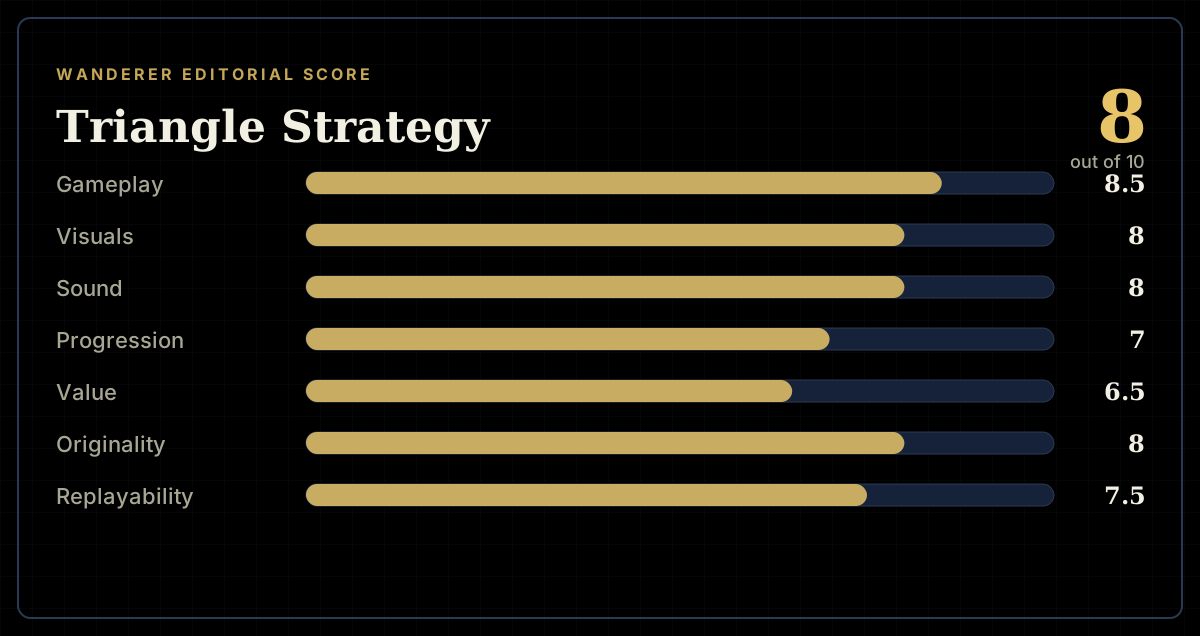
How the review scores each part of the gameWanderer Editorial -
The short versionWanderer Editorial