
Game review
Town of Salem
6 / 10
- Developer
- BlankMediaGames
- Publisher
- Digital Bandidos
- Released
- 15 December 2014
- Platforms
- Windows, macOS
- Genre
- Social Deduction RPG
- Monetisation
- Free-to-play with in-app purchases, including a premium currency and role/coven expansion packs.
- Players
- Online matches for 7 to 15 players, entirely built around live text chat and deduction between real people rather than AI.
The short version
Town of Salem takes the classic Mafia/Werewolf party-game format and gives it 33 distinct roles, a full day/night cycle, and years of iteration that a real, dedicated community has clearly valued — Very Positive across more than 30,000 reviews reflects genuine, lasting affection for the core deduction gameplay. Running alongside that affection, in review after review across more than a decade, is a specific and remarkably consistent complaint: a ban and moderation system reviewers describe as arbitrary, poorly explained, and slow or impossible to appeal, sometimes acting on reports from years earlier with no fresh context. The game has since changed publishers and brought its original developers back, and remains under active development in 2026 — but the moderation complaint predates that change and, per the most recent reviews, hasn't gone away with it.
Biggest strengths
- 33 distinct roles across Town, Mafia, Neutral and Coven alignments give the core Mafia/Werewolf format real, lasting variety few competitors match.
- A genuine day/night structure and role-specific ability system reward careful reading of other players rather than pure bluffing alone.
- Still under active development as of 2026, with the original developers having returned to the project under a new publisher after a period of reduced support.
Biggest weaknesses
- An unusually consistent, decade-long complaint describes the ban and moderation system as arbitrary, opaque, and difficult or impossible to appeal — including reports of bans issued years after the reported incident with little context given.
- A January 2019 review describes a credential-compromise incident that the developers reportedly delayed disclosing over a holiday period.
- Several long-tenured reviewers, including one citing over 500 hours played across a decade, describe current queue times and match quality as meaningfully worse than in the game's earlier years.
Who it's for: Fans of hidden-role deduction games like Mafia and Werewolf who want deep, well-designed role variety and a genuine online community, prepared to accept real risk around the game's account and moderation policies.
Our recommendation: The core game is genuinely excellent and worth playing; go in aware that account bans in this community are a real, frequently reported risk rather than a rare edge case.
6 / 10
A genuinely deep take on a classic format
Town of Salem's core idea is a faithful, well-built expansion of the Mafia and Werewolf party-game format rather than a simple digital port. Matches run 7 to 15 players, randomly assigned across Town, Mafia, Neutral and Coven alignments, cycling through day and night phases where evil roles secretly eliminate targets and the Town tries to identify and vote out threats using only conversation and deduction. What sets it apart, and what the official description leads with, is scale: "Town of Salem has 33 unique roles ensuring a different experience each time you play," each with genuinely different abilities — Sheriffs interrogate, Doctors heal, Serial Killers murder undetected — layered on top of the base social-deduction loop. The game's own official screenshot shows exactly how much information a single match juggles: a live player list with usernames, a role card panel explaining a specific character's alignment and full ability set, a graveyard tracker and a running chat log all visible simultaneously. For a genre that can often be reduced to "everyone argues, then votes," that's a real, substantive layer of mechanical depth, and it's the reason more than 30,000 reviews land at Very Positive over a decade after launch.
A moderation problem that's outlasted a change of ownership
Set against that design strength is a complaint that shows up with striking regularity across the entire span of the game's review history, not clustered around one bad patch the way some controversies are. A 2018 review describes being "perma banned because apparently if a few stupid people decide that they think you threw the game then can report and ban you." A 2019 review, from an account with over 87,000 minutes (well over 1,400 hours) logged, states plainly that "the devs have given up on the game," citing years of unaddressed frustration before finally giving up their recommendation. A December 2025 review describes an account banned "because of reports of me from 5+ years ago," with no fresh context given for why old reports resurfaced. A January 2026 review, also citing over 500 hours played "10 years ago," calls the game "pathetically mismanaged" in its current state. These aren't reviews from players who bounced off after a few matches — several of the most detailed, harshest complaints come from accounts with hundreds or thousands of hours invested, describing a specific policy failure rather than sour grapes from someone who simply didn't enjoy the format.
One additional, more serious 2019 review raises a separate concern: a reported delay in disclosing a credential-compromise incident, allegedly held back "because it would be bad timing over christmas time." This review has no way to independently verify the internal reasoning behind that timing, but the specificity of the claim — a named holiday period, a stated reason — makes it worth including as part of the documented pattern of trust issues around this game's account and security handling, distinct from the gameplay-moderation complaints above.
A real attempt at recovery, mid-story
It's worth being fair to what's changed more recently. The developer's own news feed documents a genuine transition: a mid-2024 announcement introduced Digital Bandidos as a new publisher, followed shortly after by confirmation that the game's original developers, credited as Curtis and Tuba, were returning to the project after what the same post describes as time spent "heads down" reorganising teams and reviewing community feedback. Patches have continued at a real cadence since — a Unity security update in October 2025, a quality-of-life patch and Discord Activities integration as recently as May 2026 — indicating the game is not simply coasting on inertia. What the review sample doesn't show is any indication that the specific, long-standing moderation complaints have been addressed by this transition; the December 2025 and January 2026 reviews cited above post-date the new publisher's arrival and describe the same category of problem players were raising in 2018 and 2019.
Why moderation matters more here than in most multiplayer games
It's worth explaining why a ban-system complaint carries unusual weight for this specific game rather than treating it as a generic multiplayer gripe that applies equally everywhere. Town of Salem's entire design depends on live text chat between real people as the core mechanic, not a side channel around the gameplay — accusing, defending, bluffing and reading other players' words is literally what the game is. That means the moderation layer isn't a peripheral trust-and-safety function sitting outside the game; it's adjudicating the exact behaviour the design asks players to engage in. A false or poorly explained ban here doesn't just remove access to a game, the way it might for a shooter or a platformer — it specifically penalises the kind of pointed, accusatory, in-character speech the game is built to reward, which makes the line between "gameplay" and "bannable conduct" genuinely harder to draw than in most other online games. Several of the reviews cited above make close to this exact point themselves, describing bans triggered by lines that were clearly part of in-character deduction play rather than genuine harassment. That structural tension between the game's core loop and its enforcement system is a large part of why this complaint has proven so durable across a full decade and multiple changes of ownership, rather than fading the way a typical launch-week moderation controversy usually does.
Final verdict
The game underneath Town of Salem's controversy is genuinely well designed — deep enough in its role variety and deduction mechanics to have sustained a real, dedicated community across more than a decade, and it's still receiving real development attention in 2026 after a rocky period. But an unusually long, unusually specific and unusually consistent thread of reviews describes an account and moderation system that treats its own playerbase with real inconsistency, up to and including recent reports that predate any fix from the new ownership. This review can recommend the core game on its merits while being honest that anyone investing serious time should go in aware their account security and standing may not be fully in their own hands.
Pros and cons
Pros
- 33 distinct roles across Town, Mafia, Neutral and Coven alignments give the core Mafia/Werewolf format real, lasting variety few competitors match.
- A genuine day/night structure and role-specific ability system reward careful reading of other players rather than pure bluffing alone.
- Still under active development as of 2026, with the original developers having returned to the project under a new publisher after a period of reduced support.
- Free to play with a functioning single-purchase option that unlocks a cosmetic character and account benefits, rather than the game being locked behind a paywall.
Cons
- An unusually consistent, decade-long complaint describes the ban and moderation system as arbitrary, opaque, and difficult or impossible to appeal — including reports of bans issued years after the reported incident with little context given.
- A January 2019 review describes a credential-compromise incident that the developers reportedly delayed disclosing over a holiday period.
- Several long-tenured reviewers, including one citing over 500 hours played across a decade, describe current queue times and match quality as meaningfully worse than in the game's earlier years.
- Monetisation includes a premium currency and paid expansion role packs layered onto a free base game, a common friction point even among reviewers who otherwise recommend it.
Screenshots
-

Town of SalemImage: Digital Bandidos via Steam -

Town of SalemImage: Digital Bandidos via Steam -

Town of SalemImage: Digital Bandidos via Steam -
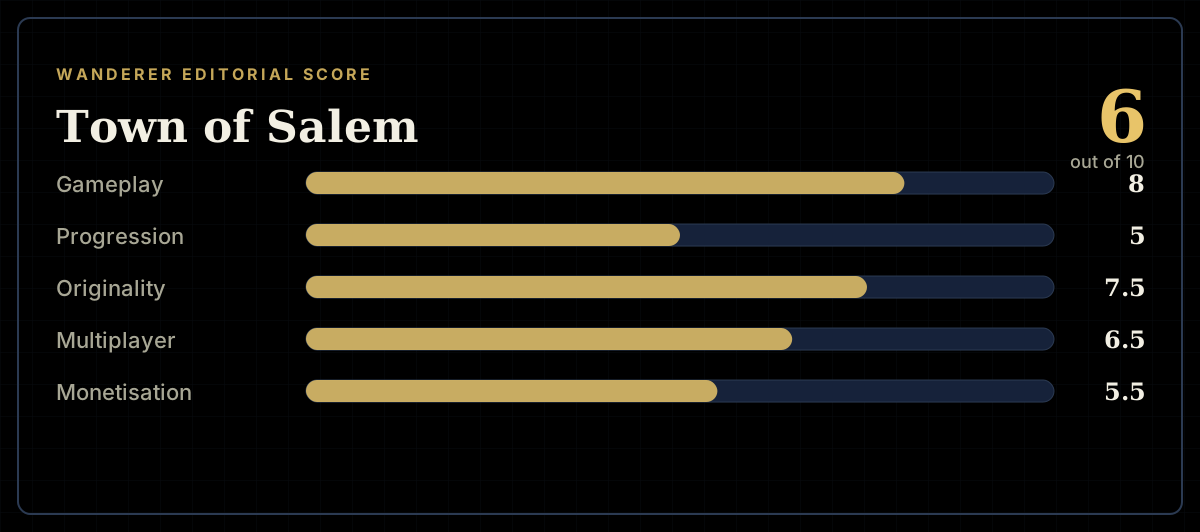
How the review scores each part of the gameWanderer Editorial -
The short versionWanderer Editorial