
Game review
Tobacco Shop Simulator
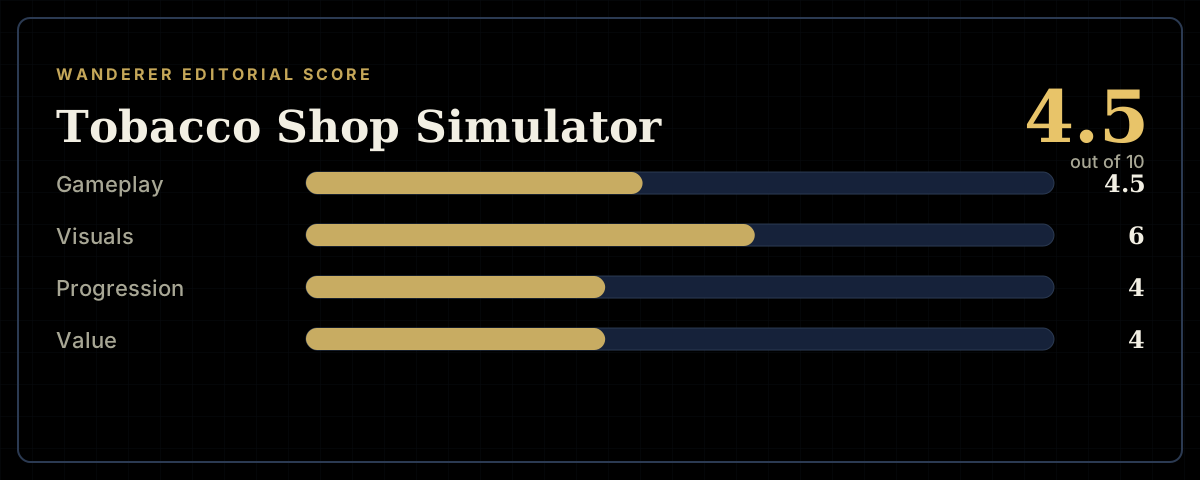
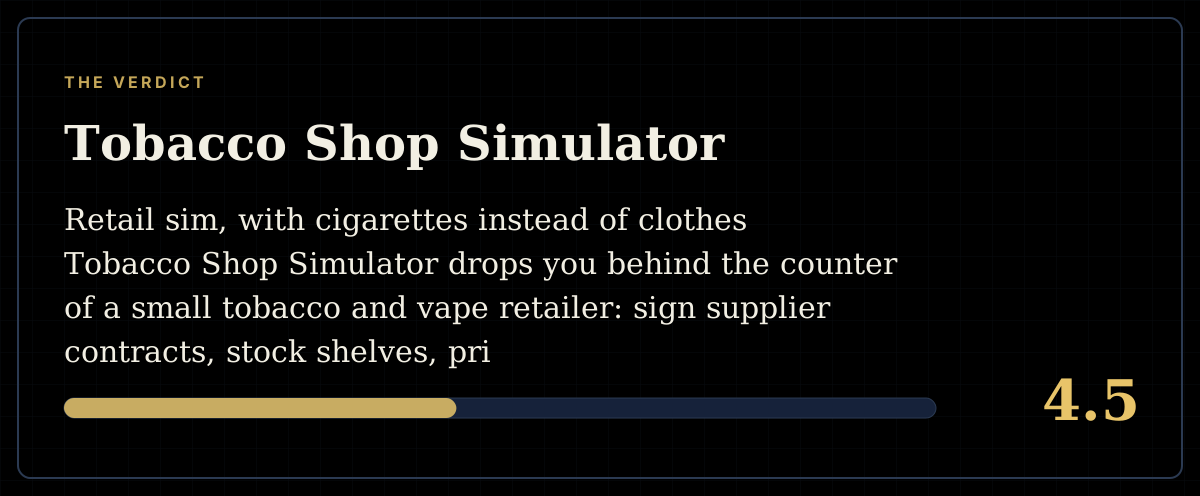
4.5 / 10
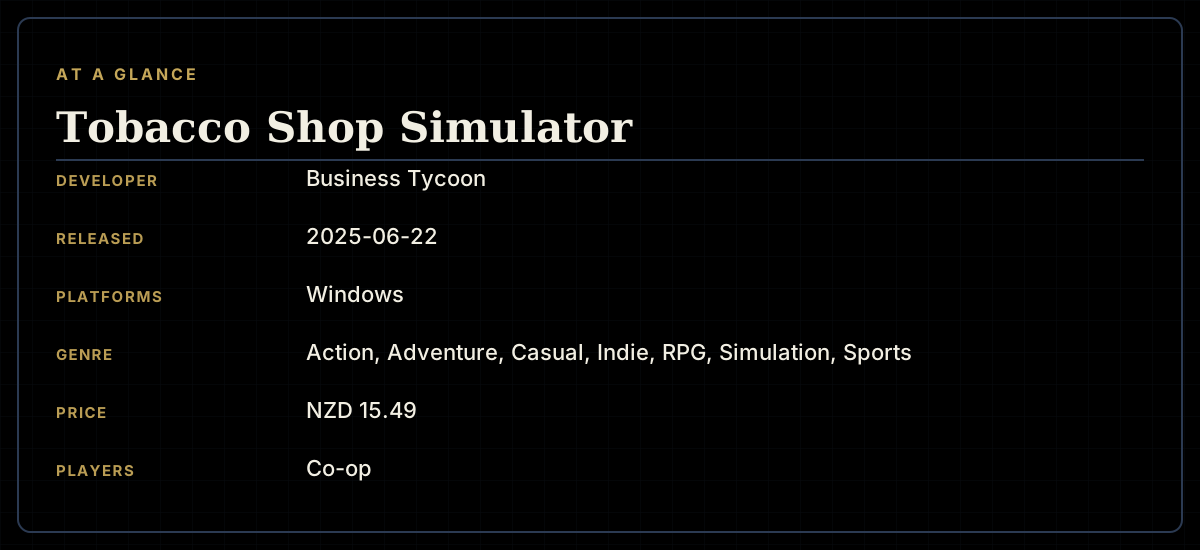
- Developer
- Business Tycoon
- Publisher
- Business Tycoon
- Released
- 22 June 2025
- Platforms
- Windows
- Genre
- Action, Adventure, Casual, Indie, RPG, Simulation, Sports
- Players
- Co-op
The short version
Biggest strengths
- A smooth, legible core loop of stocking, pricing, and selling that reviewers describe as immediately approachable even without prior genre experience
- Solid presentation for its price point, with several reviewers specifically praising graphics and general polish for what amounts to a budget indie release
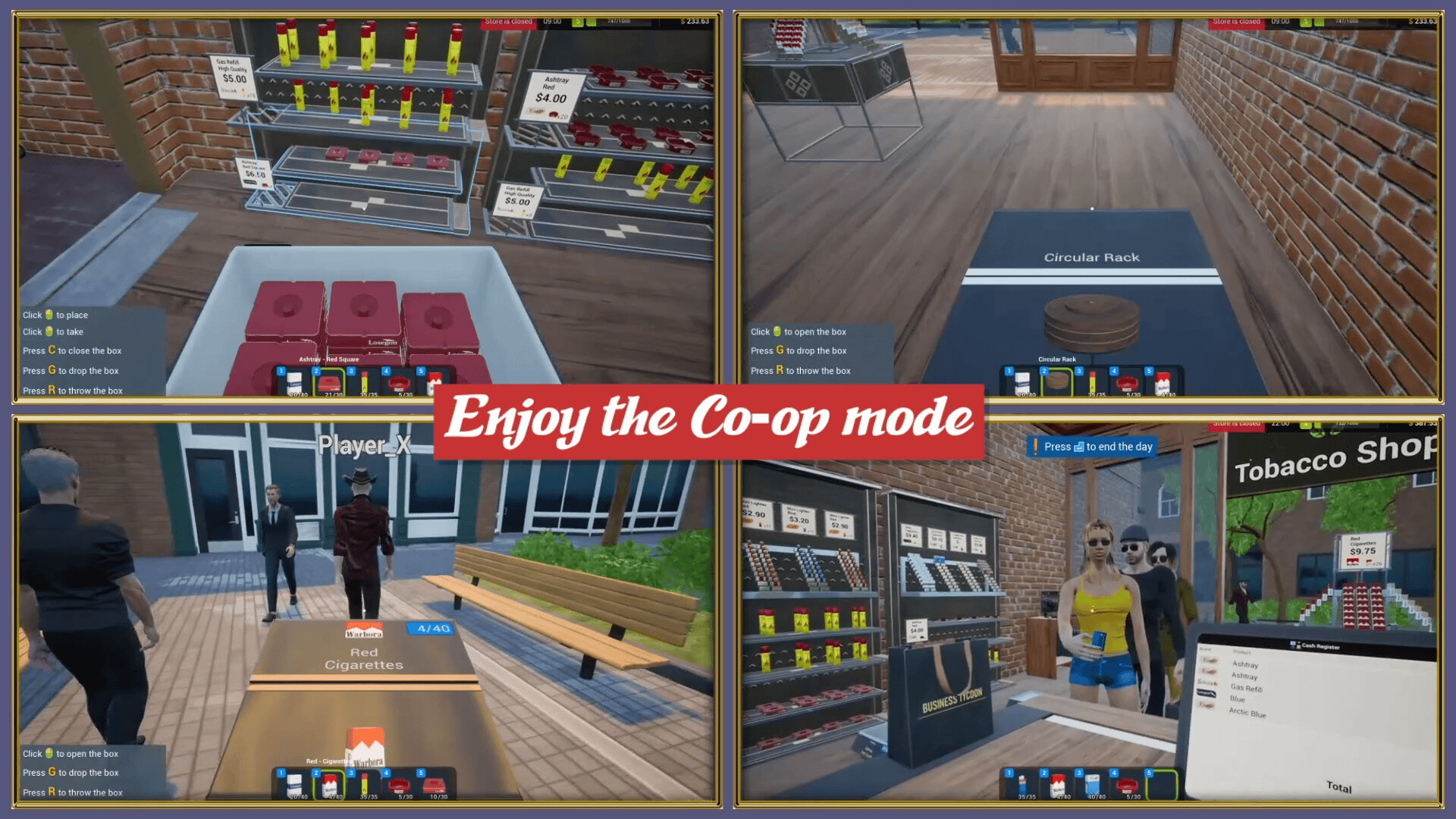
- Genuine co-op support that at least some player groups report enjoying together
Biggest weaknesses
- Multiple independent reviewers describe it as a near-identical clone of another retail-management title from the same developer, down to shared key bindings and an unfixed bug where the pause menu can't be opened while holding an item
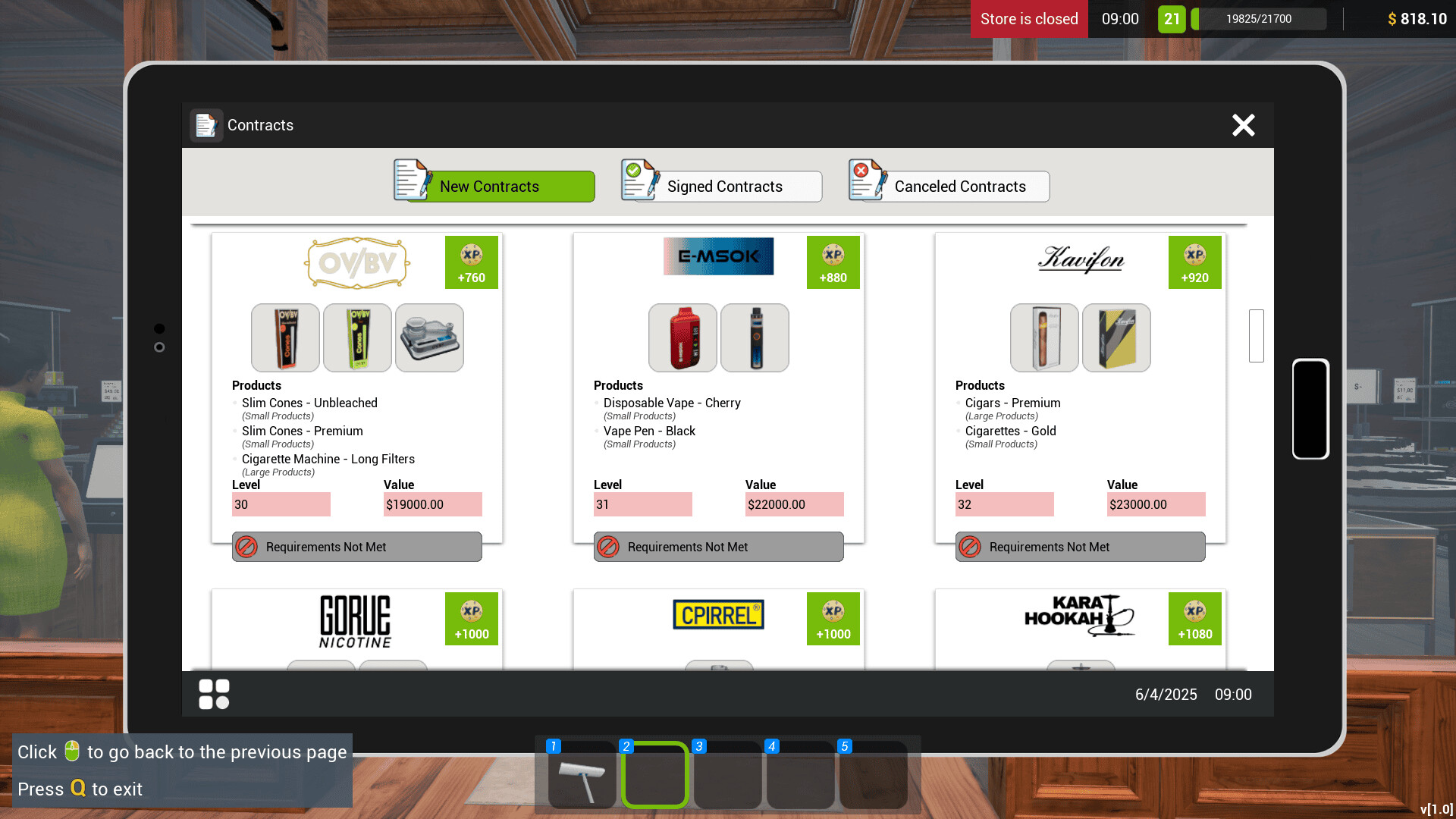
- License and "contract" costs required to sell new products are reported to escalate into the tens of thousands of in-game currency, a jump several reviewers say is disproportionate to how the game prices everything else
- A reported co-op bug can delete a held box and its entire contents if a second player cleans up nearby empty boxes at the same time
4.5 / 10
Retail sim, with cigarettes instead of clothes
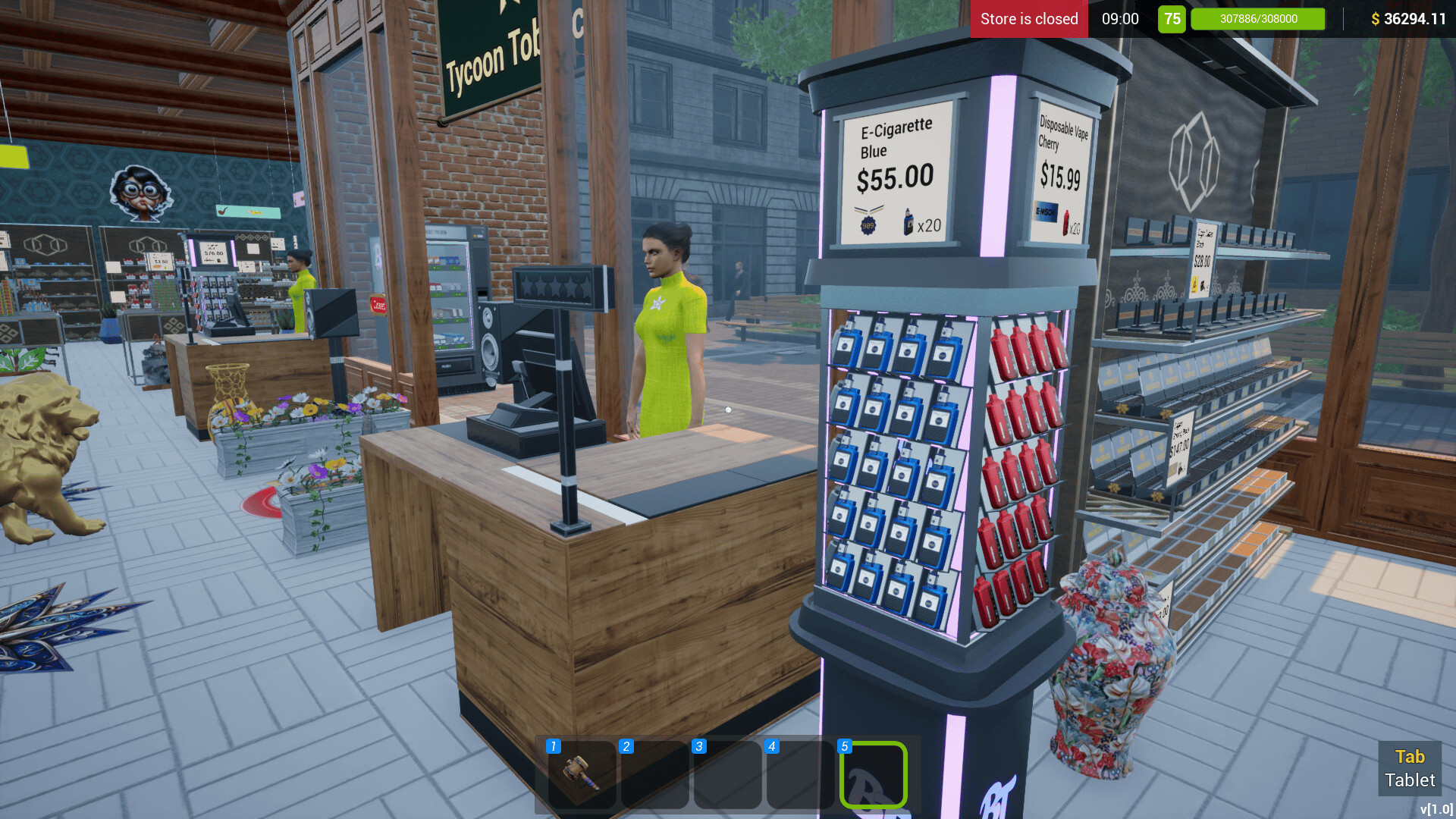
Tobacco Shop Simulator drops you behind the counter of a small tobacco and vape retailer: sign supplier contracts, stock shelves, price goods, ring up customers, and expand as revenue allows, solo or with a co-op partner. The presentation is competent for the price — several reviewers specifically single out graphics and general smoothness as better than they expected from a budget genre entry — and the core interaction loop is immediately legible, which several reviewers credit even while being critical of everything built on top of it.
That base-level competence is where the praise mostly stops, though, because the review sample converges hard on a single, specific, damaging accusation about the game's origins rather than its execution.
A specific, detailed clone accusation
The dominant complaint in the negative review sample isn't a vague "it's generic" dismissal — it's a specific, repeated claim that this game is a direct asset-and-mechanics reskin of an earlier title from the same genre space. "If at any time you played Retail Company Simulator, you won't get much difference here. This game is legit a copy paste of that game with just smokes instead of clothes," one review states plainly. A separate, even more detailed review goes further, describing not just shared mechanics but shared key bindings, and pointing to a specific unfixed bug as evidence of literal code reuse: "you aren't even allowed to hit escape for your menu while you have an item in your hand... it's not coded in" — the same specific limitation, the reviewer implies, carried over unchanged from whatever base the game was built on. When multiple independent reviewers converge on the same specific technical detail as evidence for a broader claim, it's a stronger signal than a single generalized complaint about originality would be.
Whether or not this amounts to a formal reuse of another developer's work, the practical consequence for buyers is the same either way: reviewers who've played the presumed source material report there's little reason to own both, and reviewers who haven't still describe the game as introducing nothing the wider genre hasn't already done, often better. "The game introduces nothing new to the genre while other simulators implement features better," one reviewer summarises, adding, notably, "kind and invested dev though, future projects could be promising" — a genuinely generous aside about the developer's character even from an otherwise critical review.
A progression curve that jumps hard, late
A specific economic complaint concerns the escalating cost of expanding what you're allowed to sell. One detailed review breaks it down precisely: "every item you need to sell has a 'contract' you need to purchase in order to do so, each 'contract' costs more and more as you progress to the point where you are spending 30k-70k just on a 'contract'" before even accounting for the shelving and stock needed to actually use it. That's a specific, sharp jump in required investment relative to the game's earlier, much cheaper stages, and it lines up with the achievement data's own shape: early milestones like signing the first contract, opening the store, and completing the first checkout all sit above 93%, but progression achievements for the later difficulty tiers drop steeply — LevelC at 25.8%, LevelD at 16.3%, LevelE at just 12.4%. A meaningful share of the playerbase appears to stall well before reaching the game's later, more expensive content, which is consistent with the cost-spike complaint rather than contradicting it.
Bugs that cost real progress
Beyond the clone accusation and the cost curve, two more specific technical complaints stand out. A co-op-specific bug is reported where a box a player is actively holding, along with everything inside it, can simply vanish if a second player happens to clean up nearby empty boxes at the same time — a frustrating, concrete loss of progress in exactly the shared-play mode the game promotes. Separately, one detailed reviewer describes reporting a feature that didn't function as its own in-game description claimed, only to have the developer decline to address the discrepancy and instead offer a refund — a response that resolves the individual complaint but does nothing for players who keep the game and encounter the same gap.
Music and mood, an unusual specific complaint
One smaller but oddly specific complaint is worth including for how consistently niche-yet-repeated it is: reviewers flag the in-store background music choices as a strange mismatch for the setting. "Soft-rock? Quasi-jazz? WTF are these music choices for the speakers? There had to be some Indian/Islamic/German house music available, I'm not mad, I'm disappointed," one reviewer writes, a complaint that reads as almost affectionate frustration rather than a serious criticism, but it's indicative of a broader pattern in this review sample: even relatively minor, cosmetic choices draw pointed scrutiny because so much of the game reads to its critics as generic and undifferentiated. When a game's presentation gives players little else to focus their frustration on, the soundtrack becomes fair game too.
That pattern is worth noting as a broader signal about tone: this is a review base that largely wanted to like a cheap, approachable retail-management game and instead found itself picking apart small details because the larger, structural complaints (the clone accusation, the cost curve, the co-op bug) had already soured the overall impression.
Where this leaves it
Tobacco Shop Simulator is a competently presented, immediately playable retail sim undermined by a specific and repeatedly corroborated accusation that it's largely a reskin of another developer's earlier game, compounded by a late-game cost curve that stalls a meaningful share of players and a couple of concrete, reported bugs around co-op item loss and unaddressed feature gaps. The achievement data confirms real structural content exists for anyone who pushes through, but the review base's dominant story is one of a competent shell with little underneath it that couldn't be found, likely cheaper and possibly better implemented, elsewhere in the same genre. Recommended only for buyers specifically drawn to the tobacco-retail theme itself rather than anyone shopping for a fresh take on the format.
Pros and cons
Pros
- A smooth, legible core loop of stocking, pricing, and selling that reviewers describe as immediately approachable even without prior genre experience
- Solid presentation for its price point, with several reviewers specifically praising graphics and general polish for what amounts to a budget indie release
- Genuine co-op support that at least some player groups report enjoying together
- A wide, 14-achievement completion spread (97.1% down to 12.4%) confirms real content and level-based structure for players who push through the full progression
Cons
- Multiple independent reviewers describe it as a near-identical clone of another retail-management title from the same developer, down to shared key bindings and an unfixed bug where the pause menu can't be opened while holding an item
- License and "contract" costs required to sell new products are reported to escalate into the tens of thousands of in-game currency, a jump several reviewers say is disproportionate to how the game prices everything else
- A reported co-op bug can delete a held box and its entire contents if a second player cleans up nearby empty boxes at the same time
- One specific account describes the developer dismissing a bug report about a feature not matching its own description and offering only a refund rather than a fix
- Reviewers describe the core loop as becoming repetitive and slow-paced within a couple of hours, well before the progression curve's later, more expensive stages
Screenshots
-
Tobacco Shop SimulatorImage: Business Tycoon via Steam -
Tobacco Shop SimulatorImage: Business Tycoon via Steam -
Tobacco Shop SimulatorImage: Business Tycoon via Steam -
How the review scores each part of the gameWanderer Editorial -
At a glanceWanderer Editorial -
The short versionWanderer Editorial