
Game review
The Witch's Cauldron
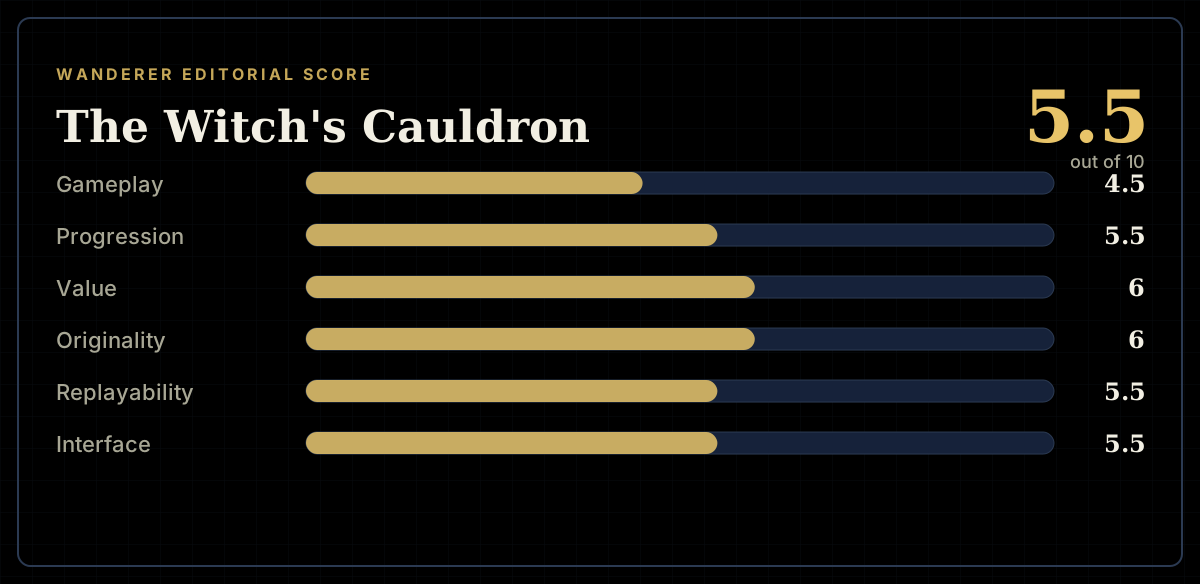
5.5 / 10
- Developer
- Harvey games
- Publisher
- Harvey games
- Released
- 24 January 2024
- Platforms
- Windows
- Genre
- Narrative roguelike potion-brewing sim
- Monetisation
- One-time purchase, no in-game store or additional currency purchases
- Players
- Single-player only
The short version
The Witch's Cauldron casts you as a medieval witch fielding requests from villagers who want love potions, curses, and everything in between, brewing ingredients together to discover recipes while navigating branching story decisions that shape your reputation and multiple possible endings. This review's sample is fond of the charming art and genuinely funny writing, several reviewers describing real laughs and repeated sessions chasing different endings. What tempers that praise, repeated consistently across a small but specific negative sample, is a structural complaint: the potion-crafting system that the game's marketing foregrounds is typically fully discovered within the first hour, after which the experience becomes closer to a repetitive visual novel than the alchemy simulator its presentation implies.
Biggest strengths
- The art style and overall presentation draw consistent praise, with reviewers describing a detailed, well-edited visual identity that suits the game's cozy witchy tone
- The writing earns genuine, specific credit for its humor, with multiple reviewers describing real laughs discovering how villagers react to different brewed potions
- The branching decision system supports a meaningful variety of endings, giving the short experience real replay incentive for players interested in seeing every outcome
Biggest weaknesses
- A specific, widely repeated complaint holds that the potion-crafting system — the game's central marketed hook — is fully discoverable within the first hour, after which the "brewing" element stops being a meaningful challenge
- Multiple reviewers describe the game settling into a repetitive visual-novel decision loop once the crafting is exhausted, with one explicitly comparing it unfavorably to the deeper alchemy mechanics of Potioncraft
- At least one reviewer reports that villager potion requests are often unclear or illogical, making it genuinely difficult to determine what a given character actually wants without guesswork
Who it's for: Fans of short, narrative-driven decision games with light crafting mechanics and comedic writing, who prioritize story branches and multiple endings over deep, ongoing crafting systems.
Our recommendation: A charming, inexpensive curiosity worth a couple of relaxed evenings chasing different endings — just go in understanding this is a light narrative game with a potion-crafting veneer rather than a true alchemy simulator, since that mismatch is the source of most disappointment in this review's sample.
5.5 / 10
The Witch's Cauldron hands you a bubbling pot, a village full of demanding customers, and a growing list of ingredient combinations to discover as you brew potions for love, curses, and everything strange in between. It's a charming premise wrapped around genuinely funny writing, and this review's sample — thinner than most this lane has covered, worth acknowledging upfront — shows that charm landing well, right alongside a specific, structural complaint about how quickly the game's central crafting hook runs dry.
Charm and humor that land well
The praise for the writing and presentation is warm and specific. "Had lots of laugh discovering the game and giving out brews/potions as a witch - do what was asked (or not) but for sure not the way they want it," one reviewer writes. Another, having fully completed the game, offers a detailed endorsement: "I love this kind of game, I got it as soon as it came out for 3 euros and it was a super good 15h. The style is detailed and well edited with also many nice and creative interactions." A third simply captures the tone: "So funny game, I love it! I still can't find the last recipe for 1 potion and I've opened just two endings."
The complaint that recurs across nearly every critical review
Set against that warmth, this review's small but specific negative sample converges on one structural issue: how quickly the crafting system stops being a meaningful part of the game. "Gameplay wise this is nothingburger. You might expect potioncrafter simulator, but in reality you're unlocking all recipes really fast and the game turns into visual novel from that point," one reviewer writes. Another describes the same arc in more detail: "This is not your usual potion maker. You have a limited amount of ingredients, and specific amount of combinations from them. So first hour... you will be experimenting and discovering the recipes. After which, congratulation, you can start [interacting with the characters, but the crafting itself is done]." A third makes the unfavorable genre comparison explicit: "I don't know what I expected, but this is incredibly boring. Potioncraft is so much better. This has nice art, but the gameplay is putting me to sleep." That's a consistent, specific pattern — not a complaint about difficulty, but about the marketed "witch simulator" premise giving way quickly to something considerably lighter.
A fair, useful reframing from an experienced reviewer
One detailed positive review offers a genuinely useful corrective for buyers going in with the wrong expectations: "Don't be deceived by its presentation. This is not actually a potion/alchemy game, nor is it particularly a witch simulator (what is, honestly.) It's a puzzle game, the puzzle itself figuring out what the ideal course of action is per random story event so that a run can go smooth[ly toward a specific ending]." That reframing — treating the game as a light decision-puzzle wearing potion-crafting clothing rather than a genuine simulation — helps explain why reviewers with different expectations land so differently on the same underlying game.
A specific usability complaint about unclear requests
Beyond the broader crafting complaint, at least one detailed reviewer flags a more concrete problem: "Very often requests are not clear enough to understand what people want from you... potion choices are not logical." That's a fair, specific usability critique distinct from the "too shallow" complaint — even within the crafting system's limited scope, understanding what a given villager actually wants can apparently be genuinely difficult to parse.
What the achievement data confirms about depth
Steam's own completion figures support both sides of this review's picture simultaneously. An early milestone sits at a near-universal 96.6%, confirming the core loop is instantly accessible, exactly as reviewers describe. But the rarest ending-specific and potion-combination achievements fall to just 2.7-3.4%, revealing real depth in the game's branching-outcome structure even if the crafting itself runs out quickly — supporting reviewer descriptions of a game whose replay value comes from chasing different story endings rather than from ongoing brewing challenge.
A thin sample, acknowledged directly
This review found only 43 total English-language reviews for The Witch's Cauldron, a notably small pool even by the standards of this lane's smaller indie titles. The patterns described here — consistent praise for writing and art, a specific, repeated complaint about the crafting system's shallow depth — are drawn from that limited sample, and this review's conclusions should be weighed with that limitation in mind.
A small developer still supporting the game
Despite its modest scale, The Witch's Cauldron received genuine ongoing attention after launch. Its partner-events feed documents several bug-fix patches, developer devlogs discussing specific content additions, and a free "Big Halloween update" adding new content later in 2024 — real, continued investment from a small studio in a low-priced game.
A quieter thread worth naming: player and character connection
A few reviewers touch on a smaller but genuine gap in how the villager cast is written once the initial jokes land. "Bought it while it was on sale, each potion/recipe can help and ruin your reputation. Pretty amusing I just wish there was some more depth for some of the NPCs you get," one reviewer writes, a fair, specific request distinct from the crafting complaints above — it suggests that even players enjoying the game's comedic tone would welcome more sustained characterization for the villagers whose requests drive each run, rather than treating them purely as one-off joke delivery mechanisms.
Final verdict
The Witch's Cauldron delivers genuine charm and funny writing wrapped around a potion-crafting system that most reviewers agree is exhausted well before the game's story fully plays out, leaving a light, replayable decision-narrative experience rather than the deeper alchemy simulator its presentation suggests. At its low price, it's a reasonable, low-risk pickup for a couple of relaxed evenings — just adjust your expectations for the crafting depth before you start.
Pros and cons
Pros
- The art style and overall presentation draw consistent praise, with reviewers describing a detailed, well-edited visual identity that suits the game's cozy witchy tone
- The writing earns genuine, specific credit for its humor, with multiple reviewers describing real laughs discovering how villagers react to different brewed potions
- The branching decision system supports a meaningful variety of endings, giving the short experience real replay incentive for players interested in seeing every outcome
- Steam's own partner-events feed documents sustained developer support well beyond launch, including a free "Big Halloween update" adding new content and multiple bug-fix patches
- The very low price makes the experiment low-risk even for players who ultimately find the crafting system thinner than expected
Cons
- A specific, widely repeated complaint holds that the potion-crafting system — the game's central marketed hook — is fully discoverable within the first hour, after which the "brewing" element stops being a meaningful challenge
- Multiple reviewers describe the game settling into a repetitive visual-novel decision loop once the crafting is exhausted, with one explicitly comparing it unfavorably to the deeper alchemy mechanics of Potioncraft
- At least one reviewer reports that villager potion requests are often unclear or illogical, making it genuinely difficult to determine what a given character actually wants without guesswork
- Several reviewers describe the overall experience as short and lacking depth in its non-crafting systems, with at least one noting the villager storylines are difficult to follow well enough to understand the consequences of in-game decisions
- The English-language review sample for this title is notably thin, a limitation this review flags directly rather than treating the resulting picture as fully representative
Screenshots
-

The Witch's CauldronImage: Harvey games via Steam -

The Witch's CauldronImage: Harvey games via Steam -

The Witch's CauldronImage: Harvey games via Steam -
How the review scores each part of the gameWanderer Editorial -
The short versionWanderer Editorial