
Game review
The Precinct
6.5 / 10
- Developer
- Fallen Tree Games Ltd
- Publisher
- Kwalee
- Released
- 13 May 2025
- Platforms
- Windows
- Genre
- Open World, Action, Simulation
- Monetisation
- One-time purchase, no DLC or in-game currency
- Players
- Single-player
The short version
The Precinct puts you behind the badge as rookie beat cop Nick Cordell Jr., patrolling the neon-lit, 1980s-inspired streets of Averno City on foot, in squad cars and by helicopter — issuing parking tickets, breaking up gang shootouts, chasing perps through rain-soaked alleys, and slowly unravelling the mystery of his father's death. It's a genuinely rare premise, and reviewers repeatedly credit the atmosphere, the neon-noir art direction and the driving feel as real, successful achievements from a comparatively small studio. Set against that praise is a large and detailed body of criticism converging on the same underlying diagnosis: this is a promising concept that shipped without the polish and mechanical depth its own pitch implies, particularly around an arrest procedure several reviewers say involves almost no actual detective work.
Biggest strengths
- The core premise — playing the cop rather than the criminal in an open-world sandbox — is genuinely rare in the genre, and reviewers who grew up on classic cop-drama media specifically credit the game with delivering real, earned nostalgia rather than a hollow aesthetic exercise
- Driving and vehicle chases draw consistent, specific praise, with destructible environments and helicopter pursuits singled out as some of the most satisfying moments in the game
- Atmosphere, art direction and the soundtrack are close to universally praised even by critical reviewers, with the neon-lit streets, dynamic weather and day-night cycle credited for real visual identity
Biggest weaknesses
- The single most repeated substantive complaint is that arrests involve almost no real detective work: reviewers describe a formulaic ID-frisk-charge sequence applied nearly identically regardless of the crime, undercutting the "solve the mystery" framing the premise implies
- Missing basic polish recurs across many independent reviews — zipped-up bodies left lying in place rather than being removed, escort units leaving their vehicles blocking roads after transporting a suspect, and similar small immersion-breaking details that accumulate into a rougher overall impression
- Multiple reviewers describe the mission and objective structure as overly restrictive, reporting that accepted cases from dispatch offer little flexibility in how a situation can be approached or resolved
Who it's for: Fans of classic cop-drama atmosphere and open-world sandbox crime response who specifically want to play the officer rather than the criminal for once, and who can tolerate real rough edges and shallow procedural mechanics in exchange for a genuinely distinctive setting. Less of a fit for anyone wanting deep investigative gameplay or a highly polished simulation experience.
Our recommendation: Worth it at a discount for the atmosphere, driving and genuinely novel premise, but go in understanding the "detective work" is largely an illusion — arrests follow the same simple ID-frisk-charge sequence regardless of the crime, and enough small polish issues persist that this reads as a strong first outing with real room to grow rather than a finished, fully-realised simulation.
6.5 / 10
Playing the badge, for once
The Precinct's central hook is refreshingly rare in an open-world genre thoroughly dominated by playing the criminal: you're rookie officer Nick Cordell Jr., patrolling neon-lit, rain-soaked Averno City in 1983, responding to everything from parking violations to full gang shootouts while working your father's unsolved murder case on the side. Reviewers who grew up on classic cop-drama media — several specifically cite the old Police Quest series — describe the premise landing as genuine, earned nostalgia rather than a superficial aesthetic wrapper, and the game backs that atmosphere up with real strengths: destructible-environment vehicle chases, helicopter pursuits, and a dynamic weather and day-night cycle that reviewers consistently credit alongside the soundtrack as some of the strongest presentation in the genre from a comparatively small studio.
Solving crimes without any actual detective work
Set against that atmospheric success is a specific, widely repeated mechanical disappointment. Despite a premise built around "uncovering the truth" and solving your father's murder, reviewers describe the actual arrest procedure as a simple, near-identical sequence regardless of the crime: check ID, frisk the suspect, receive the charges, choose how to process them. One detailed reviewer calls this "almost insulting to the player," arguing it removes any sense of real investigative reasoning from a game explicitly marketed around solving a mystery. That's a meaningful gap between pitch and delivery rather than a minor mechanical quibble, since the procedural loop is what a player actually does for the majority of their time in Averno City.
The small things that add up
Beyond the core procedure, a long list of smaller polish issues recurs across independently-written reviews rather than concentrating in one unusually harsh account. Bodies that have been zipped into bags are reported to simply remain lying on the ground rather than being removed. Escort units called in to transport an arrested suspect are reported to leave their vehicle blocking the road after walking the criminal away on foot. Several reviewers separately describe mission and objective structures as unusually restrictive, with dispatch-assigned cases offering little flexibility in how a situation can actually be approached. None of these issues is severe in isolation, but their combined weight across so many independent accounts is what leads one reviewer to describe the whole game as feeling like "a shell for its potential" — not broken, but visibly short of a full development cycle's worth of polish.
Evidence of a developer still working on it
It would be unfair to leave that impression unqualified. At least one detailed reviewer specifically updates their own account to note a post-launch patch already addressed some of the reported complaints, including adding a toggle for AI ride-along companions and a genuine solo-patrol option — concrete, specific evidence that Fallen Tree Games is actively iterating on player feedback rather than treating the launch state as final. That's consistent with several other reviewers' framing of the game as a strong foundation worth returning to as it develops, rather than a finished product to judge purely on its day-one state.
Backup you can actually call
One system that draws consistent, specific credit is the support network available during pursuits and standoffs: rather than going it alone, players can call in squad cars, roadblocks and spike strips to help bring a chase to a close. Reviewers describe this as genuinely satisfying when it works, turning a straightforward car chase into a small piece of coordinated tactics rather than a solo pursuit. It's also one of the areas the developer has specifically patched in response to feedback — the AI-companion toggle mentioned above sits alongside this broader support system, suggesting the team is treating backup mechanics as a priority area for refinement rather than a finished, static feature.
More than one reviewer frames their overall disappointment in terms of an opportunity rather than a failure: several specifically note that a genuinely open-world, third-person police game with this kind of gritty, dark tone has essentially never been attempted with a larger budget, and argue The Precinct proves the concept deserves exactly that kind of investment even where this particular execution falls short. That's a notably generous framing for a game with this many specific complaints attached to it, and it speaks to how much goodwill the underlying premise has generated even among reviewers who ultimately can't fully recommend the current build.
Weighing the price against what's there
At NZ$43.59, The Precinct sits at a conventional full-price tier for a mid-sized studio release, and reviewers' verdicts on value track closely with how much weight they give the polish issues above versus the atmosphere and premise. Several reviewers who completed the game to 100% specifically say they consider it worth the asking price precisely because the campaign doesn't overstay its welcome — one notes relief that the story wraps up before the repetitive procedural loop has a chance to wear out its welcome across another five or ten hours of padding. That's a meaningfully different calculation from judging the game purely on mechanical depth, and it's worth factoring in: a shorter, tighter experience with real rough edges may land better for some buyers than a longer one would have.
The verdict
The Precinct succeeds at something genuinely uncommon — putting players on the right side of the law in a densely-populated open-world sandbox — and its atmosphere, driving feel and soundtrack earn real, specific praise even from its critics. What holds it back is a core arrest loop that undercuts its own detective-story premise, and enough accumulated small polish issues that a large share of its audience describes a game that needed more time in the oven. With active post-launch support already visible, this reads as a strong, distinctive first outing with real room to grow rather than a fully realised simulation — worth a discount purchase for the setting alone, with reasonable hope that the mechanical gaps close over time as the developer keeps responding to exactly the feedback documented above.
Pros and cons
Pros
- The core premise — playing the cop rather than the criminal in an open-world sandbox — is genuinely rare in the genre, and reviewers who grew up on classic cop-drama media specifically credit the game with delivering real, earned nostalgia rather than a hollow aesthetic exercise
- Driving and vehicle chases draw consistent, specific praise, with destructible environments and helicopter pursuits singled out as some of the most satisfying moments in the game
- Atmosphere, art direction and the soundtrack are close to universally praised even by critical reviewers, with the neon-lit streets, dynamic weather and day-night cycle credited for real visual identity
- The volume and variety of sandbox crimes on offer — from parking infractions to bank heists to street racing — gives the open world genuine density of things to respond to, even if reviewers differ on how satisfying each individual response feels
- At least one detailed reviewer confirms the developer shipped a meaningful post-launch patch addressing specific complaints, including adding a toggle for AI companions and a true solo-patrol option, evidence of active support rather than an abandoned launch
Cons
- The single most repeated substantive complaint is that arrests involve almost no real detective work: reviewers describe a formulaic ID-frisk-charge sequence applied nearly identically regardless of the crime, undercutting the "solve the mystery" framing the premise implies
- Missing basic polish recurs across many independent reviews — zipped-up bodies left lying in place rather than being removed, escort units leaving their vehicles blocking roads after transporting a suspect, and similar small immersion-breaking details that accumulate into a rougher overall impression
- Multiple reviewers describe the mission and objective structure as overly restrictive, reporting that accepted cases from dispatch offer little flexibility in how a situation can be approached or resolved
- Character progression is called pointless by at least one detailed reviewer, who argues levelling up and collecting clues serves a story several reviewers separately describe as confusing or underwhelming relative to the game's strong atmospheric setup
- Steam's own achievement data shows a very steep completion cliff even by open-world standards: entry achievements clear above 80-90%, while deep-completionist achievements — driving every vehicle, finding every rare car, reading every plaque — fall to under 3.5%, consistent with reviewer reports that the game's density doesn't translate into sustained late-game engagement for most players
Screenshots
-

The PrecinctImage: Kwalee via Steam -

The PrecinctImage: Kwalee via Steam -

The PrecinctImage: Kwalee via Steam -
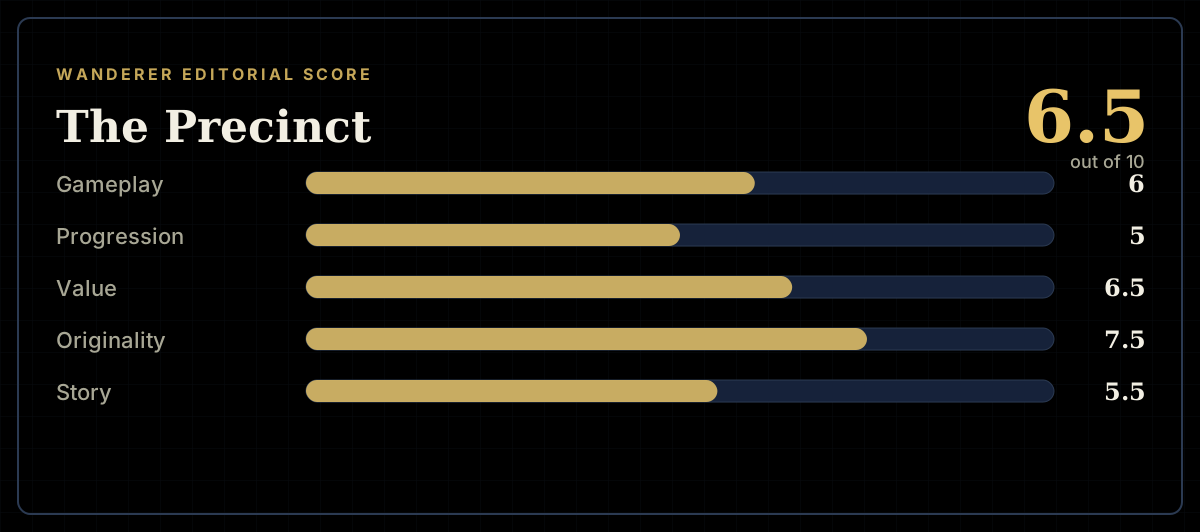
How the review scores each part of the gameWanderer Editorial -
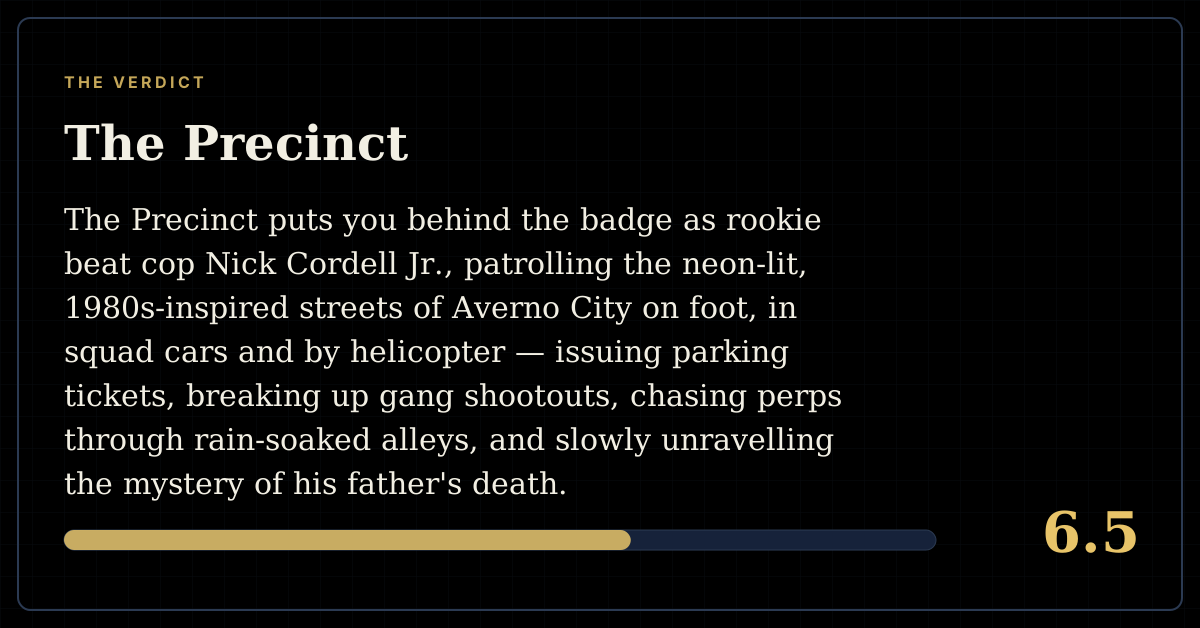
The short versionWanderer Editorial