
Game review
The Plucky Squire
7.5 / 10
- Developer
- All Possible Futures
- Publisher
- Devolver Digital
- Released
- 17 September 2024
- Platforms
- Windows, PlayStation 5, Xbox Series X|S, Nintendo Switch
- Genre
- Action Adventure
- Monetisation
- One-time purchase, no DLC or in-game currency
- Players
- Single-player
The short version
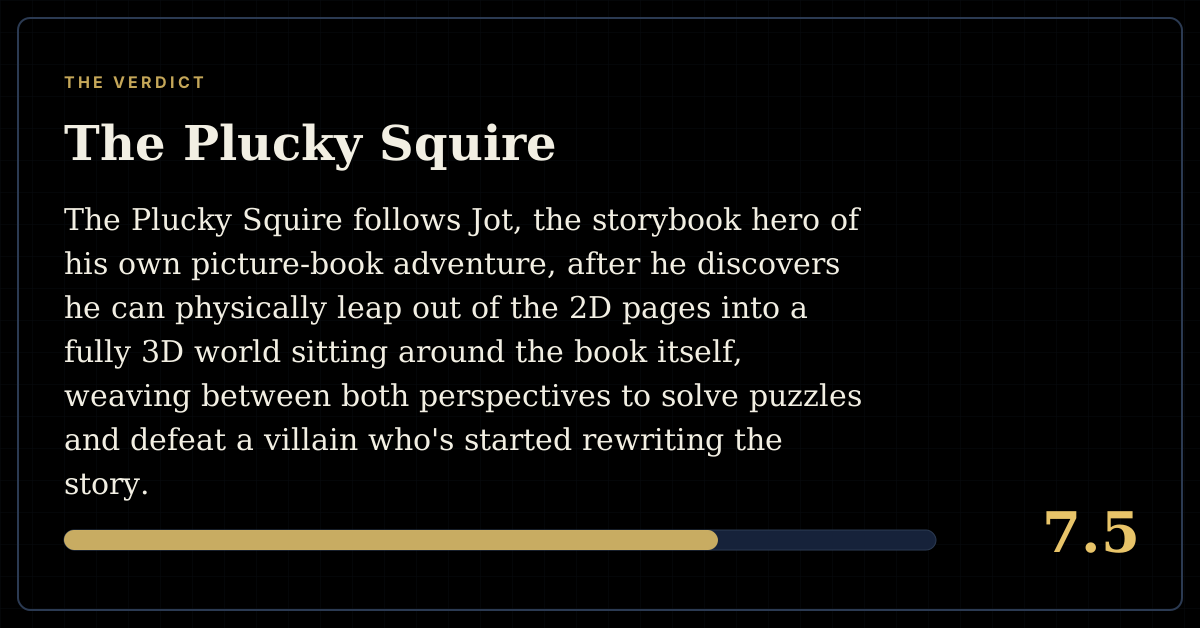
The Plucky Squire follows Jot, the storybook hero of his own picture-book adventure, after he discovers he can physically leap out of the 2D pages into a fully 3D world sitting around the book itself, weaving between both perspectives to solve puzzles and defeat a villain who's started rewriting the story. It's one of 2024's most visually distinctive ideas, earning nominations for Best Debut Game and Best Family Game at the 2025 BAFTA Games Awards, and critics responded warmly across the board — 83 on PC Metacritic, with platform scores ranging from 72 to 83. Steam's own audience agrees the concept and presentation are special, Very Positive at 84.8% across nearly 2,800 reviews. What a real, consistent slice of that audience — echoed directly by the "Best Family Game" nomination itself — independently arrives at is a specific observation about who the game is actually built for: gameplay that rarely lets the player struggle, puzzles the game solves for you as often as it asks you to solve them, and a difficulty curve clearly aimed at a younger audience than the trailers and premise suggested to many adult buyers.
Biggest strengths
- The core conceit of leaping between a 2D storybook page and the fully 3D world surrounding it is genuinely inventive, and critics and players alike credit it as one of 2024's most original mechanical ideas
- Visual presentation draws close to unanimous praise, with animation, environment design and the transition between 2D and 3D perspectives repeatedly singled out even by the game's harshest critics
- Music and overall audio design consistently earn specific praise across nearly the entire review spectrum
Biggest weaknesses
- Puzzles and progression are frequently solved for the player rather than by the player, with several detailed reviews describing a "three steps, dialogue, three steps, dialogue" pattern that leaves little room for independent exploration or discovery
- Combat and platforming are described by multiple reviewers as clunky and imprecise relative to the polish of the presentation surrounding them, a notable gap between the game's visual and mechanical craft
- Several detailed reviews independently use the "jack of all trades, master of none" framing, arguing that borrowing mechanics from many different genres for boss fights results in none of them being explored with real depth
Who it's for: Families and younger players are the audience this was built for, and the BAFTA Best Family Game nomination reflects that intentional design rather than an accident. Adult players specifically looking for a challenging puzzle-adventure, rather than a beautifully presented, heavily-guided storybook experience, should adjust expectations, and anyone particularly sensitive to bugs should know that crash and softlock reports continue to surface more than a year after launch despite the developers' responsive early patch history.
Our recommendation: Recommended, especially for families or as a genuinely gorgeous showcase of a novel idea, and the BAFTA recognition for both its ambition and its family-friendly execution is well earned. Adult players hoping for real challenge should sample gameplay footage first, since the puzzle-solving and combat are intentionally gentle rather than a difficulty shortfall the developers are likely to patch away.
7.5 / 10
A genuinely new idea, rendered beautifully
The Plucky Squire's central hook is the kind of idea that's rare in an industry built on iterating familiar formulas: Jot, hero of his own storybook, discovers he can physically climb out of his flat, 2D picture-book page into the fully three-dimensional desk and bedroom the book sits on, then dive back in elsewhere on the page or into a different page entirely. It's a genuinely inventive structural conceit, and critics responded to it with real enthusiasm — 83 on PC Metacritic, with console scores ranging from 72 to 83 depending on platform, and two nominations at the 2025 BAFTA Games Awards for Best Debut Game and, notably, Best Family Game. Steam's own player base backs up the presentation side of that acclaim emphatically: Very Positive at 84.8% across nearly 2,800 reviews, with the visual execution of the 2D-to-3D transitions drawing close to unanimous praise even from reviewers who have real reservations about everything else.
Where the acclaim is unambiguous
Nobody disputes the craft on display. Animation, environment design, and the specific moment of watching a flat storybook page fold and shift into three-dimensional space are repeatedly singled out by both critics and the overwhelming majority of Steam reviewers as genuinely special, and music draws the same consistent praise across nearly the entire review spectrum regardless of how a given reviewer feels about the gameplay underneath it. Boss encounters add real mechanical variety to what's otherwise a fairly standard top-down adventure structure, borrowing distinctly from other genres entirely — a Punch-Out-style boxing match, a Bust-a-Move-inspired puzzle sequence — giving key story beats a sense of surprise the core traversal and combat loop doesn't always deliver on its own.
Who the game is actually built for
Where a real, consistent slice of reviewers — disproportionately adult players judging by playtime and phrasing — land on the same specific complaint is difficulty and player agency. Multiple detailed reviews describe a rigid, heavily-guided rhythm: a few steps of movement, an interruption for dialogue or narration, a few more guided steps, repeated throughout. Puzzles are frequently solved by the game itself rather than by the player, with several reviewers noting the game shows the answer plainly rather than letting players work it out, and combat and platforming are described as clunky and imprecise in a way that stands out specifically because the presentation around them is so polished. The "jack of all trades, master of none" framing shows up independently across several detailed reviews, all making essentially the same argument: borrowing mechanics from many different genres for individual boss encounters means none of those borrowed systems get explored with any real depth.
None of this is really a flaw so much as a design choice the BAFTA voters explicitly recognised: a Best Family Game nomination is a direct acknowledgment that the difficulty curve and guided structure are built for a younger audience, not an oversight in an otherwise adult-oriented game. Adult reviewers who went in expecting a challenging puzzle-adventure on the strength of the trailers and central concept are the ones most likely to describe the experience as charming but ultimately shallow once that mismatch becomes clear, usually within the first couple of hours.
Bugs that outlasted the early patch cycle
A more straightforwardly negative issue concerns stability. At launch, reviews and community bug reports documented crash and softlock issues across multiple chapters and platforms — a mine-cart puzzle that could become uncompletable on PS5, chapter-specific softlocks on Steam Deck, and a boss-fight-adjacent crash serious enough to block progress entirely. Developers responded with reasonably quick patches to known issues in the months following launch. What's notable, though, is that reviews posted well over a year after release continue to describe game-halting bugs requiring sections to be replayed two or three times, suggesting the early responsiveness didn't fully resolve stability for every player, even this long after launch.
A confused tone for the audience in between
One more specific complaint deserves its own mention, since it's distinct from the difficulty question above: several adult reviewers describe the game's humour and its actual story and challenge level as pitched at two different audiences simultaneously, rather than one coherent one. The jokes and asides, several say, are clearly written with an accompanying parent's sense of humour in mind, while the story beats, pacing and puzzle difficulty are unmistakably built for the child actually holding the controller. For a solo adult player with no child audience to share the experience with, that split can land awkwardly — neither fully a game built to challenge them nor fully a piece of children's media they're simply along for the ride on. It's a smaller, more specific observation than the broader "too easy" complaint, but it's worth naming separately, since it suggests the game may be working exactly as intended for the shared, cross-generational audience the BAFTA Family Game nomination implies, even as it explains why some solo adult reviewers came away feeling like the experience wasn't quite built with them in mind either way.
Verdict
The Plucky Squire succeeds completely at what it set out to do for its intended audience: a genuinely original, gorgeously realised concept wrapped in family-friendly, gently-paced adventure design that earned its BAFTA recognition honestly on both fronts. Adult players hoping for a challenging puzzle-adventure to match the concept's ambition are the ones most likely to come away wanting more depth, and the persistent bug reports well past launch are a real, separate consideration worth checking current community discussion about before buying. For families, or for anyone happy to enjoy a beautiful idea without demanding it also be hard, this is one of 2024's genuine highlights.
Pros and cons
Pros
- The core conceit of leaping between a 2D storybook page and the fully 3D world surrounding it is genuinely inventive, and critics and players alike credit it as one of 2024's most original mechanical ideas
- Visual presentation draws close to unanimous praise, with animation, environment design and the transition between 2D and 3D perspectives repeatedly singled out even by the game's harshest critics
- Music and overall audio design consistently earn specific praise across nearly the entire review spectrum
- Boss encounters borrow distinct mechanics from different classic genres — a Punch-Out-style boxing match, a Bust-a-Move-style puzzle sequence — giving key moments real variety rather than repeating the same combat loop throughout
- Earned genuine industry recognition beyond player sentiment, with nominations for both Best Debut Game and Best Family Game at the 2025 BAFTA Games Awards
Cons
- Puzzles and progression are frequently solved for the player rather than by the player, with several detailed reviews describing a "three steps, dialogue, three steps, dialogue" pattern that leaves little room for independent exploration or discovery
- Combat and platforming are described by multiple reviewers as clunky and imprecise relative to the polish of the presentation surrounding them, a notable gap between the game's visual and mechanical craft
- Several detailed reviews independently use the "jack of all trades, master of none" framing, arguing that borrowing mechanics from many different genres for boss fights results in none of them being explored with real depth
- Crash and softlock bugs were reported at launch across multiple chapters and platforms, and while developers were responsive with early patches, reviews posted more than a year after release continue to describe game-halting bugs requiring sections to be replayed multiple times
- The tone is described by some adult reviewers as caught between audiences — jokes seemingly aimed at accompanying parents while the story and challenge level are pitched squarely at children — leaving a specific slice of solo adult players feeling like neither audience fully
Screenshots
-

The Plucky SquireImage: Devolver Digital via Steam -

The Plucky SquireImage: Devolver Digital via Steam -

The Plucky SquireImage: Devolver Digital via Steam -
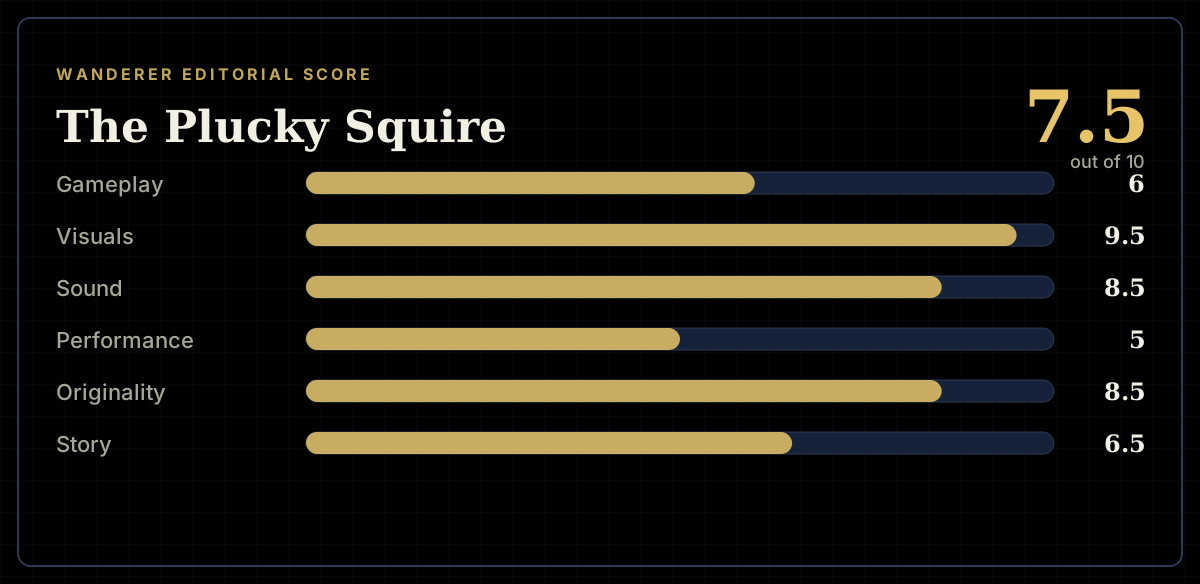
How the review scores each part of the gameWanderer Editorial -
The short versionWanderer Editorial