
Game review
The Legend of Skye
7.5 / 10
- Developer
- Point & Pixel Adventures
- Publisher
- Point and Pixel Adventures
- Released
- 2 April 2024
- Platforms
- Windows
- Genre
- Point-and-click graphic adventure
- Monetisation
- One-time purchase, no in-game store or additional currency purchases
- Players
- Single-player only
The short version
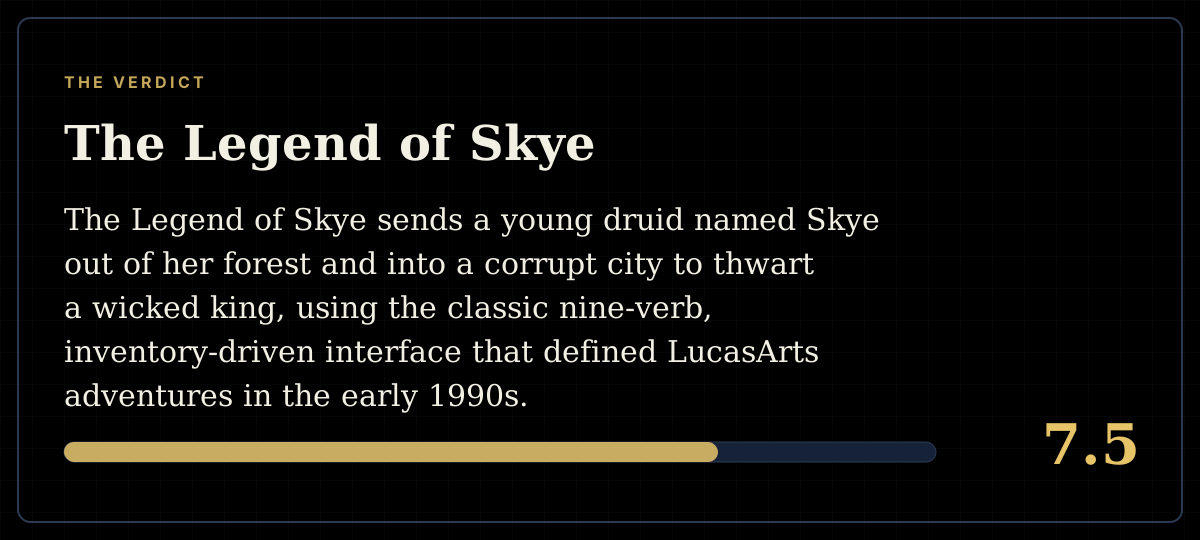
The Legend of Skye sends a young druid named Skye out of her forest and into a corrupt city to thwart a wicked king, using the classic nine-verb, inventory-driven interface that defined LucasArts adventures in the early 1990s. The homage is deliberate and thorough, down to the pixel resolution and the humour, and it's clearly landed with the genre's community — the game picked up seven nominations at the Adventure Gamers Society Awards, including Best Puzzles. Reviewers consistently praise the puzzle design's genuine cleverness and an orchestral soundtrack several call a career highlight for a small studio. What holds it back from a higher score is the genre's oldest and most persistent flaw: several puzzles are reported as too obscure, the game gives only generic, unhelpful feedback when a player tries the wrong thing, and the English localisation shows rough edges throughout, for a developer whose primary market appears to be elsewhere.
Biggest strengths
- Puzzle design draws consistent, specific praise for genuine cleverness and non-linear structure, with multiple parallel goals open at once rather than a single blocked path, closely matching what reviewers say made the LucasArts era's best games replayable in the mind rather than merely solvable
- The orchestral soundtrack, composed by Michael Lückgen, is repeatedly singled out as a career-best achievement for a small studio, with several reviewers rating the music a perfect score even when more measured about other aspects of the game
- The game was nominated in seven categories at the 2025 Adventure Gamers Society Awards, including Best Puzzles, external validation from a dedicated genre community rather than only its own Steam review base
Biggest weaknesses
- Multiple reviewers, across both positive and negative reviews, describe specific puzzles as relying on "moon logic" that's difficult to intuit even with careful attention to the environment and dialogue, a classic point-and-click failure mode this game doesn't fully escape
- The game gives only generic, unhelpful feedback when a player attempts the wrong interaction, with no built-in hint system, meaning getting stuck can mean staying stuck for a long time without external help
- English localisation shows consistent rough edges — awkward phrasing and stilted dialogue are raised independently by multiple reviewers, consistent with a developer whose primary language and market may not be English despite the game shipping in four languages
Who it's for: Fans of classic LucasArts and Sierra-style point-and-click adventures who want a new, lengthy entry in that exact tradition, and who have the patience for genuinely difficult, occasionally obscure puzzle logic without a modern hint system to lean on.
Our recommendation: A strong pick for genre veterans specifically nostalgic for the Monkey Island era, at a fair price for its ten-to-fifteen-hour length. Newcomers to point-and-click adventures, or anyone who wants built-in hints for when they get stuck, should try the free demo first to gauge their tolerance for the genre's classic obscure-puzzle problems.
7.5 / 10
The Legend of Skye doesn't hide what it's chasing: a nine-verb interaction menu, an inventory bag that somehow holds ninety-plus items, a 320×180 pixel resolution, and a young hero — Skye, a druid sent by her tribe to stop a corrupt king — venturing from a peaceful forest into a dangerous city. It's the exact shape of a Monkey Island-era LucasArts adventure, built deliberately and thoroughly by Point & Pixel Adventures rather than merely gesturing at the aesthetic, and the genre's own community has noticed: the game picked up seven nominations at the 2025 Adventure Gamers Society Awards, including one for Best Puzzles. That's meaningful outside validation for a small studio's first professional release, and the review sample largely agrees with the judges' read of the puzzle design specifically — even where it disagrees about other parts of the package.
Puzzles that earn the comparison, and the award nomination
Reviewers describe the puzzle structure with real specificity rather than generic praise. One draws a direct contrast with the genre's modern, softened tendencies: "some 21st century point-and-click games play more like visual novels, with token 'puzzles' that give no challenge; in The Legend of Skye... the puzzles all need some thought and deduction, usually across several layers." Another highlights the non-linear design specifically, noting multiple goals stay open simultaneously rather than gating progress behind a single blocked path — closely matching what made the best LucasArts games replayable in memory rather than merely solvable once. Difficulty is a consistent theme across nearly every review, positive or critical: this is a hard game by design, closer in spirit to the more demanding end of the genre than its gentler modern descendants.
A soundtrack reviewers keep singling out
If one element of the game draws unqualified praise across the entire sample, it's the score. Composer Michael Lückgen's orchestral soundtrack is repeatedly called out by name, with multiple reviewers awarding it a flat 10/10 even in reviews that are measured or critical about other elements — "Music: 10/10," reads one blunt assessment sandwiched between more qualified marks for art and story. For a small studio's debut release, that level of consistent, specific praise for the score is a genuine standout, and it's clearly part of why the game's atmosphere lands as strongly as it does across such a wide range of reviewers.
The genre's oldest problem hasn't gone away
Set against that praise is the same complaint that's dogged point-and-click adventures since their golden age: some puzzles simply don't communicate what they want clearly enough. Multiple reviewers, including several who otherwise recommend the game, describe specific puzzle solutions as relying on what the genre calls "moon logic" — a leap a player has no realistic way to intuit from the game's own clues. Compounding this, the game offers only generic responses when a player attempts the wrong interaction, without a built-in hint system to fall back on. One reviewer frames this directly as the game's central flaw: "the puzzle design is very bad... puzzles are too obscure, and the game system lacks hints. If you don't do exactly what the game expects you to do you just get gener[ic responses]." This isn't a minority complaint — it shows up, in some form, across a meaningful share of the negative reviews and as a caveat inside several of the positive ones.
Rough English, by a studio working in translation
A separate, more specific issue concerns localisation quality. The game ships in English, Spanish, French and German, but several reviewers flag the English text specifically as showing its seams — "the English translation could use some work," one writes, noting "awkward phrases and conversations." Another negative review is blunter, calling it "lazy." Given the studio's name and the range of languages offered, this reads as a case of a developer working primarily outside English and not quite closing the final gap on translation polish, rather than a deliberate stylistic choice — a fixable issue, but a real one for an adventure game whose entire appeal rests on written dialogue and clue interpretation.
An audio control gap, and a serious asset claim worth reporting plainly
Two more specific complaints round out the technical picture. First, the game offers no way to adjust individual audio channel volumes, and at least one reviewer describes repetitive sound effects — tapping noises, banging shutters — becoming genuinely grating over a longer session as a result, with no way to turn that specific layer down independently of music or dialogue. Second, and more seriously: one detailed, otherwise measured reviewer states that some of the game's backgrounds "look like they're directly stolen from Monkey Island and just painted over to have different colors," describing it as "distracting." This is a specific, pointed claim about asset originality rather than a vague stylistic gripe, and it's worth reporting on its own terms — this review examined the store page's own screenshots and found clear stylistic homage throughout, consistent with the game's openly-stated inspiration, but could not independently confirm or refute a claim of direct asset reuse without a side-by-side comparison beyond this review's scope. Readers who find this concerning should weigh it against the fact that no other reviewer in the sample raises the same specific claim.
Final verdict
The Legend of Skye is a sincere, well-executed love letter to the Monkey Island era, backed by puzzle design good enough to earn a Best Puzzles nomination from the genre's own community and a soundtrack multiple reviewers call a career-best moment for a small studio. It doesn't fully escape the era it's imitating, though — some puzzles lean on the same obscure, under-hinted logic that frustrated players thirty years ago, and the English localisation shows real rough edges for a release built specifically to be read and parsed closely. For genre veterans with the patience for a properly difficult adventure and a fair price for ten-plus hours of content, this is an easy recommendation; players who want their hand held a little more should try the demo first and see how the puzzle logic sits with them before committing.
Pros and cons
Pros
- Puzzle design draws consistent, specific praise for genuine cleverness and non-linear structure, with multiple parallel goals open at once rather than a single blocked path, closely matching what reviewers say made the LucasArts era's best games replayable in the mind rather than merely solvable
- The orchestral soundtrack, composed by Michael Lückgen, is repeatedly singled out as a career-best achievement for a small studio, with several reviewers rating the music a perfect score even when more measured about other aspects of the game
- The game was nominated in seven categories at the 2025 Adventure Gamers Society Awards, including Best Puzzles, external validation from a dedicated genre community rather than only its own Steam review base
- At roughly ten to fifteen hours for its asking price, reviewers consistently describe the game as good value, with several explicitly praising the length relative to the price after finishing it
- The developer designed the game with no dead ends by intention, avoiding the unwinnable soft-locks that plagued some genre classics, a design choice several reviewers appreciate directly even when frustrated by individual puzzles
Cons
- Multiple reviewers, across both positive and negative reviews, describe specific puzzles as relying on "moon logic" that's difficult to intuit even with careful attention to the environment and dialogue, a classic point-and-click failure mode this game doesn't fully escape
- The game gives only generic, unhelpful feedback when a player attempts the wrong interaction, with no built-in hint system, meaning getting stuck can mean staying stuck for a long time without external help
- English localisation shows consistent rough edges — awkward phrasing and stilted dialogue are raised independently by multiple reviewers, consistent with a developer whose primary language and market may not be English despite the game shipping in four languages
- There is no way to adjust individual audio channel volumes, and at least one reviewer describes specific, repetitive sound effects as genuinely grating over a long play session as a result
- At least one detailed reviewer states plainly that some game backgrounds "look like they're directly stolen from Monkey Island and just painted over to have different colors," a specific and serious claim about asset originality that this review could not independently verify but is reporting as stated
Screenshots
-

The Legend of SkyeImage: Point and Pixel Adventures via Steam -

The Legend of SkyeImage: Point and Pixel Adventures via Steam -

The Legend of SkyeImage: Point and Pixel Adventures via Steam -
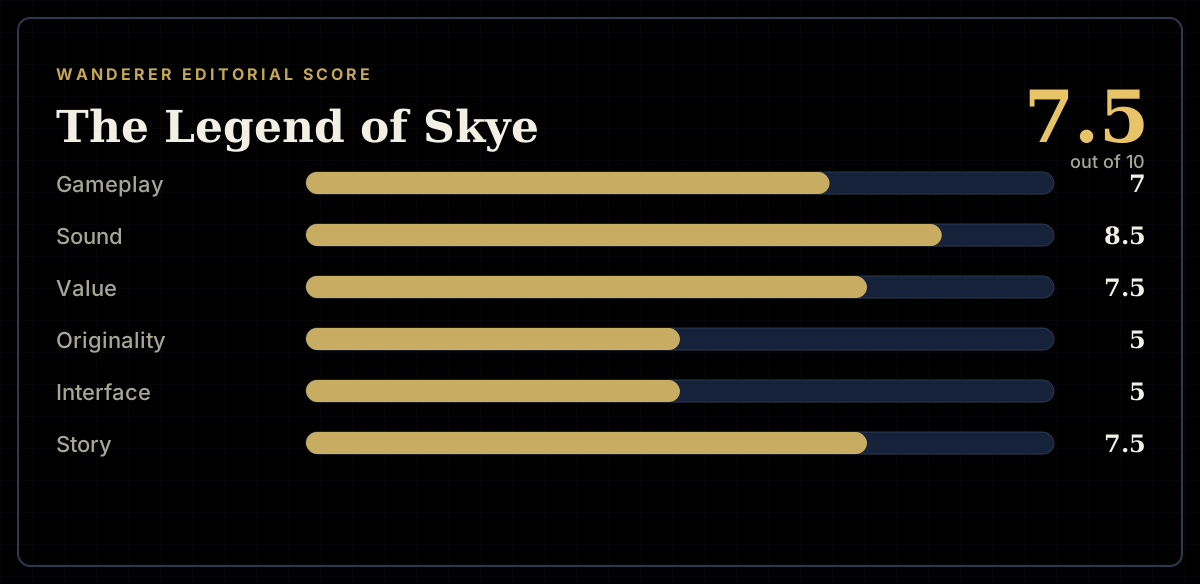
How the review scores each part of the gameWanderer Editorial -
The short versionWanderer Editorial