
Game review
The Invincible
6.5 / 10
- Developer
- Starward Industries
- Publisher
- 11 bit studios
- Released
- 6 November 2023
- Platforms
- Windows
- Genre
- Sci-Fi Walking Simulator
- Monetisation
- One-time premium purchase; cosmetic rover skins added via free updates, no ads or gameplay-affecting DLC found
- Players
- Single-player only; no online, co-op or PvP modes
The short version
The Invincible casts you as Yasna, an astrobiologist stranded on the desolate planet Regis III, searching for her missing crew across a retro-futurist 1960s vision of space exploration adapted faithfully from Stanislaw Lem's hard-science-fiction novel. Reviewers repeatedly reach for the same description — "Firewatch in space" — and largely mean it as high praise, crediting exceptional voice acting, an evocative, creepy-yet-majestic soundtrack, and a philosophical story about humanity's place in the universe that stands well above typical walking-sim writing.
Two specific, well-corroborated complaints keep the reception from being uniformly glowing. A substantial share of reviewers describe the core movement and rover-driving as genuinely unpleasant — clunky, slow and interrupted by forced climbing animations — and the developer has been candid that further speed improvements are limited by how the dialogue and pacing systems are built. Separately, a large number of reviewers report the game's ending, regardless of which of its several branches you reach, as feeling abrupt to the point of seeming unfinished, several speculating the studio ran out of scope or budget before delivering a proper conclusion.
Biggest strengths
- Exceptional voice acting for both lead characters, Yasna and Novik, that reviewers consistently single out as some of the best in the walking simulator genre
- An evocative, atmospheric soundtrack that reviewers describe as simultaneously creepy and majestic, doing significant work to sell the desolate alien world
- A genuinely faithful, thoughtfully adapted retelling of Stanislaw Lem's source novel that works both for readers familiar with the book and newcomers encountering the story fresh
Biggest weaknesses
- Core movement is widely described as clunky and unpleasant, both on foot and driving the rover, with invisible walls, forced climbing animations and a slow default pace drawing consistent complaints
- The developer has openly stated that further movement-speed improvements are constrained by how the dialogue and pacing systems are built, meaning the traversal complaints are unlikely to be fully resolved by future patches
- A substantial share of reviewers describe the game's ending, across multiple branching outcomes, as feeling abruptly unfinished, with several speculating the studio ran out of scope or budget before delivering it
Who it's for: Fans of narrative-driven walking sims and hard science fiction specifically, especially readers of Lem's original novel curious to see it adapted. Less suited to anyone who needs fluid movement and meaningful player agency, or who prioritizes a satisfying, complete narrative arc above atmosphere.
Our recommendation: Worth playing for the atmosphere, voice acting and philosophical premise alone, but go in aware that the movement will frustrate you and the ending is unlikely to feel like a real resolution.
6.5 / 10
"Firewatch in space" is the description reviewers reach for again and again when talking about The Invincible, and it's meant as a genuine compliment. Adapting Stanislaw Lem's hard-science-fiction novel of the same name, the game casts you as Yasna, an astrobiologist stranded on the desolate planet Regis III, searching for her missing crew across a retro-futurist vision of 1960s space exploration. Reviewers with and without prior familiarity with Lem's book describe the atmosphere and voice work as genuinely exceptional, elevating the game well above a typical walking simulator.
Atmosphere and performance that earn the acclaim
The praise for presentation is close to unanimous. Voice acting for both Yasna and her radio contact Novik draws consistent, specific admiration, with reviewers describing performances that capture the tone of mid-century science fiction without slipping into parody. The soundtrack earns equally strong praise, described as simultaneously creepy and majestic, doing real work to sell the sense of an alien, unknowable world. Beyond craft, reviewers credit the adaptation itself as thoughtful and faithful, working both for readers who know Lem's novel and want to see how it plays against the source material, and for newcomers experiencing the story's philosophical questions about humanity's place in the universe for the first time.
Movement that reviewers consistently find unpleasant
Set against that acclaim is a specific, widely repeated complaint about the core moment-to-moment experience of playing: movement. Both walking and driving the rover draw consistent criticism for feeling clunky, slow and interrupted by forced, lengthy climbing and descending animations that several reviewers say actively hurt the game's pacing and immersion. What's notable, checking this complaint against the developer's own public communication, is how candid Starward Industries has been about the limits of what it could fix: a substantial mid-2024 update explicitly states the team tweaked Yasna's walk and sprint speed in response to player requests, but adds directly that "further improvements are limited due to the expanded dialogue system and the pacing problems that would occur if Yasna were to move faster." That's an unusually direct admission that the movement complaints reflect a genuine design constraint rather than an oversight likely to be resolved in a future patch.
An ending a substantial share of reviewers call unfinished
A separate, equally consistent complaint concerns the game's conclusion. Regardless of which of the several branching endings a player reaches, a substantial number of reviewers describe the story stopping abruptly rather than building to a genuine resolution, with at least one detailed review noting the ending arrived "abrupt enough that I thought it was some kind of bug." Several reviewers speculate openly that the studio ran out of budget or scope before delivering a fully realized conclusion to match the quality of everything preceding it. This review found no patch note or developer communication directly addressing or disputing that framing, meaning the ending as shipped should be read as the story's final, intended state rather than an issue awaiting a fix.
Real, if narrower, accessibility and stability work
To the developer's credit, the two-and-a-half-year post-launch patch record shows genuine, sustained engagement beyond the movement speed issue. Memory optimization improved performance on lower-end hardware, an experimental widened field-of-view option was added specifically in response to player requests despite real technical tradeoffs the developer documented transparently, and several hotfixes addressed hardlocks and crashes in the weeks immediately following launch. That's meaningfully different from the movement and ending complaints above — genuine technical and accessibility issues did get addressed, even as the more fundamental design-level complaints remained largely unchanged.
What the achievement data suggests
Global achievement figures show a steady decline consistent with a linear narrative experience: 76.9% of the playerbase reaches the first tracked story milestone, declining to 38.6% for the achievement tied to reaching the game's ending. That's a meaningful but not unusually steep drop-off for a story-driven walking sim of this length, suggesting most of the falloff reflects ordinary genre attrition rather than players actively abandoning the game partway through in frustration.
Choices that matter less than advertised
A related complaint concerns player agency specifically. The game markets itself around meaningful decision-making, but multiple reviewers report that the actual branching feels shallow, with several noting they only realized in retrospect how few of their choices meaningfully diverged the plot compared to what the marketing implied. One detailed review goes further, describing tools like the in-game diary and environmental detectors as largely vestigial — present as interactive systems but rarely providing information the linear critical path doesn't already make obvious. That's a smaller complaint than the movement or ending issues, but it compounds the broader sense some reviewers describe of a game whose interactive elements feel bolted onto a story that might have worked just as well, or better, as a straightforwardly linear narrative.
Where it lands
The Invincible succeeds completely as a piece of atmosphere, voice performance and philosophical science fiction, delivering a genuinely faithful, well-crafted adaptation of a genre classic that reviewers across very different backgrounds respond to warmly. The movement complaints are real, consistent, and — by the developer's own candid admission — unlikely to be fully resolved, and the widely-reported unfinished feeling of the ending is a serious, well-corroborated structural weakness rather than a matter of taste. For hard sci-fi and walking sim fans specifically willing to accept clunky traversal and an unsatisfying conclusion in exchange for genuinely exceptional atmosphere along the way, this remains a worthwhile, thought-provoking journey.
Pros and cons
Pros
- Exceptional voice acting for both lead characters, Yasna and Novik, that reviewers consistently single out as some of the best in the walking simulator genre
- An evocative, atmospheric soundtrack that reviewers describe as simultaneously creepy and majestic, doing significant work to sell the desolate alien world
- A genuinely faithful, thoughtfully adapted retelling of Stanislaw Lem's source novel that works both for readers familiar with the book and newcomers encountering the story fresh
- Distinctive retro-futurist 1960s-inspired visual and sound design that sets it apart clearly from typical modern sci-fi presentation
- A long, sustained post-launch support record including performance optimization, accessibility improvements like a widened field-of-view option, and continued free content updates well past launch
Cons
- Core movement is widely described as clunky and unpleasant, both on foot and driving the rover, with invisible walls, forced climbing animations and a slow default pace drawing consistent complaints
- The developer has openly stated that further movement-speed improvements are constrained by how the dialogue and pacing systems are built, meaning the traversal complaints are unlikely to be fully resolved by future patches
- A substantial share of reviewers describe the game's ending, across multiple branching outcomes, as feeling abruptly unfinished, with several speculating the studio ran out of scope or budget before delivering it
- Player choices are described by multiple reviewers as having limited actual impact on the story's outcome, despite the game's marketing emphasis on meaningful decisions
- At a full asking price of roughly NZ$50 for what several reviewers estimate as a five-to-eight hour experience, a number of reviewers feel the content depth doesn't fully match the cost
Screenshots
-

The InvincibleImage: 11 bit studios via Steam -

The InvincibleImage: 11 bit studios via Steam -

The InvincibleImage: 11 bit studios via Steam -
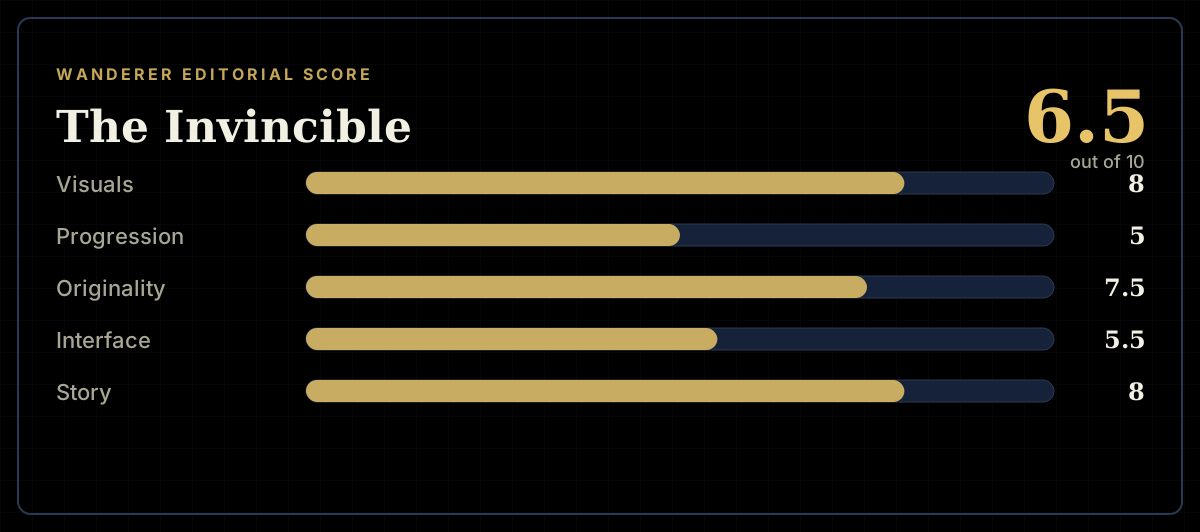
How the review scores each part of the gameWanderer Editorial -
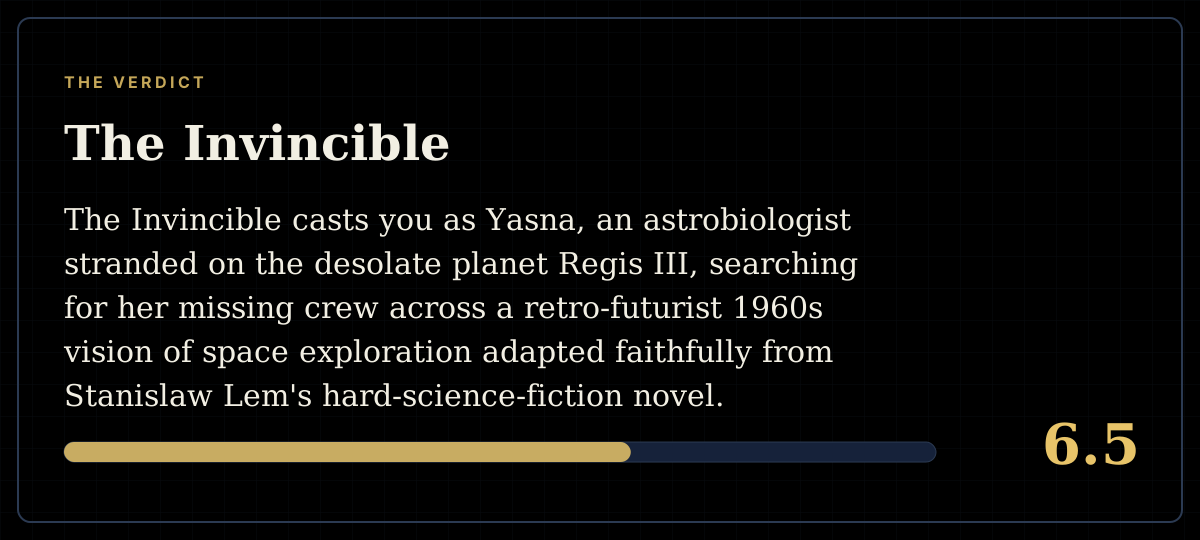
The short versionWanderer Editorial