Game review
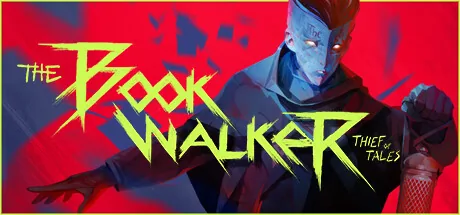
The Bookwalker: Thief of Tales
6 / 10
- Developer
- DO MY BEST
- Publisher
- tinyBuild
- Released
- 22 June 2023
- Platforms
- Windows
- Genre
- Narrative Adventure, Fantasy, RPG
- Monetisation
- One-time purchase. No advertisements or microtransactions.
- Players
- Single-player
The short version
The Bookwalker: Thief of Tales is a narrative adventure from Ukrainian studio DO MY BEST, published by tinyBuild and released 22 June 2023, in which disgraced writer Etienne Quist dives physically into fictional books to steal legendary items and restore his ability to write. It sits at a lifetime Very Positive 91.5% across 2,786 reviews. This review reads a substantial share of both samples and finds a premise this review's own sample calls genuinely unique — few games let you literally enter and alter a story to extract an object from it — paired with two consistent, specific complaints: isometric combat several reviewers describe as unnecessary filler that interrupts the narrative rather than enhancing it, and dialogue choices a striking number of reviewers say fail to meaningfully affect outcomes despite the game's framing around them.
Biggest strengths
- A genuinely distinctive core premise — diving into books to alter their stories and extract legendary items — draws consistent praise as something this review's sample hasn't encountered in quite this form elsewhere
- Art direction and worldbuilding, particularly the design of each book-world visited, earn specific, repeated praise across both positive and negative reviews
- A short, well-paced runtime that several reviewers specifically credit for respecting their time rather than padding the experience
Biggest weaknesses
- Turn-based combat draws widespread, specific criticism as unnecessary filler that interrupts the narrative flow rather than complementing it, with several reviewers questioning why a story-first game includes it at all
- A significant share of reviewers report that dialogue and story choices fail to meaningfully affect outcomes, undercutting a game whose presentation and marketing lean heavily on choice-driven storytelling
- Writing and dialogue quality draw specific criticism, with several reviewers noting English is not the developer's first language and that prose reads as basic or awkward in places
Who it's for: Narrative-focused adventure fans who prioritise atmosphere, worldbuilding and a distinctive premise over deep mechanical systems; a weaker fit for players expecting the combat and choice-consequence depth of Disco Elysium, a comparison the game's presentation invites.
Our recommendation: Worth playing for its atmosphere and central concept over a short, well-paced runtime, provided you set expectations for the combat and dialogue systems before going in.
6 / 10
Introduction
The Bookwalker: Thief of Tales casts you as Etienne Quist, a writer stripped of his ability to write and forced into a criminal deal: dive physically into published books, alter their internal stories, and extract legendary fictional items — Thor's Hammer, Excalibur — to pay off the debt. Developed by Ukrainian studio DO MY BEST and published by tinyBuild, it released 22 June 2023 and sits at a lifetime Very Positive 91.5% across 2,786 reviews. This review reads a substantial share of both samples and finds a premise this review's own reading confirms is genuinely distinctive, paired with two specific, well-corroborated complaints about how that premise plays out mechanically.
A concept few other games attempt
The strongest, most consistently praised element across this review's sample is the core hook itself. Reviewers repeatedly describe never having played anything quite like it — entering a published story as a physical space, rearranging its plot to create an opening, then stealing an object out of the resulting altered narrative. Art direction and worldbuilding within each book-world draw specific, repeated compliments, including from reviewers who otherwise land negative on the game as a whole. One reviewer, a published author themselves, describes being moved by how the game treats fictional characters as genuinely alive within their stories. That's a real achievement worth crediting on its own terms, independent of how the surrounding systems land.
Combat that reviewers wish wasn't there
Set against that, the single most consistent mechanical complaint in this review's sample concerns turn-based combat encounters layered into the book-diving sequences. Reviewers describe it repeatedly as filler — present without adding meaningful challenge or synergy with the narrative — and several ask directly why a story-first game includes it at all, with one summarising a broader genre frustration: "I don't understand why every story-driven game nowadays feels so compelled to add a pointless combat system that does nothing other than disrupting the flow." This isn't a minority complaint about difficulty; it's a specific, recurring critique that the combat exists as an obligation rather than a genuine part of the design.
Choices that reviewers say don't choose much
The second consistent thread concerns the game's dialogue and decision system, which the presentation frames as central to how each book's story unfolds. A significant share of this review's sample reports the opposite in practice — that choices fail to meaningfully diverge outcomes. One reviewer states it plainly: "your choice couldn't matter less," comparing the experience unfavourably to games built around genuine branching consequence. That's a real tension for a game whose central fantasy is literally rewriting stories from the inside; several reviewers frame it as the gap between what The Bookwalker promises and what it delivers mechanically.
Writing, comparisons and a shorter runtime
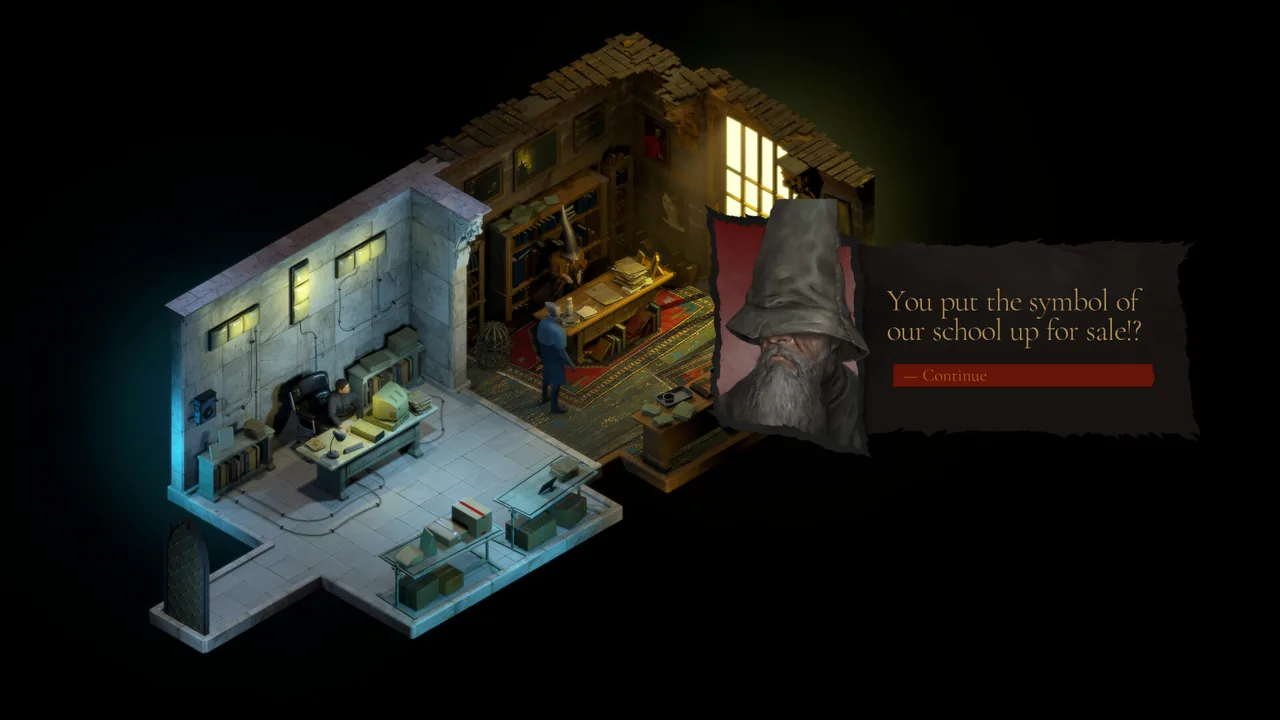
A related, more specific criticism concerns prose quality: several reviewers note, without unkindness, that English is not the Ukrainian developer's first language, and that dialogue reads as basic or occasionally awkward as a result. The game's isometric presentation and UI style also invite direct comparison to Disco Elysium, which several reviewers say works against it — one calls it "another entry in the growing list of Disco Elysium inspired 'narrative focused' RPGs" that inherits the genre's usual weak spot, a lack of genuinely interesting mechanics beneath the prose. On the more positive side, several reviewers specifically credit the game's shorter runtime as a strength rather than a limitation, describing a well-paced experience that doesn't overstay its welcome — Steam's own achievement data shows just over half of players completing the first book, a reasonable completion rate for a story-first game of this length.
Final Verdict
The Bookwalker: Thief of Tales succeeds most clearly at the thing hardest to manufacture — a genuinely original premise, rendered with real craft in its worldbuilding and art direction. Where it falls short is in the systems built around that premise: combat several reviewers call unnecessary, and dialogue choices a significant share say don't deliver on the consequence the game's structure implies. Play it for the concept and the atmosphere over a short, focused sitting, and go in with tempered expectations for its RPG systems rather than the Disco Elysium comparison its presentation invites.
Pros and cons
Pros
- A genuinely distinctive core premise — diving into books to alter their stories and extract legendary items — draws consistent praise as something this review's sample hasn't encountered in quite this form elsewhere
- Art direction and worldbuilding, particularly the design of each book-world visited, earn specific, repeated praise across both positive and negative reviews
- A short, well-paced runtime that several reviewers specifically credit for respecting their time rather than padding the experience
- From the developers of The Final Station, a previously well-received pixel-art game, giving the studio a track record several returning fans cite positively
Cons
- Turn-based combat draws widespread, specific criticism as unnecessary filler that interrupts the narrative flow rather than complementing it, with several reviewers questioning why a story-first game includes it at all
- A significant share of reviewers report that dialogue and story choices fail to meaningfully affect outcomes, undercutting a game whose presentation and marketing lean heavily on choice-driven storytelling
- Writing and dialogue quality draw specific criticism, with several reviewers noting English is not the developer's first language and that prose reads as basic or awkward in places
- The Disco Elysium comparison the game's presentation invites works against it for some reviewers, who describe the mechanical depth as considerably thinner than that comparison implies
Screenshots
-
The Bookwalker: Thief of TalesImage: tinyBuild via Steam -
The Bookwalker: Thief of TalesImage: tinyBuild via Steam -
The Bookwalker: Thief of TalesImage: tinyBuild via Steam -
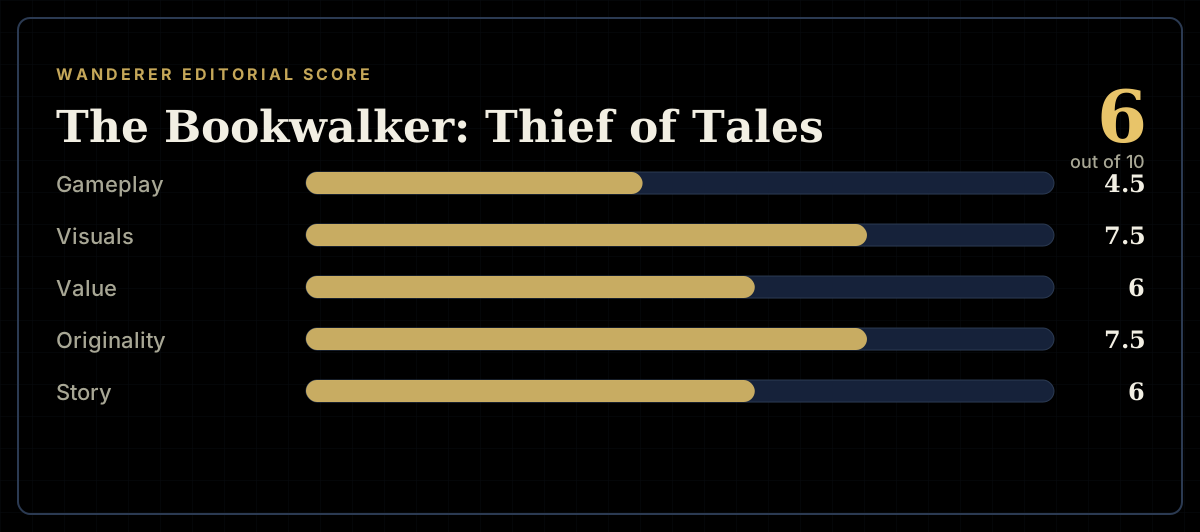
How the review scores each part of the gameWanderer Editorial -
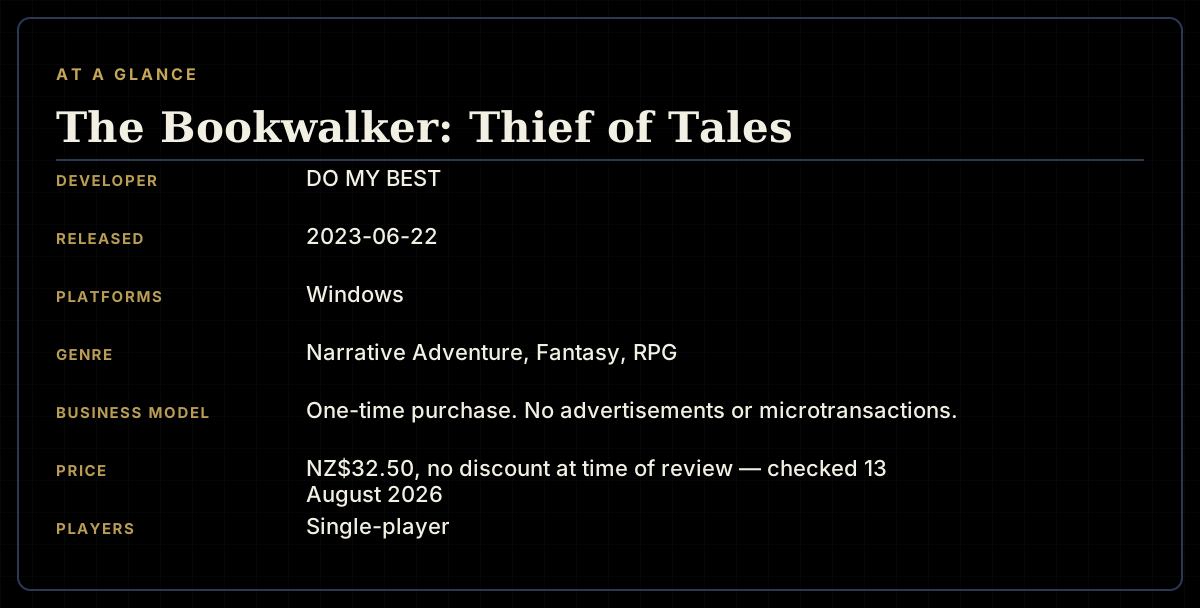
The essentials at a glanceWanderer Editorial -
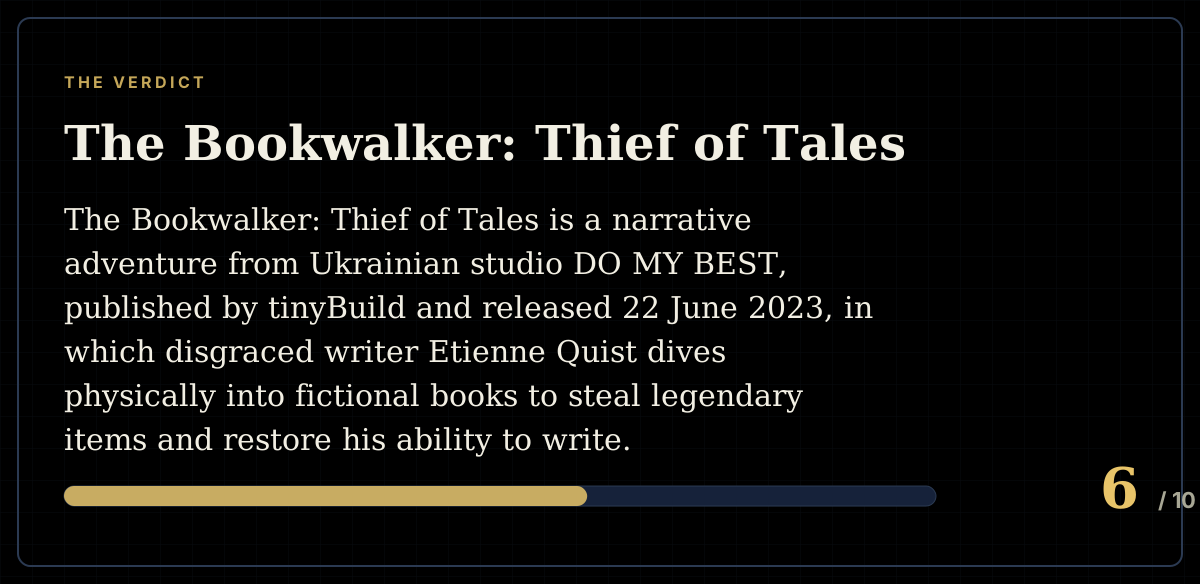
The short versionWanderer Editorial