
Game review
Terminator: Resistance
5.5 / 10
- Developer
- Teyon
- Publisher
- Reef Entertainment
- Released
- 14 November 2019
- Platforms
- Windows
- Genre
- Sci-Fi Action RPG
- Monetisation
- Paid, one-time purchase, plus a story DLC expansion.
- Players
- Single-player only.
The short version
Terminator: Resistance's core idea — finally letting players experience the "Future War" only glimpsed in flashback in the original films — is a genuinely appealing pitch for the franchise's fans, and its Very Positive rating across more than 16,000 reviews reflects real affection for that setting brought faithfully to life. What a large and consistent share of the same review base argues, openly and specifically, is that the game underneath the license feels budget-tier and dated even by 2019 standards, and that the score is being carried by nostalgia more than by the shooting, RPG systems or technical execution actually earning it on their own merits.
Biggest strengths
- A faithful, well-realised rendition of the Terminator "Future War" setting that fans consistently praise as more immersive to the source material than any other Terminator game.
- Real light RPG structure layered onto the shooting — a skill tree, dialogue choices and crafting give the campaign more shape than a pure corridor shooter.
- Recognisable franchise atmosphere, music and character tone that land well even for reviewers otherwise critical of the mechanics.
Biggest weaknesses
- A consistent complaint describes the shooting and technical execution as feeling dated even at 2019 launch, with several reviewers comparing it unfavourably to shooters from over a decade earlier.
- A specific, reproducible complaint describes invisible collision barriers preventing the player from jumping over even small obstacles, undermining traversal in an already unforgiving shooter.
- Multiple reviewers explicitly state the game is only worth recommending to committed franchise fans, describing its broader quality as middling on its own terms.
Who it's for: Committed Terminator fans who want to see the Future War rendered faithfully, with realistic expectations that the shooter mechanics and production values sit well below the genre's leading edge.
Our recommendation: Worth it for die-hard franchise fans at a discount; players evaluating it purely as a shooter or RPG should look elsewhere first.
5.5 / 10
A pitch built entirely on unrealised potential
Terminator: Resistance's premise is one the franchise's fans had wanted for decades before this game delivered it: "a first-person shooter set during the 'Future War' scenario that was only glimpsed at in the iconic films, 'THE TERMINATOR' and 'T2: JUDGMENT DAY.'" The official screenshot shows exactly that promise realised in practice — a hulking endoskeleton looming over a ruined cityscape, a red-eyed T-800 unit advancing with a plasma sword drawn, all viewed down the sights of a scavenged rifle. For a franchise whose most iconic imagery of this future war existed only as brief flashback sequences in the films, seeing it built out into an explorable, playable setting is a genuine achievement in its own right, and reviewers across the game's entire history credit that atmosphere and faithfulness as the game's clearest, most consistent strength. Light RPG systems — a skill tree, dialogue choices affecting relationships with other resistance fighters, and scavenging-based crafting — give the campaign more structure than a straightforward corridor shooter, another point reviewers consistently credit even when critical of other elements.
A recurring, specific admission: the score runs on nostalgia
What tempers that praise is an unusually candid and consistent pattern of reviewers explicitly naming the gap between their enjoyment and the game's actual technical quality. "The technical quality feels like this was released in 2015," reads a 2020 review, despite the game launching in late 2019. A 2022 review, self-described as coming "from a die-hard Terminator and video games fan," concludes plainly: "Sadly, no," after having gone in expecting the game to be "the best thing that happened" to the franchise based on other positive reviews. A July 2026 review is blunter still: "If you like generic action games from 2005 you'll love this... The massive amount of positive reviews are from players who love the Terminator series," explicitly separating franchise goodwill from actual game quality as the driver of the aggregate score. This isn't a case of reviewers hiding their reasoning — several state directly and specifically that their recommendation, where given, is conditional entirely on how much a buyer already cares about the license, not a broader endorsement of the shooting or systems on their own merits.
A specific, reproducible traversal complaint
Beyond the broader quality debate, one specific and mechanically concrete issue recurs: invisible collision barriers. "Your character is unable to jump over 2ft high walls, and unable to fire past the 1ft invisible wall which surrounds every piece of terrain," reads a 2020 review, describing this as a real, frequent source of frustration in what's already an unforgiving shooter. That's a different, more specific kind of complaint than general dated-feeling combat — a concrete traversal limitation that would be a fair criticism of any game regardless of budget or license, and worth flagging plainly rather than folding into the vaguer "feels old" complaints elsewhere in the sample.
A useful, verifiable comparison point
One of the more useful data points in this review's research comes from a reviewer with direct comparative experience: "Terminator walked so Robocop could run. After loving Robocop: Rogue City, I came into Terminator Resistance hoping for a similar experience. Unfortunately, the game is a lot rougher," reads a September 2025 review. Robocop: Rogue City is a later release from the same developer, Teyon, and widely regarded as a significant step up in production quality and combat feel over their earlier licensed shooter work. That comparison is directly verifiable — both games share a developer, and the newer one's stronger reception is well documented — and it offers a fair, concrete way to calibrate expectations: this is an earlier, rougher entry in the same studio's evolving approach to licensed action games, not their best work by their own later standard.
Why licensed games invite this specific split verdict
It's worth naming the broader pattern this review sits inside, because Terminator: Resistance is far from the only licensed game whose review base openly splits enjoyment from quality this way. Franchise-based games from smaller studios operating on tighter budgets than the properties they're adapting routinely produce exactly this shape of reception: genuine affection for finally getting to inhabit a beloved setting, layered directly on top of clear-eyed acknowledgment that the underlying game wouldn't stand out without that setting attached. What makes this particular case worth noting specifically is how openly the reviewers themselves articulate that split, rather than a reviewer outlet having to infer it from score patterns alone — multiple, independent reviews use almost the exact same "I'd only recommend this to fans" framing, which suggests the community around this game has arrived at a genuine, self-aware consensus about what it is and isn't, rather than being divided by disagreement over the game's actual merits.
Considering the story DLC separately
It's also worth noting, for completeness, that this listing includes a story expansion beyond the base campaign, adding additional playable content following different characters within the same Future War setting. This review's research didn't surface a distinct critical consensus about the DLC specifically separate from the base game's reception — reviewers who discuss it tend to treat it as more of the same experience rather than a meaningfully different one, for better or worse. Buyers already decided on the base game shouldn't expect the DLC to resolve the technical and pacing concerns raised above, since nothing in the available reviews suggests its systems or production values differ meaningfully from the main campaign's.
Final verdict
Terminator: Resistance succeeds specifically and clearly at delivering something franchise fans had wanted for decades — a playable, faithful rendition of the Future War — and that achievement deserves real credit on its own terms. Where this review's score reflects genuine caution is in taking seriously an unusually candid, repeated admission from the game's own reviewers that its broader quality as a shooter and RPG sits well below what the aggregate score alone would suggest, carried by nostalgia rather than execution. This is a fair, worthwhile purchase for the audience it's explicitly built for, and a much harder recommendation for anyone evaluating it as a shooter or RPG first and a Terminator game second.
Pros and cons
Pros
- A faithful, well-realised rendition of the Terminator "Future War" setting that fans consistently praise as more immersive to the source material than any other Terminator game.
- Real light RPG structure layered onto the shooting — a skill tree, dialogue choices and crafting give the campaign more shape than a pure corridor shooter.
- Recognisable franchise atmosphere, music and character tone that land well even for reviewers otherwise critical of the mechanics.
- A reasonably distinct campaign length and pacing for fans who specifically want a focused, single-playthrough experience.
Cons
- A consistent complaint describes the shooting and technical execution as feeling dated even at 2019 launch, with several reviewers comparing it unfavourably to shooters from over a decade earlier.
- A specific, reproducible complaint describes invisible collision barriers preventing the player from jumping over even small obstacles, undermining traversal in an already unforgiving shooter.
- Multiple reviewers explicitly state the game is only worth recommending to committed franchise fans, describing its broader quality as middling on its own terms.
- A 2025 review draws a specific, verifiable unfavourable comparison to the same developer's later, more polished Robocop: Rogue City.
Screenshots
-

Terminator: ResistanceImage: Reef Entertainment via Steam -

Terminator: ResistanceImage: Reef Entertainment via Steam -

Terminator: ResistanceImage: Reef Entertainment via Steam -
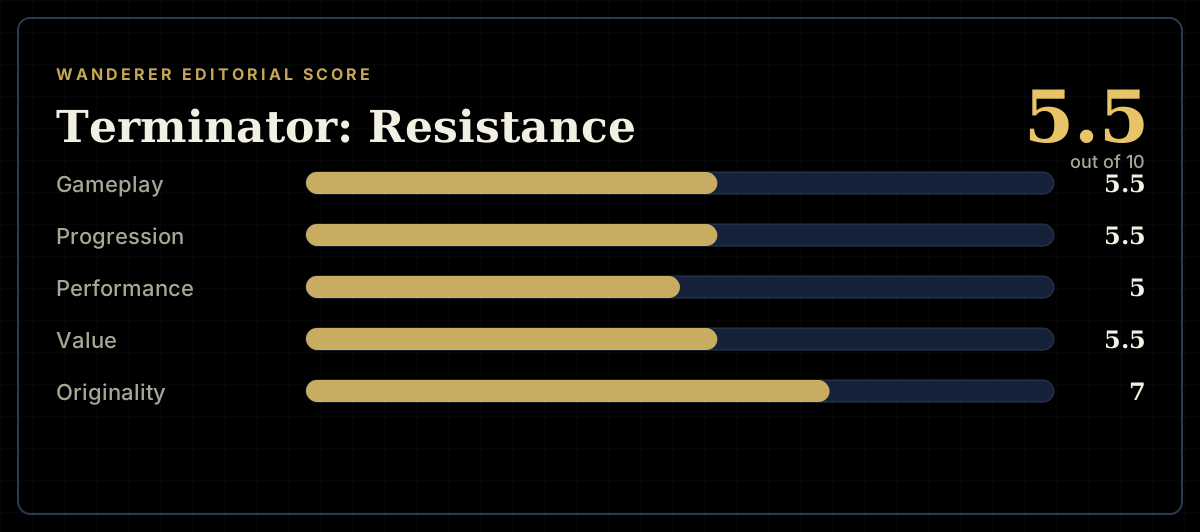
How the review scores each part of the gameWanderer Editorial -
The short versionWanderer Editorial