Game review
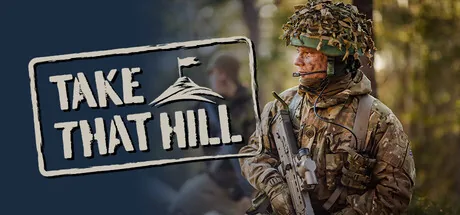
Take That Hill
6.5 / 10
- Developer
- HexWar Games, Hunted Cow Games
- Publisher
- Hunted Cow Games
- Released
- 5 August 2026
- Platforms
- Windows
- Genre
- Turn-Based Hex Wargame
- Monetisation
- One-time purchase, no DLC listed on Steam, no in-game store
- Players
- No online matchmaking category on Steam; local Shared/Split Screen PvP and Remote Play Together are listed, alongside a single-player campaign against the AI
The short version
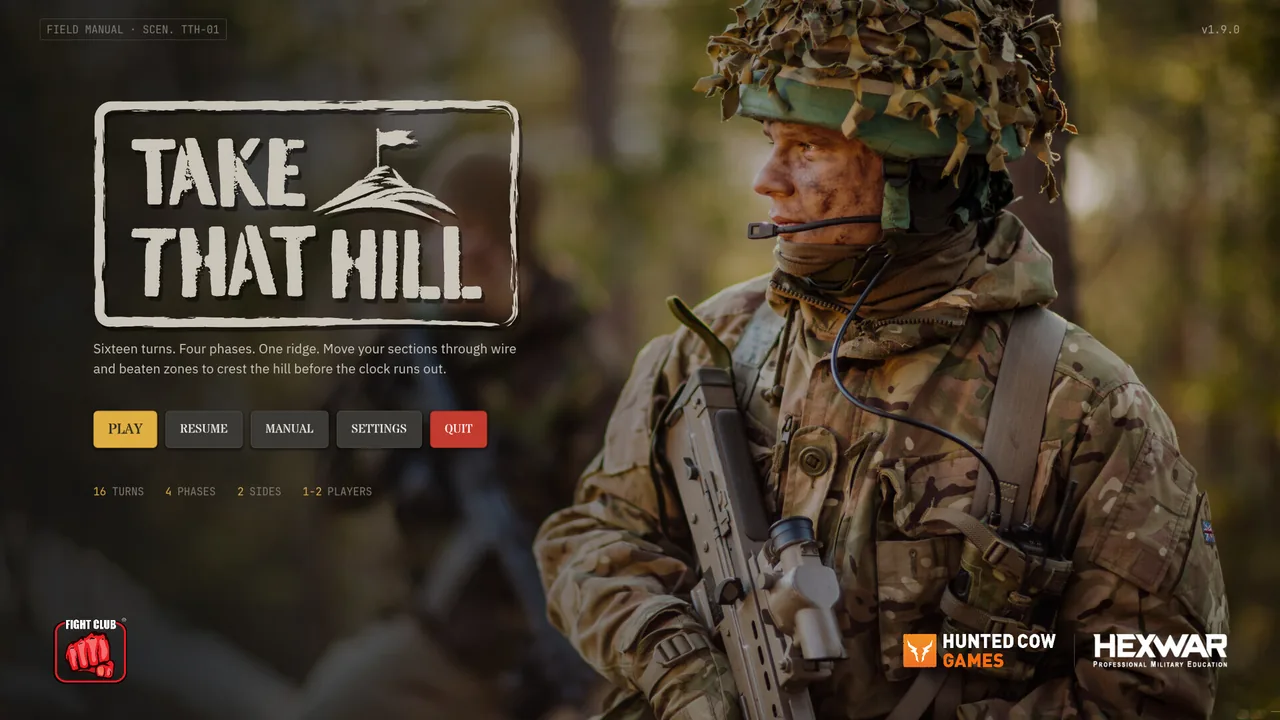
Take That Hill isn't trying to be a full wargame — it's trying to teach you how one works. The premise is unusually well credentialed: it's a digital version of a tabletop primer designed by Fight Club International, a real network of serving military, defence-industry and games-industry professionals who run wargaming education for outfits like the US Marine Corps University and various war colleges. That gives its core loop — IGO-UGO turns, dice-driven fire, suppression, morale and rally — a purpose beyond entertainment, and the scenario design backs it up: a tight 16-turn assault on one hill, an optional advanced ruleset, and a full Paratrooper Raid expansion built around a collapsing window of darkness.
What the review can't yet confirm is whether the execution matches the pedigree. Take That Hill shipped two days ago to exactly zero Steam user reviews, no tracked achievements and a current player count of zero at the time of checking, so there is no outside signal to weigh against the store page's own claims — and the developer's other Steam wargames, going back a decade under the same publishing arrangement, sit at Mixed rather than Very Positive.
Biggest strengths
- The digital adaptation is licensed from a tabletop primer designed by Fight Club International, a real wargaming-education network whose members include serving military and defence-industry professionals
- The base scenario has a genuinely tight design: 16 turns, a clean victory only inside the first 10, and a hard collapse condition once combined turns and hits reach 16
- The Paratrooper Raid expansion reuses the same core system under different pressure — assembling your force from a scattered drop while a fixed dawn clock runs out, then extracting every section rather than just reaching an objective
Biggest weaknesses
- Zero Steam user reviews and no achievement data exist at the time of writing, so pacing, AI quality and bug count currently rest entirely on the store page's own description
- Content is thin for the price: one core scenario, an optional advanced ruleset, and one expansion scenario, for NZ$30.99 before the current launch discount
- Windows only on Steam, despite the advanced rules and expansion suggesting more scope than the platform list currently supports
Who it's for: Wargame-curious players who want to learn the genre's real mechanics from a source with actual teaching credentials, rather than jumping straight into a 400-counter monster game. Less suited to anyone expecting a large scenario library or live online multiplayer.
Our recommendation: A cheap, honest way to learn hex-and-counter fundamentals from people who teach them professionally, but it is one core scenario plus one expansion for NZ$27.89, with no reviews yet to confirm how it plays in practice. Worth it for the curious at this price; wait for review data if you want reassurance first.
6.5 / 10
Most wargames assume you already speak the language: zones of control, stacking limits, combat results tables. Take That Hill doesn't. It's built to teach that language from a standing start, and it has an unusually good reason to claim it can — the tabletop version it's adapted from was designed by Fight Club International, a real network of serving military personnel, defence-industry professionals and games-industry designers who run wargaming education for organisations that include the US Marine Corps University and multiple war colleges. A commercial hex-and-counter primer with that kind of pedigree behind it is genuinely rare, and it's the single most interesting thing about this release.
One hill, sixteen turns
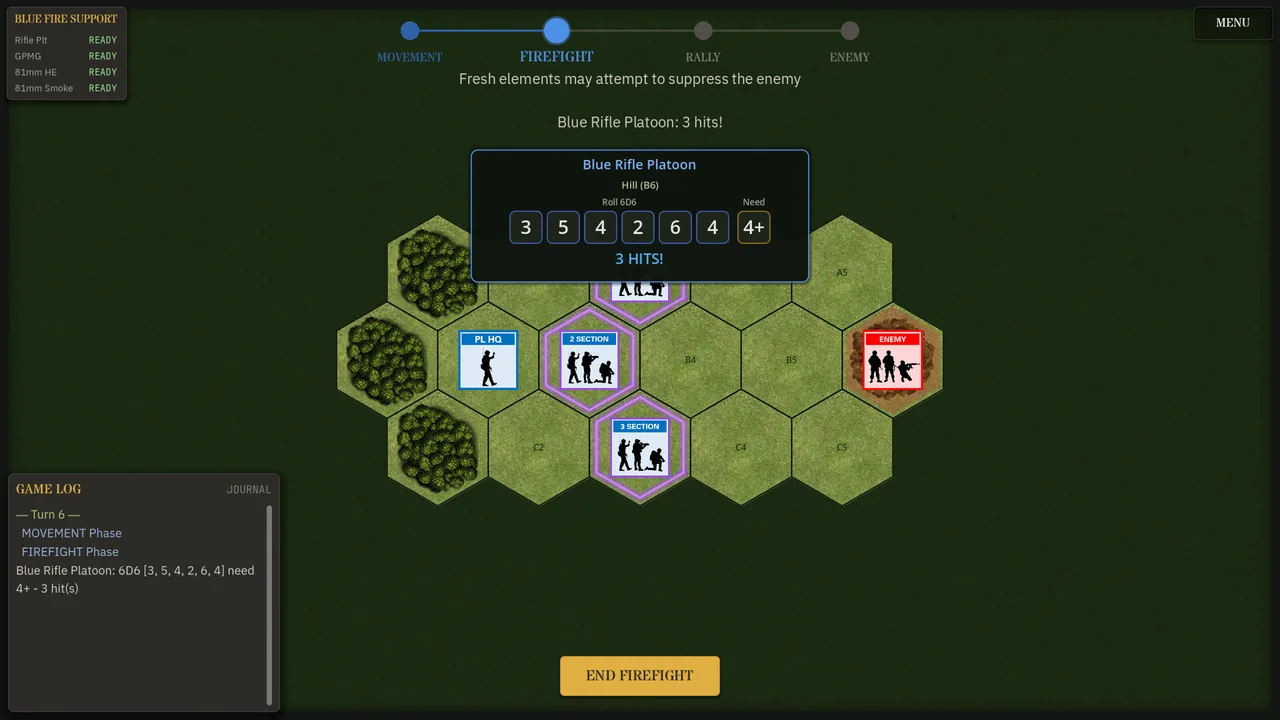
The pitch is deliberately small. You command an infantry platoon — three sections plus a platoon HQ — tasked with destroying a dug-in enemy section on a hill 500 metres across open ground, with nothing to hide behind. The turn structure is IGO-UGO: one side acts fully, then the other, which is about as foundational as hex-and-counter design gets, and the store page frames it explicitly as the entry point for "the majority of commercial wargames." Fire is dice-driven, suppression and morale determine whether a section can still act, and the whole engagement is bounded by a hard clock: combined turns plus hits reaching 16 collapses the attack outright. Reach the hill inside the first ten turns for a clean win; anything from turn eleven on tops out at a draw. That's a tight, legible failure state for a primer — it tells a new player exactly what winning and losing look like without needing a rulebook open on the desk.
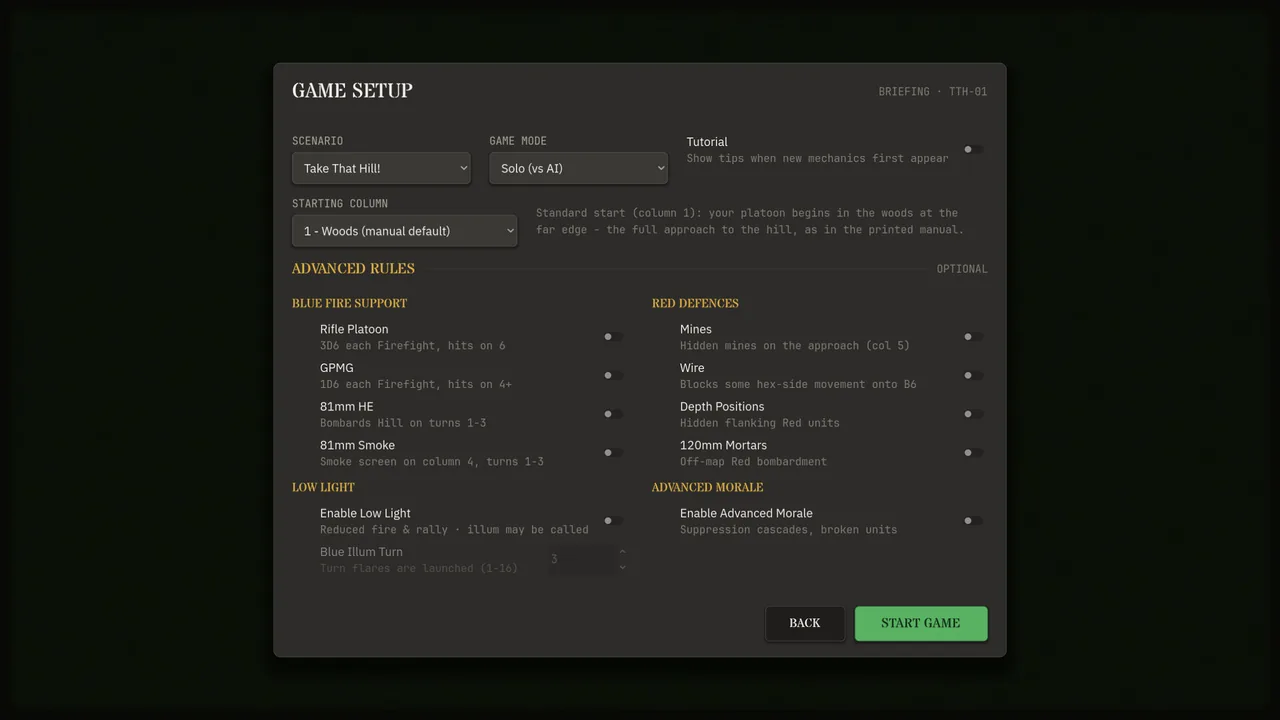
The advanced ruleset layers in the parts that make hex wargames interesting rather than merely functional: one-shot fire support (a rifle platoon, a GPMG section, 81mm HE, 81mm smoke) that rewards good timing and punishes waste; hidden Red defences — minefields, wire, depth positions that may or may not be real — plus 120mm mortars with a beaten zone that chains from hex to hex; stacking hit-marker penalties on rally rolls; and a low-light mode that penalises fire and rally by minus two until someone calls in illumination. None of that is novel to the genre, but stacking it as optional complexity on top of a scenario built to be learnable first is a sensible way to teach it.
The Paratrooper Raid
The included expansion reuses the same engine under a different kind of pressure. You drop behind enemy lines the night before a major offensive with only your platoon commander on the board — the rest of the force assembles from the drop zone over the following turns, while the garrison you're attacking gets stronger the longer that takes. Turn eleven flips on first light for good, which means the darkness the whole plan depended on is gone whether you're ready or not. Getting your commander to the crest and rolling for the engineers' demolition (three attempts, each at better odds than the last) doesn't end the mission either — every section has to physically make it back to the wood line, so the raid's real difficulty is in the extraction, not the objective. It's a smart structural mirror of the base scenario: same core system, opposite clock, different failure mode.
What nobody has said about it yet
Here's the honest limit on all of the above: at the time of writing, Take That Hill has been live for two days and has exactly zero Steam user reviews, in any language. There's no achievement data either — the global achievement API returns an empty response, meaning either no achievements are tracked or too few players have logged any activity to register — and a check of current concurrent players returned zero at the moment of checking, a single dated snapshot rather than a claim about the game's overall popularity. There is, in short, no outside signal yet to set against the store page's own description of how the AI plays, how balanced the dice-driven fire actually feels in practice, or whether sixteen turns is a tight design or simply a short one.
The closest thing to a track record is the developer's back catalogue. HexWar Games has been making small hex-and-counter wargames for Steam since 2016, published throughout by Hunted Cow Games (the two formalised that publishing arrangement in September 2023, with HexWar continuing to develop while Hunted Cow handles publishing and support). Checking two of those earlier titles with a meaningful sample size — Tank Battle: 1944 (36 of 57 reviews positive) and Civil War: 1863 (30 of 50 positive) — turns up Mixed scores in the low-to-mid 60s percent, with recurring complaints in the negative reviews about glitchy unit selection and an interface that hadn't moved with the times: "unbalanced and unrealistic... unless you like losing over and over," reads one on Tank Battle: 1944, and "this feels exactly the same as the other games by this company that I have bought," reads one on Civil War: 1863. A third title, Civil War: Atlanta 1864, has too small a sample (2 reviews total) to read anything into. None of that is a verdict on Take That Hill specifically — different game, different scenario design, and Fight Club International's involvement is new to this release — but it's a reasonable data point for calibrating expectations about UI polish from the same publishing relationship, rather than assuming a clean slate.
Multiplayer, platforms and the small print
The store page lists Shared/Split Screen PvP and Remote Play Together rather than any online matchmaking category, so playing against another person currently means sharing a screen or a Steam Remote Play session — not queuing into a match. The single-player campaign against the AI is the default way most buyers will actually play it. Steam lists Windows only for now, even though HexWar's own product page describes a wider rollout including Android, with macOS and iOS "coming soon" — worth treating as a stated intention rather than something you can act on today, since nothing on Steam confirms it yet.
The AI-content disclosure on the store page is refreshingly narrow: "AI was used to assist with translating the in-game text," matching the five supported languages (English, French, German, Spanish and Polish) rather than covering art or design. That's the kind of scoped, checkable disclosure worth crediting, in contrast to the vaguer blanket statements some releases lean on.
At NZ$30.99 (currently NZ$27.89 with a 10% launch discount), the price sits at ordinary small-indie territory, but the content on offer is genuinely small: one core scenario, an optional ruleset layer over the top of it, and one expansion scenario. That's defensible for a primer whose whole job is teaching mechanics rather than providing dozens of hours of scenarios — but it does mean the value argument rests almost entirely on how good those two scenarios turn out to be to replay, which is exactly the thing no review data exists to confirm yet.
Final verdict
Take That Hill earns a 6.5 for a genuinely distinctive premise that most wargame primers don't have: a design pedigree traceable to a real professional wargaming-education network, wrapped around a tightly scoped scenario with a legible win condition and an expansion that reuses the same system under real structural pressure. It doesn't score higher because almost everything that would confirm whether the execution lives up to that pedigree — AI quality, dice balance, how the interface actually feels to play, how much replay value two scenarios really hold at this price — currently rests on the store page's own claims, with zero user reviews and an unremarkable Mixed track record from the same publishing relationship as the only outside context available. Worth the price for players specifically curious about learning hex-and-counter wargaming from a credible source; everyone else should give the review count a little time to grow past zero.
Pros and cons
Pros
- The digital adaptation is licensed from a tabletop primer designed by Fight Club International, a real wargaming-education network whose members include serving military and defence-industry professionals
- The base scenario has a genuinely tight design: 16 turns, a clean victory only inside the first 10, and a hard collapse condition once combined turns and hits reach 16
- The Paratrooper Raid expansion reuses the same core system under different pressure — assembling your force from a scattered drop while a fixed dawn clock runs out, then extracting every section rather than just reaching an objective
- The AI-content disclosure is narrow and specific — limited to assisting with translating in-game text — rather than a vague blanket statement
- Minimum specification is modest (integrated graphics, 2GB RAM, 500MB disk), and the game supports touch input on Windows tablets
Cons
- Zero Steam user reviews and no achievement data exist at the time of writing, so pacing, AI quality and bug count currently rest entirely on the store page's own description
- Content is thin for the price: one core scenario, an optional advanced ruleset, and one expansion scenario, for NZ$30.99 before the current launch discount
- Windows only on Steam, despite the advanced rules and expansion suggesting more scope than the platform list currently supports
- The developer's earlier Steam wargames, released under the same Hunted Cow/HexWar arrangement since 2016, sit at Mixed user-review scores, with recurring complaints about buggy unit selection and dated interfaces
- Listed multiplayer is local Shared/Split Screen PvP and Remote Play Together rather than online matchmaking, so playing against another person means sharing a screen or a Steam Remote Play session
Screenshots
-
Take That HillImage: Hunted Cow Games via Steam -
Take That HillImage: Hunted Cow Games via Steam -
Take That HillImage: Hunted Cow Games via Steam -
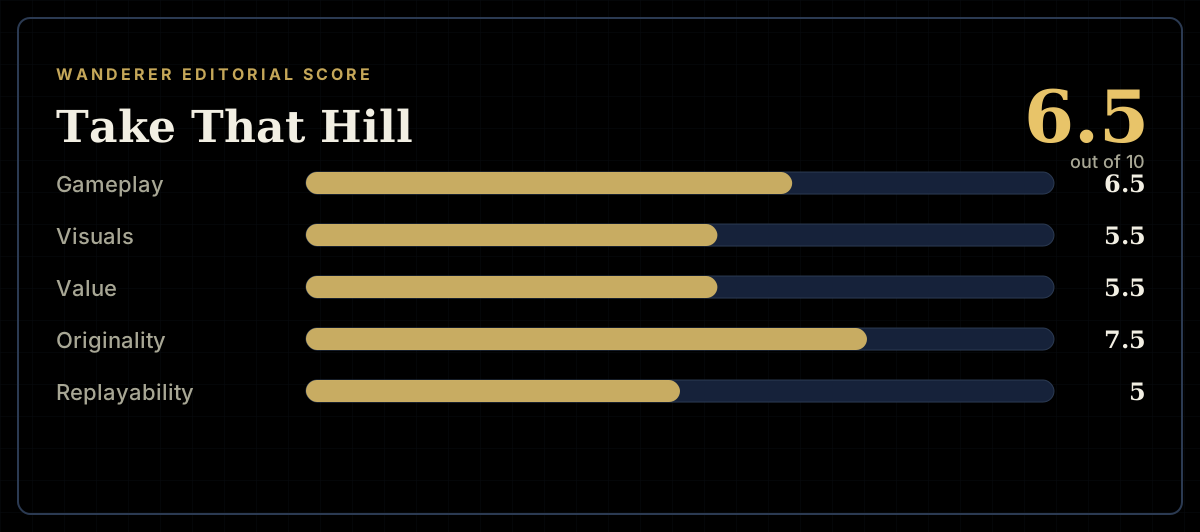
How the review scores each part of the gameWanderer Editorial -
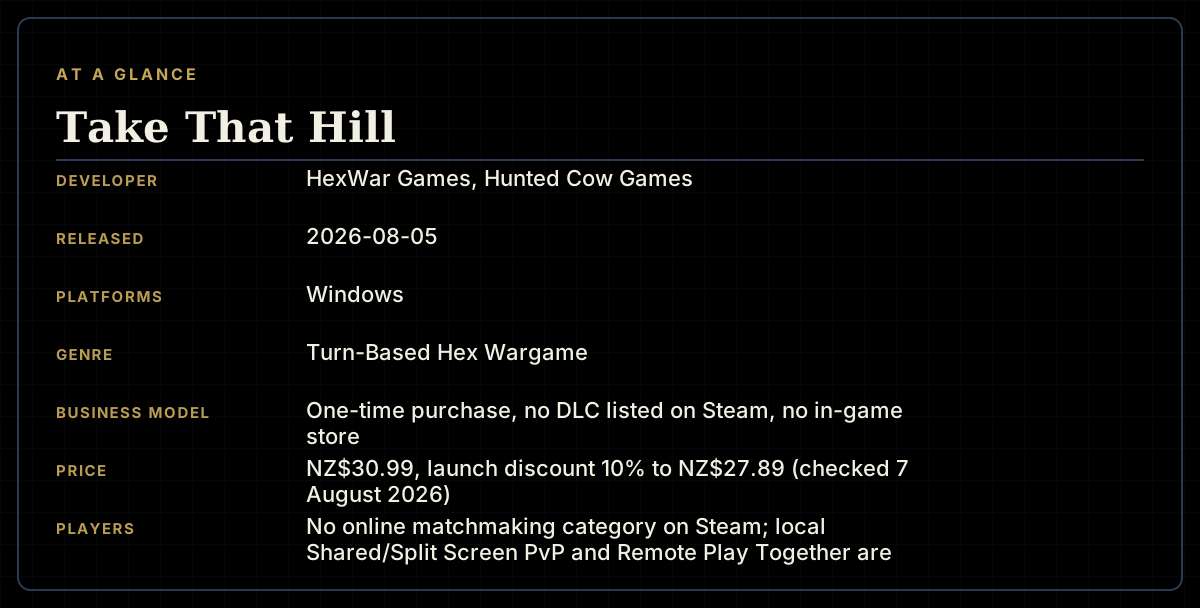
The game at a glanceWanderer Editorial -
The short versionWanderer Editorial