
Game review
Survivor's Notes Review
7 / 10
- Developer
- MYSTERY CROWN
- Publisher
- MYSTERY CROWN
- Released
- 11 September 2026
- Platforms
- ["Windows", "Mac"]
- Genre
- Adventure
A Zombie Apocalypse Told Like a Movie, Not a Game
Survivor's Notes doesn't play like most things wearing the "zombie survival" tag on Steam. There's no crafting bench, no loot economy, no hunger meter ticking down while you scavenge a suburb for canned food. Instead, it's a full-motion video interactive drama: filmed scenes, real actors, branching dialogue choices, and the occasional quick-time prompt standing in for the genre's usual systems. If you came looking for a management sim about surviving the undead, this isn't it. What it is, instead, is closer to an episodic streaming drama you get to steer.
The setup leans into that format's strengths. Ji Xingchuan is a cartoonist who's spent a year having the same recurring dream of a collapsing, zombie-overrun world, dreams he eventually turns into a hit manga called Notes of the Survivor. The story stops being fiction the moment those dreams start lining up with real events, and the mystery deepens further when Bai Yuan, a soldier from a ruined 2033, arrives from the future to stop the outbreak before it starts. Players guide both of them in parallel, weaving between a man who's seen fragments of the disaster in dreams he doesn't understand and a woman trying to unmake the very future that created her. It's a genuinely unusual hook for a genre that usually opens with "and then the dead started walking."
Choices, Quick-Time Events, and Real Consequences
Mechanically, Survivor's Notes stays close to its FMV roots. Scenes play out as filmed footage, periodically interrupted by dialogue choices or short quick-time sequences during moments of danger, and the decisions you make ripple outward, shifting who lives, who you trust, and which of the game's multiple endings you land on. It's not a deep interaction model by any stretch, and players expecting branching-path complexity on the level of a survival RPG will find the systems thin. What it does have going for it is genuine consequence: an early choice about whether to help or abandon a stranger can echo much later, and the game leans on Steam Achievements to reward players willing to replay and chase down the alternate outcomes they missed the first time.
The dialogue and choice-writing aren't uniformly polished. One recurring complaint from players is that localization occasionally muddies the actual stakes of a choice, in a couple of cases making the "safe" option read ambiguously enough that players picked the wrong one by accident. It's the kind of rough edge you'd expect from an indie studio without the marketing budget of a AAA publisher behind its English translation pass, not a fundamental design flaw, but it's worth knowing going in that the prompts don't always telegraph their outcomes as clearly as they should.
An Openly AI-Assisted Production, and a Genuinely Divisive One
The most notable thing about Survivor's Notes, and the detail nearly every player brings up first, is that the developers are upfront about using generative AI tools for a substantial portion of the game's video content. This isn't a hidden detail buried in the credits; it's disclosed plainly on the store page, and it shapes the entire viewing experience. Character models and environments occasionally show the telltale seams of AI-generated footage, continuity errors where a background shifts slightly between cuts, or a character's positioning doesn't quite track between edits.
Reactions to this split sharply. Some players wrote it off entirely, unimpressed by the visual inconsistencies. A larger and more vocal contingent, though, came away won over, framing the game as a legitimately compelling proof of concept: a roughly twelve-hour branching narrative, with over thirty professional human voice actors cast to deliver the actual performances, built by a small studio for a fraction of what traditional FMV production would cost. That's an important distinction worth underlining: the acting and vocal performances are real and human throughout, it's specifically the visual footage generation where AI tools were used, and that combination is unusual enough that it's become the game's defining talking point either way you land on it.
Priced Like What It Is: A Cheap, Ambitious Experiment
Survivor's Notes is upfront that it isn't chasing survival-horror mechanics, and that honesty matters. Its short description promises trust, rescue, or walking away, not base-building or resource management, and the actual game delivers exactly that promise. Content-wise it earns its mature rating: there's blood, mutilated bodies, and a persistent undercurrent of psychological dread sitting alongside the more grounded human drama between its two leads, and the tonal whiplash between quiet character moments and considerably darker horror beats is handled better than the low asking price would suggest. Steam Deck compatibility is currently unverified rather than officially confirmed, though given the video-driven, choice-prompt structure, there's little reason to expect major handheld issues beyond text readability on a small screen.
At $6.29, Survivor's Notes is priced less like a full game and more like a single ticket to a long, branching miniseries, and multiple players have made exactly that comparison, noting that a two-hour movie ticket alone can cost more in some regions than this entire twelve-hour, multi-ending experience. That value proposition is the game's strongest card. It won't convert players who bounce off FMV structures on principle, and the AI-assisted visuals will be a dealbreaker for some regardless of how well the human performances land. But for players curious about where interactive drama and AI-assisted production are actually heading right now, rather than where marketing promises they'll go, Survivor's Notes is a cheap, genuinely ambitious place to find out.
Verdict
Survivor's Notes swaps zombie-survival mechanics for a branching FMV drama built around a clever dream-and-time-travel hook, real human voice performances, and openly disclosed AI-assisted video production that will read as either a fascinating experiment or a visible rough edge depending on the player. It's mechanically thin and occasionally let down by shaky localization, but at just over six dollars for a lengthy, multi-ending story, it's a low-risk way to see a genuinely different approach to interactive fiction.
Pros:
- Unusual and effective premise blending dream visions, time travel, and a zombie outbreak
- Consequential branching choices with multiple distinct endings worth replaying for
- Strong, fully human voice cast (over 30 actors) carrying the emotional weight of the story
- Very low price for roughly twelve hours of branching narrative content
Cons:
- Thin interactive mechanics; closer to an interactive movie than a game for players wanting systems
- AI-assisted video footage produces visible continuity errors and inconsistent visuals
- Localization occasionally obscures the real stakes of a choice
- Steam Deck compatibility is currently unverified
Screenshots
-
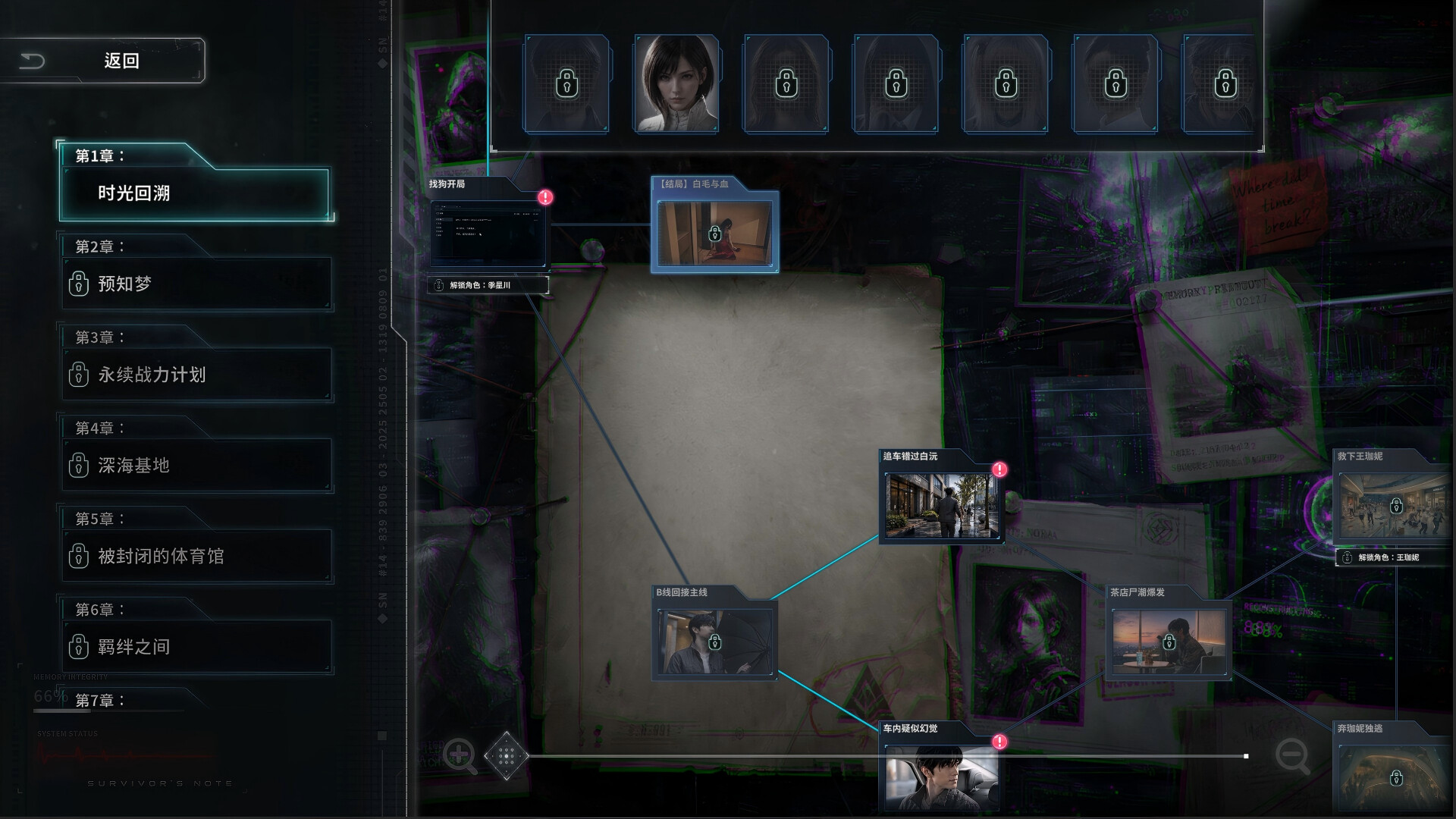
The story unfolds through a branching map of scenes and choicesImage: MYSTERY CROWN -
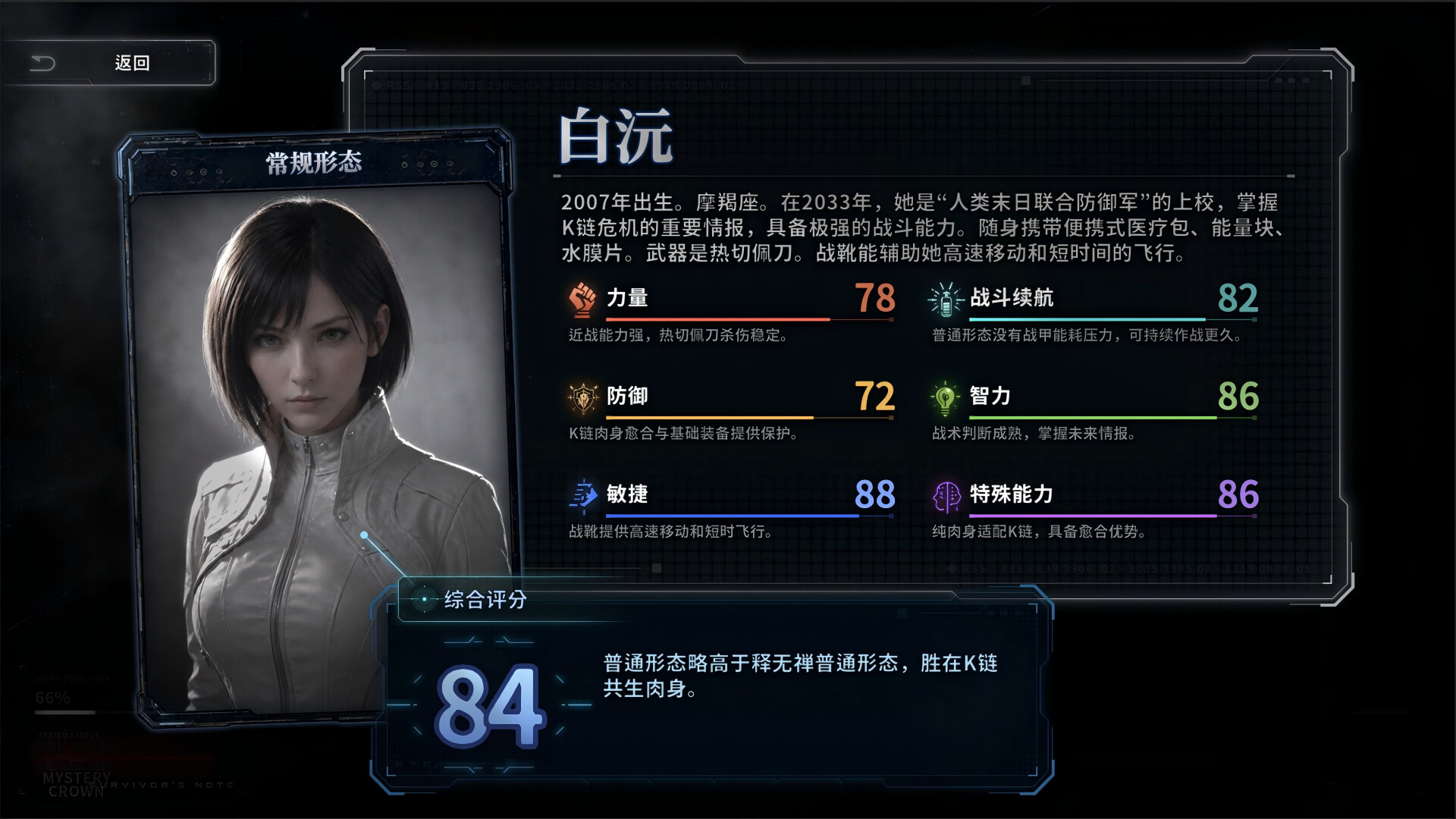
Character profile screens detail Bai Yuan's background and combat statsImage: MYSTERY CROWN -

Players can choose between different armor loadouts during key scenesImage: MYSTERY CROWN -
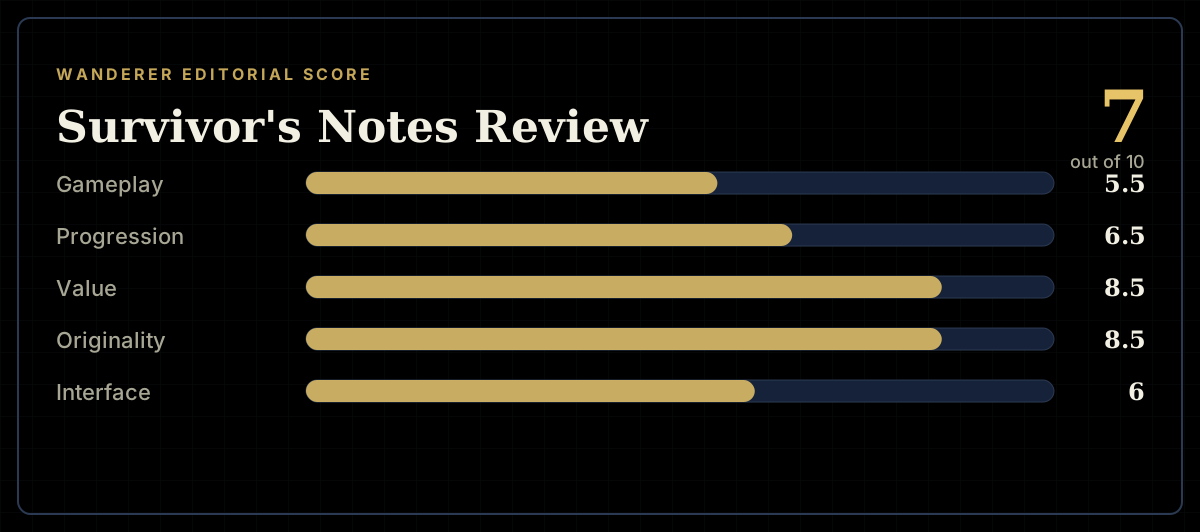
How the review scores each part of the gameWanderer Editorial -
The short versionWanderer Editorial