
Game review
Starstruck Vagabond
5.5 / 10
- Developer
- Ben "Yahtzee" Croshaw
- Publisher
- Second Wind
- Released
- 24 May 2024
- Platforms
- Windows
- Genre
- Space cargo-delivery life sim
- Monetisation
- One-time purchase, no DLC or microtransactions
- Players
- Single-player only
The short version
Starstruck Vagabond casts players as a space captain thawed out two thousand years after an accidental deep freeze, delivering cargo and slowly repairing a rickety ship while piecing together a story through a small crew of companions. This review's sample confirms the writing — penned by longtime games critic Ben "Yahtzee" Croshaw — remains genuinely funny and engaging even to reviewers who ultimately can't recommend the game, but a large, remarkably consistent negative-review theme describes a repetitive box-hauling core loop, glacial pacing that gates story content behind many hours of grinding, and a price several reviewers argue isn't justified against genre benchmarks like Stardew Valley.
Biggest strengths
- The writing consistently earns real, specific praise across this review's sample, with reviewers repeatedly describing sharp humour and surprising narrative depth even when disappointed by the game as a whole
- Several reviewers specifically enjoy the low-stakes, "turn your brain off" quality of the core delivery loop as a relaxing way to unwind, comparing it favourably to genre touchstones like Stardew Valley and Elite Dangerous in smaller doses
- The ship-repair and upgrade systems are credited by multiple reviewers as a genuinely satisfying puzzle in their own right, particularly the challenge of fitting cargo efficiently
Biggest weaknesses
- A large, specific, and remarkably consistent negative-review theme describes the core gameplay loop as repetitive and tedious, with multiple reviewers independently summarizing it as picking up crates, moving them to an elevator, and reversing the process on a different planet, over and over
- Reviewers repeatedly describe the game's pacing as extremely slow, with several specifically noting that meaningful story content doesn't arrive until 10 or more hours into play, and this review's own achievement-data check shows a steep completion drop-off consistent with many players not reaching that point
- Multiple reviewers directly compare the price unfavourably to established genre benchmarks, arguing it costs roughly twice as much as Stardew Valley while offering less polish and content variety
Who it's for: Existing fans of Yahtzee's writing specifically looking for more of his voice in a new medium, and players who genuinely enjoy slow, low-stakes "turn your brain off" delivery-sim loops; not a fit for players wanting the writing to be the primary, frequent focus of their playtime, or those expecting a tightly-paced narrative.
Our recommendation: Worth a purchase for confirmed fans of the writer specifically, ideally on sale, with realistic expectations that the celebrated dialogue is spread thin across many hours of repetitive cargo hauling.
5.5 / 10
Starstruck Vagabond puts players in command of a rickety spaceship two thousand years out of their own time, hauling cargo between planets to fund repairs while slowly meeting a small crew of companions. This review's sample confirms the writing — from a critic with a long, well-known track record — remains a genuine strength throughout, and identifies a large, unusually consistent set of complaints about how thin that writing is spread across the actual moment-to-moment gameplay.
Writing that lands, even for disappointed players
Almost every reviewer in this sample, regardless of overall verdict, singles out the same strength. "The game's strong suit is easily its writing. The dialogue is very funny and jokes would often catch me off guard," one reviewer writes after finishing the campaign. Another, ultimately unable to recommend the game, still concedes: "the writing is quite good." A third describes the tutorial specifically as a highlight: "It's a really bad sign when after 5 hours the part I liked the best was the tutorial, since it was dialogue heavy" — a backhanded compliment that nonetheless confirms the writing itself consistently lands.
A repetitive core loop, described almost identically by many reviewers
The single most repeated criticism in this review's sample uses strikingly similar language across independent reviews. "You follow a distress call and find a broken down ship. The captain says, 'Help fix my engine!' You equip your wrench and fix it. 'Thanks, here's 500 credits!' Then you leave. That's how eve[ry mission goes]," one reviewer summarizes. Another describes the same pattern even more mechanically: "You walk up to things, pick them up and put them down on an elevator, activate it and then once in your ship pick them up and put them down off the elevator. Then you fly to a different planet and do that again in reverse. That's basically the whole game." That level of near-identical description from unconnected reviewers strongly suggests this is an accurate, structural characterization rather than a subjective complaint from players simply bored by the genre.
Pacing that gates the best material behind hours of grind
Multiple reviewers specifically link the repetition complaint to a pacing problem: the writing they praise doesn't arrive often enough. "It took 10 hours to reach plot development, which only made the game marginally more interesting," one reviewer reports, while another states the same concern from a different angle: "the interesting story bits seemed too few and far between... there was a lot of slogging through same-y deliveries/rescues/planets before you got the next drip of story." This review's own check of Steam's achievement data supports that read: completion rates fall steeply from 55.5% for the most common achievement to 1.1% for the rarest, consistent with a large share of players not sticking around long enough to see the content reviewers say makes the game worthwhile.
A specific, repeated pricing complaint
Several reviewers frame their disappointment through direct comparison to genre benchmarks. "It has no right to cost twice as much as Stardew Valley," one reviewer states bluntly. Another lists specific, cheaper or similarly-priced alternatives they found more polished: "I can find countless other more polished and extensive games that is same price or cheaper like Lorelei and the Laser Eyes, Cryptmaster, and even, yes, Stardew Valley." That comparison recurs often enough to represent a genuine, shared value concern rather than an isolated complaint about the game's asking price in isolation.
A specific complaint about the ending
At least one detailed reviewer raises a serious, specific concern about the story's resolution: "It builds to the climax only for the object of interest to explain the expectation of the player is wrong, and there is no point," describing the ending as unsatisfying after a long buildup. That's a pointed narrative complaint distinct from the broader pacing and gameplay issues, worth flagging for players who specifically value a strong, earned narrative payoff after committing many hours to reach it.
What the update record confirms
Steam's own partner-events feed shows real, sustained developer support: 16 documented posts span day-one hotfixes through a substantial "Destructathon Update" and a cloud-save feature added roughly a year after the May 2024 launch, both apparently responsive to community requests. That's genuine evidence of ongoing investment, even though the fundamental structural complaints about repetition and pacing raised throughout this review appear to remain largely unaddressed by those updates.
A pattern of loyalty purchases worth naming honestly
A distinct, recurring pattern in this review's sample deserves direct mention: several reviewers explicitly state they bought the game specifically because of who made it, independent of the game's actual merits. "I admittedly mostly bought the game because I like his books and figured he'd have a fresh take on games," one reviewer writes, before rating the experience only lukewarmly. Another is more self-aware still: "I was probably always going to buy this game regardless of other factors, if only to support an artist and a company I like... keep that grain of salt in your back pocket." That's a useful signal for prospective buyers without that same existing investment in the creator: strip away the goodwill purchase, and the underlying game still needs to be judged on the repetitive-loop and pacing complaints raised consistently throughout this review.
A quieter defense: it works for unwinding
Several reviewers who ultimately gave a positive recommendation frame their enjoyment specifically around low-intensity, background-activity play rather than deep engagement. "Not hard, not deep, but surprisingly chill and I've enjoyed it winding down in the evening with something tasty to drink and my Steam Deck," one reviewer writes. Another confirms a similar use case: "you have a podcast on in the background" while playing. For buyers specifically looking for that kind of low-stakes, half-attention experience rather than a tightly engaging narrative game, several reviewers suggest the repetitive loop this review otherwise criticizes may actually be closer to a feature than a bug.
Final verdict
Starstruck Vagabond succeeds as a showcase for its writer's voice, and this review's sample confirms the dialogue and humour genuinely land even for reviewers who ultimately can't recommend the full package. But a large, unusually consistent negative-review theme — a repetitive core loop, pacing that gates the best writing behind many hours of grinding, and a price several reviewers argue isn't justified against genre benchmarks — describes real, structural problems rather than a simple mismatch of taste. Confirmed fans of the writer specifically should try it, ideally at a discount; everyone else should know the celebrated writing is a much smaller part of the actual experience than the marketing suggests.
Pros and cons
Pros
- The writing consistently earns real, specific praise across this review's sample, with reviewers repeatedly describing sharp humour and surprising narrative depth even when disappointed by the game as a whole
- Several reviewers specifically enjoy the low-stakes, "turn your brain off" quality of the core delivery loop as a relaxing way to unwind, comparing it favourably to genre touchstones like Stardew Valley and Elite Dangerous in smaller doses
- The ship-repair and upgrade systems are credited by multiple reviewers as a genuinely satisfying puzzle in their own right, particularly the challenge of fitting cargo efficiently
- Steam's own partner-events feed documents a real, sustained patch cadence across roughly a year following launch, including a substantial "Destructathon Update" and a cloud-save feature added in direct response to player requests
- The game runs well on Steam Deck according to multiple reviewers, a specific, practical point in its favour for players wanting a low-intensity handheld experience
Cons
- A large, specific, and remarkably consistent negative-review theme describes the core gameplay loop as repetitive and tedious, with multiple reviewers independently summarizing it as picking up crates, moving them to an elevator, and reversing the process on a different planet, over and over
- Reviewers repeatedly describe the game's pacing as extremely slow, with several specifically noting that meaningful story content doesn't arrive until 10 or more hours into play, and this review's own achievement-data check shows a steep completion drop-off consistent with many players not reaching that point
- Multiple reviewers directly compare the price unfavourably to established genre benchmarks, arguing it costs roughly twice as much as Stardew Valley while offering less polish and content variety
- Several reviewers describe the personality/alignment system chosen at the start as having minimal actual impact on dialogue or story outcomes, a specific letdown given how prominently it's presented early on
- At least one reviewer raises a detailed complaint about the story's ending feeling nihilistic and unsatisfying, describing a buildup that gets undercut by a late reveal that the entire premise the player was working toward was mistaken
Screenshots
-

Starstruck VagabondImage: Ben 'Yahtzee' Croshaw via Steam -

Starstruck VagabondImage: Ben 'Yahtzee' Croshaw via Steam -

Starstruck VagabondImage: Ben 'Yahtzee' Croshaw via Steam -
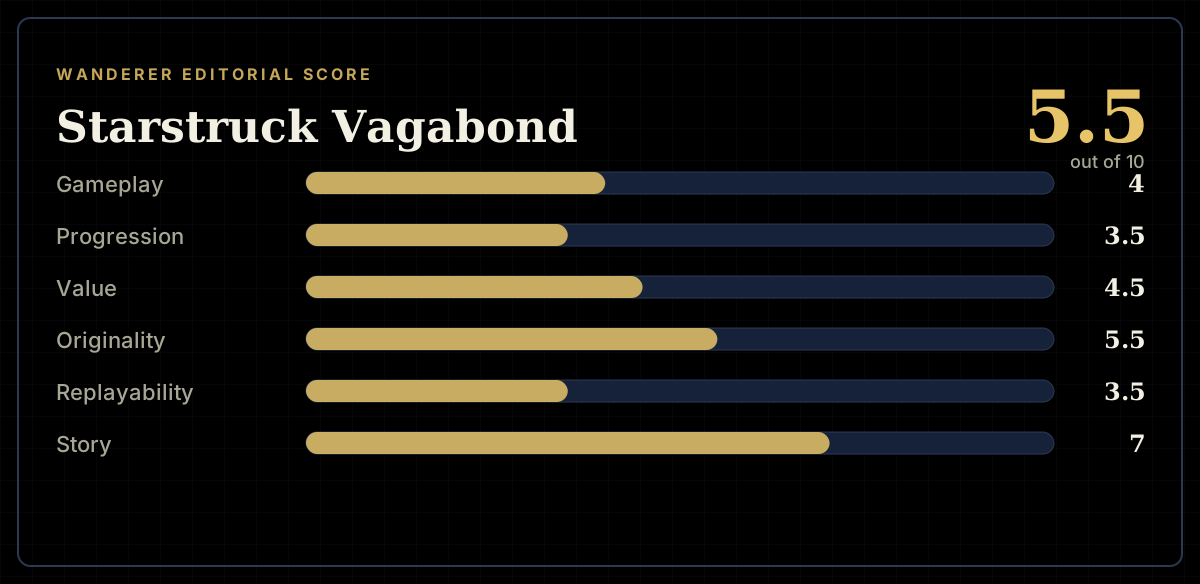
How the review scores each part of the gameWanderer Editorial -
The short versionWanderer Editorial