
Game review
Spiral Knights
5.5 / 10
- Developer
- Grey Havens
- Publisher
- Grey Havens
- Released
- 14 June 2011
- Platforms
- Windows, macOS
- Genre
- Co-op Dungeon Crawler RPG
- Monetisation
- Free-to-play with an energy-based system gating gear crafting and an optional premium currency, as described by 2017-era reviewers.
- Players
- Cooperative multiplayer dungeon runs are the core of the game, alongside a competitive Auction House economy.
The short version
Spiral Knights presents an unusual research problem: its entire visible Steam review history — every one of the 181 total reviews the game has ever accumulated — is frozen in a six-week window in early 2017, describing a charming co-op dungeon-crawler that reviewers at the time already believed the developers had abandoned. What that frozen snapshot can't show is what this outlet's own check of the game's news feed reveals: a genuine seven-year silence from December 2018 through December 2025, followed by a real, substantive, still-ongoing revival with monthly content updates and meaningful system reworks running into August 2026. This review has almost no current player sentiment to draw on, and says so plainly rather than pretending otherwise.
Biggest strengths
- A distinctive co-op dungeon-crawling loop with real visual charm, evident in official screenshots showing chaotic, colourful boss encounters.
- Free to play with no barrier to trying it, and a real Auction House player economy layered on top of the core crafting and gear progression.
- Genuinely revived: after a documented multi-year silence, the developer's own news feed shows substantive, ongoing updates through August 2026, including a full rework of the gear-forging system aimed at making it friendlier for new players.
Biggest weaknesses
- The entire available Steam review record is nearly a decade old, offering no current player sentiment on the actively-updated 2025-2026 version of the game.
- 2017-era reviews describe a grindy, energy-gated crafting economy and Java-based technical issues on then-current Windows versions; this review cannot confirm whether either has been addressed since.
- The game was, by its own reviewers' account, genuinely abandoned by its developers for years before this recent revival, and there is no current community discussion available to confirm the revival has rebuilt trust or population.
Who it's for: Free-to-play co-op RPG fans curious about a quietly-revived cult classic, with the clear understanding that this outlet has no recent player-review record to confirm how the current, actively-updated version actually plays.
Our recommendation: Worth trying given it's free and genuinely being updated again, but go in as an early adopter of its second life — there is essentially no current review record to lean on.
5.5 / 10
A charming co-op loop, seen through a decade-old lens
Spiral Knights' pitch is a straightforward, appealing one: "Join the ranks of the Spiral Knights. Stranded on an alien world, you must explore the ever-changing Clockworks beneath its surface," per the store page, with a heavy emphasis on cooperative dungeon delivery. The official screenshot confirms the tone in practice — a chaotic, brightly-lit boss encounter with a towering mechanical enemy firing laser beams across a tiled arena while several knights coordinate around it, colourful and readable even at a glance. Reviewers writing in early 2017, the last point at which this game accumulated a meaningful volume of Steam reviews, describe real affection for that loop even while flagging its limits: one calls it "this was mass effect before i knew about mass effect," describing genuine attachment to the world and its creatures, while others found the co-op dungeon crawling "too casual" or lacking long-term strategic depth. A recurring economic complaint from the same period describes an energy-based system gating gear crafting behind real-time recharge or paid currency, alongside a general "too grindy" characterisation of progression.
A frozen record, and what it can't tell us
What makes this review unusually difficult to write with full confidence is a simple, verifiable fact: checking Steam's review API for the complete, untruncated sample returns exactly 181 total reviews for this game's entire public history, and every one available for detailed reading dates to a roughly six-week window in January and February 2017. Several of those reviews explicitly describe the game as already abandoned at the time of writing — "the developers had left the game, they're never adding nothing," reads one, and another reports the client no longer launching properly on then-current Windows 10 systems due to a Java dependency issue. That's the entire available first-hand account of what it's like to actually play this game, and it's nearly a decade old.
What that frozen snapshot doesn't capture is what this outlet's own check of the game's official news feed found: the silence reviewers were describing in 2017 continued for years afterward, with the last substantive news post dated December 2018 and nothing following until December 2025 — a genuine seven-year gap. Since then, the developer's feed shows a real, sustained return: monthly seasonal events and, more tellingly, a May 2026 post detailing a genuine mechanical rework of the game's Forge system, explicitly aimed at making gear progression "more friendly to newer knights" by guaranteeing successful upgrades rather than leaving them to chance. That's a substantive design change, not a low-effort cosmetic refresh to justify a comeback announcement, and it directly targets exactly the kind of grind complaint 2017 reviewers were raising. This review has no way to confirm from player accounts whether that change, or the broader revival, has actually resolved the community's concerns — there simply isn't a current review record to check it against — and says so rather than assuming continuity between a 2017 snapshot and a 2026 reality separated by a documented multi-year absence.
Judging what can and can't be verified
Given the gap in available evidence, this review is necessarily built more heavily on the developer's own stated intentions and documented actions than this outlet's usual practice of weighing detailed player accounts. That's a meaningfully different, weaker evidentiary position than most reviews in this coverage, and readers should treat this score accordingly — as a read on a game genuinely attempting a substantive second life, not a confirmed assessment of how that second life is actually landing with players.
A revival that reads as more than marketing
It's worth examining the Forge rework specifically, because the details of what changed say something useful about whether this revival is substantive or cosmetic. The developer's own description is specific: previously, spending crafting materials on gear upgrades carried a chance of failure regardless of how many resources were committed, a design that directly matches 2017 reviewers' complaints about grindy, unreliable progression. The new system guarantees a successful upgrade at the lowest resource cost by default, while preserving a higher-cost, higher-risk option for players chasing bonus effects. That's a genuine trade-off being rebalanced, not a marketing-driven login bonus or a cosmetic item drop dressed up as a comeback — it directly targets the specific mechanical complaint this review's only available player evidence describes. A team returning to a project after seven years of silence and choosing to spend that return addressing a nine-year-old, specifically documented complaint is a more credible signal of genuine reinvestment than a generic "we're back" announcement would be on its own.
What the silence itself suggests about the format
It's also worth naming plainly what a seven-year content silence on a free-to-play, live-service game usually means for its population, even without direct evidence: games in this category rarely survive a gap that long with an intact playerbase, since free-to-play economies depend on continuous engagement to sustain both revenue and the social density that makes co-op modes function. Whatever community remained active enough to notice and appreciate the December 2025 revival was very likely small, and this review has no way to estimate how much smaller than the game's 2011-2017 peak that remaining base was, or how quickly a substantive but recent update cycle can rebuild it. This is exactly the kind of judgment a real, current player review would help resolve, and exactly the kind of judgment this review is not in a position to make responsibly given the evidence available.
Final verdict
Spiral Knights presents a genuinely rare case: a free game with real historical goodwill, a well-documented period of abandonment, and now a substantive, still-ongoing revival that this outlet can verify happened but cannot yet confirm has succeeded from a player's perspective. The core co-op dungeon-crawling concept has real, evidenced charm, and free-to-play removes the risk of trying it for yourself. But this review's score reflects genuine uncertainty rather than confidence, and readers weighing whether the 2026 version has actually solved 2017's complaints should treat this as an invitation to find out firsthand rather than a settled verdict this outlet is in a position to give.
Pros and cons
Pros
- A distinctive co-op dungeon-crawling loop with real visual charm, evident in official screenshots showing chaotic, colourful boss encounters.
- Free to play with no barrier to trying it, and a real Auction House player economy layered on top of the core crafting and gear progression.
- Genuinely revived: after a documented multi-year silence, the developer's own news feed shows substantive, ongoing updates through August 2026, including a full rework of the gear-forging system aimed at making it friendlier for new players.
- A historically well-regarded design pedigree, having drawn comparisons in its own review history to a lighter, more casual take on dungeon-crawling RPG structure.
Cons
- The entire available Steam review record is nearly a decade old, offering no current player sentiment on the actively-updated 2025-2026 version of the game.
- 2017-era reviews describe a grindy, energy-gated crafting economy and Java-based technical issues on then-current Windows versions; this review cannot confirm whether either has been addressed since.
- The game was, by its own reviewers' account, genuinely abandoned by its developers for years before this recent revival, and there is no current community discussion available to confirm the revival has rebuilt trust or population.
- A small number of 2017 reviews describe the game as shallow for players seeking depth or strategy beyond casual co-op play.
Screenshots
-

Spiral KnightsImage: Grey Havens via Steam -

Spiral KnightsImage: Grey Havens via Steam -

Spiral KnightsImage: Grey Havens via Steam -
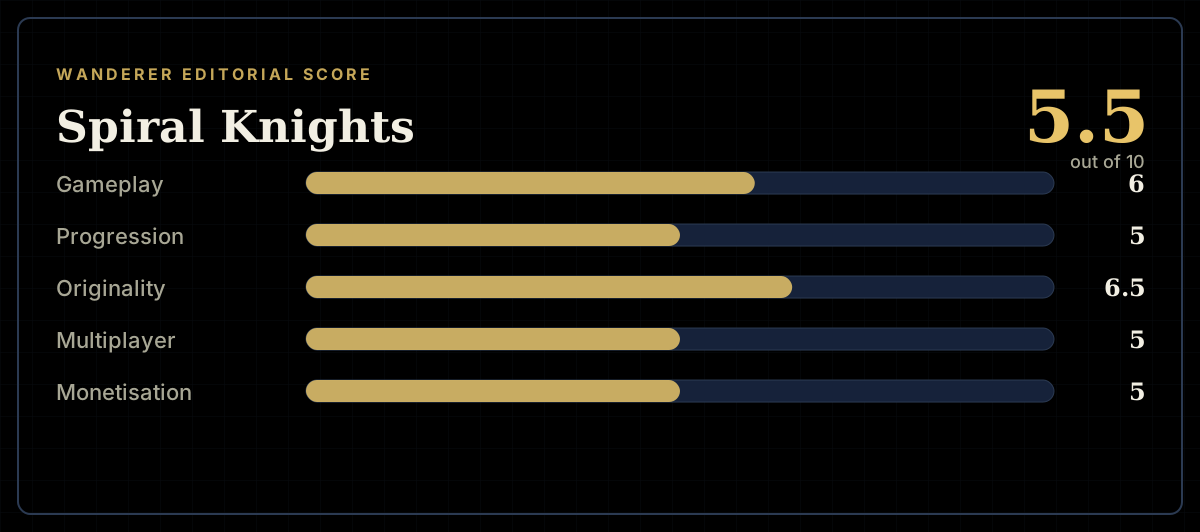
How the review scores each part of the gameWanderer Editorial -
The short versionWanderer Editorial