
Game review
SCUM
6 / 10
- Developer
- Gamepires
- Publisher
- Devolver Digital
- Released
- 29 August 2018
- Platforms
- Windows
- Genre
- Open-world survival
- Monetisation
- One-off purchase for the base game, plus a growing catalogue of cosmetic DLC packs released across its support life; a large and consistent share of the review sample specifically criticizes the volume and framing of this DLC relative to unresolved core bugs
- Players
- Core to the design — official and community-hosted servers support large persistent populations, with a single-player mode also available and specifically praised, though several reviewers say it doesn't get as much developer attention as the multiplayer side
The short version
SCUM's core pitch remains genuinely distinctive nearly seven years on: an unusually granular body-simulation and metabolism system, real character customization tied to what you actually eat and how your body responds, layered under standard open-world survival scavenging and PvP. Reviewers who've stuck with it, some for well over a thousand hours, describe it as scratching a "survival itch" nothing else quite matches. Set against that is an unusually consistent, unusually well-corroborated set of complaints from those same experienced players: specific, long-standing bugs — items and entire bodies vanishing on death, base pieces failing to align, hostile NPCs spawning directly on top of players — that multiple independent reviewers say have persisted since as early as 2021 without a fix, alongside a steady, heavily-criticized stream of cosmetic DLC that a large share of the sample frames as prioritized over actually fixing those bugs. One detailed reviewer's account is representative of a real, recurring shape across many others: "the game I bought and the game I own right now are completely different games... it is generally a much worse game." None of this erases the real, distinctive systems underneath — it just means the honest recommendation depends heavily on whether a reader trusts a still-active, still-selling DLC catalogue to eventually catch up with the bug list its own longtime fans keep repeating.
Biggest strengths
- An unusually detailed, genuinely distinctive body-simulation and metabolism system that gives survival mechanics real depth beyond typical hunger-and-thirst meters
- A dedicated base of veteran players, some with well over a thousand hours logged, still actively return to it, describing it as uniquely able to scratch a specific survival-genre itch
- A real single-player mode with adjustable metabolism settings exists for players who want the systems without full multiplayer stakes, though it draws requests for more attention
Biggest weaknesses
- Multiple independent, high-playtime reviewers report the same specific, long-standing bugs — items and bodies disappearing on death, base pieces failing to grid-snap, hostile NPCs spawning on top of players — persisting since as early as 2021 without resolution
- A large, consistent share of the review sample frames the game's DLC strategy as prioritized over fixing these core issues, with phrases like "cash grab" and comparisons to Sims 4-style cosmetic packs recurring across many independent reviews
- A specific, serious complaint that the game has diverged substantially from its original Early Access roadmap, with at least one detailed reviewer stating plainly that "the game I bought and the game I own right now are completely different games"
Who it's for: Survival-genre veterans specifically drawn to unusually detailed body-simulation mechanics who can tolerate real, longstanding bugs and a heavy cosmetic-DLC presence. Less suited to anyone expecting a fully stable, polished experience matching what the game's own early Early Access roadmap promised, or players sensitive to aggressive monetisation alongside unresolved core issues.
Our recommendation: Worth it for genre veterans specifically chasing its unique body-simulation hook, bought with clear eyes about a long list of persistent, well-documented bugs and a DLC strategy a large share of the game's own longtime fans actively resent.
6 / 10
SCUM drops players onto a hostile island as convicted prisoners fitted with a tracking implant, forced to scavenge, hunt, build, and fight to survive against wildlife, hostile NPCs, and each other. What set it apart from the wave of open-world survival games it launched alongside in August 2018 was an unusually granular body-simulation system — real character stats tied to metabolism, nutrition, and physical condition rather than abstract meters — layered under standard crafting and PvP survival mechanics. Nearly seven years later, having reached 1.0 in June 2025, it carries a Mostly Positive 73.9% across 38,040 English reviews. That's a real, substantial audience, and reading through its review sample surfaces both what's kept that audience engaged and a specific, unusually well-corroborated set of complaints from the players who've stuck around longest.
A body-simulation hook that still stands out
The system that made SCUM distinctive at launch still earns real, specific praise. One reviewer frames the appeal directly: "if you enjoy games with deep and immersive survival mechanics and don't mind dying multiple times and losing all the loot you were carrying, this game is perfect for you. The body simulation system is extremely complex and certainly won't appeal to everyone." Another reviewer, despite acknowledging real flaws elsewhere, keeps coming back specifically for this depth: "Is it old? Yes. Is it buggy? Absolutely. Do I keep coming back every time I need my survival itch scratched? Without hesitation. Learning how the crazy detailed mechanics in this game work is fun." That's a genuinely rare kind of endorsement — reviewers naming the exact same specific system as both the reason to tolerate everything else and the reason the game remains worth playing at all.
Bugs its most invested players say never got fixed
Set against that is an unusually consistent, specific, and credible thread of bug reports, made more notable by the playtimes behind them. One reviewer with roughly 1,459 hours logged states plainly: "There is a LOT of bugs that have been there for a couple of years such as; trees and shrubbery regrow through your base, Puppets (and now armed NPCs) that respawn on top of you, base building elements don't grid snap together. When you get killed your bo[dy]..." — cut off, but clearly continuing the same body-disappearance complaint raised independently by a separate reviewer with over 1,000 hours: "Sometimes when you die you cannot recover your body. It just isn't there." Two independent, extremely high-playtime reviewers describing the same specific, named bugs is strong enough convergence to treat as an accurate, current account of the shipped game rather than outdated complaints from early access years ago — both were posted well after the game's 2025 1.0 release.
A monetisation pattern its own fans keep naming the same way
The single most repeated criticism in the entire sample concerns DLC. One reviewer sums up the sentiment shared across dozens of others: "From beautiful and immersive game it has become a metabolism and cooking simulator attached to a dlc selling platform." Another, more pointed: "Stop adding trash updates dlc's and useless stuff that lag the game... JUST FIX THE GAME!" A third compares the pattern directly to a well-known cosmetic-DLC model: "SCUM become Scumy to players, the Sims 4 DLCs... they dont realy seem to care to improve the own survival game." This isn't one or two outlier complaints — it's the dominant framing across a large share of the critical review sample, all converging on the same specific claim: paid cosmetic content keeps shipping while the bug list above stays open.
A serious claim about broken promises
One detailed, widely-read review makes a claim worth stating plainly because of how specific and falsifiable it is: "The game I bought and the game I own right now are completely different games. The game I have right now does not even follow the roadmap of the game I purchased, and it is generally a much worse game." This review can't independently verify every specific roadmap item referenced, but the sentiment is echoed closely enough by other reviewers describing years of feature drift and unmet expectations that it's worth reporting as a real, widely-shared grievance among the game's own long-term Early Access backers, distinct from ordinary "this game has bugs" feedback.
What the numbers say about ongoing engagement
Global achievement data shows the core loop still holds real attention despite everything above: completion tapers gradually from 84.7% for reaching the island down through the 25-35% range for surviving multiple days and reaching early reputation milestones — a smooth, healthy curve rather than an early wall, consistent with a genuinely large population of players still actively engaging with the survival loop regardless of the frustrations documented above.
Verdict
SCUM's body-simulation hook remains genuinely distinctive, and a real, substantial community of deeply invested players — some with well over a thousand hours logged — continues to find real value in its systems. That same community is also the source of the sharpest, most specific, and most consistent complaints in this review: long-standing, named bugs that outlived the jump to 1.0, and a DLC strategy a large share of its own fans describe as prioritized over fixing them. Both things are true at once, verified by the same high-playtime reviewers making both claims. Buy it for the survival systems specifically, with clear eyes about a bug list and monetisation pattern its most dedicated players have been documenting for years.
Sources: Steam store page and appdetails API (release date, pricing, platform data, the raw HTML "Early Access Release Date" field); Steam's aggregate review data (query_summary totals, English-language sample); individually read user reviews, both positive and negative, sorted by helpfulness and recency, with attention to reviewer playtime as a credibility signal; Steam's global achievement statistics API.
Pros and cons
Pros
- An unusually detailed, genuinely distinctive body-simulation and metabolism system that gives survival mechanics real depth beyond typical hunger-and-thirst meters
- A dedicated base of veteran players, some with well over a thousand hours logged, still actively return to it, describing it as uniquely able to scratch a specific survival-genre itch
- A real single-player mode with adjustable metabolism settings exists for players who want the systems without full multiplayer stakes, though it draws requests for more attention
- Large, explorable open-world scope with real scavenging, crafting, and base-building depth once its systems are learned
- Achievement data shows a healthy, gradual engagement curve rather than an early wall, evidence the core survival loop holds real attention for a meaningful share of buyers
Cons
- Multiple independent, high-playtime reviewers report the same specific, long-standing bugs — items and bodies disappearing on death, base pieces failing to grid-snap, hostile NPCs spawning on top of players — persisting since as early as 2021 without resolution
- A large, consistent share of the review sample frames the game's DLC strategy as prioritized over fixing these core issues, with phrases like "cash grab" and comparisons to Sims 4-style cosmetic packs recurring across many independent reviews
- A specific, serious complaint that the game has diverged substantially from its original Early Access roadmap, with at least one detailed reviewer stating plainly that "the game I bought and the game I own right now are completely different games"
- PvP-focused servers draw complaints about being killed by highly experienced, well-equipped players from extreme range with little counterplay for newcomers
- Reports of cheating and unmoderated server populations appear across multiple reviews, compounding frustration with the unresolved bug list rather than existing independently of it
Screenshots
-

SCUMImage: Gamepires via Steam -

SCUMImage: Gamepires via Steam -

SCUMImage: Gamepires via Steam -
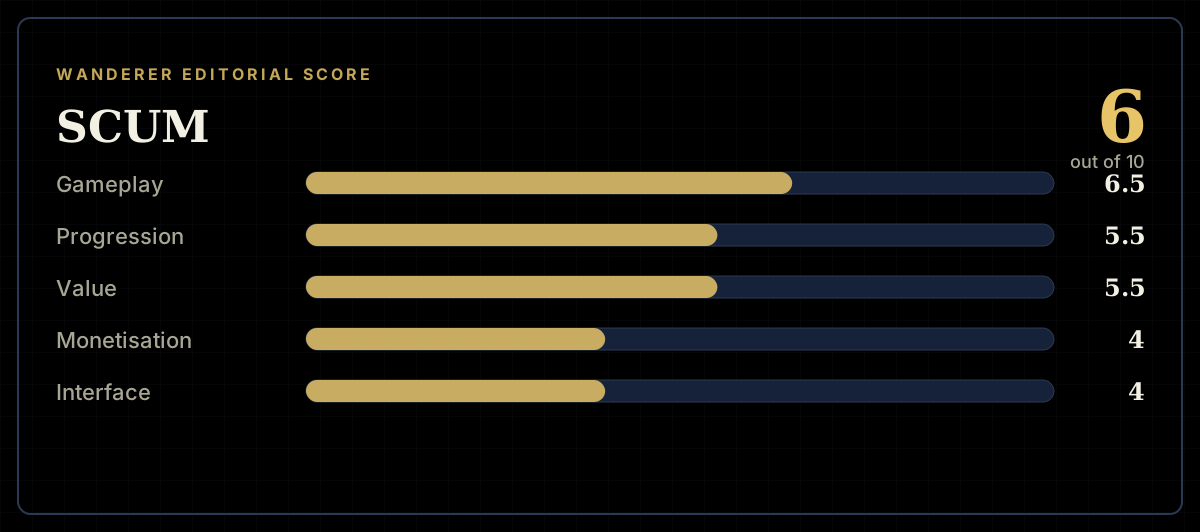
How the review scores each part of the gameWanderer Editorial -
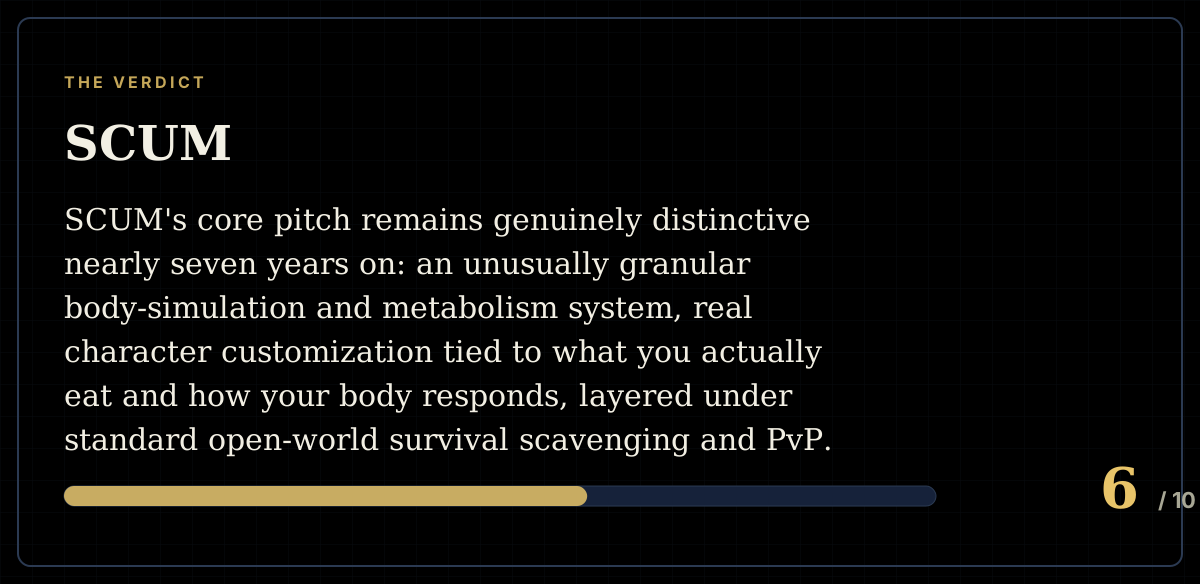
The short versionWanderer Editorial