
Game review
ROGUE FLIGHT
6 / 10
- Developer
- Truant Pixel, LLC
- Publisher
- Perp Games
- Released
- 24 October 2024
- Platforms
- Windows, Steam Deck
- Genre
- On-rails arcade space shooter
- Monetisation
- One-time purchase, no in-game store or additional currency purchases
- Players
- Single-player only
The short version
ROGUE FLIGHT puts you in the cockpit of a starfighter for an on-rails arcade shooter styled after the space opera anime and Super Scaler arcade games of the 80s and 90s, drawing heavy and intentional comparisons to Star Fox at every turn. This review's sample shows near-universal admiration for the presentation — the art direction, voice acting, and soundtrack draw consistent, specific praise across nearly every review. What tempers that admiration, repeated by a substantial portion of the sample, is a complaint about substance: the campaign is short, its multiple required playthroughs recycle much of the same level content, and its roguelite-adjacent marketing implies more meaningful randomization and progression than the actual, largely fixed structure delivers.
Biggest strengths
- The art direction, presentation, and overall 80s/90s space opera anime aesthetic draw near-universal, specific praise, with reviewers repeatedly describing the visual and tonal execution as immaculate
- The voice acting and soundtrack earn consistent, enthusiastic credit, with multiple reviewers specifically praising the rock and J-pop-inspired score as a standout element
- The ship customization and weapon-specialization systems add a real layer of build variety within individual playthroughs, even as reviewers note the overall content pool is limited
Biggest weaknesses
- A widely repeated complaint concerns overall content variety, with multiple reviewers describing a limited enemy roster and level design that repeats across the multiple playthroughs the story's branching endings require
- Several reviewers argue the game's roguelite and Star Fox-inspired marketing oversells its actual structure, describing the experience as considerably more linear and fixed than the framing implies, with one reviewer specifically saying they felt "cheated" by the mismatch between expectation and delivery
- The campaign is consistently described as short, with most reviewers reporting full completion including multiple required playthroughs in around four to five hours total
Who it's for: Fans of Star Fox and classic Sega Super Scaler arcade shooters looking for a short, stylish, anime-inspired throwback experience, who value atmosphere and presentation over long-term mechanical depth or variety.
Our recommendation: A gorgeous, well-crafted style-first shooter well worth its price for genre fans who go in expecting a short, focused experience rather than a deep roguelite — try the demo first, since reviewers note it accurately represents the entire game.
6 / 10
ROGUE FLIGHT sets out to recreate a very specific feeling: the space opera anime and Sega Super Scaler arcade games of the late 70s through early 90s, delivered as an on-rails shooter clearly and openly indebted to Star Fox. This review's sample shows that ambition landing with real force on the presentation side, and lands with equal specificity on where the game underneath that presentation runs thinner than its marketing implies.
A style that nearly everyone agrees on
The praise for how ROGUE FLIGHT looks, sounds, and feels is remarkably consistent across the entire sample. "ROGUE FLIGHT absolutely OOZES charm and mid-90s nostalgia from every corner. With poppy visuals and responsive controls that manages to keep everything readable and in your hands even in the most enemy saturated segments," one reviewer writes. Another distills the pitch memorably: "If Starfox and Ace Combat had an anime baby... Very good throwback to classic rail shooter/Shoot 'em up. A good amount of customization and unlocks, a great soundtrack and awesome visuals." A third, even in an otherwise cautious review, admits the atmosphere works: "The vibes of this on-rails anime shooter are fantastic. The 90's VHS aesthetic, the prestige anime art style, the rock and j-pop music, the genre and science references, the VA direction -- they all make me smile."
The complaint about what's actually underneath the style
Set against that shared admiration, a substantial portion of this review's sample describes real disappointment once the presentation gives way to repeated play. "Flashy presentation but very shallow gameplay and uninteresting enemies. You'll experience all of the game's mechan[ics within the first hour and see little new after that]," one reviewer writes. Another describes the specific mismatch between expectation and delivery directly: "I expected a StarFox-like game with roguelike mechanics (you know, from the name), routes to choose, meaningful decisions to make, randomized equipment, and proper progression after dying." That reviewer goes on to describe feeling "cheated" once the actual, more fixed structure became clear. A third reviewer sums up the pattern bluntly: "If you play the demo you've seen the entire game. Boring story with zero twists and levels that loop the same 5 enemies at you for way too long."
A specific, useful piece of buyer guidance
What's genuinely valuable about this review's sample is how many reviewers, on both sides of the recommendation divide, converge on the same practical advice. "TL;DR: Try the demo. It's as good as it looks," one reviewer writes, treating that recommendation as sufficient context on its own. Another independently confirms the same point: "If you play the demo you've seen the entire game," intending it as a warning rather than an endorsement. That agreement across otherwise differing overall verdicts is itself useful — the demo appears to be a genuinely representative sample of the full experience, meaning prospective buyers have an unusually reliable way to judge for themselves before purchasing.
The short runtime, contextualized fairly
Several reviewers who ultimately recommend the game frame its brevity as a deliberate, acceptable trade-off rather than a flaw. "The vibes are immaculate and the Arrow felt great to control. Even though I must have done a couple hundred drift combos in the four-hour campaign, it felt sick as hell to do every time. This was a great rail shooter and I recommend it. I like that it was short. Not every game ne[eds to overstay its welcome]," one reviewer writes. Another lays out the actual structure precisely: "This game is short. The full story is experienced across 4 playthroughs. The first two are about 4 missions each, the last two are about 7 missions each. But those are not all unique" missions, describing meaningful content overlap across the required replays. That specificity is useful context — the short runtime isn't in dispute, only whether the multiple-playthrough structure required to see the full story adds genuine value or just repeats content to pad length.
A specific, documented bug
Beyond the broader content debate, at least one reviewer reports a concrete, reproducible technical problem: "Got stuck on that Manufacturing (mini?) boss. 4 complete playthrough's of that level to see if it was something I was doing wrong. In the end I just got stuck fighting and endless wave of 4 mini enemy's forever." That's a specific, actionable warning distinct from general difficulty complaints, worth flagging directly for anyone who encounters the same encounter.
What the achievement data confirms about the completion curve
Steam's own figures show a game that's broadly accessible early on, with steep depth reserved for full completionists. An early combo milestone sits at 94.0%, and even the first story level clears at a healthy 80.1%. The steepest drop comes at platinum-equivalent full completion, at just 3.9% — consistent with reviewer reports that seeing every ending and unlocking every mode requires real dedication to the multiple-playthrough structure, even if the core campaign itself is short and largely accessible.
Solid, ongoing developer support
This review found real evidence of continued investment beyond launch. ROGUE FLIGHT's partner-events feed documents a public beta patch branch, two numbered content updates, mouse and keyboard support added specifically in response to player requests, and Steam Deck compatibility confirmed after launch — a solid, responsive support record for a smaller studio's stylish niche title.
Final verdict
ROGUE FLIGHT delivers a genuinely gorgeous, lovingly crafted tribute to a specific era of arcade space combat and anime style, earning near-universal praise for its presentation alone. Its content variety and roguelite-adjacent marketing don't fully match the shorter, more linear experience reviewers consistently describe underneath that style — but with an accurate, representative demo available and a fair, modest runtime expectation set going in, this remains a worthwhile, stylish pickup for genre fans.
Pros and cons
Pros
- The art direction, presentation, and overall 80s/90s space opera anime aesthetic draw near-universal, specific praise, with reviewers repeatedly describing the visual and tonal execution as immaculate
- The voice acting and soundtrack earn consistent, enthusiastic credit, with multiple reviewers specifically praising the rock and J-pop-inspired score as a standout element
- The ship customization and weapon-specialization systems add a real layer of build variety within individual playthroughs, even as reviewers note the overall content pool is limited
- Steam's own partner-events feed documents solid, responsive post-launch support, including a public beta patch branch, mouse and keyboard support added after launch, and Steam Deck compatibility
- The game is confirmed by multiple reviewers to be accurately represented by its free public demo, meaning prospective buyers can make a fully informed purchase decision before committing
Cons
- A widely repeated complaint concerns overall content variety, with multiple reviewers describing a limited enemy roster and level design that repeats across the multiple playthroughs the story's branching endings require
- Several reviewers argue the game's roguelite and Star Fox-inspired marketing oversells its actual structure, describing the experience as considerably more linear and fixed than the framing implies, with one reviewer specifically saying they felt "cheated" by the mismatch between expectation and delivery
- The campaign is consistently described as short, with most reviewers reporting full completion including multiple required playthroughs in around four to five hours total
- At least one reviewer documents a specific, reproducible bug at a boss encounter that trapped them in an endless wave of minor enemies across four separate attempts
- At least one reviewer reports the absence of windowed-mode display support as a specific, dealbreaking technical gap
Screenshots
-

ROGUE FLIGHTImage: Perp Games via Steam -

ROGUE FLIGHTImage: Perp Games via Steam -

ROGUE FLIGHTImage: Perp Games via Steam -
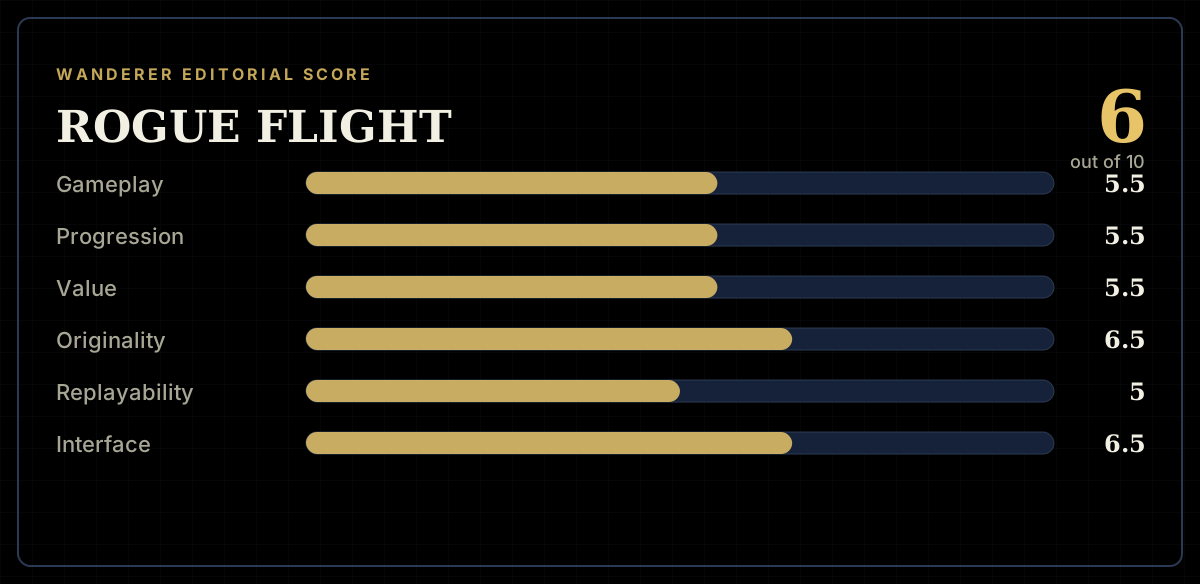
How the review scores each part of the gameWanderer Editorial -
The short versionWanderer Editorial