
Game review
Rocky Idle
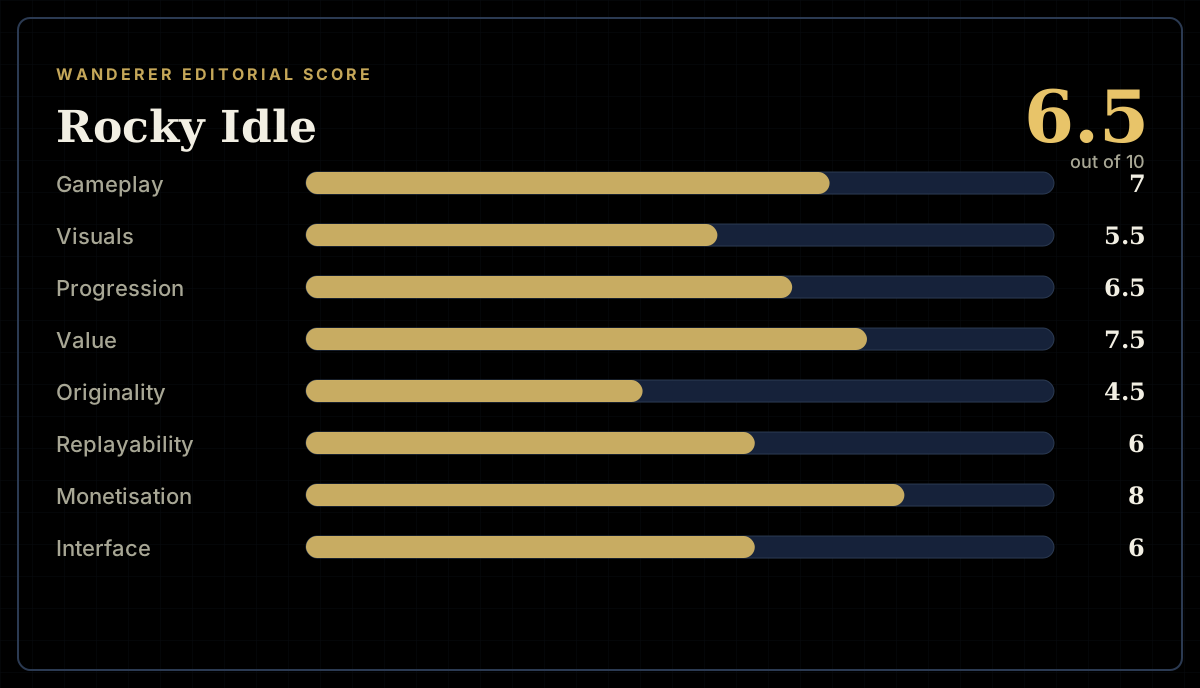
6.5 / 10
- Developer
- Rocky Games Studio
- Publisher
- Rocky Games Studio
- Released
- 26 March 2026
- Platforms
- Windows
- Genre
- Idle RPG
- Monetisation
- Premium, one-time purchase
- Players
- Single-player
The short version
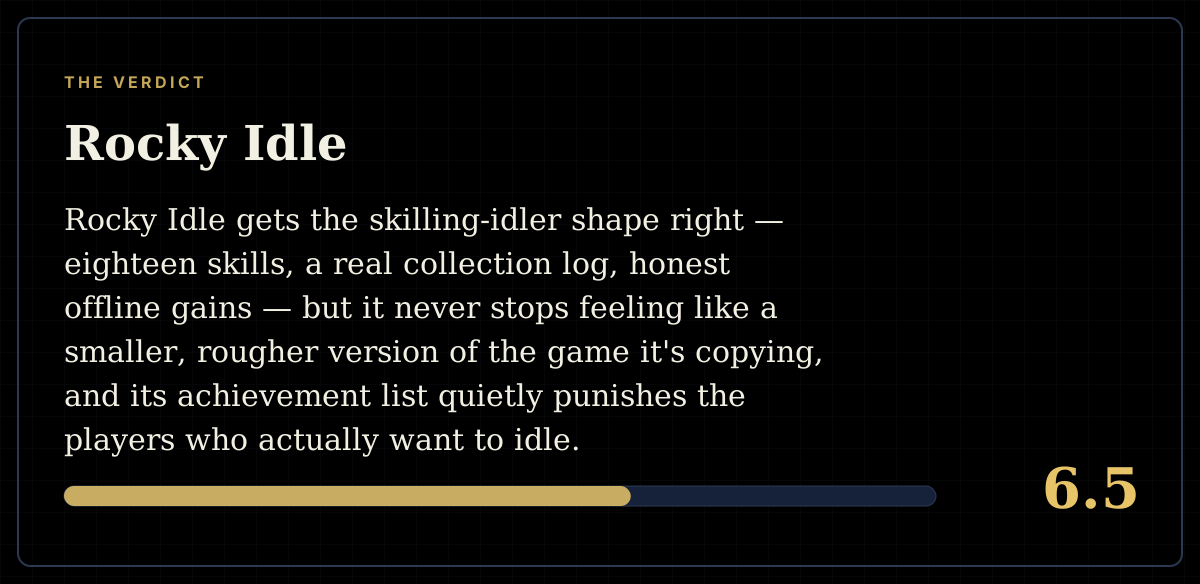
Rocky Idle gets the skilling-idler shape right — eighteen skills, a real collection log, honest offline gains — but it never stops feeling like a smaller, rougher version of the game it's copying, and its achievement list quietly punishes the players who actually want to idle.
Biggest strengths
- Eighteen separate skills give Mining, Woodcutting and Farming their own crafting payoff instead of feeding one shared resource pool
- Contracts and the collection log give late-game skilling actual direction instead of just watching a number climb
- Cross-progression between the Steam build and the free browser version means a wiped PC or a lapsed machine doesn't cost you your save
Biggest weaknesses
- The achievement list leans so heavily on the ten-minute active boost that players who genuinely want to walk away feel penalised for doing exactly that
- Community sentiment consistently frames it as a smaller, less confident retread of Melvor Idle rather than its own thing
- The developer's disclosed use of AI-generated art, brought in after the original artist left the project, is a visible step down in presentational consistency
Who it's for: Players who've burned through Melvor Idle and want more of the same loop for less money, and anyone who wants a skilling game they can leave running in a browser tab as easily as on Steam.
Our recommendation: Worth the asking price if you know exactly what you're buying. Not the genre's best entry point.
6.5 / 10
A first game that never quite steps out of Melvor's shadow
Rocky Idle wants to be judged as its own game, and on paper it has the parts to earn that: eighteen skills, a collection log worth chasing, crafting chains that actually connect Mining to Smithing to combat, and a farming loop that ticks along in the background whether or not you're watching. It's the debut release from Rocky Games Studio, built over roughly two and a half years, and it launched on Steam in March 2026 with a companion browser version that shares your save through a linked Google account. That last part is genuinely good design — a lapsed Steam install or a borrowed laptop doesn't have to mean starting over.
The problem is that almost every mechanic here invites the same comparison, and the comparison isn't kind. Melvor Idle already proved this exact formula — click a skill, gather, craft, automate combat, fill a log — can carry hundreds of hours of engagement with real depth underneath the simplicity. Rocky Idle runs the same play without yet finding its own voice, and the Steam community has said so bluntly and repeatedly. It's a fair review target precisely because it's honest about what it's chasing; the question is whether it chases well enough to be worth ten dollars of anyone's time who already owns the genre leader.
The skilling loop, and the boost problem
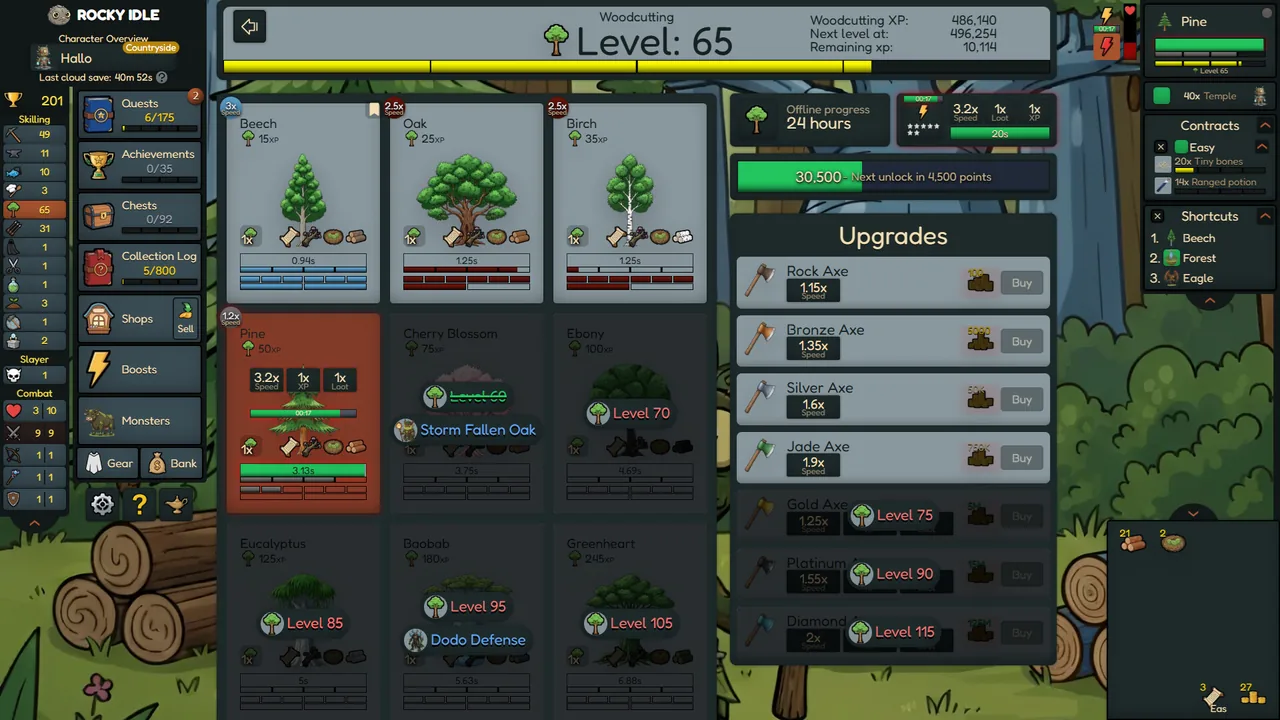
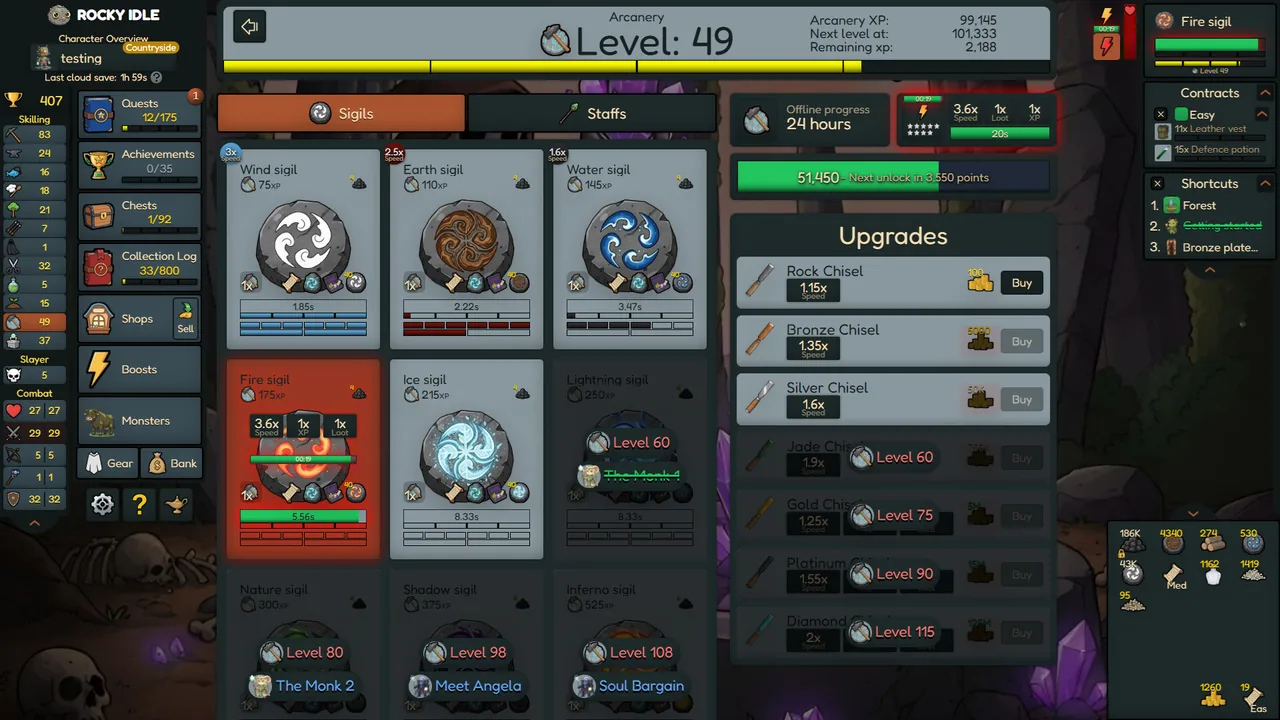
The core loop is familiar to anyone who has played a RuneScape-adjacent idler: pick a skill, start an action, watch experience and materials accumulate, spend the output somewhere else in the web of systems. Mining feeds Smithing, Woodcutting feeds Crafting and Fletching-style gear lines, Farming runs a slower background timer for potion ingredients, and combat consumes everything downstream of it in the form of gear, food and potions. Contracts — rare drops tied to specific skilling tasks — give the mid-game a sense of directed goals instead of pure number-watching, and the collection log gives the same treatment to combat drops. Structurally, none of this is a bad idea. It's the same skeleton that makes the genre work.
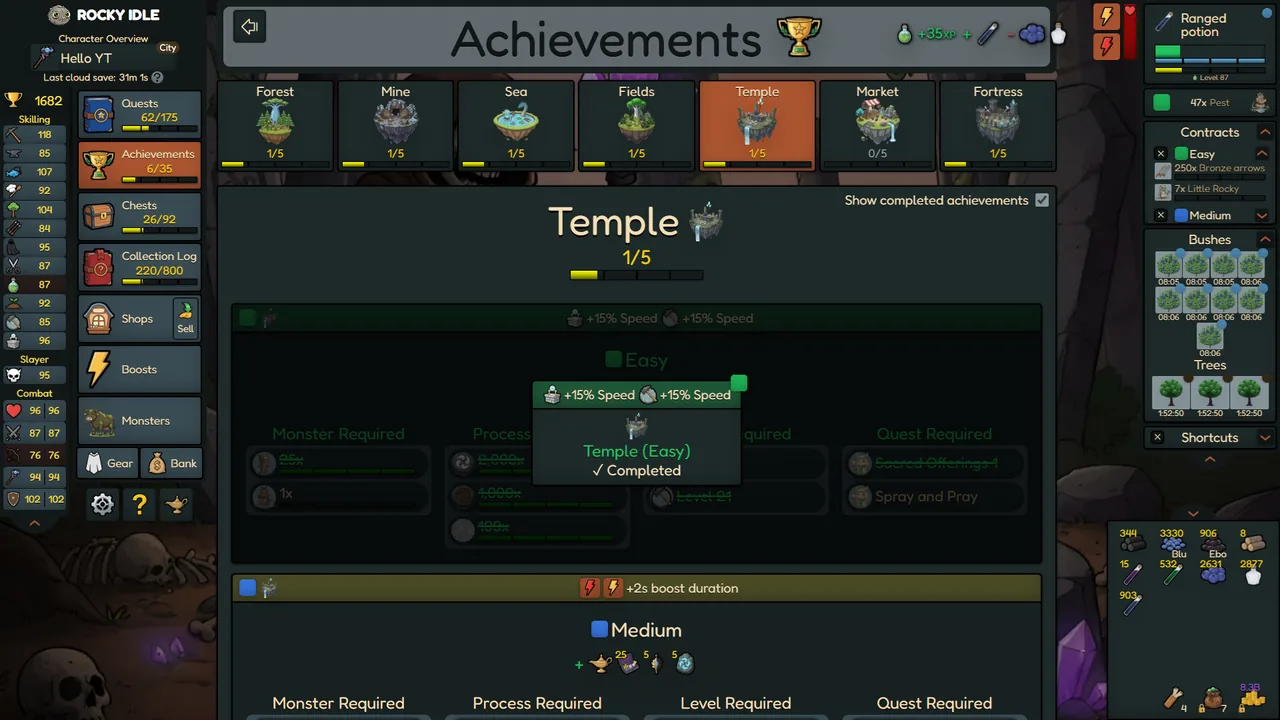
Where Rocky Idle diverges from "idle" in the way players actually mean it is the active boost: a manually-triggered buff, usable once every ten minutes, that grows stronger the further you progress. It's a clever enough hook for a game that wants players checking in rather than fully disengaging, and reviewers have noted it makes otherwise mindless actions like mining slightly more active and engaging. The trouble is what the game then does with it. A meaningful share of the achievement list is built around boost usage and boost strength, which means the players most drawn to an idle game — the ones who want to start an action and leave — are the ones locked out of a chunk of the completion list unless they change how they play. One of the more pointed pieces of community feedback put it plainly: the developer clearly wants active play rewarded in a genre whose whole pitch is that you don't have to be there. That's a real design tension, not a nitpick, and it's the single biggest thing standing between Rocky Idle and feeling coherent.
Presentation, and the AI-art disclosure
Visually, Rocky Idle sits well below the genre's better-dressed entries, and the reason is unusually transparent: the developer has stated that the original artist departed partway through development and that AI-generated artwork was used to fill the gap, both in the game itself and in community-facing assets. Disclosing that is the right call, and it doesn't automatically sink a budget idle game where the interface matters more than the illustration. But it does show. Player feedback has picked up on the art directly, and it's a visible step down in consistency next to a game like Melvor Idle, where the presentation — however simple — was built with one coherent hand throughout. For a genre where most of your screen time is spent looking at menus, progress bars and icon grids rather than character art, this matters less than it would in a full RPG, but it's not nothing either, and it's part of why "cheaper and rougher" is the fairest short description of the whole package.
The interface itself has been a moving target since launch. The developer has shipped UI-focused patches addressing player feedback and has added a low-performance display option aimed at weaker or mobile-class hardware, both signs of a studio actually listening to its Discord and Steam communities. Some of those same UI passes have drawn complaints about the new layout feeling sluggish, which is the normal cost of iterating on an interface in public rather than getting it right before launch. Neither state is disqualifying, but it means the interface isn't a finished product yet in the way the rest of the systems already are.
Value and monetisation
This is where Rocky Idle earns back a lot of the ground it loses elsewhere. Ten dollars, one purchase, no premium currency, no energy system gating your session length, no battle pass and nothing on the storefront suggesting a cosmetic shop bolted on later. Steam Achievements are the only progression-adjacent system tied to anything resembling a completionist push, and cloud saves work across the Windows build and the browser version without an extra fee. For a first game from a small studio, that's a genuinely respectable monetisation stance, and it's worth crediting directly — plenty of bigger, better-funded idle releases this year have been far less honest about where the money goes.
Whether that price is good value depends entirely on what you already own. Against Melvor Idle's deeper systems and years of accumulated content, Rocky Idle reads as the budget option — competent, functional, occasionally clever, but consistently the second-best version of every idea it borrows. Against nothing — a player who hasn't touched this genre before — it's a perfectly serviceable entry point at a fair price, with offline progression that behaves honestly and a return-summary screen that tells you exactly what you missed rather than hiding the number behind a vague "welcome back" banner.
Final verdict
Rocky Idle is a competent first swing that never fully escapes the shadow of the game it's most often measured against. The skill spread is broad, the collection log gives it teeth, and the cross-platform save is a smart, player-first decision that costs the developer nothing to maintain goodwill on. But an achievement list built around forcing active check-ins undercuts the genre's core promise, the AI-assisted art is a visible dip in polish, and the interface is still being patched in response to real-time community complaints rather than arriving finished. At $9.99 it's hard to call a bad purchase, and skilling fans who've exhausted their current game will find enough here to justify the price of admission. It's just not the version of this loop you should start with if you haven't played one before — and it's not, yet, a rival to the game everyone will inevitably compare it to.
Players who like watching skills tick upward while they're away from the keyboard, and who want that progression to keep running without demanding constant attention, may also want to look at Wanderer, which builds its own world around the same idea without asking you to check back in every ten minutes.
Pros and cons
Pros
- Eighteen separate skills give Mining, Woodcutting and Farming their own crafting payoff instead of feeding one shared resource pool
- Contracts and the collection log give late-game skilling actual direction instead of just watching a number climb
- Cross-progression between the Steam build and the free browser version means a wiped PC or a lapsed machine doesn't cost you your save
- A single $9.99 purchase with no premium currency, energy paywall or IAP layer visible anywhere on the storefront
Cons
- The achievement list leans so heavily on the ten-minute active boost that players who genuinely want to walk away feel penalised for doing exactly that
- Community sentiment consistently frames it as a smaller, less confident retread of Melvor Idle rather than its own thing
- The developer's disclosed use of AI-generated art, brought in after the original artist left the project, is a visible step down in presentational consistency
- Recent UI overhauls have drawn "laggy" complaints from players, suggesting the interface is still being worked out in public
Screenshots
-
Rocky IdleImage: Rocky Games Studio via Steam -
Rocky IdleImage: Rocky Games Studio via Steam -
Rocky IdleImage: Rocky Games Studio via Steam -
How the review scores each part of the gameWanderer Editorial -
The short versionWanderer Editorial