Game review
Retro Gadgets
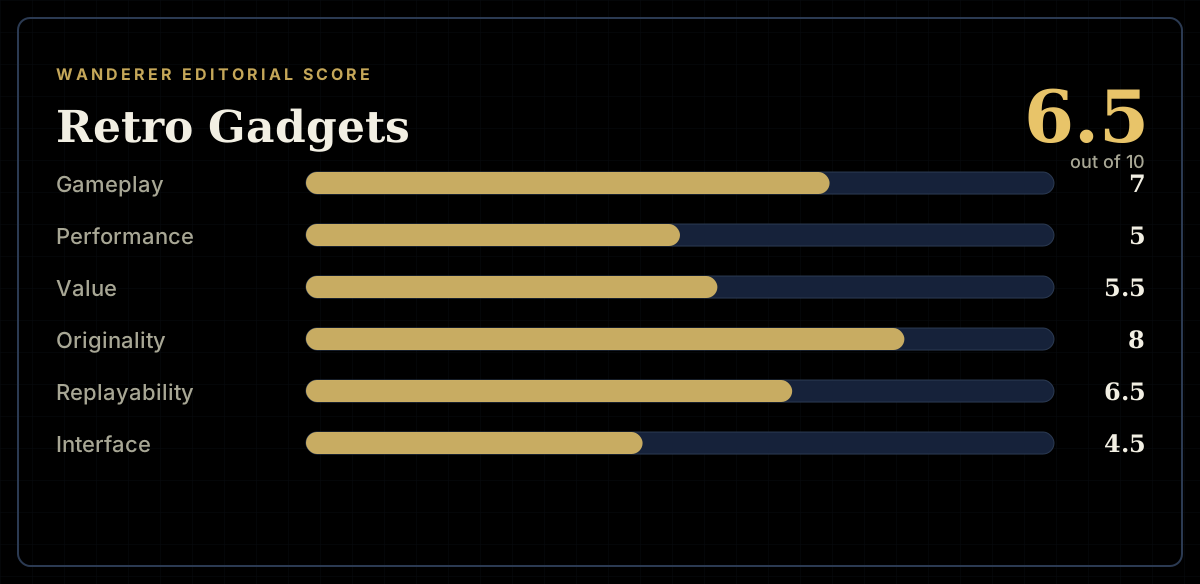
6.5 / 10
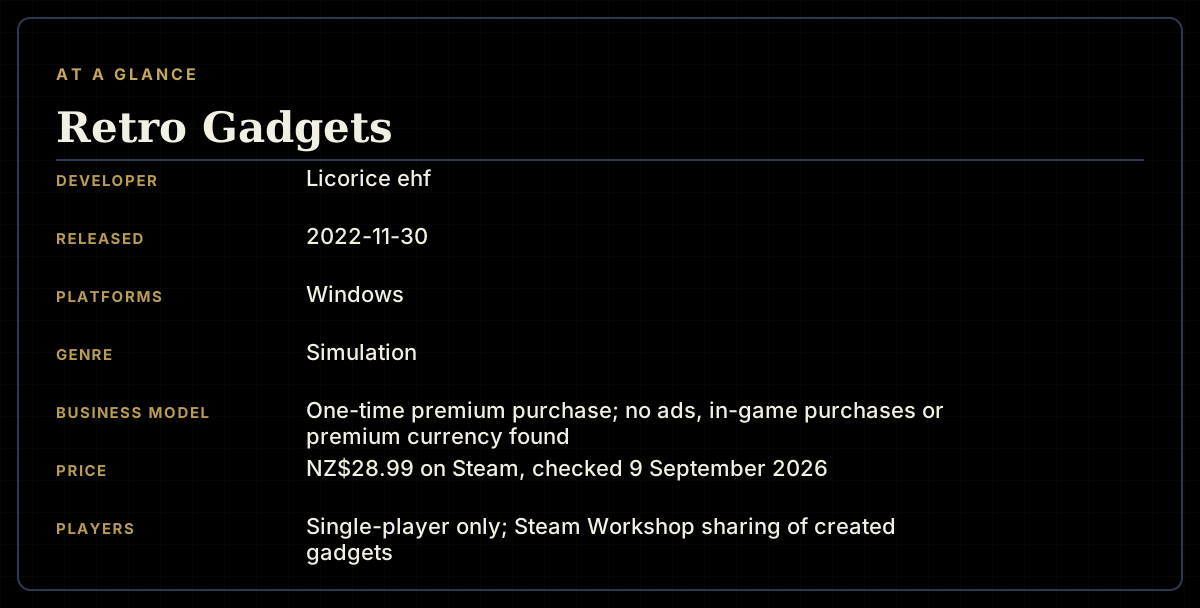
- Developer
- Licorice ehf
- Publisher
- Licorice ehf
- Released
- 30 November 2022
- Platforms
- Windows
- Genre
- Simulation
- Monetisation
- One-time premium purchase; no ads, in-game purchases or premium currency found
- Players
- Single-player only; Steam Workshop sharing of created gadgets
The short version
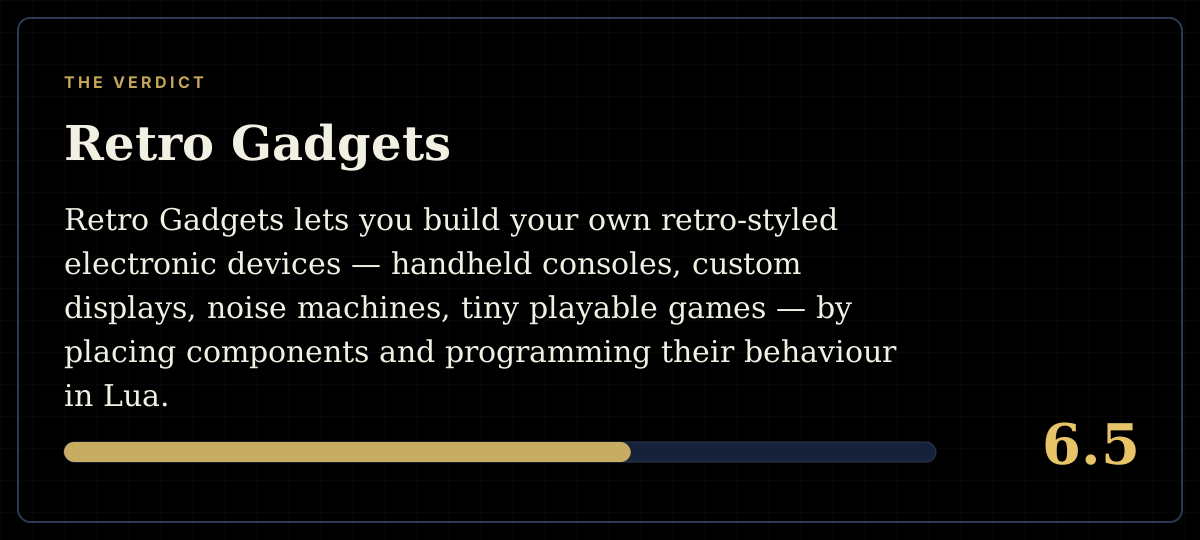
Retro Gadgets lets you build your own retro-styled electronic devices — handheld consoles, custom displays, noise machines, tiny playable games — by placing components and programming their behaviour in Lua. Reviewers who stick with it describe it as one of the most fulfilling programming-adjacent sandboxes they've played, several crediting it with genuinely teaching them to code from scratch, and Steam Workshop support means finished gadgets, and the ideas behind them, spread well beyond any one player's own project.
Getting to that payoff is the hard part. A large share of reviewers describe the learning curve as brutal, with thin in-game documentation and tutorials that don't go far enough for players without prior coding experience. On top of that, this game has had a genuinely uneven Early Access life: real, substantive support through 2022 and 2023, a real lull through most of 2024 that led some reviewers to describe the project as abandoned, and a subsequent return from April 2025 through the present with a major version update, a companion release, and continued monthly-ish patches as recently as August 2026.
Biggest strengths
- A genuinely inventive, hard-to-compare creative sandbox — building retro electronic gadgets and programming their behaviour in Lua — that reviewers who commit to it describe as uniquely fulfilling among coding-adjacent games
- Real teaching value: multiple reviewers describe going from zero programming knowledge to building working custom games and devices, with at least one saying it sparked broader interest in learning to code elsewhere
- Steam Workshop integration lets finished gadgets and their underlying code be shared, studied and built upon by other players, extending the game's creative ceiling well past any single player's own skill level
Biggest weaknesses
- A brutal learning curve for anyone without prior programming experience: multiple reviewers describe struggling to find adequate tutorials or documentation, with one bluntly warning that the game isn't accessible unless you're already comfortable scripting
- Real, specific stability problems are reported repeatedly: menus that freeze and can't be closed (with Alt+F4 sometimes not working either, forcing a Task Manager kill), and components getting stuck in a player's hand with no way to release them
- Component placement is criticised for imprecise, inconsistent grid-snapping that makes even simple physical assembly frustrating, and the "wiring" between components is entirely coded rather than physically connected, which some reviewers say undercuts the electronics-building fantasy
Who it's for: Programmers and programming-curious players who want a genuinely creative sandbox to build in, and who can tolerate or enjoy a real learning curve. Not for anyone wanting a polished, approachable creative toy without prior coding exposure, or who's put off by a game still technically in Early Access four years after launch.
Our recommendation: A genuinely rewarding sandbox for players willing to put in the work to learn it, with development now demonstrably active again after a real quiet period — worth checking the most recent patch notes before buying to confirm that trend has held.
6.5 / 10
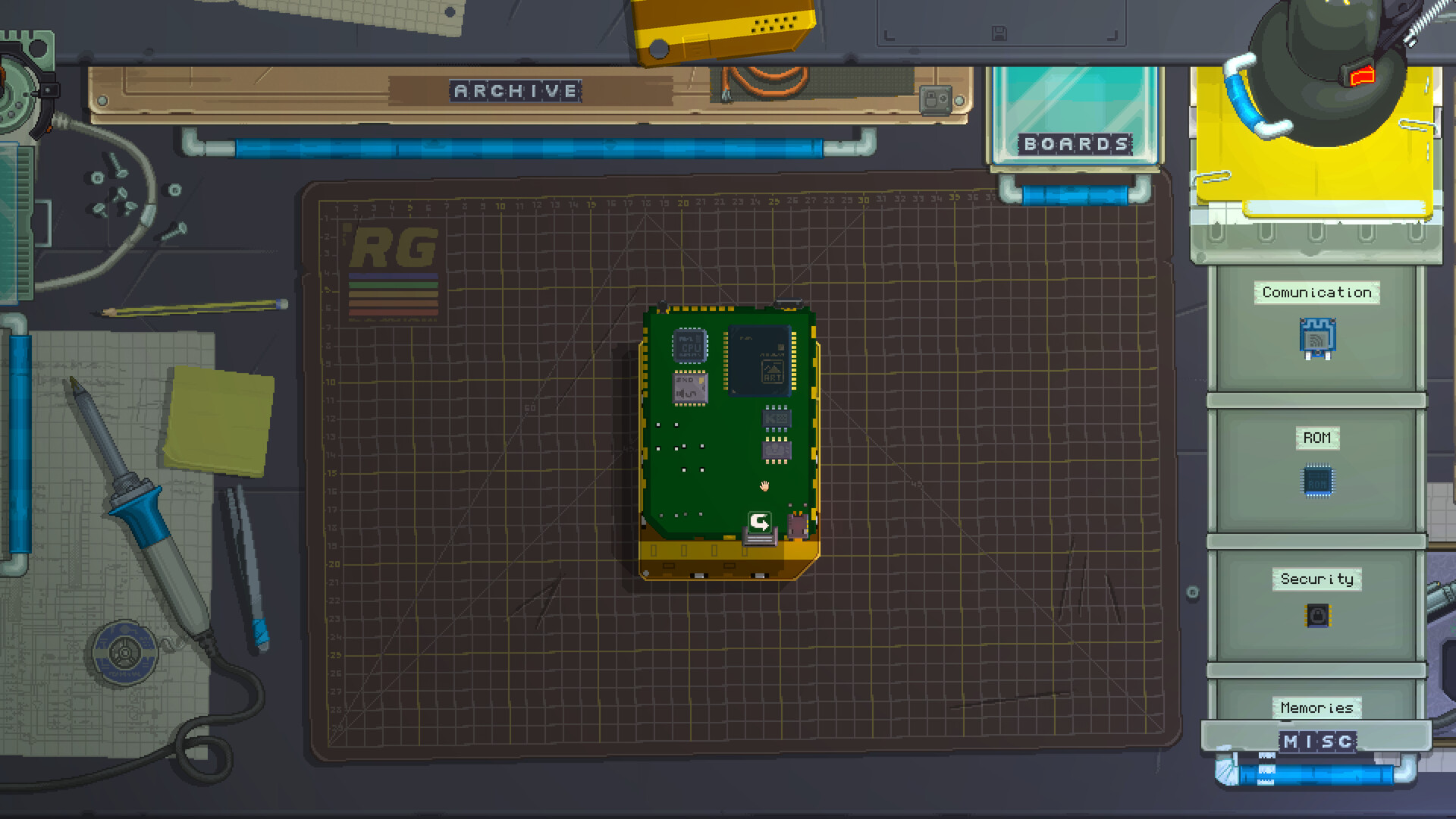
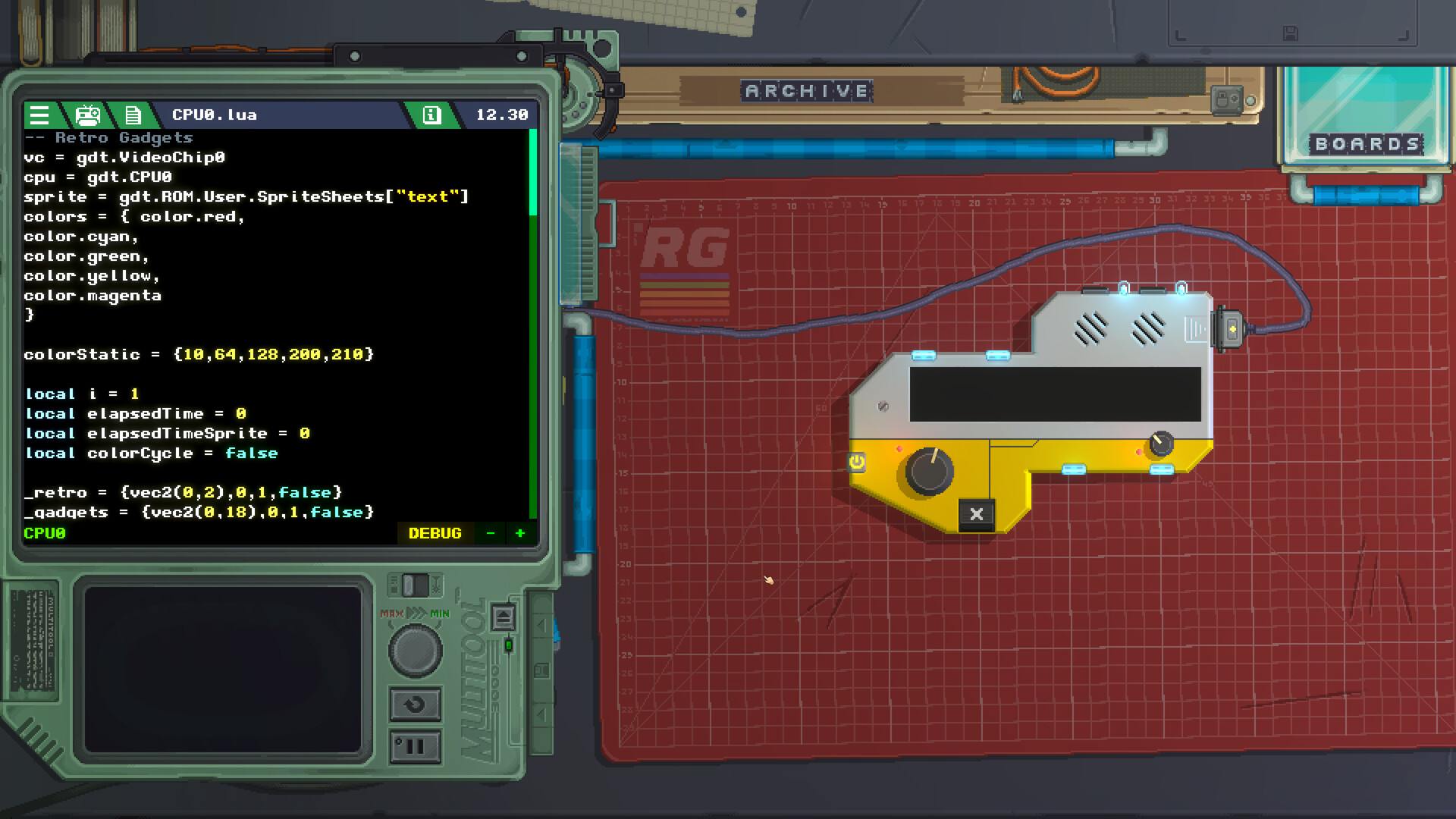
Retro Gadgets asks you to build your own electronic devices from scratch: place buttons, screens, speakers and sensors onto a small circuit board, then bring the whole thing to life by writing Lua code that reads inputs and drives outputs. The results reviewers describe building range from simple noise-making toys to fully playable handheld games, and Steam Workshop is full of finished projects other players can open up, study and remix. It's a genuinely distinctive idea — not quite a programming tutorial, not quite a hardware simulator, but something closer to both at once — and the reviewers who get past its front door describe real, lasting enthusiasm for what's inside.
A sandbox that genuinely teaches, if you can get in the door
The praise for Retro Gadgets is specific rather than generic "fun sandbox" enthusiasm. Multiple reviewers describe starting with zero programming knowledge and coming out the other side having built a working custom device — one details going from a basic cow-themed toy to picking up an external tool (Pico-8) to keep coding elsewhere, crediting Retro Gadgets directly with sparking that interest. Another reviewer, comparing it to several other games that incorporate coding, calls it the most fulfilling of the bunch specifically because the challenges of building something feel meaningfully close to the real constraints of working with actual hardware and I/O devices, even while some of the messier real-world friction is smoothed away. That's a strong endorsement from people who know the genre.
A genuinely brutal learning curve
Set against that praise is an equally consistent complaint: getting to the point where any of that enthusiasm kicks in takes real, unsupported effort. Reviewers describe thin in-game documentation, tutorials that don't go far enough for anyone without existing coding background, and a general sense of being dropped in with a powerful toolset and no map. One reviewer states it plainly: you need to already be comfortable scripting to have fun with this, which is a fair complaint about accessibility even from someone who otherwise loves the core idea. A separate, more specific complaint concerns the physical building layer: components don't snap to a clean, consistent grid, making even simple physical assembly fiddly, and connections between components are entirely code-driven rather than physically wired — a design choice at least one reviewer says undercuts the electronics-building fantasy the game is otherwise selling.
Real bugs, and a real quiet stretch
Beyond the learning curve, reviewers report genuine stability problems: menus that freeze and can't be closed through normal means, sometimes not even responding to Alt+F4 and requiring a Task Manager kill, and components that get stuck in a player's hand with no way to release them. These aren't universal — many reviewers report a stable, functional experience — but they recur often enough across independent reviews to be a real, documented issue rather than isolated bad luck. More seriously for a project's long-term trust, development genuinely stalled for roughly a year through 2024: reviewers from that period describe a roadmap that wasn't being delivered, and at least one claims Steam itself began showing a possible-abandonment warning on the store listing, a specific platform-level claim this review couldn't independently confirm by inspecting the current public page. One detailed review also names a second Early Access title from the same developer, Plasma, as part of a repeated pattern — this review independently confirmed Plasma exists and does list Licorice ehf as a co-developer, though couldn't verify that game's own development history to judge whether the pattern claim holds.
A real return, worth weighing against the lull
What makes this a fairer story than a simple abandonment would be the record since. Starting in April 2025, Retro Gadgets received a live developer update, a major "0.2" version release in October 2025 (adding new networking functions, a GIF recorder for Workshop uploads, and — directly relevant to the bug reports above — what the developer's own patch notes describe as "tons of crash fixes and stability improvements"), a companion release called Retro Gadgets Playground, and continued smaller updates running as recently as August 2026, including a post describing story mode development as "near." That's a substantial, real return to active work, not a token gesture, and it postdates most of the "abandoned, avoid" reviews this research turned up. Anyone weighing those older reviews against a purchase today should weigh them against this more recent record too.
Whether the price fits a still-unfinished product
At NZ$28.99, several reviewers explicitly question whether the game is worth the price for anyone who isn't already deeply invested in the coding-sandbox niche, with one bluntly suggesting it's mainly worth it for content creators or people who already own a large library of games rather than a casual buyer. That's a fair, proportionate complaint for a game that's still technically in Early Access nearly four years after launch, hasn't shipped the story mode still described as "near" as of August 2026, and demands real time investment before its central appeal becomes clear. It's worth weighing against the genuine creative and teaching value reviewers who push through report finding on the other side of that investment.
Where it lands (as of today)
Retro Gadgets is a genuinely inventive, well-regarded creative sandbox that rewards real investment with real depth — but that investment is steep, the game has had real stability problems, and it went through a documented, roughly year-long stretch where its own community reasonably worried it had been abandoned. A 6.5 credits both realities: a good idea, executed with real care when the developer is actively working on it, that asked more patience of its community than it probably should have during 2024, and has spent the time since trying to earn that patience back.
Pros and cons
Pros
- A genuinely inventive, hard-to-compare creative sandbox — building retro electronic gadgets and programming their behaviour in Lua — that reviewers who commit to it describe as uniquely fulfilling among coding-adjacent games
- Real teaching value: multiple reviewers describe going from zero programming knowledge to building working custom games and devices, with at least one saying it sparked broader interest in learning to code elsewhere
- Steam Workshop integration lets finished gadgets and their underlying code be shared, studied and built upon by other players, extending the game's creative ceiling well past any single player's own skill level
- Active, substantial development has resumed as of this review, with a major version update, a companion release, and continued patches running from April 2025 through August 2026
Cons
- A brutal learning curve for anyone without prior programming experience: multiple reviewers describe struggling to find adequate tutorials or documentation, with one bluntly warning that the game isn't accessible unless you're already comfortable scripting
- Real, specific stability problems are reported repeatedly: menus that freeze and can't be closed (with Alt+F4 sometimes not working either, forcing a Task Manager kill), and components getting stuck in a player's hand with no way to release them
- Component placement is criticised for imprecise, inconsistent grid-snapping that makes even simple physical assembly frustrating, and the "wiring" between components is entirely coded rather than physically connected, which some reviewers say undercuts the electronics-building fantasy
- Development stalled for roughly a year through 2024, with reviewers from that period describing the roadmap as undelivered and at least one reporting Steam had begun surfacing a possible-abandonment warning on the listing, a specific claim this review could not confirm on the current public store page
- One detailed reviewer names a second Early Access title from the same developer, Plasma (independently confirmed to share a developer credit), as an example of a similar pattern; this review could not verify that second game's own development history
Screenshots
-
Retro GadgetsImage: Licorice ehf via Steam -
Retro GadgetsImage: Licorice ehf via Steam -
Retro GadgetsImage: Licorice ehf via Steam -
How the review scores each part of the gameWanderer Editorial -
The specsWanderer Editorial -
The short versionWanderer Editorial