
Game review
Rainbow Legends Review
6.5 / 10
- Developer
- Unpixel Cloud Cedar Studio
- Publisher
- Light Up Games
- Released
- 6 May 2026
- Platforms
- ["Windows"]
- Genre
- Strategy
Slay the Spire Meets Territory Control
Rainbow Legends launched May 6, 2026, from developer Unpixel Cloud Cedar Studio under publisher Light Up Games, after nearly a year of demo builds, festival showcases, and a Steam Next Fest appearance. Its core pitch is a genuine mechanical hybrid: instead of the familiar attack-and-block card duel, combat plays out on a grid where cards paint tiles, and whichever side controls more territory at the end of a round deals the damage. One reviewer summed up the lineage cleanly: "A creature was made from parts of Into The Breach, Splatoon, and Slay The Spire. That creature was Rainbow Legends." At review time it sat at 132 positive reviews against 28 negative across all languages, an 83 percent "Very Positive" score that undersells just how strong the reaction is to the core idea, even among reviewers who ultimately marked the game not recommended.
Painting the Board Instead of Just Attacking It
The territory-control hook is the thing nearly every reviewer, positive or negative, singles out as genuinely novel. Cards aren't simple numbers; each has its own tile footprint, so a card that claims a 3x3 block plays very differently from one that claims nine tiles in a line, layering spatial reasoning on top of the deckbuilding decisions Slay the Spire veterans already know. "The unique territory-control mechanic combined with deck building creates a genuinely fresh experience that stands out from typical roguelikes," one reviewer wrote, while another praised the depth this opens up: "I highly recommend this game for anyone looking for a well-polished and innovative strategy experience... there are so many characters, items, events and cards leading to so many playstyles with a ton of modifiers to switch up the game." A third reviewer, further into strategy games generally, called it "a perfect board based deckbuilder," singling out the absence of PvP as the one thing they wished for given how much replay value the system seemed to promise.
Armies, Builds, and a Gacha System That Splits the Room
Beyond the tile mechanic, Rainbow Legends gives players multiple playable factions, referred to in reviews by color, Blue, Pink, and others, each with distinct cards, buildings, and summons, alongside enemy factions with their own gimmicks and reactions. Several reviewers praised the sheer variety on offer: "Unique rogue-like deckbuilder unlike anything else I've seen available on the market. Think a combination of Slay the Spire and 4X map control. UI and clarity still has room for improvement but the game depth has a lot of potential." Character unlocks, however, run through a gacha-style pull system, and while it's not monetized with real money, at least one reviewer flagged it as an unwelcome design choice regardless: "Character unlocks happen through a Gacha system which is just the worst (thankfully not paid but I got duplicates on my first 3 pulls)." Balance is also a live concern this early in the game's life; one reviewer who'd tried two of the factions found the power gap between them stark, writing that one army "was very powerful from the start" while the other struggled by comparison.
The Recurring Complaint: An Incomplete, Likely Machine-Translated English Localization
By far the most consistent thread running through the negative reviews, and even through several positive ones, is that Rainbow Legends' English localization is unfinished and, in the view of multiple reviewers, reads like it went through machine translation. One reviewer put it plainly: "The first is the english translation, which is incomplete, inconsistent, and sometimes flat out wrong. Different cards with the same effects are translated differently, which can be pretty frustrating, and there are lots of places where the english translation is missing completely." Another reviewer who marked the game not recommended was blunter still: "why the negative review? because the game is HORRIBLY translated, almost all the text is poorly structured, actively misleading, or just straight up not translated to a degree that is unplayable." A third reviewer softened the framing but reached the same conclusion: "the game's English TL is likely just put through an MTL and incomplete in a few places... The MTL being so inconsistent really hurts the gameplay, as it muddies the clarity of some mechanics." Multiple reviewers also reported functional bugs layered on top of the translation problems: a fight against a boss called the Kunoichi that could leave players unable to target anything, matches that restart from the beginning after leaving and re-entering, and frame rate drops that shouldn't occur in a card game this simple visually. One player summarized the whole situation with a mix of hope and frustration: "For now, it really needs some refining. The concept is there, the game, in theory, would be a lot of fun, but between limited explanations of what's going on, and translation issues... there are enough issues which make me just unable to enjoy the experience."
A Distinct Art Style Wrapped Around the Systems
Presentation drew consistent, if secondary, praise across the review pool. Reviewers repeatedly called out the character designs and general visual identity as a strength, one describing them as "well done in an artstyle" that suits the game's tone, and another calling out "great gameplay, great visuals and physicality" as part of what made the core loop land despite its rough edges. The soundtrack got more muted marks, generally described as fine rather than memorable, consistent with a small team's resources being spent primarily on the systems and art rather than audio.
A Small Team Patching Steadily Since Launch
Rainbow Legends' post-launch cadence suggests a team aware of exactly the problems reviewers are describing. Day one through day four patch notes followed the May 6 launch in quick succession, a 1.05 hotfix-consolidation update arrived a week later, and the studio has kept up regular or weekly development updates through the summer, including a 1.06 update in late June and a 1.07 content update introducing a new "Purple" color type in late July, with another update as recently as August 28, 2026. That pace mirrors the pattern reviewers describe of a game that's mechanically ambitious and visually distinct but was pushed out before its English localization and a handful of core bugs were fully sorted, with the developer now working through that backlog in public.
Verdict
Rainbow Legends deserves real credit for the idea at its center: painting tiles for territory control is a genuinely fresh spin on the Slay the Spire deckbuilding formula, and it's paired with distinct playable factions, striking character art, and enough build variety that multiple reviewers independently reached for the same "unlike anything else on the market" framing. What holds it back from an easy recommendation right now is squarely a localization and stability problem rather than a design one: an English translation that reads as incomplete or machine-generated in enough places to actively confuse core mechanics, a gacha-style unlock system some players resent even unpaid, faction balance that swings hard in the early going, and bugs that can leave a fight unplayable outright. At just under thirteen dollars, strategy fans drawn to the concept should know they're buying into a genuinely inventive but visibly unfinished localization, and would do well to wait for a patch or two more before jumping in if clean, clear card text matters to how they play.
Screenshots
-
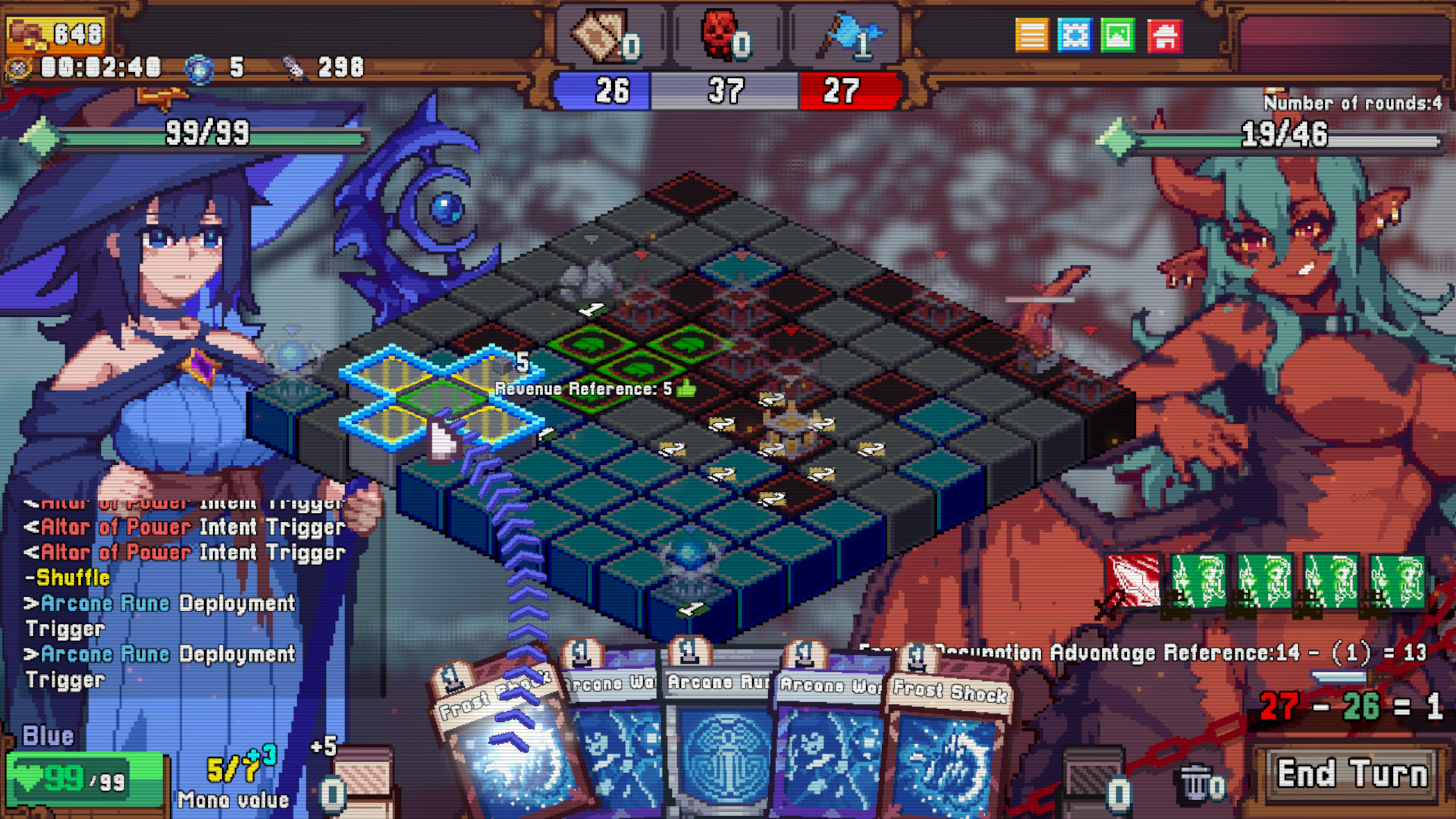
A territory-control battle mid-round, tiles claimed in blue and green as the two sides race to control more of the grid than their opponent.Image: Light Up Games via Steam -
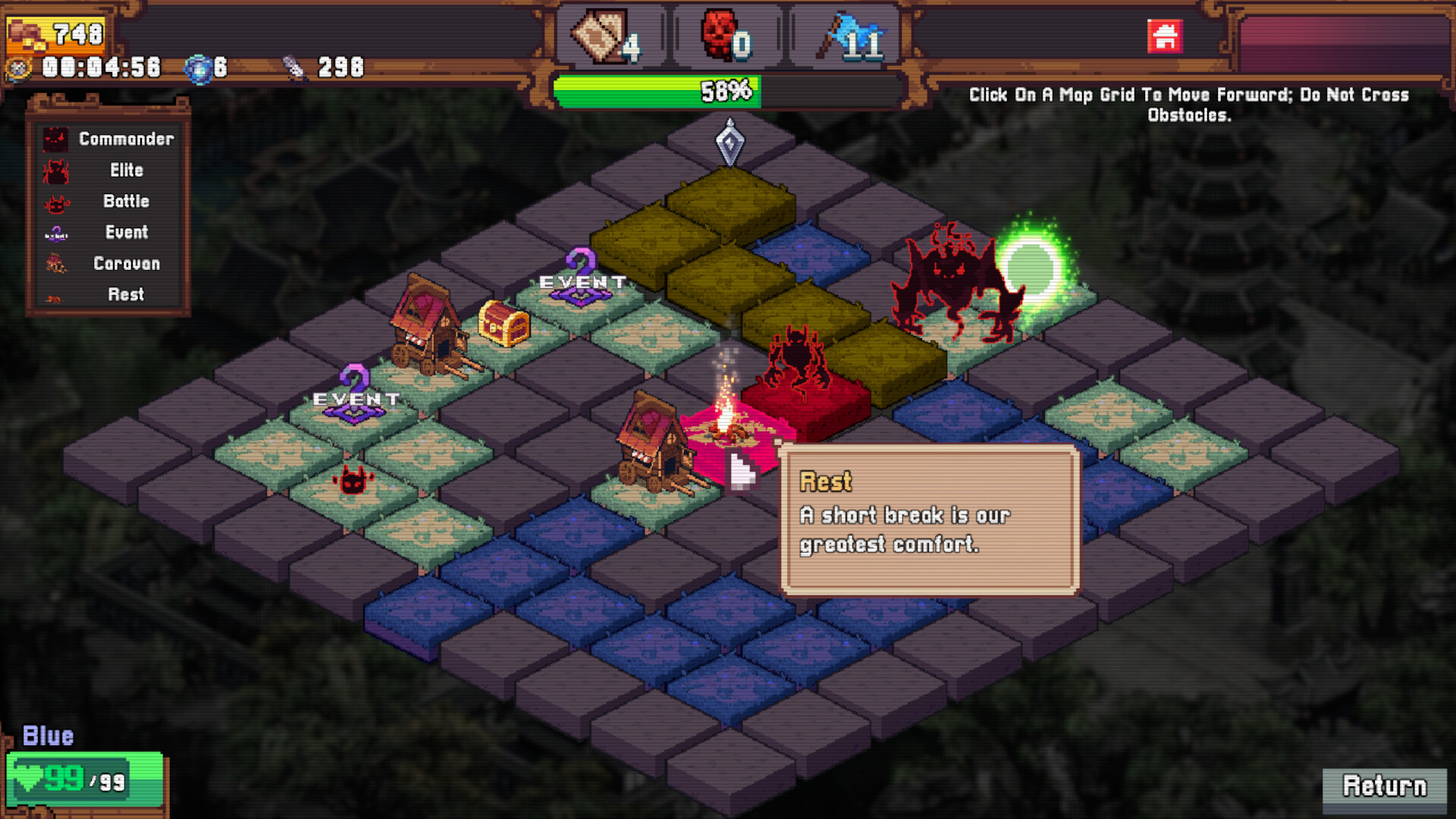
The overworld map between fights, where players choose a path between battles, events, caravans, and rest stops.Image: Light Up Games via Steam -
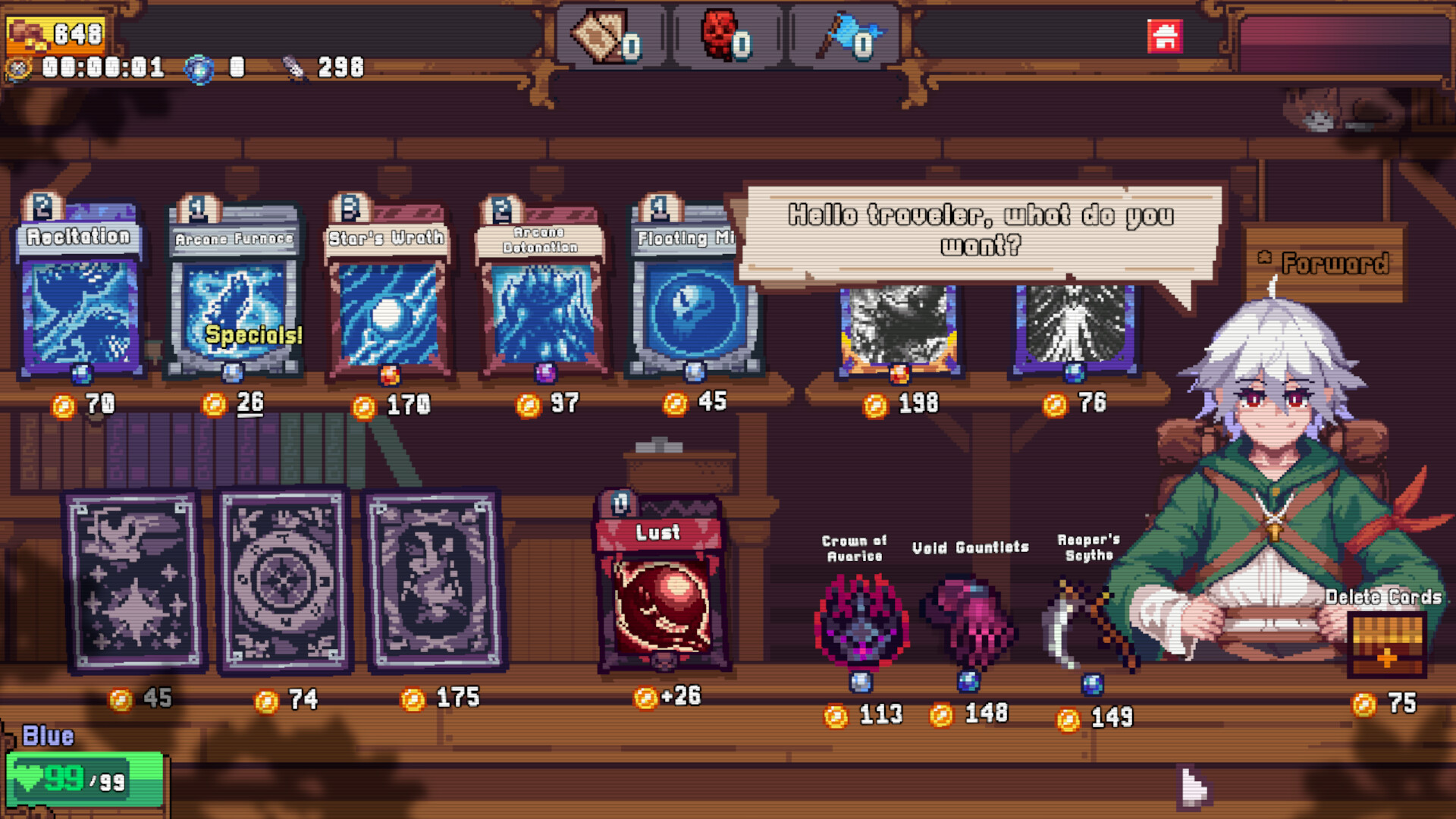
A run's shop screen, where earned currency buys new cards and equipment between encounters.Image: Light Up Games via Steam