
Game review
PROXIMATE
6 / 10
- Developer
- Cain Maddox
- Publisher
- Cain Maddox
- Released
- 8 November 2024
- Platforms
- Windows
- Genre
- First-person narrative horror
- Monetisation
- One-time purchase, no DLC or microtransactions
- Players
- Single-player only
The short version
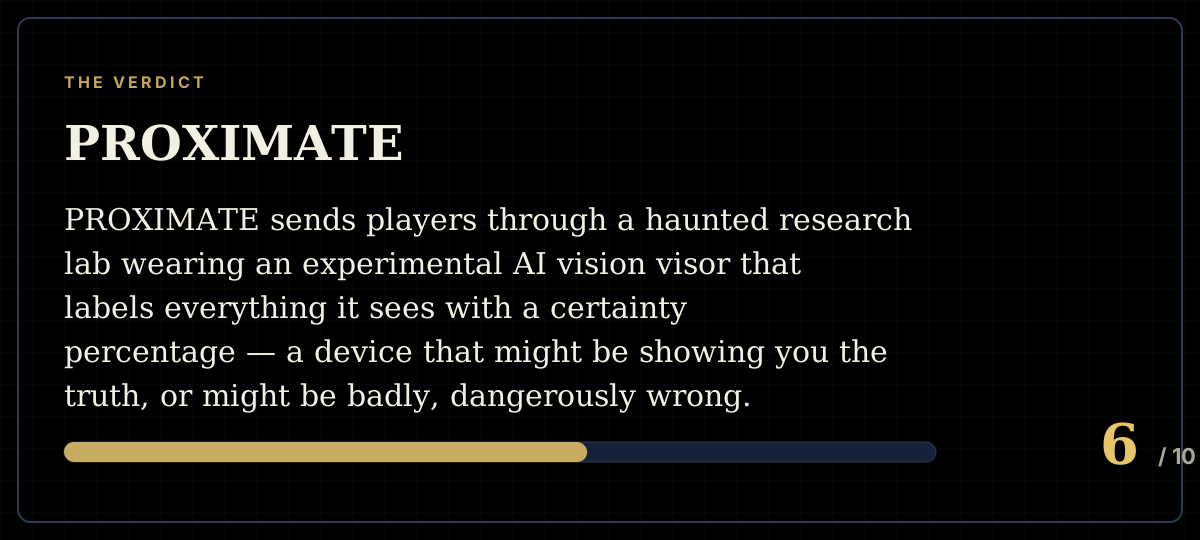
PROXIMATE sends players through a haunted research lab wearing an experimental AI vision visor that labels everything it sees with a certainty percentage — a device that might be showing you the truth, or might be badly, dangerously wrong. This review's sample finds near-universal admiration for that premise and its sound design, alongside a large, specific negative-review consensus that the visor mechanic itself is used to genuinely interesting effect for only the first few minutes before the game settles into straightforward, often frustrating navigation and text-reading for the remainder of its short runtime.
Biggest strengths
- The core AI-visor concept — viewing the world through an uncertain, sometimes-wrong machine interpretation — earns specific, widespread praise as a genuinely inventive take on first-person horror, even from reviewers otherwise disappointed with the execution
- Sound design is consistently and specifically singled out as a major strength, with reviewers describing distinct audio cues that let players build a mental map of unseen surroundings
- Several reviewers praise the dialogue's natural, distinct character voices, and multiple reviewers specifically highlight the game's trans representation as well-realised and personally resonant
Biggest weaknesses
- A large, specific, and repeated negative-review theme describes the central visor mechanic as barely developed beyond its opening minutes, with multiple reviewers independently reporting the game does little more with the concept than remove the map and briefly disable image recognition
- Several reviewers describe the writing as juvenile or grating, with one calling every character's personality "some flavor of quirky" and arguing the story would work better as a straightforward visual novel than as an interactive game
- Multiple reviewers report significant navigation frustration once the in-game map is removed, describing controls that feel disconnected from what's shown on screen and extended stretches of bumping into walls searching for a way forward
Who it's for: Horror fans drawn to atmosphere, concept, and environmental storytelling over jump scares or extended interactive systems, and players specifically interested in a short, unconventional narrative experience with well-regarded queer representation; not a fit for anyone expecting the AI-visor gimmick to remain central throughout.
Our recommendation: Worth a low-cost purchase for the concept and sound design alone, with realistic expectations set around a very short runtime and a central mechanic that peaks early and is rarely revisited.
6 / 10
PROXIMATE puts players inside an experimental AI vision visor exploring a haunted research lab, labelling every object and person it sees with a percentage of certainty about what it thinks it's looking at. This review's sample confirms that premise is a genuine standout — and identifies a large, specific negative-review consensus that the game rarely does as much with it as its opening minutes promise.
A concept reviewers keep calling brilliant
The praise for PROXIMATE's central idea recurs constantly and specifically across this review's sample. "Cool mechanics and premise... Goes deep on environmental storytelling," one reviewer writes, while another describes the sound design in detail: "being able to distinctly tell what area of a room you're in based on the squishy organs and blood puddles you're stepping in was really neat." A third reviewer sums up the appeal directly: "the idea of viewing through what an AI is telling you that you're looking at is quite interesting especially coupled with a certainty percentage." That level of specific, mechanically detailed praise — not vague atmosphere talk, but genuine enthusiasm for a distinctive design idea — appears across both positive and negative reviews alike.
The dominant complaint: a hook that peaks early
Set against that praise, the single most repeated criticism in this review's sample concerns how little the game actually does with its own premise after the opening stretch. "It doesn't really do much with the core gimmick of the game. What happens in the first two minutes is basically as far as the game goes with exploring the AI visor mechanic," one reviewer writes. Another independently confirms the same disappointment: "Sadly I can't say the game does a ton with its core mechanic of navigation beyond like two sections of the game. I would have loved to been able to interact with the environment a LOT more." A third reviewer, despite loving the concept, is blunt about where it goes: "The googles never help you do something you couldn't have done otherwise, and are never used in a puzzle. The only 'puzzle' is navigating with an incredibly narrow field of view without a map." That consistency across many independent, detailed accounts suggests this is a genuine structural gap rather than a one-off complaint.
A split reaction to the writing
Reviewers disagree sharply on the quality of the game's dialogue and characters. "The writing is all the game has, and it's really bad. Every character's personality is some flavor of 'they're quirky,'" one reviewer argues. Set against that, other reviewers specifically praise the same characters: "the way people speak/text is just so natural, while also being so distinct between characters," one writes, while another highlights the game's trans representation directly: "Found the characters to also be very relatable, especially Ella and my own experiences as a transwoman." That split suggests the writing style is a genuine matter of taste rather than an objective flaw, and buyers should weigh both accounts rather than assume either represents consensus.
Navigation frustration once the map disappears
Several reviewers raise a specific, related complaint about a mid-game design choice: removing the in-game map. "Taking away the map but having quest markers ended up being a little too easy," one reviewer notes as a missed opportunity for tension, while another describes the practical frustration directly: "After the map is taken away, navigation just becomes super annoying and turned me off from the game." At least one reviewer reports a more serious, specific bug: a story trigger failing to activate, requiring a full restart to progress.
What couldn't be verified
This review's checks of Steam's achievement data and partner-events feed returned no data for this title — no tracked achievements and no logged update posts — so this review could not independently corroborate or refute any claims about post-launch patches or ongoing developer support, though no reviewer in this sample raised abandonment as a specific concern.
A memorable handful of horror moments
Even reviewers disappointed by the overall execution consistently carve out an exception for a couple of specific, effective horror beats. "I never anticipated that seeing 'Dog' would be the most dreadful moment I have experienced in a video game," one reviewer writes, a specific, memorable example of the game building dread through implication rather than a jump scare. Another reviewer frames the game's overall horror approach approvingly: "if you're into the type of horror that cranks up the dread and anticipation of seeing the aftermath of something horrible that may very definitely happen to you, this is the game for you." That the same handful of moments get cited repeatedly and specifically, across otherwise very different overall verdicts, suggests the game's horror writing is capable of real highlights even where its broader mechanical and narrative structure disappoints.
Weighing a short runtime against its price
Several reviewers explicitly frame their overall verdict around a value calculation rather than a pure quality judgment. "6 dollars is a reasonable price for this for me," one reviewer writes despite cataloguing the same underused-mechanic complaint found throughout this review's negative sample, while another states more bluntly: "If the game were free, I could have said it's an interesting concept... But they sell it for 5 bucks, so no." That disagreement suggests the core creative and technical shortcomings described throughout this review are real regardless of price, but whether they sink the overall recommendation depends heavily on how much weight an individual buyer puts on cost versus polish for a short, single-idea experience.
Final verdict
PROXIMATE succeeds brilliantly at its core creative pitch, and this review's sample confirms real, widespread admiration for its AI-visor concept and sound design, alongside genuinely well-regarded character writing for many players. But a large, specific, and consistent negative-review theme — a central mechanic that's barely explored past its opening minutes, and navigation frustration once the map disappears — describes a real gap between the game's most exciting idea and how thoroughly it's realised. At its low price and short runtime, this remains a worthwhile curiosity for horror fans specifically drawn to unconventional concepts, with expectations calibrated around a premise that peaks early rather than one that deepens throughout.
Pros and cons
Pros
- The core AI-visor concept — viewing the world through an uncertain, sometimes-wrong machine interpretation — earns specific, widespread praise as a genuinely inventive take on first-person horror, even from reviewers otherwise disappointed with the execution
- Sound design is consistently and specifically singled out as a major strength, with reviewers describing distinct audio cues that let players build a mental map of unseen surroundings
- Several reviewers praise the dialogue's natural, distinct character voices, and multiple reviewers specifically highlight the game's trans representation as well-realised and personally resonant
- The game's low price is repeatedly cited as reasonable given its short length, with several reviewers who otherwise criticized the gameplay still calling it a fair value proposition
- A handful of specific, memorable horror beats — built more on dawning realisation than jump scares — earn genuine, repeated praise as effectively unsettling without relying on cheap scares
Cons
- A large, specific, and repeated negative-review theme describes the central visor mechanic as barely developed beyond its opening minutes, with multiple reviewers independently reporting the game does little more with the concept than remove the map and briefly disable image recognition
- Several reviewers describe the writing as juvenile or grating, with one calling every character's personality "some flavor of quirky" and arguing the story would work better as a straightforward visual novel than as an interactive game
- Multiple reviewers report significant navigation frustration once the in-game map is removed, describing controls that feel disconnected from what's shown on screen and extended stretches of bumping into walls searching for a way forward
- At least one reviewer reports a specific, game-blocking bug requiring a full restart when a story trigger failed to activate correctly
- Reviewers consistently describe the experience as extremely short and lacking meaningful difficulty or danger, with several noting the horror elements rarely escalate beyond a couple of standout early moments
Screenshots
-

PROXIMATEImage: Cain Maddox via Steam -

PROXIMATEImage: Cain Maddox via Steam -

PROXIMATEImage: Cain Maddox via Steam -
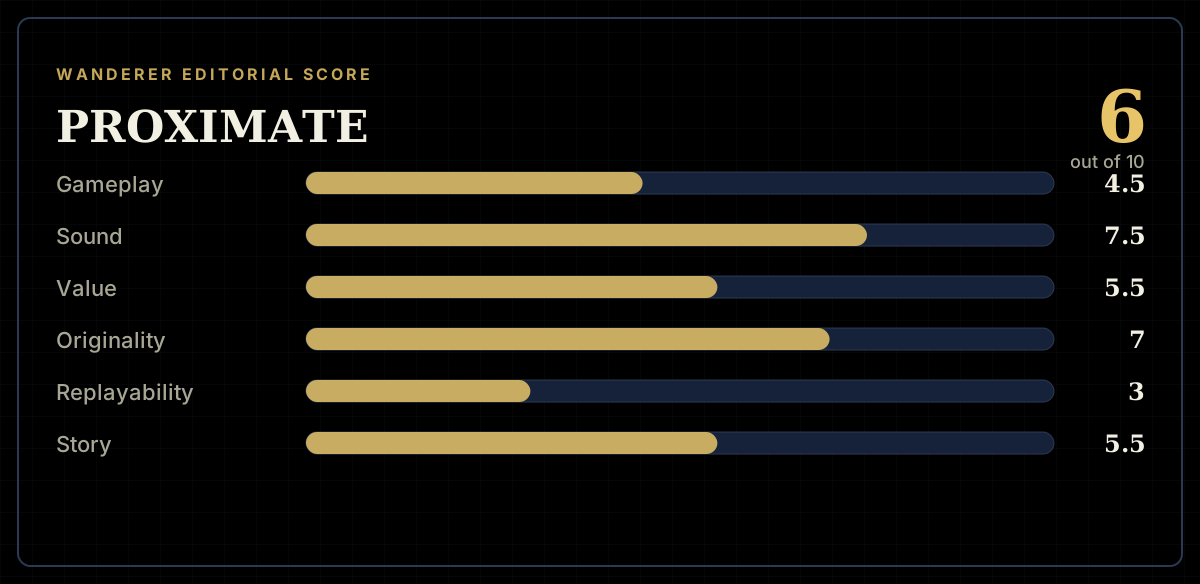
How the review scores each part of the gameWanderer Editorial -
The short versionWanderer Editorial