
Game review
Penguin Helper
4.5 / 10
- Developer
- ArtDock
- Publisher
- Dreland Enterprises
- Released
- 6 June 2024
- Platforms
- Windows
- Genre
- Meditative first-person penguin-care toy
- Monetisation
- One-time purchase, no in-game store or additional currency purchases
- Players
- Single-player only
The short version
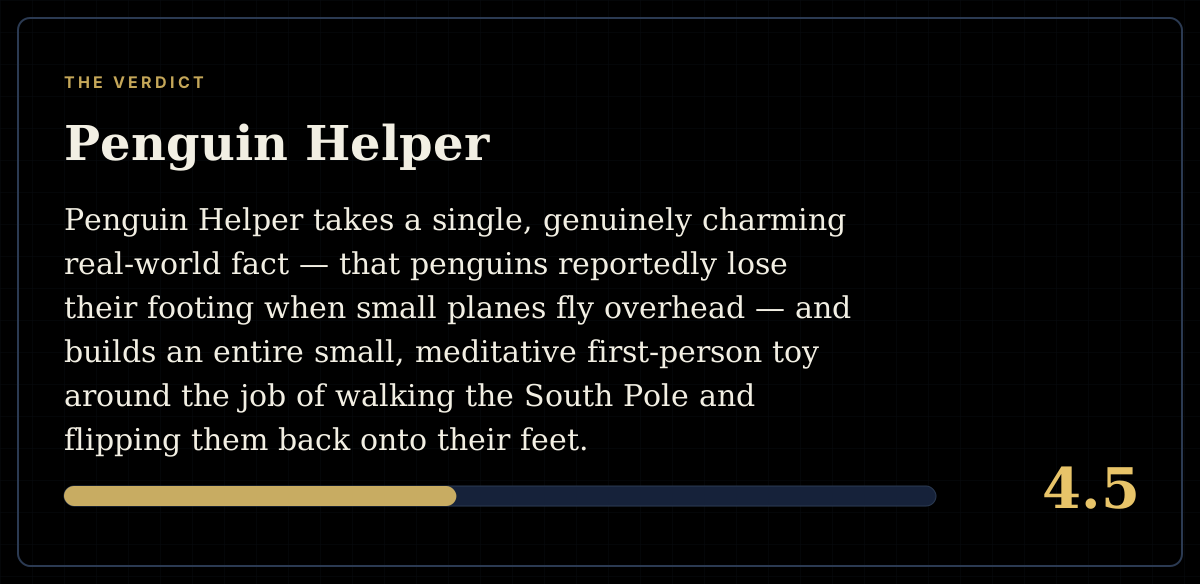
Penguin Helper takes a single, genuinely charming real-world fact — that penguins reportedly lose their footing when small planes fly overhead — and builds an entire small, meditative first-person toy around the job of walking the South Pole and flipping them back onto their feet. Reviewers consistently describe real, if brief, delight in that premise, praising the game's soothing atmosphere and the simple pleasure of petting, feeding, and dressing up its cast of penguins. Set against that charm, this review's small sample is unusually consistent about the ceiling: nearly every reviewer, positive and negative alike, independently describes seeing everything the game has to offer within a single short session, sometimes minutes long, and at least one specific broken achievement and a factual error mislabeling the setting as Arctic rather than Antarctic point to real, if minor, quality-control gaps. The developer has kept the game alive well past launch, including a Nintendo Switch port and continued seasonal promotion, suggesting real, if modest, commercial staying power for a game this small.
Biggest strengths
- The core premise, inspired by a genuine real-world viral phenomenon about planes startling penguins, is repeatedly praised as a specific, charming hook that reviewers find genuinely funny and endearing
- The overall atmosphere earns consistent praise for its relaxing, meditative quality, with reviewers describing petting, dressing, and feeding the penguins as a soothing, low-stakes activity well suited to unwinding
- At its very low price, value draws little serious dispute, with even critical reviewers generally describing the purchase as a fair trade for the short experience it delivers
Biggest weaknesses
- The single most repeated observation across nearly the entire review sample, positive and negative alike, is that the game's full content is visible within a single short session, with several reviewers reporting they'd "seen all there is" within 10-20 minutes of play
- At least one reviewer reports a specific, broken achievement tied to helping 50 penguins in a single session, noting 0% of players have earned it, a concrete quality-control gap rather than a subjective content complaint
- A specific factual error is repeatedly flagged by at least one detailed reviewer, who notes achievement text mislabels the setting as "Arctic" rather than "Antarctic," a real inconsistency given the game's own South Pole setting and penguin cast
Who it's for: Players specifically looking for a very short, low-effort, charming novelty to unwind with for under an hour, particularly penguin enthusiasts. Not for anyone expecting meaningful content depth, replay value, or a game that rewards more than a single brief session.
Our recommendation: Worth its very low price for a single, genuinely cute half-hour to an hour of penguin-flipping relaxation. Don't expect anything beyond that one short session — nearly every reviewer, however fond of the premise, agrees there isn't much more here to find.
4.5 / 10
Penguin Helper's entire premise rests on a single, genuinely delightful real-world fact: penguins, reportedly, sometimes fall over when startled by low-flying planes, and someone, somewhere, has to walk over and flip them back upright. That's the whole job description here — you play a "penguin flipper" stationed at the South Pole, wandering snowy expanses to right toppled penguins, pet them, dress them in small outfits, and feed them fish. It's a charming enough hook to have earned the game a small, genuinely fond audience, and this review's sample is unusually direct about exactly how far that charm actually extends.
A premise reviewers genuinely enjoy
The specific joke at the game's center lands well. One reviewer frames the whole appeal succinctly: "Penguin Helper as it is, should probably be a meme," describing the core absurdity of the premise as the game's real appeal rather than any deeper systems underneath it. Another writes with real, if slightly tongue-in-cheek, sincerity: "I helped penguins get back on their feet at the South Pole" as the proud summary of their Sunday. The atmosphere earns its own genuine praise — "meditative atmosphere with pleasant sound," multiple reviewers note, describing petting and caring for the penguins as a soothing, low-effort way to unwind.
A ceiling nearly everyone in the sample agrees on
What's most useful about this review's small sample is how consistently reviewers, regardless of their overall recommendation, describe hitting the game's content ceiling almost immediately. "I feel like I saw all there is" within a short session, one reviewer writes, and another states even more directly: "gets repetitive within 5 minutes. I have 35% of achievements within 9 minutes of play time." A third, more measured account acknowledges the charm while still landing on the same conclusion: "quickly repetitive and I don't think I'll replay it after this short 1h try." This isn't a split sample with defenders and detractors talking past each other — it's close to unanimous agreement about scope, differing mainly in how forgiving individual reviewers are willing to be about that scope given the price.
Specific quality-control gaps worth naming
Beyond the broader brevity complaint, at least one detailed reviewer identifies two concrete, fixable issues. First, a specific achievement tied to helping 50 penguins in a single session appears to be broken, with the reviewer noting "0% of players have it" despite presumably being achievable by design. Second, the same reviewer flags a factual inconsistency in the achievement text itself, which labels the setting "Arctic" rather than "Antarctic" — a real error given that the entire game is explicitly set at the South Pole among penguins, animals that exist exclusively in the Antarctic and nowhere near the actual Arctic. These are small things, but they're the kind of easily correctable details that speak to how little additional polish has gone into the game since its initial content was locked in.
A voice performance that undercuts the calm it's aiming for
At least one reviewer raises a specific critique of the protagonist's voiced dialogue, describing it as sounding artificial enough to work against the otherwise calming mood the rest of the presentation is going for. That's a fair, specific piece of feedback — a game this explicitly built around meditative relaxation is particularly vulnerable to any single element breaking that spell, and voice work is often exactly the kind of detail that's hardest to get right on a small budget.
A small game the developer has kept alive
To its credit, this review can confirm ArtDock and Dreland Enterprises didn't simply release the game and disappear. The partner-events feed documents the game exiting Early Access to a full release in September 2024, followed by a Nintendo Switch port in January 2025 and continued participation in seasonal Steam sales and a dedicated Animal Fest promotion as recently as November 2025. That's a reasonable, ongoing commercial trajectory for a game this small and cheap, even without major new content updates specifically documented.
What the achievement data confirms
Steam's own completion figures line up with the brevity complaints raised throughout this review. An early milestone sits at 91%, meaning nearly everyone who buys the game engages with its basic loop, but full completion still requires meaningful time investment, with the rarest achievements sitting around 6-7% — numbers broadly consistent with a very short, easily digestible experience that a healthy majority of buyers do finish rather than abandon.
A generous outlier worth weighing honestly
It's worth being fair to the sample's full range rather than only its majority view. At least one reviewer reports over 13,880 minutes logged — well over 230 hours — describing the game in almost meditative, personal terms as a genuine refuge from real-life stress. That's an extreme outlier relative to nearly every other reviewer's account of the content ceiling, and this review can't fully explain the gap between that playtime and the "everything visible in minutes" consensus elsewhere in the sample. It's possible that reviewer simply left the game running in the background rather than actively engaging with it that entire time, a pattern this lane has seen with other minimalist toys, but the review itself doesn't clarify one way or the other, so it's included here as an honest, if puzzling, data point rather than something this review can confidently explain away.
A request several reviewers make in good faith
Beyond straightforward criticism, several reviewers frame their disappointment as a wish list rather than a dismissal, specifically requesting more customisation options, additional locations, or a potential sequel that expands meaningfully on the core idea. That's a useful signal in its own right — it suggests the underlying concept has real, untapped potential that reviewers want to see built out further, rather than a premise they consider exhausted on its own merits.
Final verdict
Penguin Helper is a small, sincerely charming novelty built around a single good joke, delivered competently enough that reviewers across the board enjoy the brief time they spend with it. But "brief" is doing real work in that sentence — nearly every reviewer in this small sample, whatever their final verdict, agrees the game's entire content is visible within a single short sitting, and a couple of small, fixable quality-control gaps suggest limited ongoing polish since launch. Worth its very low price for one cute, short session; don't expect it to hold your attention much beyond that.
Pros and cons
Pros
- The core premise, inspired by a genuine real-world viral phenomenon about planes startling penguins, is repeatedly praised as a specific, charming hook that reviewers find genuinely funny and endearing
- The overall atmosphere earns consistent praise for its relaxing, meditative quality, with reviewers describing petting, dressing, and feeding the penguins as a soothing, low-stakes activity well suited to unwinding
- At its very low price, value draws little serious dispute, with even critical reviewers generally describing the purchase as a fair trade for the short experience it delivers
- The developer has kept the game commercially active well past launch, including a Nintendo Switch port roughly seven months after the Steam release and continued participation in seasonal Steam sales and animal-themed promotional events
- The core interaction loop of flipping, dressing, and feeding penguins is functional and bug-free at a basic level, with reviewers not reporting the kind of game-breaking technical failures seen in many other small releases this lane has covered
Cons
- The single most repeated observation across nearly the entire review sample, positive and negative alike, is that the game's full content is visible within a single short session, with several reviewers reporting they'd "seen all there is" within 10-20 minutes of play
- At least one reviewer reports a specific, broken achievement tied to helping 50 penguins in a single session, noting 0% of players have earned it, a concrete quality-control gap rather than a subjective content complaint
- A specific factual error is repeatedly flagged by at least one detailed reviewer, who notes achievement text mislabels the setting as "Arctic" rather than "Antarctic," a real inconsistency given the game's own South Pole setting and penguin cast
- Interactions are described by multiple reviewers as repeating without meaningful variation, with dialogue and available actions becoming familiar quickly and offering little reason to continue playing once the novelty has worn off
- At least one reviewer describes the protagonist's voice acting as artificial-sounding enough to detract from the otherwise soothing atmosphere, suggesting the game might have been better served without spoken dialogue at all
Screenshots
-

Penguin HelperImage: Dreland Enterprises via Steam -

Penguin HelperImage: Dreland Enterprises via Steam -

Penguin HelperImage: Dreland Enterprises via Steam -
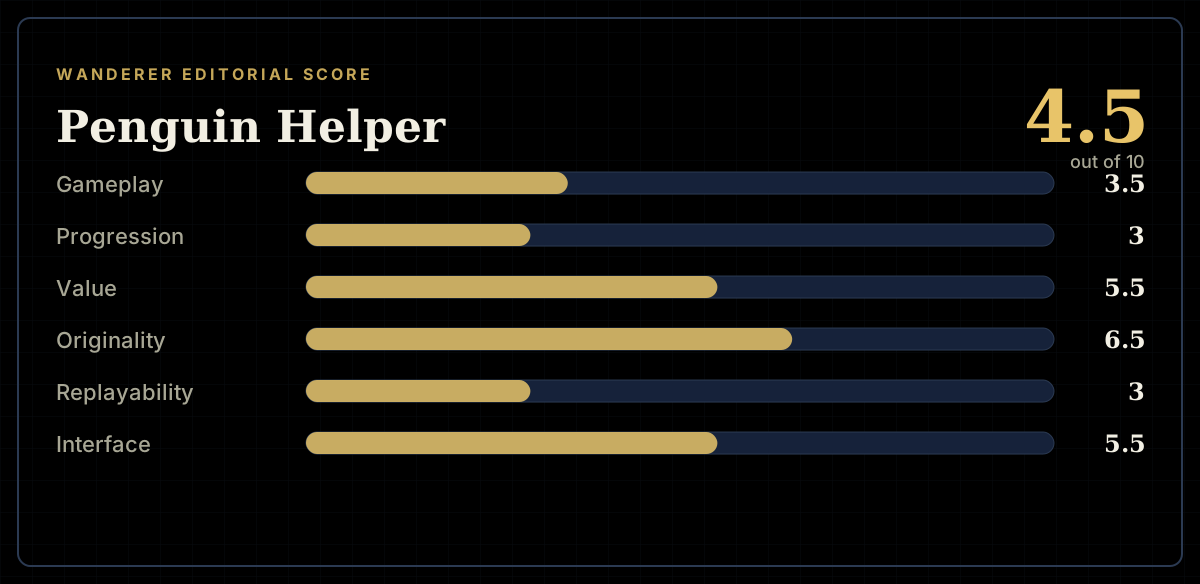
How the review scores each part of the gameWanderer Editorial -
The short versionWanderer Editorial