
Game review
Bit Buddy
7 / 10
- Developer
- Salt Fish Studio
- Publisher
- Salt Fish Studio
- Released
- 18 November 2025
- Platforms
- Windows
- Genre
- Idle, Casual, Simulation
- Monetisation
- One-time purchase, Steam Workshop content free
- Players
- Single-player, with an online co-op lobby feature
The short version
Bit Buddy is a desktop-widget pet that watches your keyboard and mouse input in real time, reacting with small animations to typing, clicking and moving the cursor, and quietly rewarding ordinary computer use with a steady drip of new decorations from a pool of more than 600 unique accessories and skins. With Steam Workshop support layered on top for community-made buddies and items, reviewers consistently frame it as a smarter, more rewarding evolution of the free "Bongo Cat" concept — cheap, charming, and genuinely additive to long study or work sessions rather than a distraction from them. The review corpus, while almost entirely positive, is small enough that its handful of specific technical complaints (fullscreen-game incompatibility, a Steam-dependency requirement, and incomplete Linux support) deserve real weight precisely because there's so little competing negative signal to balance them against.
Biggest strengths
- Reviewers consistently and specifically frame Bit Buddy as a superior, paid alternative to the free Bongo Cat concept, citing better item variety, more generous drop mechanics, and permanent unlocks that persist even after being traded up for higher-quality items
- The core loop of ordinary, already-happening computer use passively unlocking new decorations is described by multiple reviewers as genuinely additive to long study or work sessions, making the presence of the buddy something that produces a smile rather than a distraction
- Steam Workshop support opens the pool of collectible content well beyond the base 600-plus accessories and skins, letting players add community-made buddies tied to specific fandoms or aesthetics, such as one reviewer's example of adding a Warrior Cats character skin
Biggest weaknesses
- A specific and repeated feature request across the review corpus asks for microphone or voice reactivity so the buddy could respond to speech, particularly valued by streamers and content creators, and this remains unimplemented at time of writing
- Multiple reviewers report the buddy freezes or stops reacting entirely whenever another application is run in fullscreen mode, a meaningful limitation for anyone who wants the companion active while gaming rather than only during desktop work
- At least one reviewer notes the game requires Steam to remain open and running as an active process rather than launching independently at startup the way a comparable desktop tool like Wallpaper Engine can, which can visibly register as "in a game" to friends and interfere with other Steam-dependent workflows
Who it's for: Anyone who spends long stretches at a keyboard for work, study or streaming and wants a low-effort, low-cost source of ambient charm and light collection-based progression running in the background. Particularly appealing to streamers and creators drawn to the Bongo Cat-style desktop-companion aesthetic who want more customization depth than that free alternative offers.
Our recommendation: An easy, low-risk recommendation at NZ$2.99 for the intended desktop-companion use case, with the caveat that it won't run alongside fullscreen games and needs Steam kept open in the background — worth checking those two specific limitations against your own setup before buying.
7 / 10
A pet that watches you work
Bit Buddy occupies a small but recognizable niche: the reactive desktop companion, a category popularized for free by Bongo Cat and now given a paid, more feature-rich treatment by developer Salt Fish Studio. The pitch is simple — a small creature sits on your desktop and visibly reacts to your keyboard presses and mouse movement in real time, turning ordinary computer use into a source of small, ambient charm. What elevates it beyond a novelty toy, according to the review corpus, is the progression system layered on top: every interaction carries a passive chance to unlock new decorations from a pool of more than 600 accessories and skins, meaning hours already spent typing or clicking at your desk quietly accumulate collectible rewards without requiring any additional attention or effort.
Better than free, according to reviewers who compare directly
Several reviewers make the Bongo Cat comparison explicit and specific rather than glancing, arguing Bit Buddy earns its price tag through concrete mechanical advantages: unlocked customizations remain permanently available even after being combined into higher-tier items, and the combination system requires only five matching-quality pieces rather than the ten some comparable systems demand, making the collection loop feel generous for what one reviewer describes as "a symbolic payment." That's a specific, checkable claim about system design rather than vague enthusiasm, and it recurs consistently enough across independently-written reviews to read as a genuine differentiator rather than isolated praise. Steam Workshop integration extends the pool further still, letting the community contribute entirely new buddies and cosmetics — one reviewer specifically describes adding a Warrior Cats character skin found through Workshop browsing, illustrating how far the customization can stretch beyond the base game's own content.
What reviewers keep asking for
The most consistent, repeated feature request in the corpus concerns voice or microphone reactivity — multiple reviewers, several explicitly identifying as streamers or content creators, ask for the buddy to respond to speech the way it already responds to keyboard and mouse input, comparing the request to PNGtuber-style avatar tools. That this same request appears independently across several of the highest-voted reviews suggests real, specific demand for a feature roadmap item rather than a single enthusiast's wish list, and it's worth flagging clearly for prospective buyers who might specifically want that capability before purchasing.
The fullscreen and background-process caveats
Two more technical limitations recur with enough independent corroboration to treat as reliable rather than isolated. First, multiple reviewers report the buddy simply freezes and stops reacting whenever another application runs in fullscreen mode, meaning it won't function as a companion during fullscreen gaming sessions, only during windowed desktop work. Second, at least one reviewer specifically contrasts Bit Buddy's requirement that Steam remain open and actively running with Wallpaper Engine, a comparable desktop-customization tool that can run independently of Steam and doesn't visibly register as "in a game" to friends or interfere with other Steam-dependent activity. Neither issue is described as game-breaking, but both are specific, actionable pieces of information a prospective buyer should weigh against their own typical desktop setup.
A thin but telling dissent
With only two English-language negative reviews in the entire corpus, this review can't lean on a large sample of critical accounts the way larger releases in this survey allow. What little dissent exists is narrow and specific rather than broadly damning: one long-term player reports over a thousand hours played while still waiting on a small number of promised card drops, and another reports the game responding only to mouse input rather than keyboard presses on their system, a possible compatibility or configuration issue rather than a universal complaint. Given how overwhelming the positive signal is by comparison — 503 positive reviews against just 3 negative across all languages — this should be read as a genuinely well-received niche tool rather than one propped up by an absence of scrutiny.
An unexpected social layer
One detail that separates Bit Buddy from a purely solitary desktop toy is its online co-op lobby feature, listed among its Steam store categories alongside single-player support. At least one reviewer specifically asks for more social tools within that lobby space, requesting emotes to interact with other players present rather than simply existing alongside them, and asks for the ability to rejoin a previous session or a friend's active lobby more easily. That request implies the shared-lobby feature is functional enough to be worth using in the first place, but currently thin enough in its social tooling that at least one engaged player wants more built around it — a reasonable growth area for a game whose core, single-player loop is already well-liked, rather than a flaw in what's currently on offer.
Tracking your own habits as a side effect
A feature that gets less attention in the review corpus but is worth noting for prospective buyers is Bit Buddy's built-in activity logging: the game automatically records daily and historical keyboard and mouse activity, letting players see concretely how much they've typed or clicked over time. That's a quietly useful secondary function distinct from the cosmetic-collecting core loop, giving the desktop companion a small utility dimension beyond pure charm — closer to a lightweight, gamified productivity tracker than a typical idle collectible, for anyone curious how their actual computer habits look once measured rather than estimated.
The verdict
Bit Buddy succeeds at exactly what it sets out to do: a cheap, charming, technically competent desktop companion that turns ordinary computer use into a source of small, ongoing collectible rewards, and does it well enough that reviewers who've tried the free alternatives it competes with consistently prefer paying for this one instead. The specific, repeated requests for voice reactivity and the fullscreen-compatibility limitation are worth knowing before you buy, but neither undermines the core experience for its intended use case. At NZ$2.99, with hundreds of items to unlock and a Workshop community actively expanding the pool further, this is a low-risk, well-reviewed pickup for anyone who wants ambient charm at their desk.
Pros and cons
Pros
- Reviewers consistently and specifically frame Bit Buddy as a superior, paid alternative to the free Bongo Cat concept, citing better item variety, more generous drop mechanics, and permanent unlocks that persist even after being traded up for higher-quality items
- The core loop of ordinary, already-happening computer use passively unlocking new decorations is described by multiple reviewers as genuinely additive to long study or work sessions, making the presence of the buddy something that produces a smile rather than a distraction
- Steam Workshop support opens the pool of collectible content well beyond the base 600-plus accessories and skins, letting players add community-made buddies tied to specific fandoms or aesthetics, such as one reviewer's example of adding a Warrior Cats character skin
- The unlock system is specifically praised for requiring only five matching-quality items to combine upward, compared to ten in comparable systems, plus a fair chance for bonus item drops, making the collection loop feel generous rather than grindy for a NZ$2.99 purchase
- Multiple reviewers report substantial voluntary playtime, with several logging well over a thousand hours of the game running passively in the background, a strong signal that the ambient companion format sustains long-term engagement rather than novelty wearing off quickly
Cons
- A specific and repeated feature request across the review corpus asks for microphone or voice reactivity so the buddy could respond to speech, particularly valued by streamers and content creators, and this remains unimplemented at time of writing
- Multiple reviewers report the buddy freezes or stops reacting entirely whenever another application is run in fullscreen mode, a meaningful limitation for anyone who wants the companion active while gaming rather than only during desktop work
- At least one reviewer notes the game requires Steam to remain open and running as an active process rather than launching independently at startup the way a comparable desktop tool like Wallpaper Engine can, which can visibly register as "in a game" to friends and interfere with other Steam-dependent workflows
- Linux and Steam Deck desktop-mode support is reported as incomplete by at least one reviewer, who states the core functionality doesn't fully work outside Windows despite the game still being playable there
- The review sample, while almost unanimously positive at 503 positive to 3 negative, is modest in absolute terms compared to larger releases in this survey, so the near-total absence of dissent should be read as an early, promising signal about a niche desktop tool rather than an exhaustively battle-tested verdict
Screenshots
-

Bit BuddyImage: Salt Fish Studio via Steam -

Bit BuddyImage: Salt Fish Studio via Steam -

Bit BuddyImage: Salt Fish Studio via Steam -
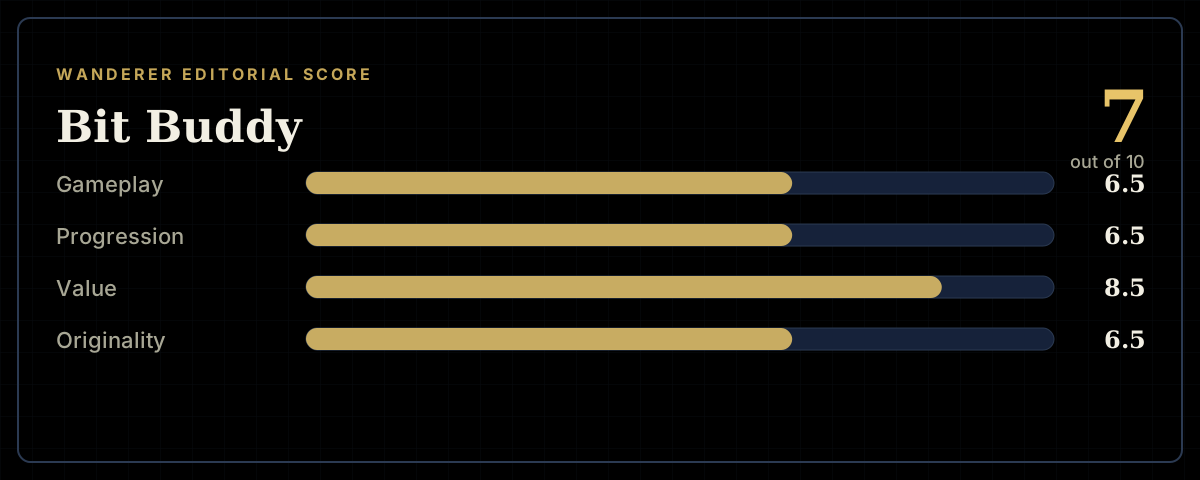
How the review scores each part of the gameWanderer Editorial -
The short versionWanderer Editorial