
Game review
Out of the Park Baseball 27 Review
7 / 10
- Developer
- Out of the Park Developments
- Publisher
- Out of the Park Developments
- Released
- 13 March 2026
- Platforms
- ["Windows", "Mac"]
- Genre
- Sports Management Simulation
- Monetisation
- Paid
- Players
- Online co-op / online multiplayer
The short version
Out of the Park Baseball 27 remains the deepest baseball simulation money can buy, and the added statistical layers reward series veterans who dig in, but a cluttered new interface, persistent stability complaints, and the growing shadow of its monetized card mode make this a tougher sell than past entries, especially for anyone who already owns a recent installment.
Biggest strengths
- Unmatched statistical and organizational depth, covering every MLB, KBO, and historical season alongside fully custom leagues
- Flexible modes let you manage every pitch or sim entire decades, from GM-only front-office play to full 3D-rendered games
- The Perfect Team card mode can be played and enjoyed without spending beyond the base purchase, for players who want it
Who it's for: Baseball statistics obsessives and franchise-mode diehards willing to push through a steep learning curve and an uneven interface.
Our recommendation: Recommended for series newcomers and deep-simulation fans; owners of recent editions should wait for a sale unless the new stat layer specifically appeals.
7 / 10
Twenty-Seven Years In, Still the Deepest Sim in Baseball
Out of the Park Baseball has been the reigning heavyweight of baseball management simulation for nearly three decades, and its twenty-seventh annual release does nothing to threaten that crown. This is still, by a wide margin, the most granular baseball experience available on PC: every MLB and KBO franchise is fully licensed, every season back to the sport's earliest professional years is playable, and the tools for building entirely fictional leagues, from custom rules to invented cities and rosters, are as open-ended as anything in the sports-sim genre. Players describe replaying the 1990 season with a homebrew eighteen-team league, watching alternate-history storylines emerge as prospects who never got a real chance suddenly break out years early, and losing entire afternoons to nothing more than reading scouting reports and mentally re-drafting their favorite team's farm system.
That scope is the game's whole appeal, and it remains genuinely singular. No console sports title offers anything close to this level of front-office control, and long-time players describe OOTP as the only game that lets them "manage like a real GM" rather than simply pick lineups and hope. New players coming from Football Manager or similar management sims will find a familiar rhythm underneath an intimidating surface: it takes real time to learn where information lives, but once the interface clicks, the sheer number of levers to pull, trades, scouting assignments, player development plans, roster construction, coaching staff, stadium economics, becomes the game's biggest draw rather than an obstacle.
A New Stat Layer and Redesigned Interface, Received Unevenly
OOTP 27's headline changes are a deeper statistical layer, including new advanced metrics and percentile-based player cards, and a reworked user interface. The response to both has split the community roughly along experience lines. Players newer to the series, or those coming from other management sims, generally welcome the extra data and find the new player cards easier to parse at a glance. Long-time veterans are far less charitable: many describe the redesigned UI as more cluttered than its predecessor, citing smaller text, misaligned elements, awkward slider controls that lost their midpoint markers, and screens that now require more clicks to reach information that used to sit in one place. Several reviewers specifically recommend the previous interface be offered as an optional "compact" toggle rather than forced on everyone.
Beyond the cosmetic overhaul, the underlying simulation continues to draw both praise and pointed criticism. The new AI-driven trade logic is called a genuine improvement by some longtime players who say counter-offers finally make more contextual sense, while others report the exact same nonsensical low-ball offers and illogical demands that have dogged the series for years. Waiver-wire logic in particular comes in for heavy criticism this year, with multiple reviewers describing established, valuable prospects passing through waivers completely unclaimed in ways that break the fiction of a competitive league. Scouting has also reportedly been split into narrower, less informative individual stat investigations that some veterans feel actually reduced the value of a full scouting report compared to prior versions.
Between Simulation Depth and a Card Game Built on Twitch Drops
Two features draw the most attention, for very different reasons: the in-game 3D visualization of games, and the Perfect Team card-collecting mode. The 3D engine, while modestly improved with new player models, better jersey detail, and weather effects, remains the game's weakest technical component by a wide margin. Multiple longtime players describe watching the same scripted-feeling sequences repeat constantly, a first baseman flipping every routine grounder to the pitcher covering first regardless of the play, outfielders inexplicably charging in on balls hit over their heads before turning to chase them down, or specific "bases loaded, no outs" situations reliably collapsing into a strikeout-strikeout-popup sequence. For a series built fundamentally on text simulation with a 3D layer bolted on top, the visual presentation continues to undercut rather than enhance the experience for players who choose to watch games play out rather than sim through them.
Perfect Team, the card-based online mode built around opening packs and building a roster of collectible player cards, remains playable without spending beyond the base purchase price according to several reviewers, who describe filling out a competitive roster purely through free missions, Twitch-stream card drops, and careful play. But an equally large group of reviewers describes the mode as increasingly pay-to-win, with progression gated behind time-limited Twitch drop windows that punish players who can't babysit a stream schedule, and top-tier competitive play effectively locked behind hundreds of dollars in optional purchases. The tension between "the base simulation is excellent and still worth the price on its own" and "the card mode is where the business model clearly lives now" runs through a large share of the game's critical reception this year, and it's fair to say the series' reputation among its most devoted longtime fans has taken a real hit as a result.
Stability, Compatibility, and a Steep but Rewarding Learning Curve
Stability complaints are common enough this cycle to be worth flagging directly. Reports include repeated crashes to desktop, memory leaks that worsen over long sessions and require periodic restarts, corrupted stadium data blocking access to specific minor-league ballparks, and, notably, broken compatibility on Linux systems that reportedly worked fine in the previous year's release despite identical hardware. None of these issues are universal, and plenty of players report smooth, crash-free sessions across hundreds of hours, but the volume and specificity of the bug reports suggest real quality-control gaps at launch that a text-and-spreadsheet-driven simulation, of all genres, shouldn't be shipping with in its twenty-seventh year.
None of this erases what the game does well. For players willing to push through an admittedly steep learning curve, the payoff is a baseball experience with no real peer: full statistical transparency, historically accurate rosters and rule sets, meaningful long-term player development, and a modding and community-database scene that keeps extending the game's already enormous scope. Series veterans who've played every entry since the early 2000s largely agree the core simulation, when it isn't buckling under a bug, is still the gold standard for the genre, even as many of the same players say this particular year gives them fewer concrete reasons to upgrade from OOTP 24 through 26 than most past releases did.
Verdict
Out of the Park Baseball 27 is exactly what its name promises: an incremental but real step forward for the most comprehensive baseball simulation on the market, wrapped in an interface overhaul and stat expansion that will please curious newcomers more than the loyal veterans who've bought every entry since the early 2000s. The statistical depth, licensing breadth, and sheer flexibility of league creation remain unmatched by anything else in the sports genre, and that alone justifies a purchase for anyone who has never played an OOTP game before. But this year's specific mix of a divisive UI redesign, persistent bugs and crash reports, and a Perfect Team mode that leans harder into Twitch-drop grinding and optional spending than ever before gives long-time fans real reason to hesitate. If you already own a recent installment and the core simulation loop hasn't changed enough to justify another forty dollars, waiting for a sale is the sensible call; if you've never managed a season in OOTP before, there's still no deeper baseball game to start with.
Pros and cons
Pros
- Unmatched statistical and organizational depth, covering every MLB, KBO, and historical season alongside fully custom leagues
- Flexible modes let you manage every pitch or sim entire decades, from GM-only front-office play to full 3D-rendered games
- The Perfect Team card mode can be played and enjoyed without spending beyond the base purchase, for players who want it
Screenshots
-
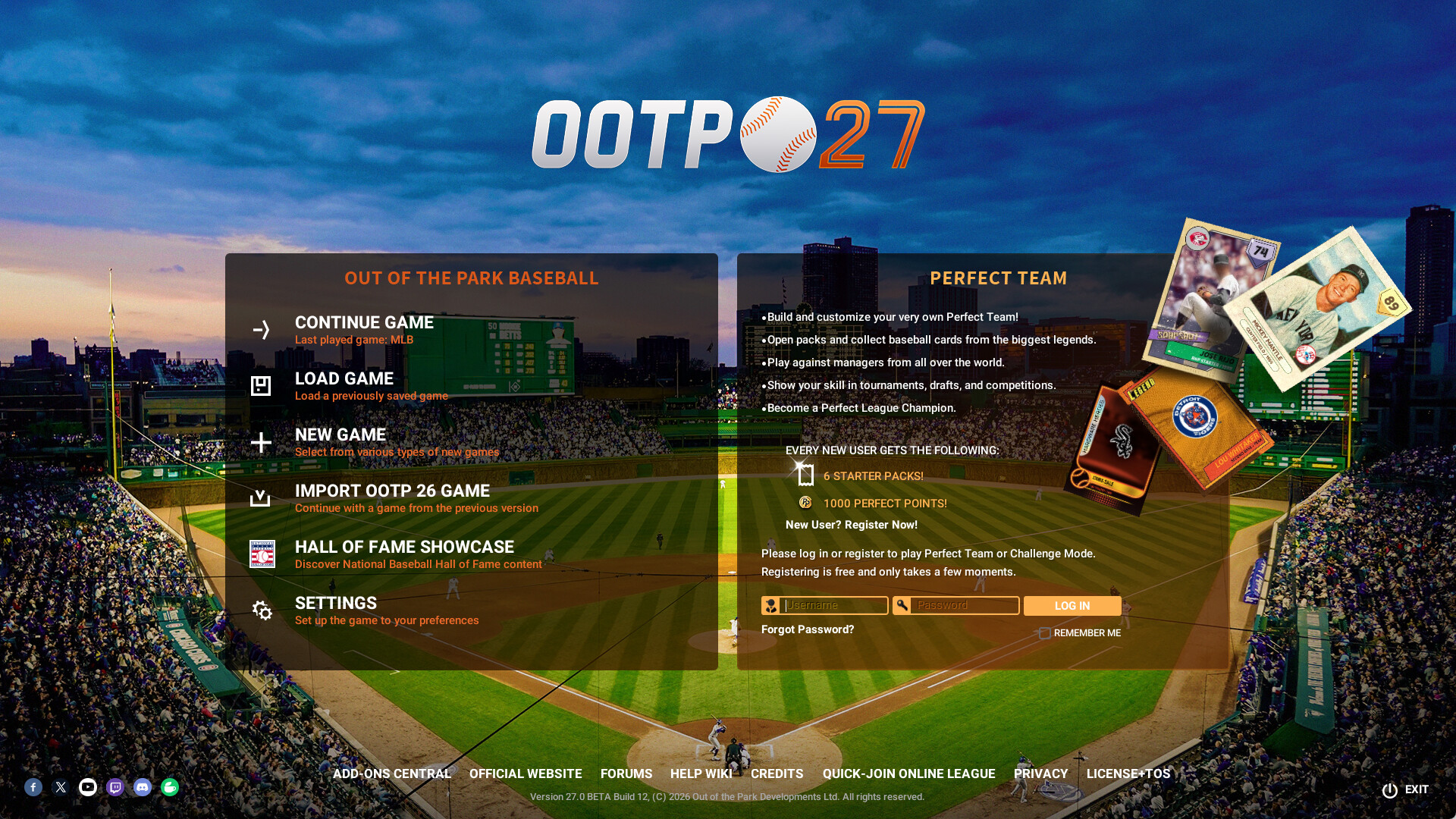
The main menu splits the core GM simulation from the card-collecting Perfect Team modeImage: Out of the Park Developments -
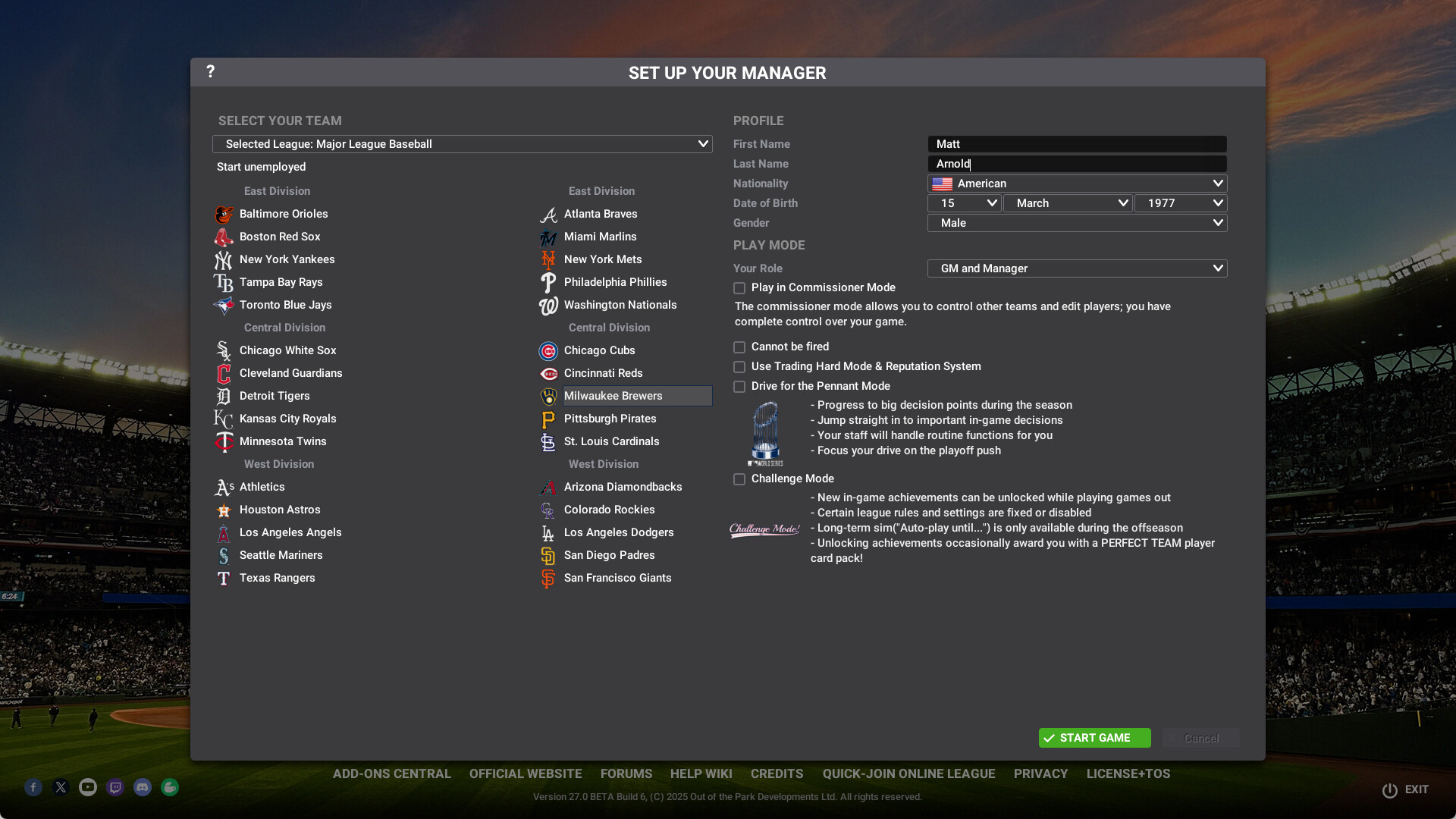
Setting up a new game, from team selection to GM role and difficulty optionsImage: Out of the Park Developments -
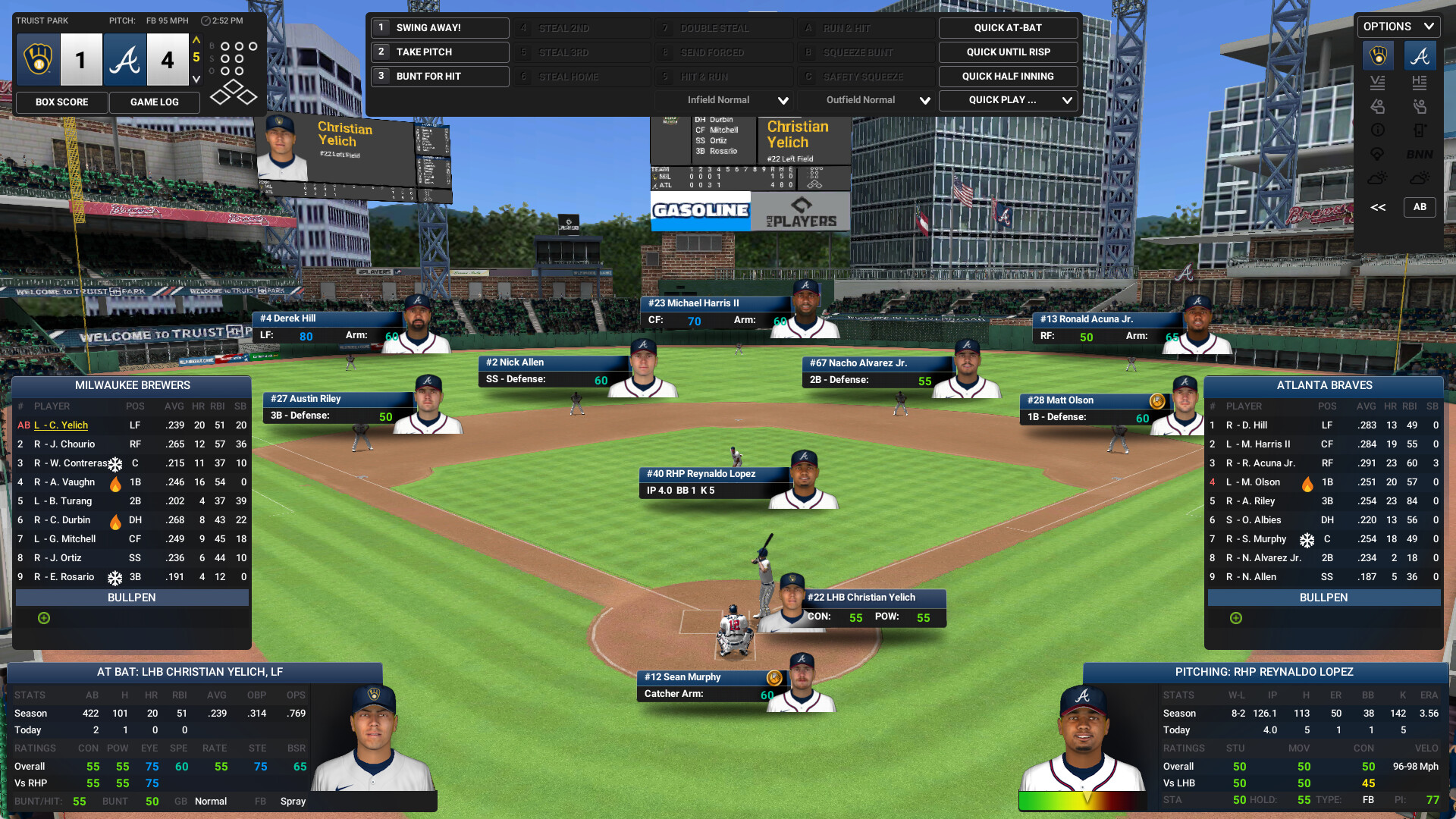
The 3D game engine renders every plate appearance, complete with full stat overlaysImage: Out of the Park Developments -
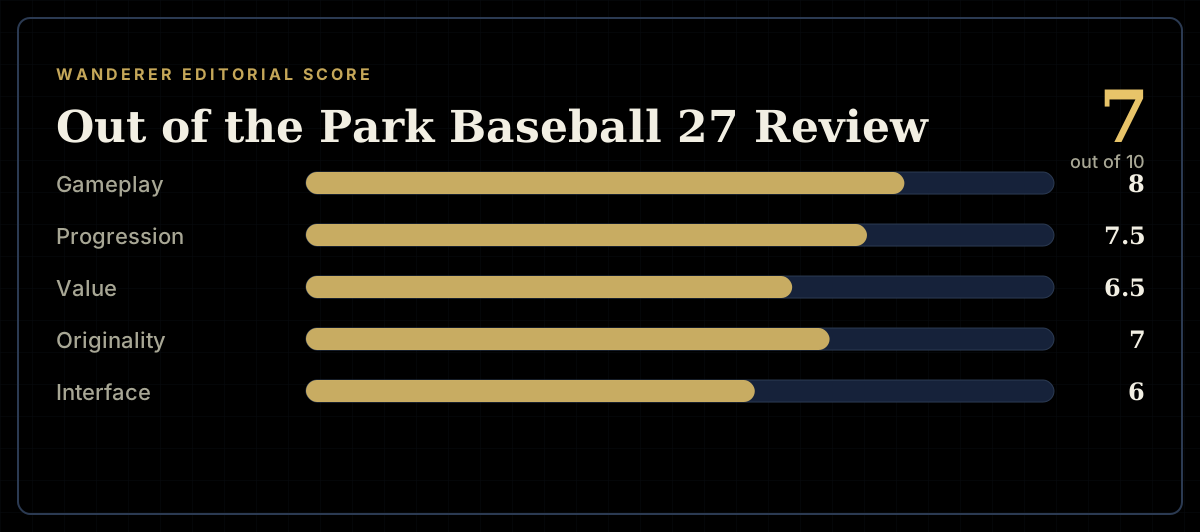
How the review scores each part of the gameWanderer Editorial -
The short versionWanderer Editorial