Game review
Necromancer Idle: The Endless Drain
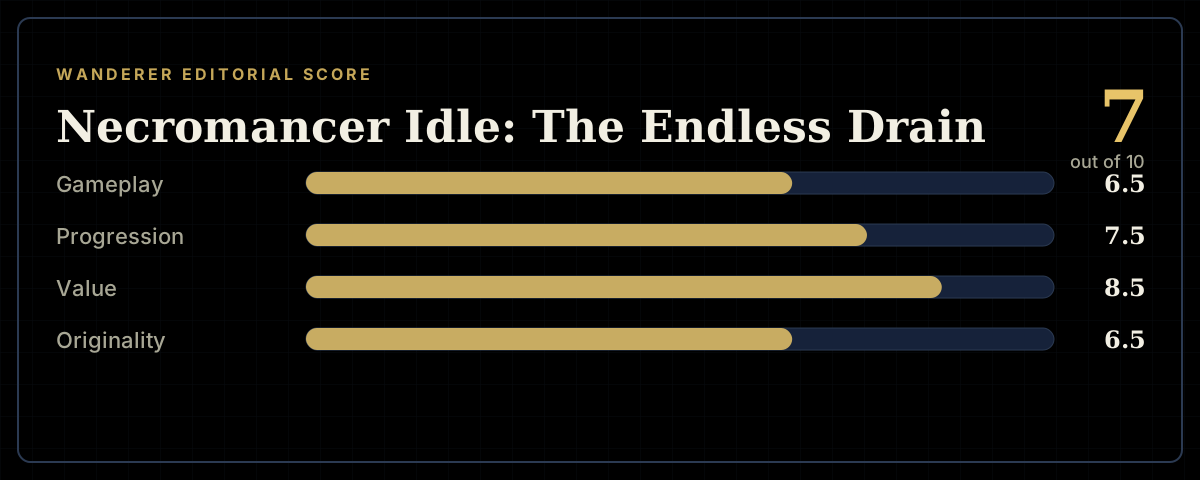
7 / 10
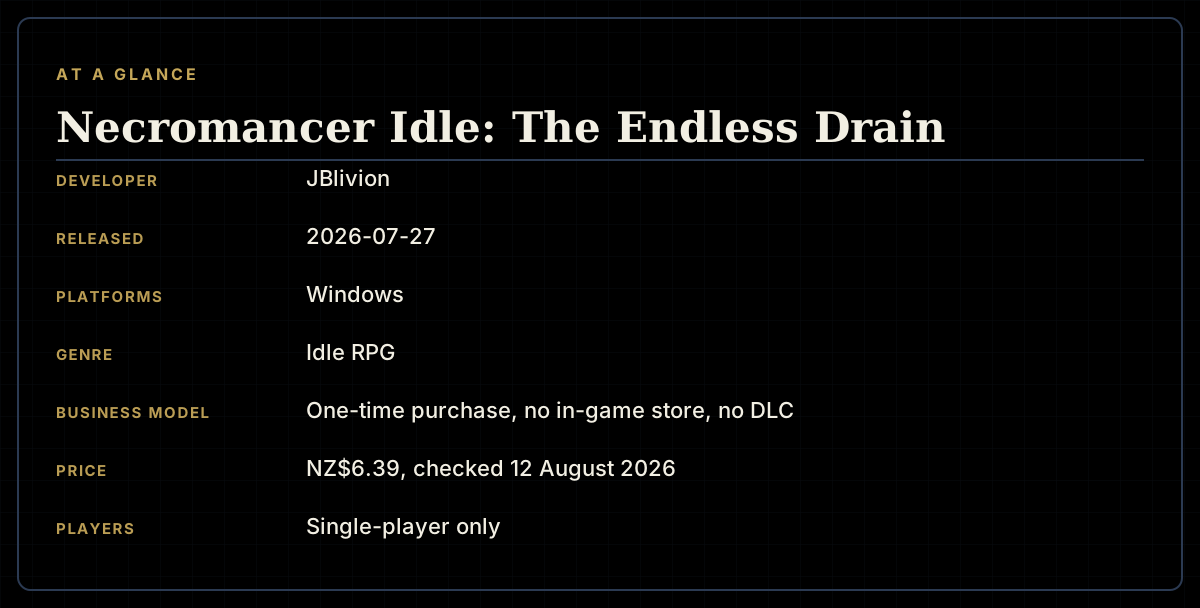
- Developer
- JBlivion
- Publisher
- JBlivion
- Released
- 27 July 2026
- Platforms
- Windows
- Genre
- Idle RPG
- Monetisation
- One-time purchase, no in-game store, no DLC
- Players
- Single-player only
The short version
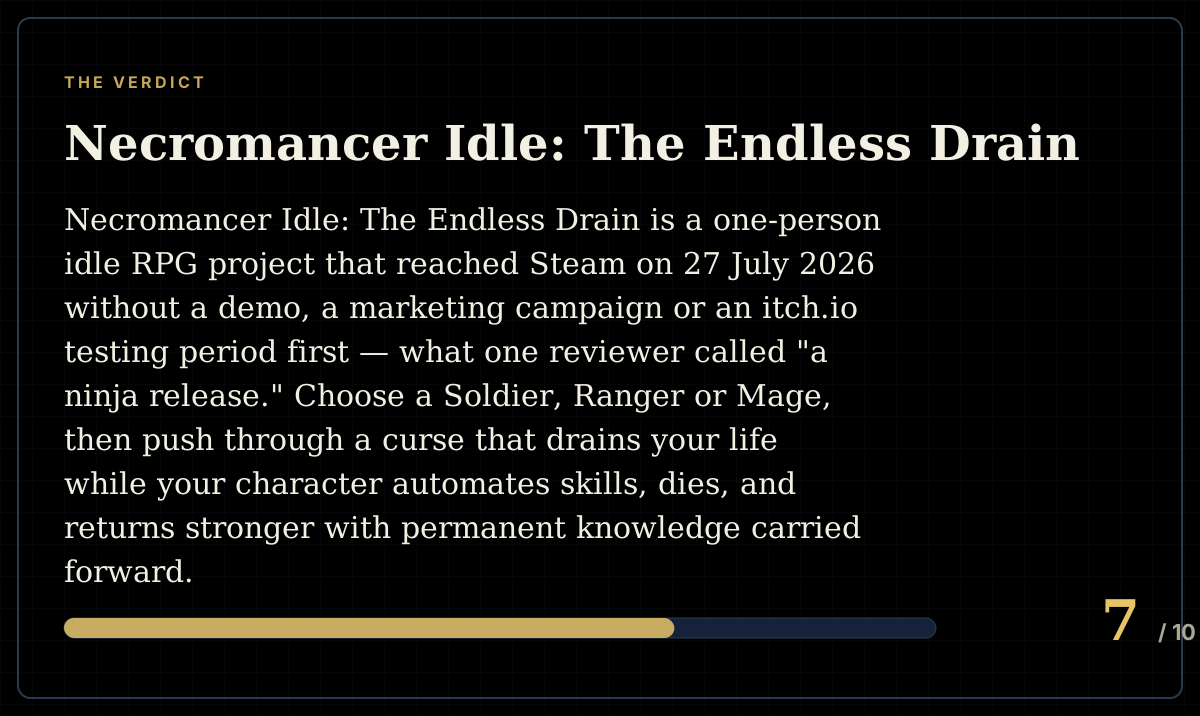
Necromancer Idle: The Endless Drain is a one-person idle RPG project that reached Steam on 27 July 2026 without a demo, a marketing campaign or an itch.io testing period first — what one reviewer called "a ninja release." Choose a Soldier, Ranger or Mage, then push through a curse that drains your life while your character automates skills, dies, and returns stronger with permanent knowledge carried forward. Sixteen days in, it holds a small but genuinely enthusiastic Positive rating, and its most-repeated comparison — to the well-regarded idle RPG Increlution — is meant, and taken, as a compliment.
The review sample is small enough to read in full, and it splits cleanly along a fault line this library sees often in the idle genre: reviewers logging well over a hundred hours describe a patient, narratively layered game rewarding long-term investment, while at least one reviewer dismisses the entire premise as "just bars going up" with no real interaction underneath. Both readings are honest descriptions of the same game — they just disagree about whether that's the point or the problem.
Biggest strengths
- Reviewers who stuck with it report exceptional depth for the price, with logged playtimes running into the hundreds of hours and still describing new systems left to explore
- The reincarnation structure — permanent "innate" experience carried between deaths, plus player-created characters who can reappear to help future runs — draws specific, repeated praise as more interesting than a simple prestige reset
- No cash-grab signals of any kind: a single upfront price, no demo-to-launch funnel, and multiple reviewers explicitly credit the developer for releasing without hype or pre-launch marketing
Biggest weaknesses
- At least one reviewer dismisses the core loop outright as "just bars going up," with no meaningful interaction or sense of what's actually happening — a fair description of the moment-to-moment experience if the narrative and system layers don't grab you
- The pacing is slow even by idle-genre standards, and several positive reviewers note it takes real hours before the game's more interesting mechanics — multi-character interplay, route choices, class-specific obstacles — become apparent
- The interface draws mild but repeated criticism, including a wish for better menu-snapping and small lore blurbs attached to actions
Who it's for: Fans of slow-burn, narrative-flavoured idle RPGs — especially anyone who already knows and likes Increlution — who are prepared to invest real hours before the game's systems fully open up. Not suited to players who want visible, moment-to-moment interaction or a quick session; this is a background-running, long-haul game by design.
Our recommendation: At NZ$6.39 with no in-game monetisation and a solo developer patching multiple times a week since launch, this is an easy, low-risk pickup for idle RPG fans specifically — just go in understanding the pacing is genuinely slow and the interesting systems reveal themselves over dozens of hours, not the first few.
7 / 10
Introduction
Some releases arrive with trailers, wishlist campaigns and a Next Fest demo run. Necromancer Idle: The Endless Drain arrived on 27 July 2026 with none of that — a single solo developer's page going live with no prior public testing period, which one reviewer clocked immediately: "Seems like a ninja release without any promotions, demo and itch.io iterations which tells me that it isn't a cash grab and probably a quality pet project." Sixteen days later, the game has exactly twelve reviews — a small enough number that this review has read every one of them rather than a sample — and ten of those twelve are enthusiastic, several from players who've logged well over a hundred hours already.
Dying, remembering, and doing it again
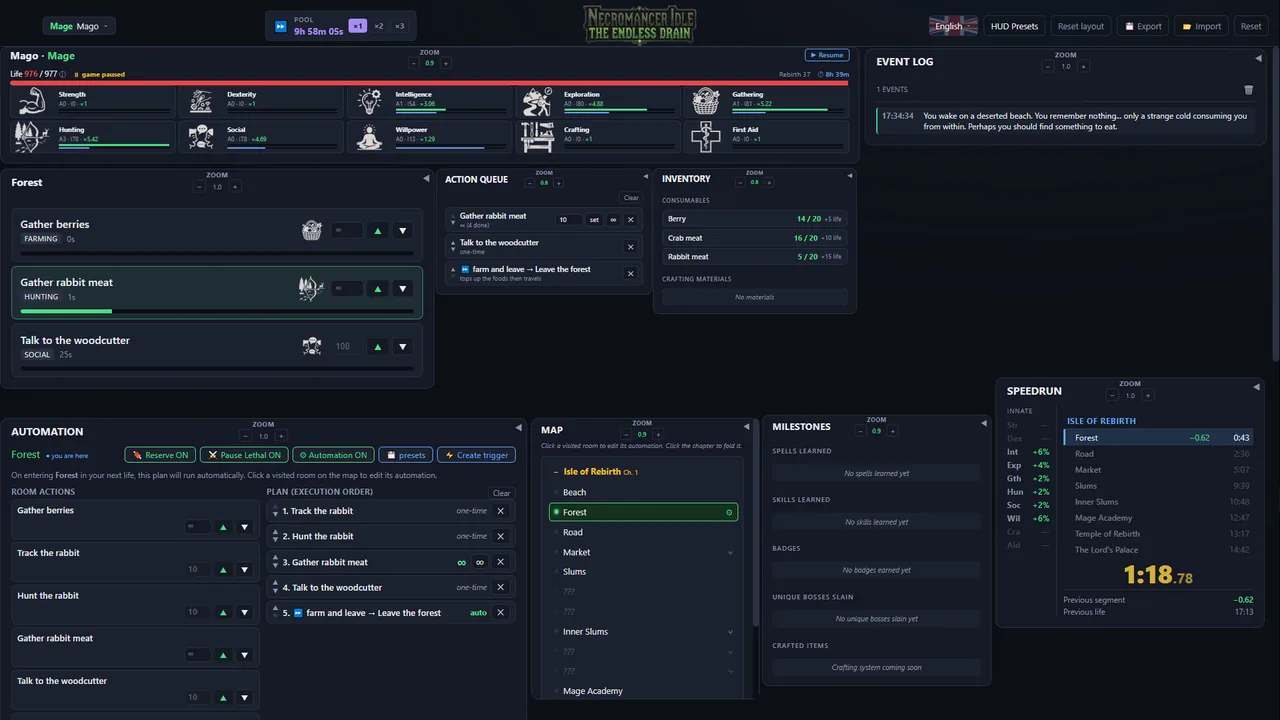
The premise is straightforward fantasy framing wrapped around a genre-standard idle loop with one real twist. Choose a Soldier, Ranger or Mage, and your character automatically trains skills and fights through a world drained by a necromancer's curse. Death isn't a failure state; it's the game's central mechanic. Each life ends, but "innate" experience — as opposed to the temporary "learned" experience gained during that specific run — carries forward permanently, making every subsequent attempt faster and stronger. That's a recognisable prestige structure to anyone who's played this corner of the idle genre before, and reviewers repeatedly name the game it most resembles: Increlution, a well-regarded idle RPG the wider genre treats as something of a reference point. "Increlution clone — Yes, but seems like it has more features and a better interface," wrote one reviewer, framing the comparison as a compliment rather than a knock, and several others independently reach for the same name.
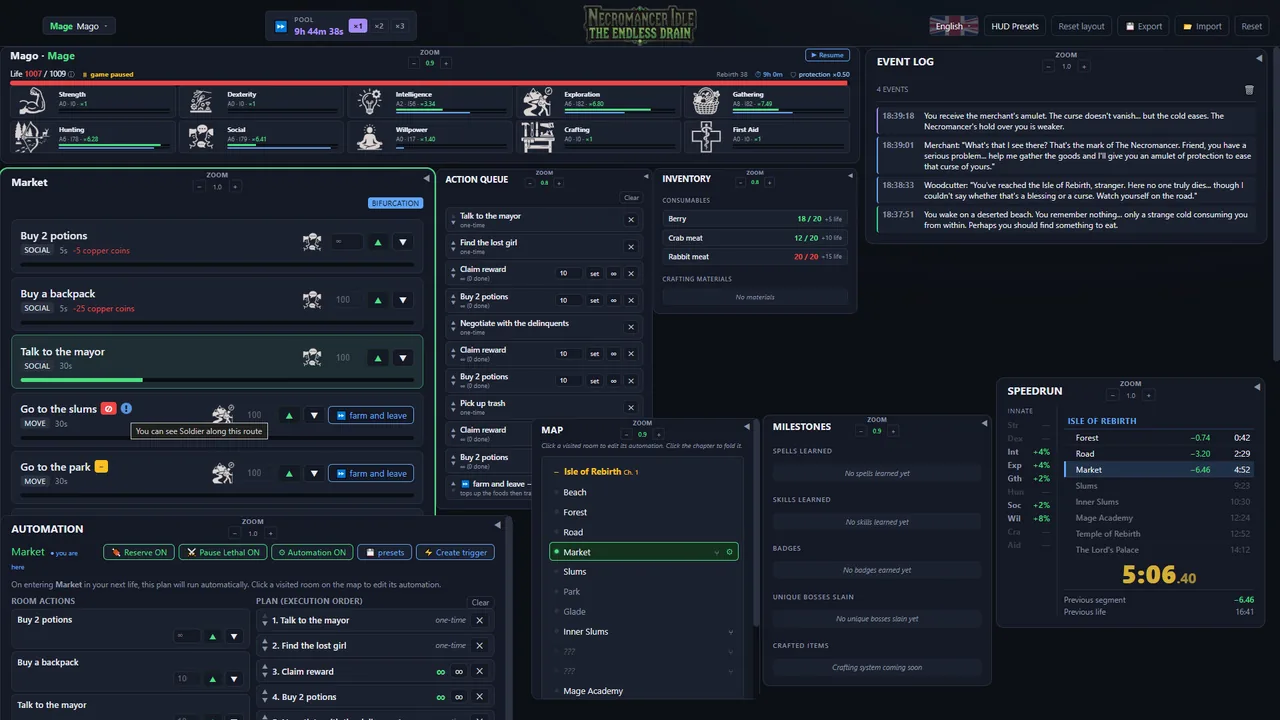
Where Necromancer Idle adds its own wrinkle is in how player-created characters persist. Rather than each new life existing in total isolation, characters you've previously created can reappear later to help — or occasionally hinder — a current run, opening paths and rewards that would otherwise be inaccessible to a given class alone. One reviewer flagged this directly as a stand-out: "having multiple characters is hella interesting," while noting they'd already rolled three just to see how the system played out early. Combined with genuinely branching route choices — some obstacles are deliberately harder for a given class, with the harder path sometimes hiding class-specific rewards — the structure asks for real strategic thinking about when to push through difficulty and when to detour, rather than presenting one obvious optimal line.
The case against it, stated plainly
It would be dishonest to let the enthusiasm above stand as the whole story, because the negative side of this review's sample makes a real, coherent argument rather than a drive-by complaint. "Not really much of a game, just bars going up, not any real sense of what is going on, no real interaction," wrote the more detailed of the two negative reviewers, logging over 250 hours before concluding that two days of active attention had produced no new understanding of what the game's systems were actually doing. A second, much shorter negative review put it more bluntly: "This is boring as ****. Its just watching progress bars load... None of my level ups do anything but make the bars move faster. Not a good idle game."
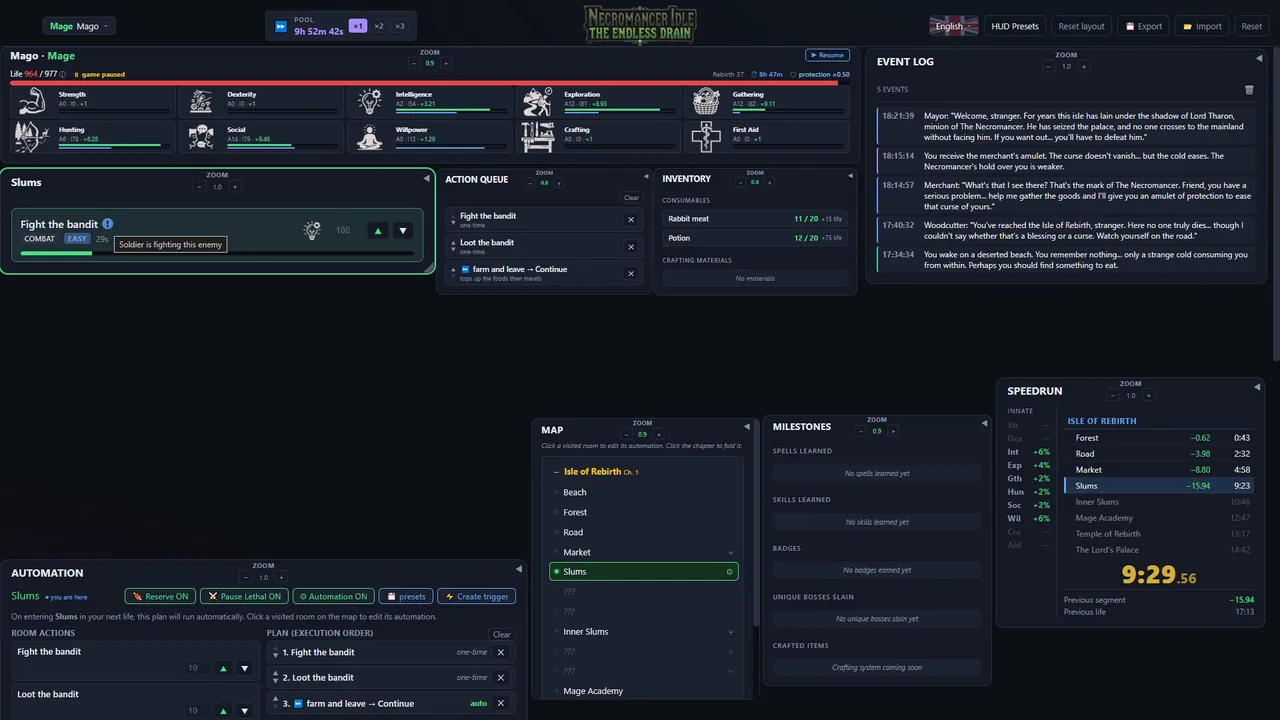
That's worth taking seriously rather than dismissing, because it's not wrong about the moment-to-moment experience — Necromancer Idle genuinely is, at the surface level, a set of bars filling and skills automating with minimal direct input. The disagreement between the two camps in this small sample isn't about what the game does; it's about whether the narrative framing, the reincarnation structure and the slowly-unlocking multi-character interplay are enough to make that loop feel purposeful over time. The positive reviewers with the highest logged hours — 257, 213, 142, 123 — all frame their enjoyment in exactly those longer-arc terms, describing runs getting incrementally faster, new areas opening, and narrative beats landing as they progress. The negative reviewer with the highest logged hours, notably, logged the same order of magnitude of playtime (257 hours) and still came away unconvinced — so this isn't purely a matter of not giving it enough time. It's a genuine, honest split in what different idle-genre players want from the format.
Evidence the pacing is real
One useful, independently verifiable data point: Steam's achievement completion data confirms this is a long, honestly-structured game rather than a short loop wearing a big number on the box. The first milestone, dying for the first time, sits at 79% — nearly everyone who tries the game reaches it quickly, as expected. From there the curve drops steadily through the game's chapter-boss achievements: 37.9% for the Chapter 1 boss, 25.4% for Chapter 2, 16.0% for Chapter 3, 7.8% for Chapter 4, and just 0.3% globally for actually defeating the Necromancer. That's a much steeper, longer curve than the handful of two-to-four-hour incrementals this library has covered this same week, and it corroborates what the high-playtime positive reviews describe directly: this is built to be played for a long time, and very few players — so far — have reached the end of it.
A developer who's still actively working on it
Since launch, the developer has shipped a steady cadence of fixes and small content updates: a "Key Items & Fullscreen" update the day after release, a 1.0.1 patch on 31 July, 1.0.2 on 5 August, back-to- back hotfixes on 9 and 10 August, and a 1.0.3 patch on 11 August. One reviewer specifically credits this responsiveness: "as soon as they receive feedback about an issue, finds a solution in no time." That's a meaningful signal for a NZ$6.39 solo project with essentially no marketing budget behind it — this isn't a game that shipped and went quiet.
Final Verdict
Necromancer Idle: The Endless Drain is a small, quiet release that rewards patience specifically, and punishes impatience specifically — there's very little middle ground in how its own reviewers describe it. Players willing to invest real hours, particularly anyone who already has a soft spot for Increlution-style idle RPGs, describe a genuinely deep, narratively considered game with a reincarnation system smarter than a simple number reset. Players expecting more immediate engagement, or skeptical of the "watch the bars, trust the process" idle-genre promise generally, will likely find the surface-level experience exactly as thin as the harshest review in this sample describes. At NZ$6.39, with no monetisation risk and a developer actively patching the game more than two weeks after launch, the downside of trying it is small. Go in expecting a slow burn rather than instant gratification, and this is one of the more quietly interesting idle RPGs this library has come across recently.
Pros and cons
Pros
- Reviewers who stuck with it report exceptional depth for the price, with logged playtimes running into the hundreds of hours and still describing new systems left to explore
- The reincarnation structure — permanent "innate" experience carried between deaths, plus player-created characters who can reappear to help future runs — draws specific, repeated praise as more interesting than a simple prestige reset
- No cash-grab signals of any kind: a single upfront price, no demo-to-launch funnel, and multiple reviewers explicitly credit the developer for releasing without hype or pre-launch marketing
- The developer has shipped patches and hotfixes on at least five separate dates within the game's first two and a half weeks, including responses to specific bugs reviewers reported
- Achievement data confirms genuine long-form structure rather than padding: completion drops steadily and steeply from a 79% first-death milestone down to 0.3% for defeating the Necromancer, indicating a long, honestly-paced campaign rather than a short loop dressed up big
Cons
- At least one reviewer dismisses the core loop outright as "just bars going up," with no meaningful interaction or sense of what's actually happening — a fair description of the moment-to-moment experience if the narrative and system layers don't grab you
- The pacing is slow even by idle-genre standards, and several positive reviewers note it takes real hours before the game's more interesting mechanics — multi-character interplay, route choices, class-specific obstacles — become apparent
- The interface draws mild but repeated criticism, including a wish for better menu-snapping and small lore blurbs attached to actions
- A reproducible bug in the "Temple of Rebirth" sequence, reported by one reviewer, can skip a scripted "heal" step early — a beneficial glitch for the player, but still a sign of an undertested edge case
- With only twelve reviews at time of writing, any read on lasting reception is necessarily provisional, even though this review has read the complete sample
Screenshots
-
Necromancer Idle: The Endless DrainImage: JBlivion via Steam -
Necromancer Idle: The Endless DrainImage: JBlivion via Steam -
Necromancer Idle: The Endless DrainImage: JBlivion via Steam -
How the review scores each part of the gameWanderer Editorial -
The essentials at a glanceWanderer Editorial -
The short versionWanderer Editorial