Game review
Murder at the Birch Tree Theater
7.5 / 10
- Developer
- Crucible Juice Games
- Publisher
- Crucible Juice Games
- Released
- 15 March 2026
- Platforms
- Windows
- Genre
- Adventure / Indie / Puzzle / Mystery
- Monetisation
- One-time purchase
- Players
- Single-player
The short version
Murder at the Birch Tree Theater takes The Case of the Golden Idol's click-and-deduce word-cloud puzzle formula and sets it in a falling-apart community theater staffed by quirky animal actors, working through ten increasingly dramatic productions to piece together who did what to whom. Developed and published solo by Crucible Juice Games, it released 15 March 2026 at $14.99. Its review sample is warm and consistent: reviewers love its musical-theater heart, original songs, and humor, broadly agree it is easier and rougher around the edges than its inspiration, and repeatedly single out an overstuffed, unsatisfying final chapter as its weakest link.
Biggest strengths
- This review's sample repeatedly praises the game's heart and presentation, calling it 'clearly made with a lot of heart,' crediting its original musical score and voiced numbers as 'a pleasant surprise,' and specifically highlighting its detailed, affectionate parodies of real musical theater, down to original sheet music for in-game songs
- This review checked the global achievement data and found a gentle, steady completion curve across all ten chapters, from 93.6% on the first down to 67.2% on the last, corroborating the review sample's frequent description of the game as 'bite-sized' and easier to finish than its genre benchmark rather than a game most buyers abandon partway through
- This review checked the store's category tags and found an unusually strong accessibility list for a puzzle game in this genre: Adjustable Text Size, Color Alternatives, Custom Volume Controls, Save Anytime, and both 'Playable at Your Own Pace' and 'Playable without Timed Input,' meaning nothing about the core deduction loop demands quick reflexes
Biggest weaknesses
- This review's sample repeatedly frames the puzzle difficulty as a step down from the genre's namesake, with one reviewer summarizing it as Golden Idol 'without the part where you have to think creatively and fill in the gaps,' describing solutions as spelled out rather than inferred
- This review's sample singles out the same weak point from multiple independent reviewers: the final chapter is 'overly convoluted,' 'doesn't fit the personality of the main characters as established,' and 'tarnishes the game a bit' after nine chapters most reviewers otherwise enjoyed
- This review checked the achievement data for the built-in hint system and found only 39.6% of tracked players ever triggered it, a modest figure that, read alongside reviewer complaints about occasionally 'obtuse' puzzles and hard-to-see click prompts, suggests many players who got stuck simply pushed through rather than reaching for the help on offer
Who it's for: Fans of The Case of the Golden Idol and its imitators who want a gentler, funnier entry point into the genre, and anyone with a soft spot for musical theater in-jokes; a poor fit for genre veterans specifically chasing Golden Idol's toughest, most inferential puzzle highs.
Our recommendation: A warm, easy recommendation for deduction-puzzle fans, especially newcomers to the genre or anyone drawn to its musical-theater setting, tempered only by a final chapter that several reviewers feel undercuts an otherwise well-loved package.
7.5 / 10
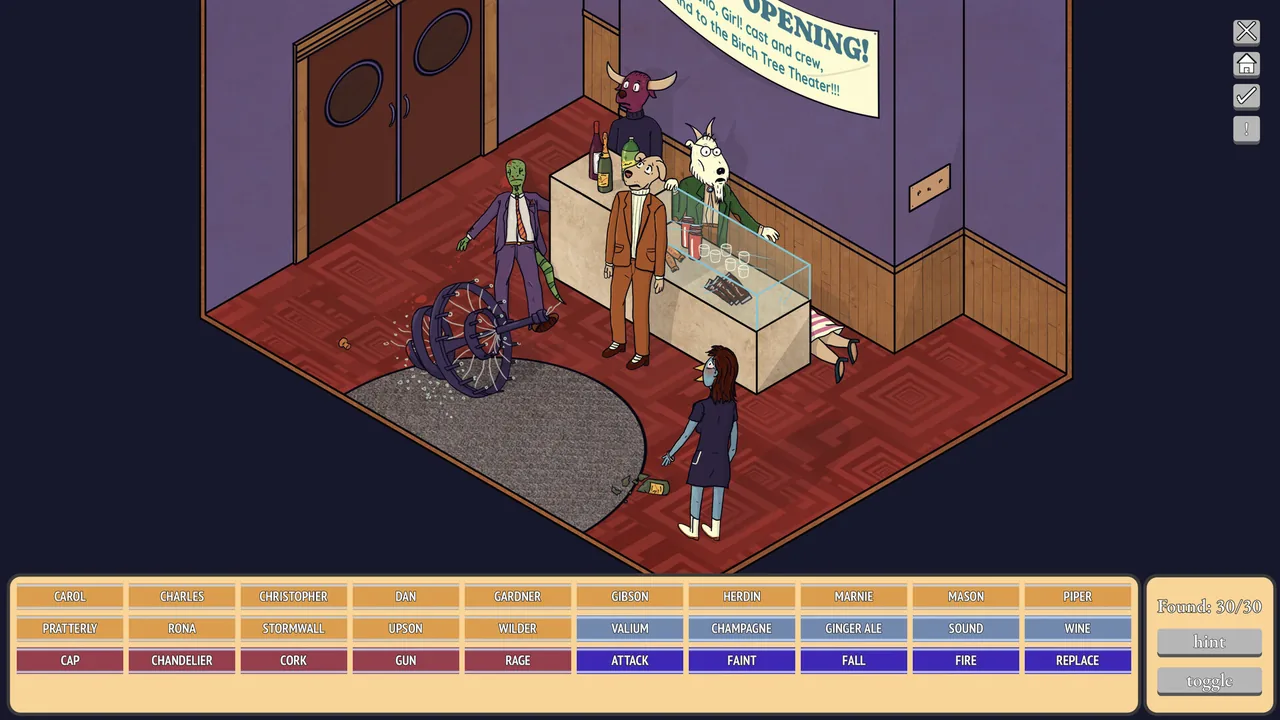
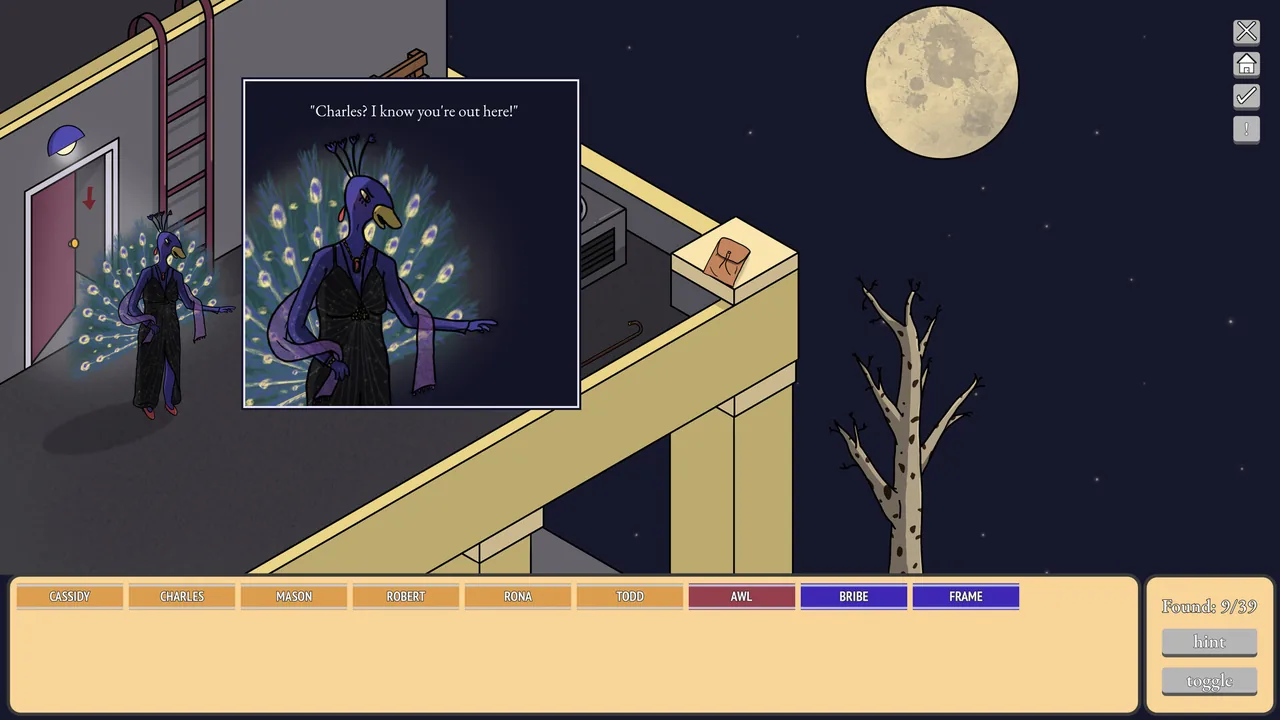
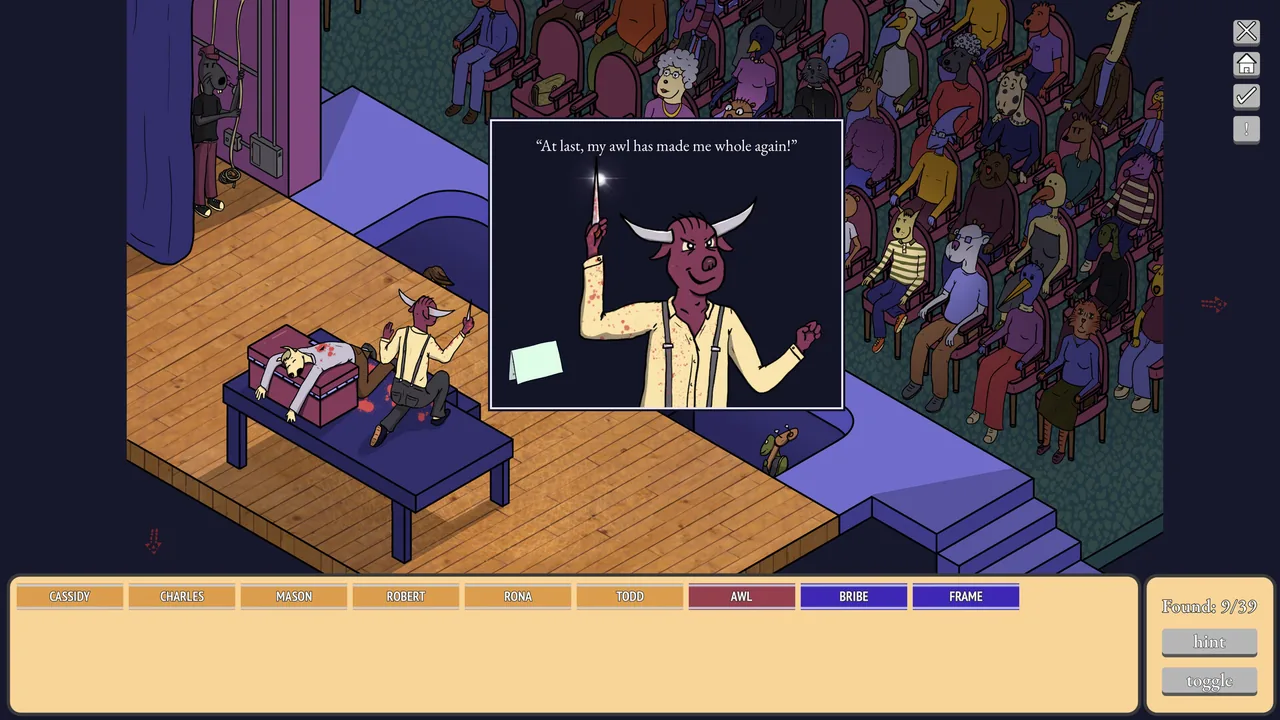
Murder at the Birch Tree Theater borrows its entire investigative interface from The Case of the Golden Idol, click on highlighted objects and dialogue to build a word cloud, then drag the right words into blanks to explain who did what, and points it at a much sillier target: ten backstage crimes across a struggling small-town community theater staffed by quirky animal actors. It's developed and published solo by Crucible Juice Games and released 15 March 2026 at $14.99. This review draws on roughly 30 individual reviews read across the game's full 132-review, all-language total, alongside its global achievement data and the developer's post-launch patch history.
Wearing its inspiration openly, and getting credit for it
Nearly every review in this sample opens by naming The Case of the Golden Idol directly, and this review checked the credits, which reviewers note explicitly acknowledge the Golden Idol team's blessing for reusing its interface. Rather than counting against it, that transparency seems to have earned goodwill: reviewers treat the borrowed mechanic as a foundation to build a very different tone on top of, not a lack of originality, and several specifically welcome a growing genre of "Golden-Idol-likes" rather than resenting another entry in it.
A musical-theater setting reviewers say was made with real love
What reviewers credit as genuinely original is the theming. Multiple reviews describe original songs, voiced musical numbers, and detailed parodies of real musicals, one reviewer notes the game even provides sheet music for its in-game songs, as evidence of a developer with deep, specific affection for the subject. This review found that affection cited constantly as the game's emotional core, with reviewers repeatedly using words like "heart," "love," and "delight" well beyond what a straightforward puzzle-mechanics clone would typically earn.
Easier than its inspiration, and reviewers are split on whether that's a problem
The most consistent critical thread in the sample is difficulty. Several reviewers state plainly that the puzzles are more straightforward than Golden Idol's, with one summarizing it as lacking "the part where you have to think creatively and fill in the gaps," offering answers that are effectively spelled out rather than inferred. Other reviewers frame the same trait positively, calling it "cozy" and appropriately gentler for a game more focused on story and comedy than on punishing logic. This review reads the difference as a genuine design choice with real trade-offs rather than a straightforward flaw, since it clearly works for the majority of the sample even as a vocal minority misses the harder edge.
What the completion curve confirms about that choice
This review checked the global achievement data and found a notably gentle drop-off across the game's ten chapters, from 93.6% completion on the first chapter down to 67.2% on the last, a shallower decline than many puzzle games in this lane show. That pattern independently supports the review sample's read: whatever difficulty exists here, it isn't steep enough to make most players quit partway through, which lines up with reviewers who call the game accessible and "bite-sized" rather than a slog.
A final chapter that repeatedly drags down an otherwise well-loved game
If this review sample agrees on one specific weakness, it's the ending. Multiple, independent reviewers single out the final chapter as "overly convoluted," inconsistent with the established personalities of its characters, and directly responsible for lowering their overall opinion of an experience they otherwise enjoyed throughout. This review treats that repetition, several unconnected reviewers reaching for nearly identical language, as a genuine structural soft spot rather than one player's individual taste, and prospective buyers should go in expecting the game's strongest material to be front-loaded.
Rough edges the developer was quick to patch
This review checked the developer's partner-events feed and found five patches released within about three weeks of launch, versions 1.02 through 1.06, a fast post-launch cadence for a solo developer. That responsiveness lines up with reviewer complaints about "clumsy" drag-and-click controls and occasionally hard-to-see interactive prompts, issues that appear to have been actively targeted rather than left unaddressed, even if this review can't confirm every specific complaint was fully resolved by the most recent patch.
A hint system some players may not have found worth using
This review checked the achievement tied to using the game's built-in hint system and found only 39.6% of tracked players ever triggered it, despite reviewer complaints about "obtuse" puzzles and unclear prompts elsewhere in the sample. Read together, that gap suggests a meaningful share of players who hit a confusing moment chose to push through rather than lean on the help the game offers, whether because the hint system itself is hard to find, or because the puzzles' apparent simplicity discourages players from reaching for it.
A genuinely accessible puzzle game by design
This review checked the store's category tags directly and found a stronger accessibility offering than most games in this genre: Adjustable Text Size, Color Alternatives, Custom Volume Controls, Save Anytime, and both "Playable at Your Own Pace" and "Playable without Timed Input." Combined with the achievement data's gentle difficulty curve, this reads as a deduction game genuinely built to welcome newcomers to the genre rather than gatekeeping them the way its inspiration sometimes can.
Verdict
Murder at the Birch Tree Theater takes a well-loved puzzle interface, points it at a setting soaked in real affection for musical theater, and delivers a warm, funny, broadly accessible mystery game that most of its review sample genuinely loved, right up until an overstuffed final chapter several reviewers feel doesn't stick the landing. At $14.99 for ten mostly well-regarded cases and a soundtrack reviewers keep singling out, it's an easy recommendation for deduction-genre fans, and a gentler entry point than its inspiration for anyone newer to the format.
Pros and cons
Pros
- This review's sample repeatedly praises the game's heart and presentation, calling it 'clearly made with a lot of heart,' crediting its original musical score and voiced numbers as 'a pleasant surprise,' and specifically highlighting its detailed, affectionate parodies of real musical theater, down to original sheet music for in-game songs
- This review checked the global achievement data and found a gentle, steady completion curve across all ten chapters, from 93.6% on the first down to 67.2% on the last, corroborating the review sample's frequent description of the game as 'bite-sized' and easier to finish than its genre benchmark rather than a game most buyers abandon partway through
- This review checked the store's category tags and found an unusually strong accessibility list for a puzzle game in this genre: Adjustable Text Size, Color Alternatives, Custom Volume Controls, Save Anytime, and both 'Playable at Your Own Pace' and 'Playable without Timed Input,' meaning nothing about the core deduction loop demands quick reflexes
- This review checked the developer's partner-events feed and found five patches released within three weeks of launch (versions 1.02 through 1.06), a fast, responsive cadence that lines up with reviewer complaints about UI roughness being addressed quickly rather than left to linger
Cons
- This review's sample repeatedly frames the puzzle difficulty as a step down from the genre's namesake, with one reviewer summarizing it as Golden Idol 'without the part where you have to think creatively and fill in the gaps,' describing solutions as spelled out rather than inferred
- This review's sample singles out the same weak point from multiple independent reviewers: the final chapter is 'overly convoluted,' 'doesn't fit the personality of the main characters as established,' and 'tarnishes the game a bit' after nine chapters most reviewers otherwise enjoyed
- This review checked the achievement data for the built-in hint system and found only 39.6% of tracked players ever triggered it, a modest figure that, read alongside reviewer complaints about occasionally 'obtuse' puzzles and hard-to-see click prompts, suggests many players who got stuck simply pushed through rather than reaching for the help on offer
- This review's sample includes a specific complaint about voice acting quality, with one reviewer calling it 'strangely bad' and suspecting a single voice actor covered every role, alongside recurring smaller gripes about a lack of an in-scene indicator for remaining unclicked clues
Screenshots
-
Murder at the Birch Tree TheaterImage: Crucible Juice Games via Steam -
Murder at the Birch Tree TheaterImage: Crucible Juice Games via Steam -
Murder at the Birch Tree TheaterImage: Crucible Juice Games via Steam