Game review
Morhval: Ravenglaire
6.5 / 10
- Developer
- Seven Weeks Studios
- Publisher
- Seven Weeks Studios
- Released
- 5 August 2026
- Platforms
- Windows
- Genre
- Open-World RPG / Survival Sandbox
- Monetisation
- One-time purchase, no in-game store, no IAP. The developer states in the Early Access FAQ that price will rise as content is added during Early Access, with a higher price again at 1.0.
- Players
- None; fully single-player
The short version
Morhval: Ravenglaire is a first-person open-world RPG built by a single developer around one idea: every system in a 250 km² procedural province — combat, crafting, magic, farming, crime, romance, family upkeep and slave-trade abolition alike — feeds the same skill-and-attribute character rather than sitting off to the side as a minigame. That ambition is genuine and the scope already on the ground at launch is unusually large for a day-one Early Access build. It is also, by the developer's own account, unfinished: the main storyline isn't in the game yet, and AI, animation, interface and balance are all described as rough. This is a review of a promising, honestly-labelled skeleton, not a finished sandbox.
Biggest strengths
- The skill system genuinely ties combat, crafting, dialogue and exploration into one shared ladder — skills improve through use rather than menus, and mastering a discipline to 100 unlocks three tiers of Prestige specialization on specific spells, weapons, potions or crops
- A working family-upkeep system turns ordinary jobs personal: your parents' pantry empties every day whether or not you send food home, and ignoring it creates debt and lasting consequences rather than a scripted guilt trip
- Systemic depth well beyond most solo Early Access releases — contract negotiation with counteroffers, freight hauling that manages horse energy over real distance, tavern card and dice games with persistent bankrolls, and a crime system that has guards and locals react immediately rather than through a hidden reputation stat
Biggest weaknesses
- The developer's own Early Access FAQ states plainly that the complete main storyline isn't in the current build, and that AI, animations, interface elements, balance and procedural content are all still unfinished or rough
- An estimated 18 to 24 months to 1.0 from a single developer is a long runway for a project this size, and the same FAQ warns that major updates may occasionally require starting a new campaign rather than preserving a save
- No controller support and English-only text and audio, on a game built around dense menus, contracts and dialogue
Who it's for: Players who liked the freedom of classic sandbox RPGs — Mount & Blade, early Kenshi, Morrowind at its jankiest — more than their polish, and who are willing to treat an Early Access purchase as buying into a roadmap rather than a finished game.
Our recommendation: Worth the price for genre fans specifically drawn to systemic, consequence-heavy sandboxes who understand what Early Access means; everyone else should wait for the main storyline and the interface pass the developer has already promised.
6.5 / 10
A province built to be lived in, not cleared
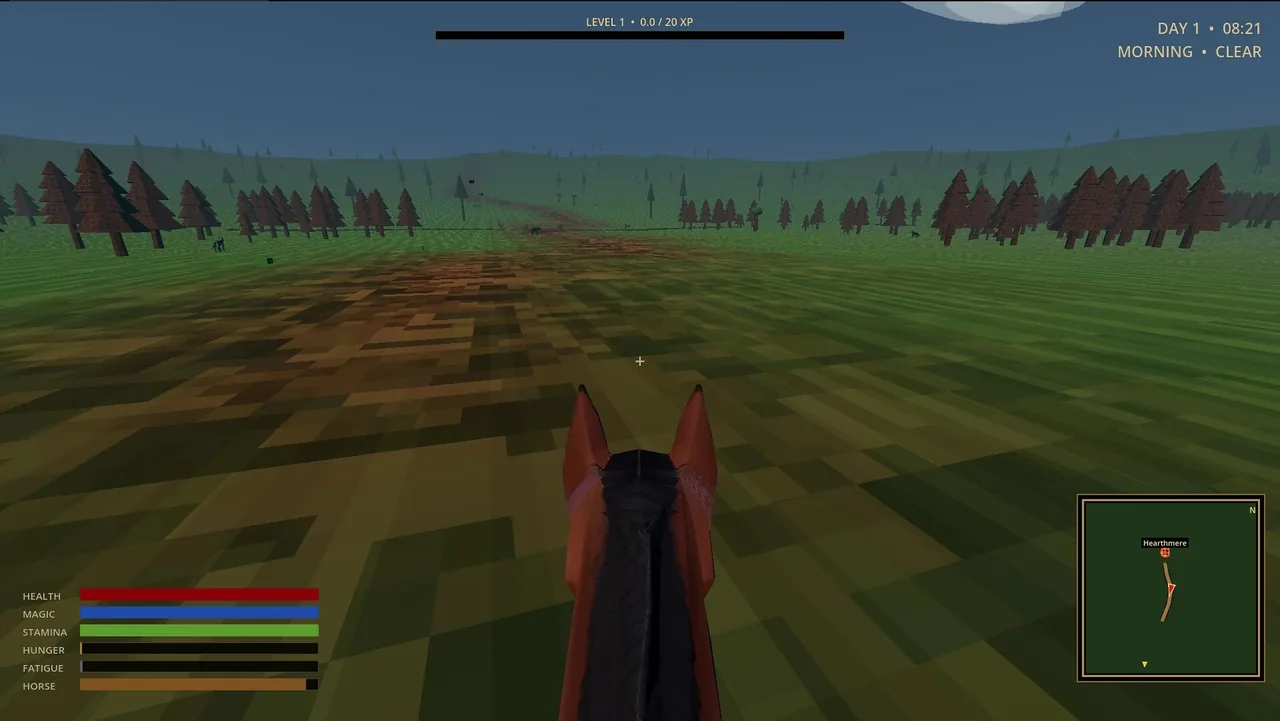
Morhval: Ravenglaire drops you into the world at eighteen years old, in a village called Hearthmere, with whatever meagre equipment and coin your parents could spare and a family pantry already running low. What happens next is entirely open: ride to a distant tavern looking for work, study forbidden magic, join a mercenary order, buy a farm, become a thief, or just walk into the wilderness and see what's there. That pitch — total freedom, real consequences, a world that keeps running whether or not you're looking at it — is a well-worn one in RPG marketing. What makes Ravenglaire worth taking seriously is how much of it is actually built, and how honestly the developer talks about how much isn't.
This is a first-person open-world RPG made by one person, trading under the name Seven Weeks Studios, and it began life as something else entirely. A Steam post from launch day explains that Morhval started as a text-based RPG built around choices and consequence, and that the developer was separately working on a first-person procedural sandbox before deciding to merge the two. The text campaign wasn't abandoned — it's slated to be folded into the 3D game in a future update — but what launched on 5 August 2026 is the systemic sandbox half of that plan, not the finished combination.
What's actually here on day one
It's worth being precise about this, because Early Access listings routinely oversell their current state. The developer's own FAQ on the store page doesn't: asked directly what the current version offers, the answer is that Ravenglaire "currently offers a playable open-world sandbox covering nearly 250 km²," where players can "create a character, select a starting class, improve skills through use, explore on foot or horseback, fight with weapons and magic, trade, negotiate contracts, perform faction and settlement jobs, enter caves and procedural dungeons, loot enemies, camp, rest, manage hunger, gather resources and participate in crafting and economic activities." The same answer states flatly that "the complete main storyline is not currently available" and that "some artificial intelligence, animations, interface elements, balance and procedural content remain unfinished or rough."
That's an unusually specific admission for a launch-day FAQ, and it should be read as the actual scope of the purchase rather than the eventual pitch. Everything described above is reportedly playable today. The main quest, the larger handcrafted cities, and a good deal of visual and AI polish are not.
A single skill ladder underneath everything
The part of Ravenglaire's design most worth an RPG-focused reader's attention is how few separate progression tracks it actually has. A character is defined by six attributes — Strength, Agility, Intelligence, Endurance, Charisma and Speed — and twenty-four skills covering weapons, armour, stealth, persuasion, lockpicking, six schools of magic and practical professions like alchemy, farming, cooking, fishing, mining and smithing. Crucially, none of that sits in a separate crafting or dialogue subsystem: fighting with a bow raises Archery, brewing potions raises Alchemy, working a field raises Farming, and skill checks against the world run on a visible d20-based roll modified by the relevant skill and attributes. Reaching new character levels grants attribute points, and pushing an individual skill to 100 unlocks Prestige training — up to three further tiers of specialization on a specific spell, weapon, potion, meal or crop, trading time and gold for extra power or efficiency.
It's a design that rewards actually doing things rather than shopping for level-up screens, and on paper it's exactly the kind of interconnected system the developer's Early Access FAQ says the whole project is built to test: "Early Access will allow players to help identify problems, balance the economy and progression, improve procedural generation, refine the interface, and determine which parts of the world and its systems should receive the most attention." Whether twenty-four skills sharing one attribute pool actually stays legible over dozens of hours, rather than collapsing into a handful of dominant builds, is exactly the kind of thing that can't be assessed from a store page — and it's also exactly the kind of thing the developer says this Early Access period exists to find out.
Combat, magic, and a world that doesn't pause when you're not fighting
Combat runs in real time across short weapons, long weapons, blunt weapons, bows, crossbows and bare fists, with weapons differentiated by reach, recovery time, stamina cost and critical affinity rather than being reskins of each other. Bows are drawn manually and consume physical arrows; crossbows reload between shots; stamina is spent on attacking, blocking, sprinting and even long-distance travel. Magic runs on six schools with a spellcrafting layer on top — combining components, elemental effects and control or damage types into personal formulae, up to twelve of which a character can keep in their spellbook at once.
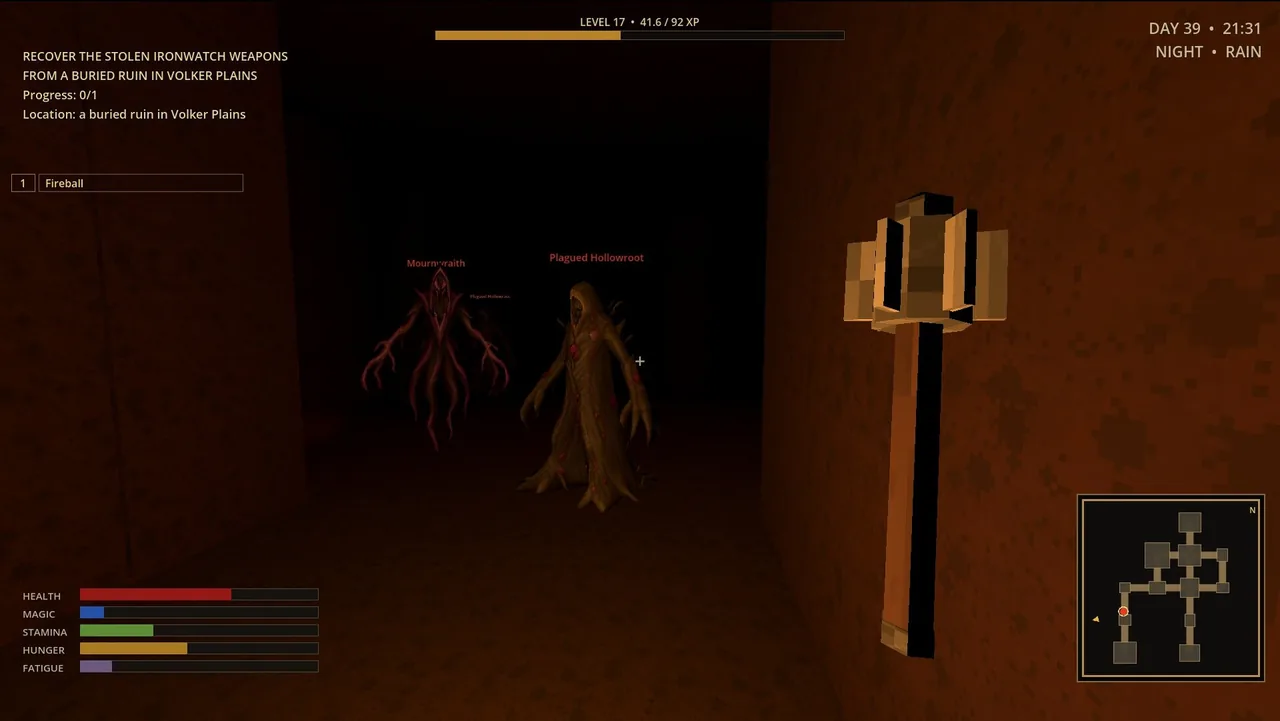
Combat is also only ever half the danger. Hunger and fatigue climb over time, weather and exposure matter, and named diseases — grave fever, rotting wounds, arcane static, anomalous tremors, flu — persist until actually treated with potions, Vitalism or an apothecary. None of that is unusual in survival-RPG hybrids individually, but it's stitched to the same skill-and-attribute character as everything else here, so a bad decision about shelter or food has the same weight as a bad decision in a fight.
The family, the ledger, and the province's harder edges
The systems most worth flagging for readers deciding whether this is their kind of game aren't the combat or the magic — they're the ones built around consequence rather than power. Your parents remain part of the simulation after the opening: their household needs feeding every day, and letting the pantry run dry can weaken them, create debt, and eventually cause permanent consequences. You can walk away from them entirely, at a stated cost the developer describes only as "consequences." A working economy layers supply agreements on top of ordinary trading — propose custom quantities, intervals and prices to residents and businesses, who can accept, reject or counteroffer, and either fulfil the deal manually or automate it through owned property.
The harshest system in the province is its treatment of slavery and abolition. Some settlements permit it and others actively oppose it, with slaver compounds, abolitionist camps, raids and captured NPCs existing as physical, ownable entities in the world rather than as menu flavour text. A player can buy, sell or free an enslaved follower, raid a compound, or build standing with abolitionists — or become a target of retaliation for doing so. The store page is direct that this is intentional: these systems are "intended to create uncomfortable choices and lasting consequences, not a morally neutral commodity loop." It's a serious design swing for a solo project to take, and one that will suit some players' appetite for a genuinely dark sandbox and alienate others outright — worth knowing before buying either way.
A province that regenerates, and the look it wears while doing it
Ravenglaire's roads, settlements, dungeons, factions and points of interest are distributed from a campaign seed while its major authored story locations stay fixed, so a fresh playthrough changes the actual geography rather than just reshuffling loot tables. The developer states the current map already holds more than eighty dungeons and a hundred-plus points of interest across nine named regions, from the cold forests of Hollow Pines to the Redglass desert and a fishable western coastline. The 1.0 target is to roughly double that to 500 km², built out with larger handcrafted cities rather than simple padding — though the FAQ is careful to call that a target rather than a promise, "although the final size may change depending on development and the quality of the added regions."
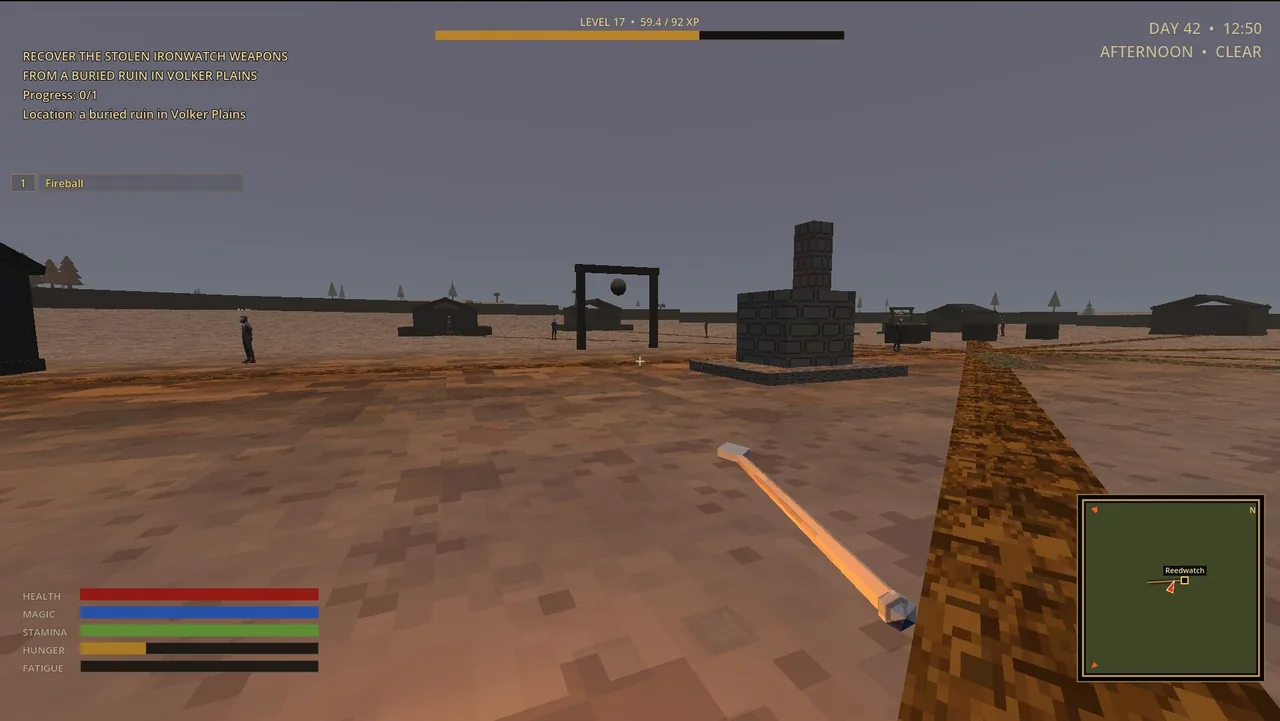
Visually, the project commits hard to a specific throwback: "coarse textures and the atmosphere of late-1990s 3D games," in the developer's own words, applied deliberately rather than as a budget compromise. That's a legitimate aesthetic lineage — it puts Ravenglaire closer to Morrowind or original Gothic than to any modern open-world RPG — but it's also a look that gives a buyer nothing to judge except taste, since there's no meaningful difference yet between "deliberately rough" and "actually unfinished" for a game this early in Early Access.
What Early Access means for this specific purchase
The developer's roadmap answers are worth reading directly rather than summarised, because they're unusually candid for a launch FAQ. Asked how long Early Access will run: "We currently expect Morhval to remain in Early Access for approximately 18 to 24 months. This is an estimate rather than a guaranteed deadline." Asked what changes by 1.0: the main storyline, larger handcrafted settlements, more factions, quests, enemies, dungeons, equipment and spells, plus dedicated work on "artificial intelligence, balancing, performance, interface usability, procedural variety, animations and overall technical stability" — essentially a list of the same things the current FAQ admits are rough today. Pricing is confirmed to rise in steps: "The Early Access price is intended to reflect the content and level of polish available in the current version. The price may increase as major content, features and improvements are added, with a higher price planned for the full 1.0 release."
That's an honest structure and it should be read as such: buying now at NZ$15.39 means buying the roughest, cheapest version of the game that will ever exist, in exchange for the lowest price it will ever have. A follow-up developer post made two weeks after launch reinforces that this is an active, communicative project rather than a launch-and-abandon listing — it names a specific near-term fix (quests feeling "mechanical," with more narrative context planned for an update roughly two to three weeks out) and lays out a longer-term vision of six further provinces beyond Ravenglaire, each with its own laws and culture. None of that is evidence of anything yet, but it's a more concrete commitment than most solo Early Access launches offer on day one.
Final verdict
Morhval: Ravenglaire is genuinely hard to score cleanly, because the honest answer sits between two different reviews. Judged on ambition and design coherence — one skill ladder running through combat, crafting, romance, crime, and a genuinely difficult moral system around slavery and abolition — this looks like one of the more interesting solo RPG projects to land in Early Access this year, and there's already a striking amount of it playable today. Judged on what a buyer actually gets right now, the developer's own words are the fairest summary: no main story yet, rough AI and interface, unfinished balance, and an 18-to-24-month runway carried by a single developer with no independent player reviews yet to check any of it against.
Neither half should be discounted to flatter the other. This is worth buying today only for players who specifically want to watch — and help shape — a systemic sandbox RPG grow from its foundations, and who are comfortable with the real risk that an ambitious solo project can stall or fall short of its roadmap. Everyone else should treat this review as a bookmark: check back once the main storyline and the interface pass the developer has already promised actually land, and once a real body of player reviews exists to weigh against the pitch.
Pros and cons
Pros
- The skill system genuinely ties combat, crafting, dialogue and exploration into one shared ladder — skills improve through use rather than menus, and mastering a discipline to 100 unlocks three tiers of Prestige specialization on specific spells, weapons, potions or crops
- A working family-upkeep system turns ordinary jobs personal: your parents' pantry empties every day whether or not you send food home, and ignoring it creates debt and lasting consequences rather than a scripted guilt trip
- Systemic depth well beyond most solo Early Access releases — contract negotiation with counteroffers, freight hauling that manages horse energy over real distance, tavern card and dice games with persistent bankrolls, and a crime system that has guards and locals react immediately rather than through a hidden reputation stat
- The province regenerates from a campaign seed while keeping its authored story locations fixed, so a new playthrough changes the actual geography rather than just resetting loot
- Slavery, abolition and captivity are built as an actual two-sided moral system with consequences for either choice, not a background detail dressing up a normal loot loop
Cons
- The developer's own Early Access FAQ states plainly that the complete main storyline isn't in the current build, and that AI, animations, interface elements, balance and procedural content are all still unfinished or rough
- An estimated 18 to 24 months to 1.0 from a single developer is a long runway for a project this size, and the same FAQ warns that major updates may occasionally require starting a new campaign rather than preserving a save
- No controller support and English-only text and audio, on a game built around dense menus, contracts and dialogue
- There were zero user reviews on Steam at the time of writing, so there is no independent account yet of how these systems hold up over the dozens of hours the game is designed around
- The deliberately low-poly, late-1990s-style visuals will read as a considered throwback to some buyers and as underbaked to others, and nothing in the current build resolves that ambiguity either way
Screenshots
-
Morhval: RavenglaireImage: Seven Weeks Studios via Steam -
Morhval: RavenglaireImage: Seven Weeks Studios via Steam -
Morhval: RavenglaireImage: Seven Weeks Studios via Steam -
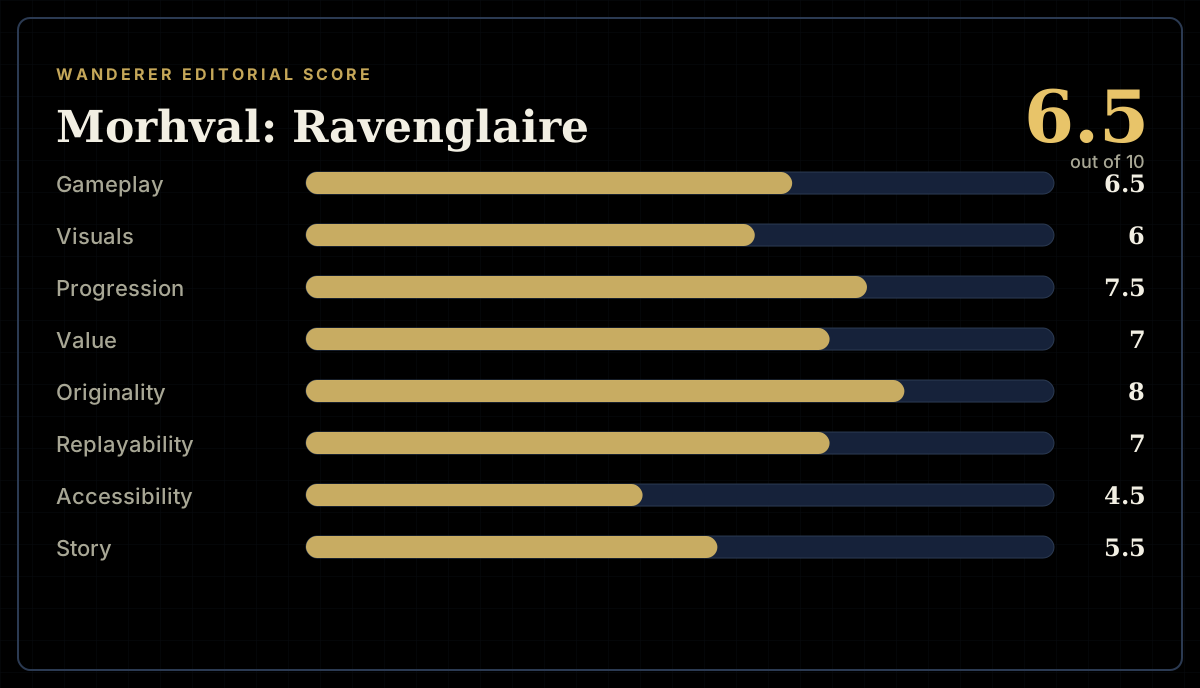
How the review scores each part of the gameWanderer Editorial -
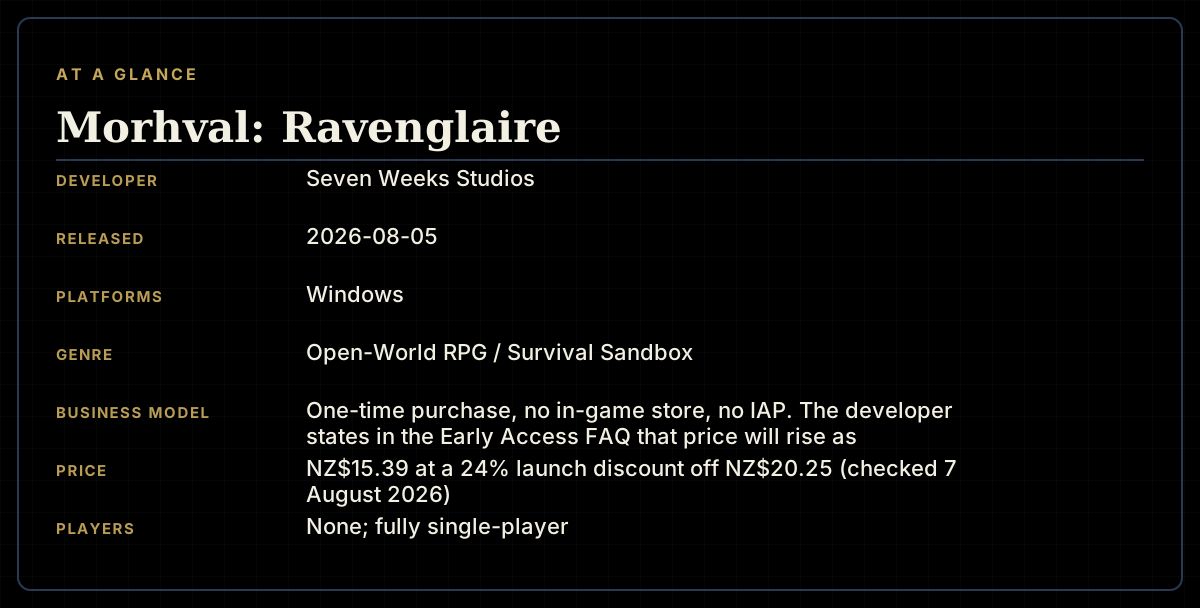
The game at a glanceWanderer Editorial -
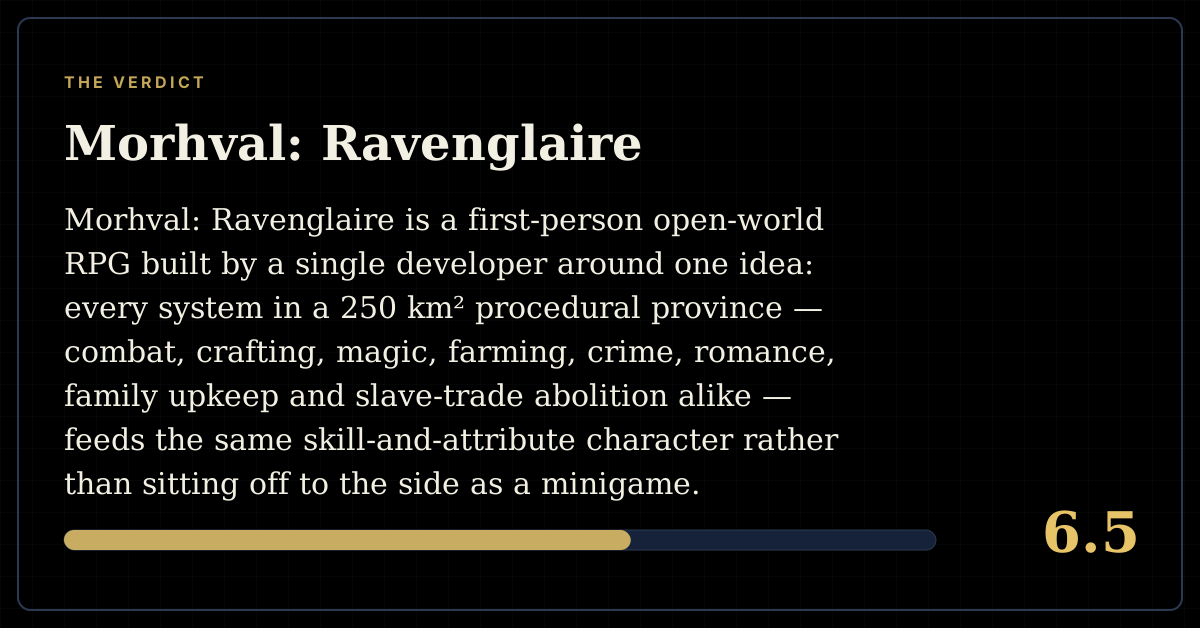
The short versionWanderer Editorial