
Game review
Money Trails
6.3 / 10
- Developer
- Sportz League
- Publisher
- Sportz League
- Released
- 19 August 2026
- Platforms
- Windows
- Genre
- Simulation
Zero Reviews for a Money-Themed Road Trip
Money Trails launched on Steam on 19 August 2026 from developer Sportz League, and at the time of writing it has no user reviews at all, so everything below reflects the store page's own description of the game rather than any confirmed player experience. The premise is a clicker-idler wrapped in a specific, fairly charming framing device: rather than tapping an abstract counter or watching a generic factory tick over, the player rides in a limousine along an endless, procedurally generated road, clicking to build wealth and building up an island as they go, with the explicit invitation on the store page to "roll the windows, turn on the radio" while doing it.
Clicking and Cruising: The Core Loop
The core loop splits cleanly between active and passive income, which is standard for the incremental genre, but the presentation layer around it is doing real work: instead of a static background, every trip is procedurally generated, meaning the biomes and specific island layout a player encounters are meant to be unique to that particular playthrough rather than a fixed, memorized map. Clicking increases wealth directly, while passive income accrues automatically while the player is away or multitasking, and the store page frames this dual system as something that rewards both active attention and idle neglect depending on what the player wants from a given session. That's a fairly conventional structure dressed in an unusually specific and coherent visual theme, and for a clicker specifically, a strong theme that gives the number-watching some narrative texture is a meaningful point in its favor rather than a purely cosmetic one. The dual active/passive framing also means the game is explicitly designed to serve two different play styles without forcing a choice between them: a player who wants to sit and actively click through a session can do so, while a player who wants to leave the limo running in the background while doing something else entirely gets the same underlying progression at a slower rate — a flexibility that's worth calling out directly rather than assuming, since plenty of clickers quietly favor one mode over the other despite claiming to support both.
Costly Vices and a PDA That Talks Back
The more distinctive system on the store page is a risk layer built around a "Personal Digital Assistant" that delivers random events, bets, and incoming messages, each of which can swing outcomes positively or negatively rather than simply adding more currency. Screenshots confirm this is a real, working system rather than store-page flavor text: a PDA "MESSAGES" popup shows an exchange with a lawyer, "Lawrence," resolving a legal mishap with the outcome "YOU SETTLED OUT OF COURT! RESTORE 1 HEART" — direct evidence that random events are narratively framed rather than abstract dice rolls, and that they can resolve in the player's favor as easily as against them. That screenshot also reveals something the store page doesn't spell out plainly: "hearts" are a separate, depletable life-style resource that sits alongside cash, not just a decorative icon. A shop-interior screenshot shows a row of items priced explicitly in hearts rather than dollars — cans of cola and soda beside a locked, more expensive item — confirming that the "costly vices" the store page names have a literal, non-monetary cost attached, spending health rather than just money to indulge. A second, roadside screenshot at a stop called "Rusty's Gas Station" shows a life-total readout of three filled hearts and one emptied one, meaning a run can genuinely be threatened by depleting that pool through repeated vices or unlucky PDA events, not merely slowed down. That's a real mechanical stake layered on top of the pure-upside clicker template, and a more concrete implementation of the "risk" pitch than the store page's own wording suggests. Whether hearts can be fully depleted to end a run, or simply regenerate over time as a soft penalty, is the kind of detail that would need extended play or a wider review base to confirm — but the underlying system is now confirmed to exist and to matter, rather than being an unverified marketing claim.
Procedurally Generated Biomes and Island-Building
Beyond the clicking and the risk events, the game layers in a construction system: players choose what to build as their island grows, with different construction opportunities available depending on the biome the limo is currently passing through, and periodic stops to shop and restock along the way. The store page frames this as an "endlessly evolving" structure, with no fixed endpoint to the island's growth or the road's length, which puts Money Trails closer to the sandbox end of the incremental spectrum than to games with a defined, achievement-gated finish line. Notably, the game has no listed Steam achievements at all — a real gap for gauging scope from the outside, since achievement lists have proven a genuinely useful research tool for uncovering hidden systems and progression tiers in several other idle games reviewed recently. A gas-station stop screenshot, "Rusty's Gas Station 24hrs," does show a more built-out interface than the store page's screenshots alone suggest, with a car-radio-style control bar along the bottom of the screen carrying a lock icon, a gauge or dial toggle, a house icon, and a dedicated "TAB AUDIO" control — a small but concrete sign that navigation and settings got more UI attention than a bare-bones clicker typically receives. Without an achievement list to cross-reference, though, the true depth of the biome and construction variety beyond what's visible in these stops is something only extended, first-hand play could confirm.
Price, Scope, and What's Unverified
At NZ$4.79, Money Trails is priced as a light, low-commitment clicker, consistent with its modest single-player, Windows-only, English-only scope. There's no controller support listed, no multiplayer, and the accessibility tags are limited to custom volume controls and pace-related options rather than anything more extensive. For a genre where budget clickers are extremely common and quality varies wildly, the specific theming here — a limo road trip through procedurally generated biomes rather than a generic tap-to-earn interface — is a genuine differentiator worth noting, but a zero-review launch means none of the balance, event variety, or long-term progression pacing claims on the store page have been tested by anyone outside the developer yet.
Verdict
Money Trails takes a familiar clicker-idler shell and wraps it in a specific, well-articulated theme — a limousine road trip through procedurally generated biomes, with a risk layer of random PDA events and costly vices that promises more genuine decision-making than the genre's pure-upside norm. At NZ$4.79 it's a low-risk pickup for clicker fans drawn to its theme, but the lack of any Steam achievements to cross-reference against the store page's claims, combined with a total absence of player reviews, means the depth of its biome variety, its construction options, and how meaningfully punishing its negative events actually are all remain open questions rather than confirmed strengths.
Screenshots
-
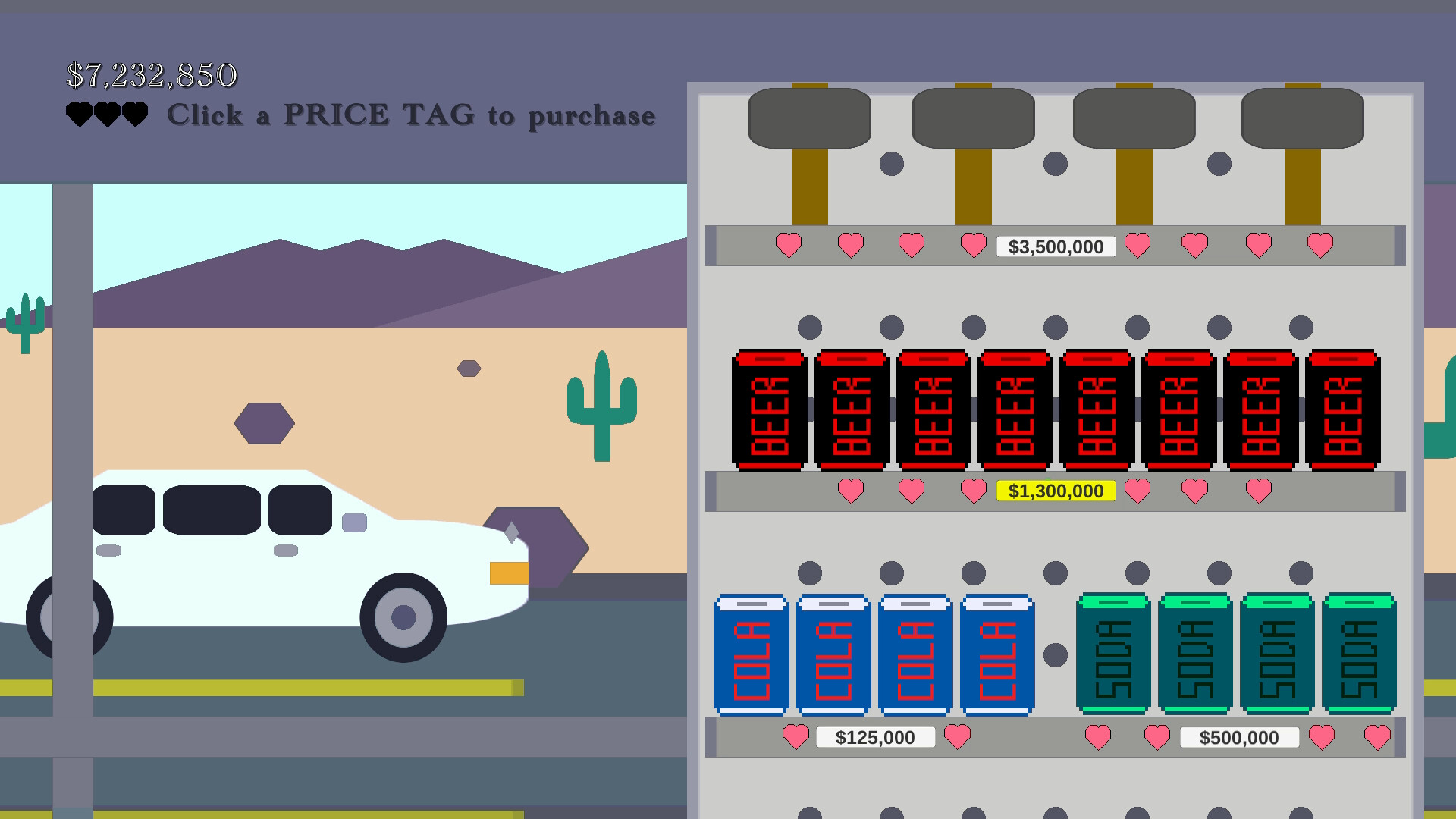
A roadside shop screen, where some items are priced in hearts (health) rather than cash — a literal cost for the game's advertised vices.Steam store page -
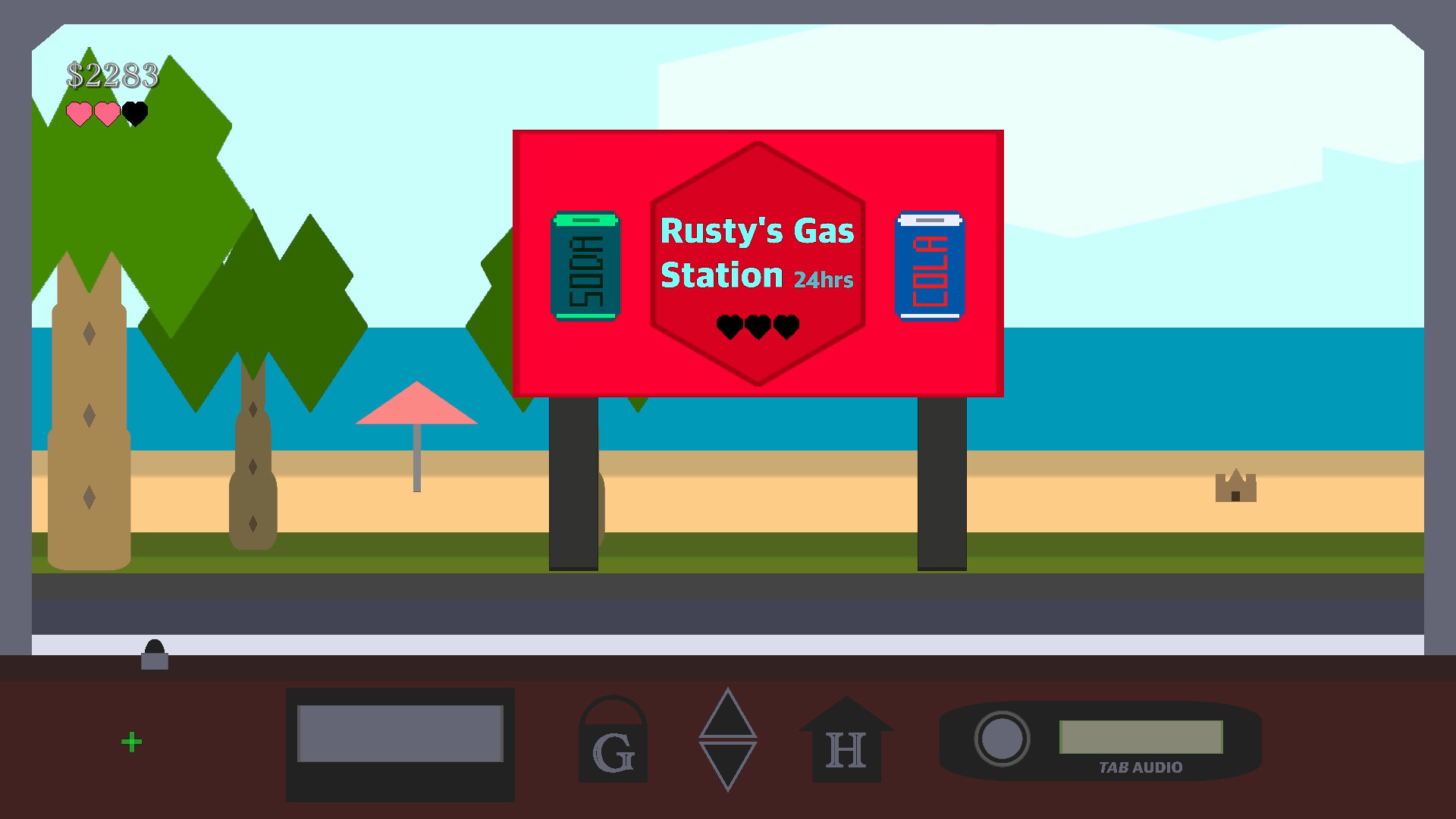
A gas-station shop stop, with dashboard controls including a garage lock, a diamond toggle, and a house icon below the windshield.Steam store page -

A random PDA event in progress: a lawsuit resolved by settling out of court, restoring one heart of health.Steam store page