
Game review
Kaiju Harvest
6.4 / 10
- Developer
- Tavuno Forge
- Publisher
- Tavuno Forge
- Released
- 19 August 2026
- Platforms
- Windows, macOS, Linux
- Genre
- Simulation
Seventy-Two Reviews, Very Positive, With a Clear Turn Toward Idle Play
Kaiju Harvest entered Early Access on Steam on 19 August 2026 from developer Tavuno Forge, and at the time of writing it has 72 user reviews, 58 positive and 14 negative, landing it a "Very Positive" rating at roughly 80%. The premise flips the usual kaiju-movie structure on its head: the heroes already won, the city already survived, and the player's job starts after the credits would roll, as a "Harvester" sent to carve up the fallen monster for meat, bones, organs, and rare kaiju amber. The most detailed positive review available, from a player who logged 571 minutes and completed all 33 achievements, sums up the structural arc plainly: after reaching a specific mid-game achievement milestone, the game "turns into an idle game... you can sit in middle and let the others collect everything leaving you to tab into other things" — confirming directly that Kaiju Harvest isn't just idle-adjacent in its marketing copy but genuinely transitions into hands-off automation once its collector systems are unlocked, which fits its own store-page promise to "automate the grind" and lets the harvesting loop earn its Idle and Incremental tags on mechanical merit rather than genre-tag technicality alone.
Cut, Collect, Automate: The Core Harvesting Loop
The moment-to-moment loop is built around revving up a saw to carve into a downed kaiju's carcass, collecting the meat, bones, organs, and heart-cores that spill out, then feeding those materials into equipment upgrades — better saws for more damage and higher critical-hit chance — that make the next carcass fall apart faster. Layered on top of that manual-harvesting core is a genuinely broad automation toolkit: collector robots and helper drones that pick up materials without player input, supply drops, critters, and booster drinks that the store page frames as accelerants for "the harvest" once unlocked. Several reviewers independently describe this exactly as advertised: a Japanese-language review with 469 minutes logged calls the underlying game "a normal incremental" with damage numbers that "keep growing" from a mix of base stat upgrades and randomly-dropped perk items collected mid-stage, eventually reaching the point where both perk pickups and return-trips to the dismantling point happen automatically, turning active play into "just watching." That's a fairly textbook incremental-game arc — active engagement early, automation taking over later — delivered through a kaiju-carcass skin rather than the genre's more common factory or tree-chopping framing, though it's worth noting directly that at least one very short, negative review dismisses the whole conceit as "just a skin of a game about chopping tree," a blunt but not entirely baseless comparison to the genre's more generic incremental templates, even if that reviewer only logged six minutes before forming the opinion. An in-run screenshot from the Rio de Janeiro stage backs up the automation claim concretely: alongside the player character, a squad of collector-bot drones and a ground-crawling robot dog are already independently gathering scattered meat and coin drops mid-fight, exactly the hands-off collection reviewers describe taking over later in a run. A between-run upgrade screen confirms the scale those numbers eventually reach, too — a large hex-grid skill tree with dozens of nodes, most already claimed, sitting alongside currency totals of 999.3 million meat and a full billion coins, a genuinely huge-number incremental economy that matches the Japanese-language reviewer's account of damage output reaching into the tens of millions.
Five Global Disaster Zones and a 33-Achievement Scope Check
The store page names five distinct disaster zones as the game's stage progression — Los Angeles, Rio de Janeiro, Istanbul, Siberia, and Tokyo — each pitched as a different backdrop for the harvesting loop rather than a purely cosmetic reskin of the same stage. The 33-entry Steam achievement list backs that zone structure up with specific, checkable names: "Between Two Continents" reads as an unmistakable Istanbul reference, "Cold Calculation" almost certainly marks Siberia, and "Land of the Rising Sun" is a direct nod to Tokyo, alongside broader milestone achievements like "First Cut," "Seasoned Butcher," "Harvest Veteran," and a late-game-sounding "Absolute Evolution." The 571-minute completionist reviewer's own account confirms the zone variety is real but not perfectly consistent in execution, noting that "some kaiju dismantling didn't align with the area, like the one in Tokyo, the arm is slightly different and the head off to the left looks like a rock" — a small but specific visual-consistency complaint worth flagging directly rather than assuming every zone's monster art received equal polish. Screenshots of the Rio de Janeiro and Istanbul stages back up the zone-identity claim visually: Rio's stage is clearly set against a Christ the Redeemer skyline with the Vidigal and Morro do Providência favela names labelled directly on screen, while Istanbul's stage sits against a distinct mosque-dominated skyline with its own rubble-pile carcass design — genuinely different backdrops rather than a single reused cityscape recoloured per zone.
Balance Rough Edges: Uniforms That Outlive Their Usefulness and a Skewed Skill Tree
The clearest, most consistent critique across the more detailed reviews is a progression-balance one rather than a complaint about the core concept. The same 571-minute reviewer describes several harvester uniforms as functionally obsolete almost as soon as they're unlocked: an early magnet-upgrade uniform that only collects coins and meat becomes worthless once a later magnet upgrade picks up buffs and perks too, on top of auto-collector pets already gathering everything — meaning a chunk of the cosmetic-and-stat progression ladder doesn't actually reward advancing through it in practice. A separate, more technically detailed Japanese-language review with 415 minutes logged raises a deeper skill-tree balance concern: base damage output can reach the tens of millions while other upgrade branches remain stuck in the low thousands, effectively "showy but pointless" once a player realizes concentrating entirely on personal damage and attack speed vastly outperforms diversifying into other systems, with attack speed singled out as "the strongest element" because faster attacks simply generate more perk-drop rolls. A third English-language reviewer with 337 minutes logged flags a seemingly unfinished mechanic directly: an "experience" stat that they had "no idea what... is meant to be used for," describing it as "a mechanic that wasn't implemented" — a concrete, specific gap worth taking at face value for an Early Access title still being built out, though it's worth noting a screenshot from the Istanbul stage shows a "+15% experience gained" perk drop alongside a visible level counter and progress bar, which suggests experience does feed into character leveling on some level even if its downstream purpose isn't made clear enough to the player in practice — a communication problem as much as a missing-mechanic one, based on what's actually visible on screen. Several shorter reviews, particularly from Chinese-language players, separately complain the game's total content clears in only a few hours, a fair concern for an incremental game where the genre's appeal usually depends on a long tail of upgrades to chase.
Price, Scope, and Early Access Caveats
At NZ$7.89, Kaiju Harvest is priced as a light, low-commitment incremental, and several reviewers explicitly frame it as solid value at that price — one calling it "a cheap $5 USD game for an adequate time killer" and another simply noting it's "not bad" despite its rough edges. It supports Windows, macOS, and Linux, and ships with an unusually wide localisation footprint for an Early Access indie — eleven listed languages including English, French, German, Spanish, Simplified Chinese, Korean, Polish, Portuguese, Russian, and Japanese — a genuinely broad accessibility reach for a solo-scale automation game. The 571-minute reviewer also flags two concrete, specific polish issues worth taking seriously: an audio bug where tabbing back into the game briefly blasts sound at maximum volume, and cloud sprites in some stages visibly moving far faster than intended, both minor but the kind of rough-edge bugs that are reasonable to expect improved during an Early Access cycle rather than accepted as final. One Korean-language reviewer separately reports the game consuming more system memory than its pixel-art presentation would suggest, a performance complaint worth weighing alongside the otherwise-positive technical consensus. Being Early Access, the shorter-than-hoped content length several reviewers mention is also the most fixable of the game's current weaknesses, provided Tavuno Forge follows through on further zones or achievements — sentiment at least one reviewer explicitly hopes for, writing simply that they're "waiting for updates, the future looks promising." That follow-through is already underway in a small way: the game's own key art carries a banner reading "New Location — DLC Out Now," and Steam's own storefront data confirms a paid downloadable-content pack exists for the base game, meaning at least one additional disaster zone or piece of content beyond the base five is available as a separate purchase — a detail worth flagging plainly for buyers deciding whether the base NZ$7.89 price covers everything reviewers describe, since it doesn't.
Verdict
Kaiju Harvest takes a genre built on chopping wood or running factories and gives it a genuinely fresh, well-received skin: harvesting the fallen giants that action heroes leave behind, with a real mid-game turn into hands-off automation that reviewers confirm works as advertised, five internationally-themed disaster zones with a checkable 33-achievement structure, and an unusually wide language footprint for an Early Access indie at this price. The consistent critique across detailed reviews is a fair one — a skill tree that rewards stacking damage and attack speed far above its other branches, some cosmetic uniform upgrades that become pointless the moment better automation arrives, an apparently unimplemented experience mechanic, and a total playtime several reviewers found shorter than they'd hoped. At NZ$7.89, with 72 reviews landing at Very Positive, it's a reasonable, low-risk pickup for incremental fans drawn to its kaiju-cleanup premise, with the understanding that its Early Access status means both its rough balance edges and its content length are still very much subject to change.
Screenshots
-
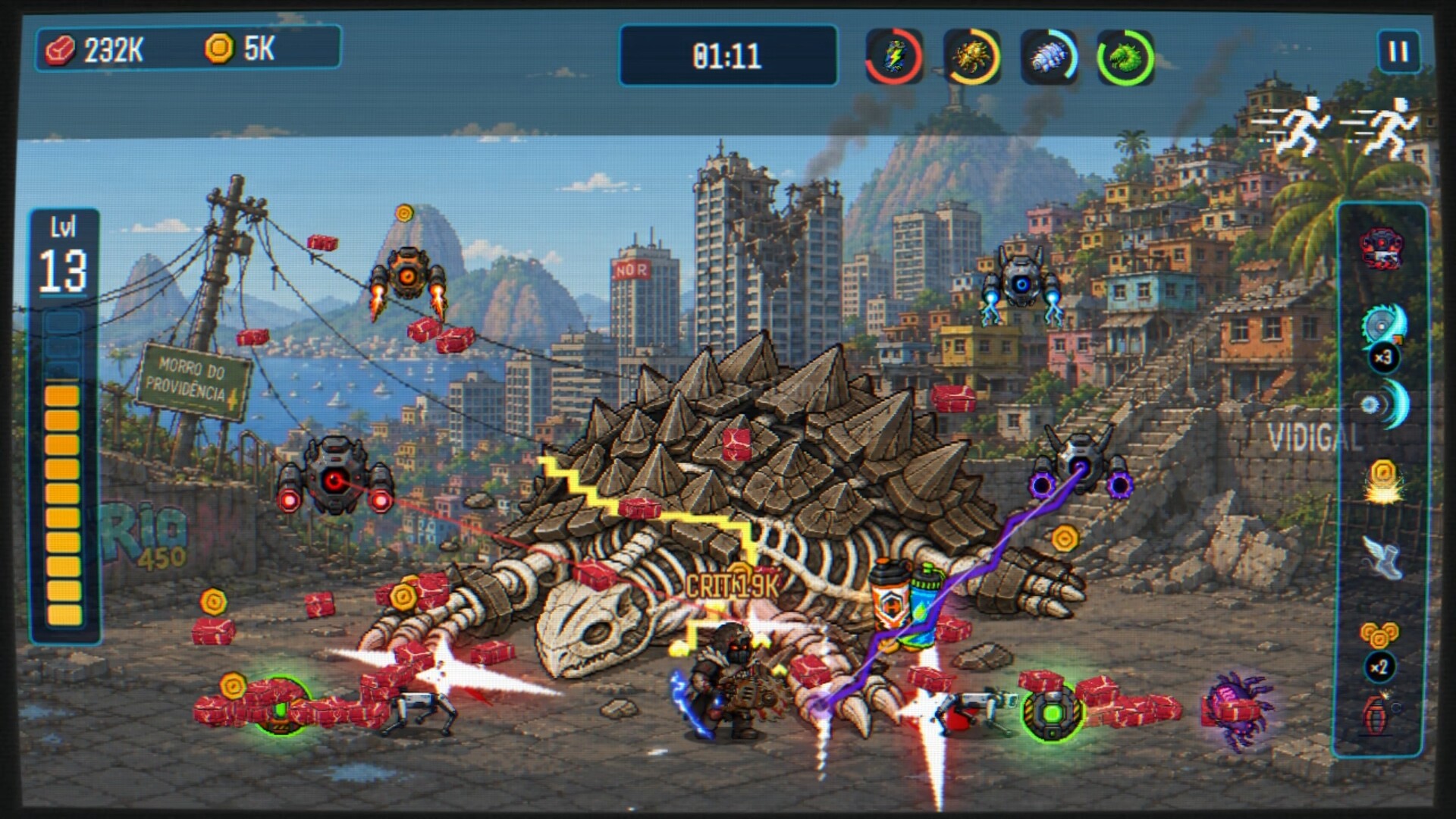
A Rio de Janeiro stage in progress, with meat and coin totals in the hundreds of thousands, a crit hit for 19K, and collector-bot drones already working the carcass.Steam store page -
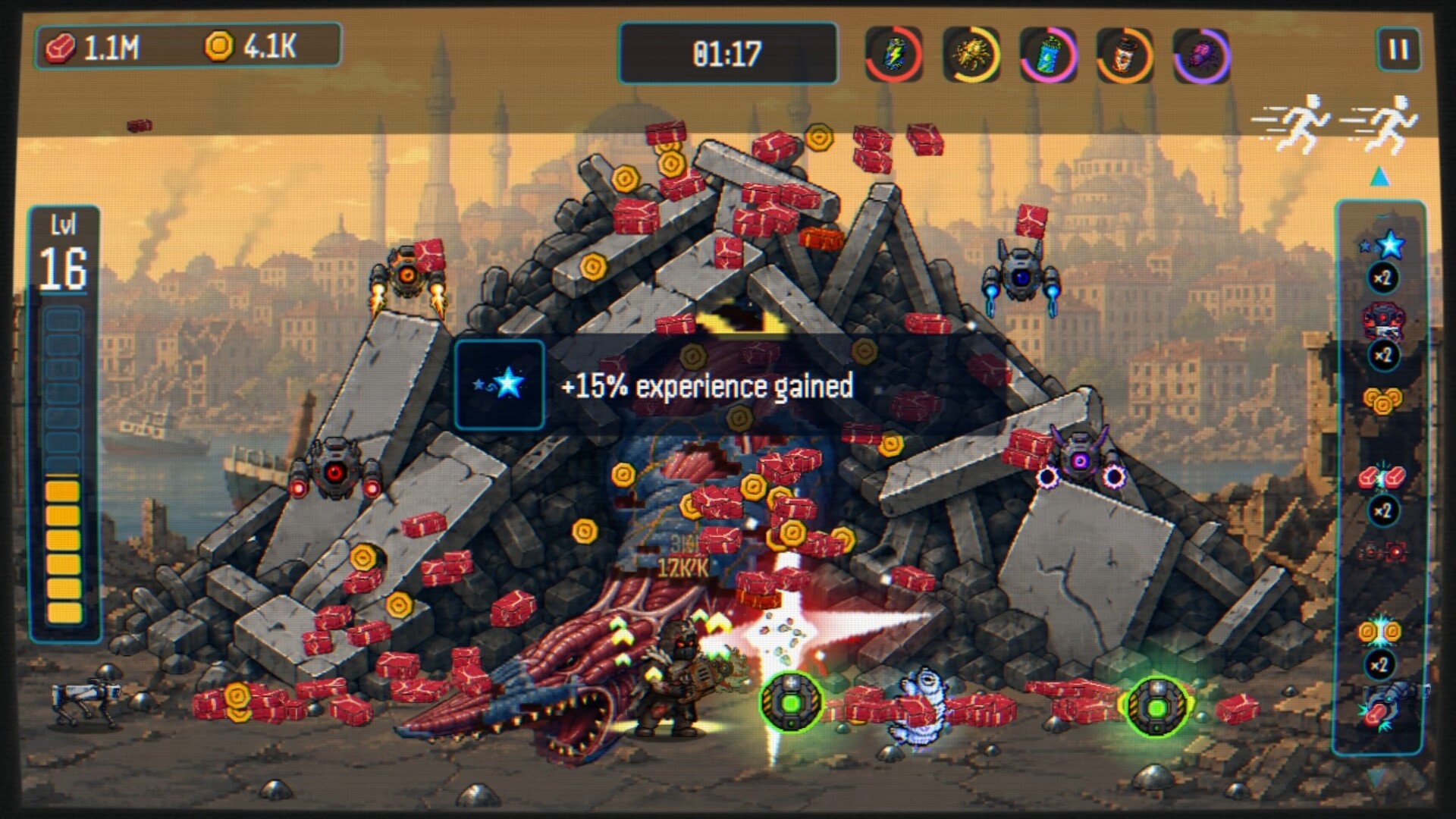
The Istanbul stage, with resource totals climbing into the millions and a plus-15%-experience perk drop confirming the leveling system is active.Steam store page -
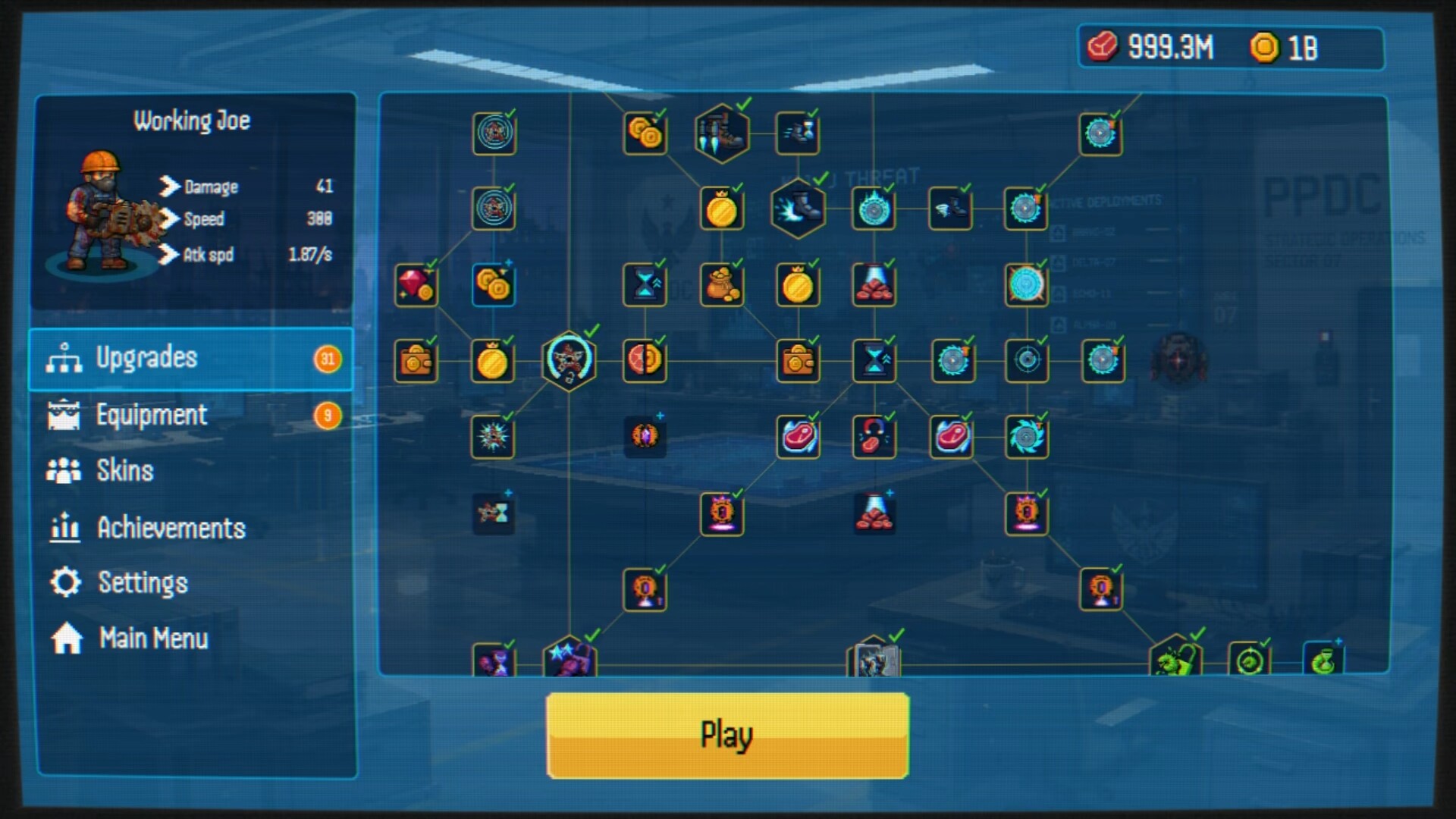
The upgrade skill tree between runs: dozens of nodes, most already claimed, with currency totals scaling into the hundreds of millions and billions.Steam store page