
Game review
Midnight Monitor: Aldercourt
6 / 10
- Developer
- Viexi Games
- Publisher
- Viexi Games
- Released
- 14 March 2024
- Platforms
- Windows
- Genre
- First-person anomaly-spotting horror
- Monetisation
- One-time purchase, no DLC or microtransactions
- Players
- Single-player only
The short version
Midnight Monitor: Aldercourt drops players into an endless train station, tasking them with spotting subtle anomalies across repeated loops to find the true exit, in the mold of the genre-defining Exit 8. This review's sample confirms many fans regard it as one of the strongest entries in a now-crowded field, thanks to a generous 80-anomaly roster and sustained post-launch support, but a specific and repeated controversy concerns AI-generated content: the developer's own official disclosure covers only "concept imagery," while multiple reviewers allege AI-generated assets appear directly in playable in-game signage, well beyond that stated scope.
Biggest strengths
- The 80-anomaly roster is repeatedly praised as unusually generous for the genre, with multiple reviewers specifically noting it offers substantially more content than comparable titles
- Several reviewers, including ones with extensive experience across many similar games, specifically rank this among the best entries in the anomaly-spotting genre, in some cases preferring it to Exit 8 itself
- The range of anomaly difficulty, from obvious to genuinely subtle, is credited by multiple reviewers as well-tuned, with an easy mode available for players who find the full difficulty overwhelming
Biggest weaknesses
- A serious, specific, and repeated controversy concerns the scope of AI-generated content: the developer's official Steam disclosure states AI was used only to "craft some concept imagery," but multiple independent reviewers allege AI-generated art appears directly in playable in-game signage, a scope this review's sample could not fully resolve one way or the other beyond noting the dispute exists
- Multiple reviewers report poor technical performance for a first-person walking game, with at least one describing unusually high system load and heat output relative to comparable titles
- A large, consistent negative-review theme frames the game as derivative of Exit 8 without significant innovation, with several reviewers describing it as executing the same core concept competently but without meaningfully expanding on the format
Who it's for: Fans of Exit 8-style liminal horror and anomaly-spotting games looking for a generously-sized, well-supported entry in the genre; not a fit for players who weigh AI-content concerns heavily or are strictly looking for the most original take on the format.
Our recommendation: A reasonable purchase for genre fans specifically, provided the AI-content dispute doesn't concern you, since the core anomaly-spotting loop itself is executed about as well as this crowded genre currently offers.
6 / 10
Midnight Monitor: Aldercourt drops players into an endless train station, walking the same corridor on repeated loops while scanning for subtle anomalies that signal something has gone wrong, in the well-established mold of Exit 8. This review's sample confirms many genre fans consider it a genuinely strong entry — and identifies a specific, unresolved controversy over exactly how the game's visuals were made.
A generous, well-regarded entry in a crowded genre
Reviewers with real comparative experience across the anomaly-spotting genre consistently rank this favourably. "I play a ton of games like this as a streamer, and this is, without a doubt, the MOST FUN ANOMALY GAME I'VE EVER PLAYED," one reviewer writes, specifically praising the range from subtle to obvious anomalies. Another agrees directly: "I would say it's better than exit 8 in many ways." A third reviewer credits the sheer volume of content: "Really enjoyed finding all 80 anomalies (most similar games have far fewer)." That kind of specific, comparative praise from players deeply familiar with the format suggests genuine execution quality within a genre that has produced many imitators.
A specific, disputed AI-content controversy
The most serious complaint in this review's sample concerns a real, checkable discrepancy. Steam's own official disclosure for this game states plainly: "AI assistance used to craft some concept imagery." But multiple independent reviewers argue the actual scope goes further. "The dev claims AI was only used to 'craft some concept imagery,' but the in-game signs are mostly AI garbage," one reviewer writes. Another separately confirms a similar concern: "Also contains a bunch of (undisclosed?) AI generated artwork." At least one reviewer frames this as their central objection while still finding value elsewhere: "why the downvote? this will be swapped to upvote once they replace the ai art assets if they choose to. they're ugly and upsetting to look at... regardless rest of the games great." This review's sample could not independently resolve whether the in-game signage exceeds what the developer's disclosure covers, but the specificity and repetition of the allegation across multiple reviewers makes it a legitimate concern for prospective buyers to weigh directly rather than dismiss.
Real performance complaints for a walking simulator
Beyond the AI-content dispute, at least one reviewer raises a specific, checkable technical concern: "Performance is abysmal and it somehow heats up my PC more than most AAA games." That's an unusual complaint for a genre typically built around simple, low-fidelity corridors, and worth flagging directly for players with older or more thermally sensitive hardware.
A familiar formula, competently executed
Several reviewers frame their more measured or negative verdicts around the format's now well-worn familiarity rather than any specific flaw. "It introduces nothing new over Exit 8 and manages to have the same quirks, such as posters that change and a person that walks who can be an anomaly," one reviewer writes, adding: "I appreciate the ATTEMPT to be different, but when you have the entire core concept intact" the innovation feels limited. That's a fair, structural criticism distinct from the AI-content dispute, and worth naming for buyers hoping for a meaningfully different experience rather than a well-executed variation on an established format.
What the update record confirms
Steam's own partner-events feed documents genuinely sustained developer support: 22 posts span the March 2024 launch through a substantial "2.0 Update" roughly two months later, adding new anomalies, a new room, and expanded interactivity, continuing through a security patch as recently as 2027. That level of ongoing investment is real and verifiable, though this review found no post in that feed directly addressing the specific AI-art scope dispute raised by reviewers, leaving that particular controversy unresolved as of this review.
A word of caution about jump scares
Beyond the AI-content and originality debates, at least one reviewer raises a specific complaint about tonal execution: "It has cheap jumpscares.... Hate it when games has this and what made the originals so good that this game is based on is that they built horror by creating immersion where with the existence of cheap jump scares you're way more on edge for way less payout." That's a specific critique of pacing and tone rather than a general complaint about difficulty or content, and it's worth flagging directly for players who specifically value the genre's traditional slow-burn dread over more conventional scare tactics.
Achievement data and typical completion
The achievement spread here — from 74.5% for an early milestone down to 13.2% for the rarest — suggests a moderately challenging but broadly completable experience, consistent with reviewer descriptions of an anomaly difficulty range that spans from obvious to genuinely subtle without becoming punishing. That's a meaningfully gentler curve than some comparable horror titles in this review's lane, and it lines up with reviewer accounts of an accessible easy mode existing alongside the harder standard difficulty for players who want the anomaly-spotting challenge without excessive punishment for early mistakes.
Final verdict
Midnight Monitor: Aldercourt succeeds as a well-executed, generously-sized entry in the crowded anomaly-spotting genre, and this review's sample confirms real, comparative praise from experienced genre fans for its anomaly variety and difficulty tuning. But a specific, unresolved dispute over AI-generated content scope, alongside real performance complaints and the format's now well-established familiarity, are worth weighing directly rather than ignoring. Genre fans comfortable with the AI-content question should find a genuinely strong entry here; anyone who weighs that concern heavily should look elsewhere in the same crowded field.
Pros and cons
Pros
- The 80-anomaly roster is repeatedly praised as unusually generous for the genre, with multiple reviewers specifically noting it offers substantially more content than comparable titles
- Several reviewers, including ones with extensive experience across many similar games, specifically rank this among the best entries in the anomaly-spotting genre, in some cases preferring it to Exit 8 itself
- The range of anomaly difficulty, from obvious to genuinely subtle, is credited by multiple reviewers as well-tuned, with an easy mode available for players who find the full difficulty overwhelming
- Steam's own partner-events feed documents sustained post-launch support, including a substantial "2.0 Update" adding new anomalies, a new room, and expanded interactivity roughly two months after launch, continuing through security patches years later
- The low asking price is repeatedly cited approvingly relative to the amount of content on offer, with several reviewers specifically framing it as a good value even among genre peers
Cons
- A serious, specific, and repeated controversy concerns the scope of AI-generated content: the developer's official Steam disclosure states AI was used only to "craft some concept imagery," but multiple independent reviewers allege AI-generated art appears directly in playable in-game signage, a scope this review's sample could not fully resolve one way or the other beyond noting the dispute exists
- Multiple reviewers report poor technical performance for a first-person walking game, with at least one describing unusually high system load and heat output relative to comparable titles
- A large, consistent negative-review theme frames the game as derivative of Exit 8 without significant innovation, with several reviewers describing it as executing the same core concept competently but without meaningfully expanding on the format
- At least one reviewer raises a specific complaint about unclear game rules, reporting confusion over which in-game elements (such as station announcements) count as anomalies versus incidental atmosphere
- Cheap jump scares are specifically criticized by at least one reviewer as working against the genre's usual strength in slow-burn dread, arguing the tension the format is known for is undercut by more conventional scare tactics
Screenshots
-

Midnight Monitor: AldercourtImage: Viexi Games via Steam -

Midnight Monitor: AldercourtImage: Viexi Games via Steam -

Midnight Monitor: AldercourtImage: Viexi Games via Steam -
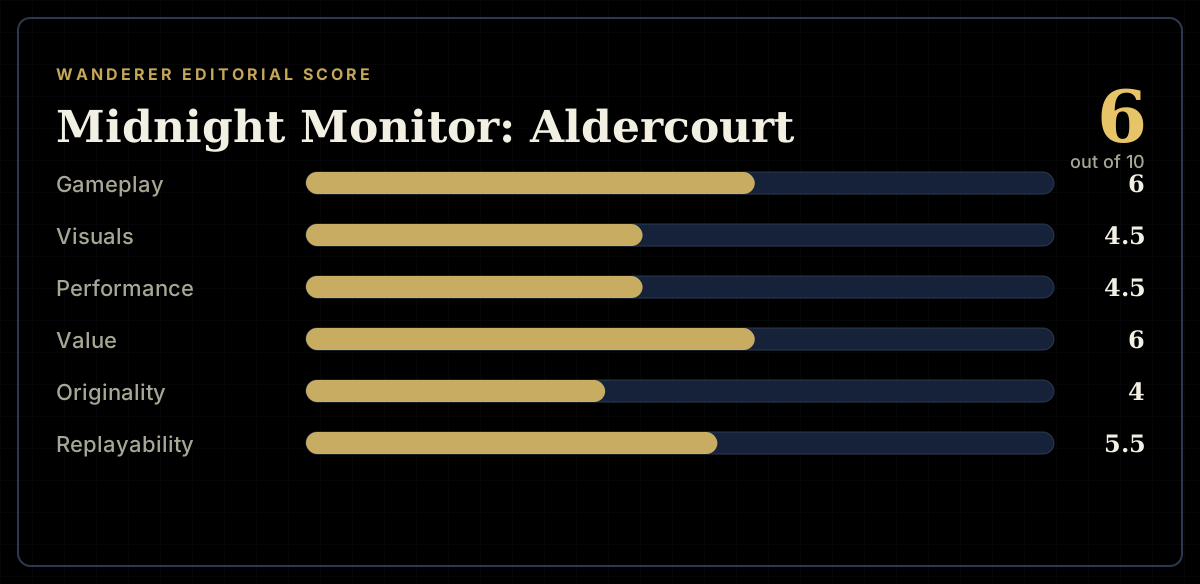
How the review scores each part of the gameWanderer Editorial -
The short versionWanderer Editorial