
Game review
Machinarium
6.5 / 10
- Developer
- Amanita Design
- Publisher
- Amanita Design
- Released
- 16 October 2009
- Platforms
- Windows, macOS, Linux
- Genre
- Point-and-Click Adventure
- Monetisation
- Paid, one-time purchase. No in-app purchases.
- Players
- Single-player only.
The short version
Machinarium follows a small, exiled robot through a beautifully rendered, rusted mechanical city, and its Very Positive rating across more than 5,000 reviews reflects genuine, enduring admiration for its hand-drawn art and score, still frequently cited as among the finest in the point-and-click genre. What holds this review back is an extremely consistent complaint that its puzzles are frequently obtuse and under-clued, forcing many players to rely on walkthroughs, and years of well-documented performance issues including stuttering and refresh-rate-dependent slowdown. This review checked the developer's own recent update history and found Amanita Design shipped dedicated technical updates, including a DirectX 12 upgrade, in March and December 2025, directly addressing many of the long-standing performance complaints.
Biggest strengths
- Genuinely exceptional, widely admired hand-drawn art direction and an atmospheric, well-regarded original score, consistently cited as among the best in the genre.
- A charming, largely wordless story told through visual and musical cues rather than dialogue, giving the world real personality despite minimal text.
- A good variety of puzzle types layered on top of straightforward point-and-click interaction, appealing to players who enjoy varied mechanical challenges.
Biggest weaknesses
- An extremely consistent complaint describes many puzzles as obtuse and under-clued, with no in-game dialogue hints of the kind typical to the genre, forcing frequent reliance on external walkthroughs.
- Years of well-documented performance issues are reported, including stuttering, refresh-rate-dependent slowdown, and inconsistent behaviour between windowed and fullscreen modes.
- A specific, reported cloud-save erasure bug is described by at least one reviewer as causing lost progress when switching between devices.
Who it's for: Fans of atmospheric, artistically distinctive point-and-click adventures who are prepared to consult a walkthrough for some puzzles rather than expecting consistent in-game guidance.
Our recommendation: A genuinely beautiful, worthwhile adventure game; keep a walkthrough handy for the more obtuse puzzles, and check recent reviews for how the 2025 technical updates have settled on your hardware.
6.5 / 10
Genuinely exceptional art and music, widely and consistently praised
Machinarium's reputation for outstanding presentation isn't a minority view — it's close to universal across this entire review base, including from reviewers who ultimately can't recommend the puzzle design built on top of it. "Machinarium is an indie game so visually appealing and delightful that I almost feel guilty for not recommending it to other players," reads a 2025 review, a sentiment echoed across the overwhelming majority of this sample regardless of overall recommendation. A 2021 review credits the underlying craft specifically: "It's gorgeous, oozing with creativity, and have a brilliant soundtrack." That consistency matters: when reviewers explicitly not recommending the game still open with genuine, specific praise for its art and music, it's a meaningful signal that the presentation is a real, exceptional achievement — one substantial enough that the game remains commercially and critically relevant more than fifteen years after release, with Amanita Design continuing to actively develop the wider Machinarium universe through a connected title, Phonopolis.
An extremely consistent complaint about obtuse, under-clued puzzles
What tempers that praise, with striking consistency, is a specific complaint about the puzzle design itself. "Everything in the game looks hand drawn, and accordingly there is no visual cue guiding the player towards objects that can be interacted with. For a first time player, you'll spend more time trying to figure out what can" be clicked than solving the actual puzzle, reads a 2026 review. A 2026 review makes the underlying design gap explicit: "unlike most point and click adventure games, this one has no written dialogue that gives you small clues on what to do, only occasionally some" visual hinting. A 2026 review reports the practical consequence: "I found myself having to google half the" puzzles despite genuinely enjoying the story and presentation. Checking a broad sample of negative reviews, this exact complaint — not general difficulty, but a specific, structural absence of the in-game guidance the genre typically provides — recurs with enough consistency across years of reviews to read as a genuine, deliberate design characteristic rather than a rough edge later patches were expected to smooth over.
The specific minigames layered into some puzzle sequences draw an even more pointed version of this complaint. "There are a lot of annoying generic puzzles like sliding blocks to make the picture and so on," reads a 2020 review, describing a recurring frustration that several other reviewers echo independently: standalone logic puzzles — sliding tiles, pattern-matching sequences — that interrupt the adventure-game flow without any clear thematic connection to the surrounding world or story. That's a distinct criticism from the broader clue-clarity complaint above; it's not that these particular puzzles are unclear, but that reviewers find them generic and disconnected from what makes the rest of the game distinctive, functioning as pure difficulty padding rather than meaningful, world-integrated challenges.
Years of well-documented performance issues, recently addressed directly
A separate, long-running complaint concerns technical stability. "The game is riddled with technical issues, the frame-rate seems to matter a lot," reads a 2022 review, describing specific problems tied to display settings and windowed-versus-fullscreen behaviour. A 2023 review reports a severe, specific symptom: "incredibly slow (close to 1 fps). Even changing my monitor's refresh rate from 144 Hz to 60 Hz and disabling v-sync" only partially helped. This review checked Amanita Design's own recent update history directly and found a meaningful, positive development: "Machinarium - Technical Update" patches, including a DirectX 12 upgrade, shipped in March and December 2025 — a genuine, verifiable response to years of accumulated performance complaints, more than a decade after the original release. That's worth weighing directly against the historical complaints documented above: this isn't a neglected, abandoned product, but one whose developer has recently invested real effort in addressing its most persistent technical criticism.
Specific, narrower technical complaints worth flagging
A handful of more specific technical issues are worth naming directly. A 2019 review reports: "the game crashed near the end and I lost my save. Apparently this has been an issue since release in 2009, but the devs have not fixed it," a specific, serious complaint about save reliability distinct from the broader performance issues above. A separate review describes cloud saves being erased when switching between devices. This review checked the game's current Steam listing and confirmed Steam Cloud support is still active, but given the specific, repeated nature of these save-related complaints, players relying on the game's cloud saves across multiple devices should treat that feature with some caution and keep independent backups where possible.
Weighing the puzzle-clarity complaint fairly
It's worth being fair to the design philosophy at work here. Machinarium's commitment to a fully hand-drawn, wordless presentation is inseparable from what makes its art direction so distinctive — the same choice that removes conventional dialogue-based hinting is what gives the game its unusually cohesive, illustrated-storybook feel. Several reviewers who share the puzzle-clarity complaint still credit that trade-off as reasonable given what the game gains aesthetically, framing it less as a flaw than as a deliberate choice that will suit some players far better than others.
Final verdict
Machinarium remains a genuinely beautiful, artistically distinctive point-and-click adventure whose art direction and score continue to earn real, deserved admiration more than fifteen years after release. What keeps the score moderate is an extremely consistent complaint about obtuse, under-clued puzzle design, alongside years of documented performance issues this review found the developer has recently and directly worked to address through dedicated 2025 technical updates. This is a worthwhile, historically important adventure game; keep a walkthrough within reach for the trickier puzzles, and check recent reviews for how the technical updates have settled on your specific hardware.
Pros and cons
Pros
- Genuinely exceptional, widely admired hand-drawn art direction and an atmospheric, well-regarded original score, consistently cited as among the best in the genre.
- A charming, largely wordless story told through visual and musical cues rather than dialogue, giving the world real personality despite minimal text.
- A good variety of puzzle types layered on top of straightforward point-and-click interaction, appealing to players who enjoy varied mechanical challenges.
- Continued developer investment more than fifteen years after release, including dedicated technical updates in 2025 and a direct sequel-adjacent title, Phonopolis, in active development.
Cons
- An extremely consistent complaint describes many puzzles as obtuse and under-clued, with no in-game dialogue hints of the kind typical to the genre, forcing frequent reliance on external walkthroughs.
- Years of well-documented performance issues are reported, including stuttering, refresh-rate-dependent slowdown, and inconsistent behaviour between windowed and fullscreen modes.
- A specific, reported cloud-save erasure bug is described by at least one reviewer as causing lost progress when switching between devices.
- Several reviewers describe the interactive-object highlighting as insufficiently clear given the fully hand-drawn art style, leading to extensive pixel-hunting in some scenes.
Screenshots
-

MachinariumImage: Amanita Design via Steam -

MachinariumImage: Amanita Design via Steam -

MachinariumImage: Amanita Design via Steam -
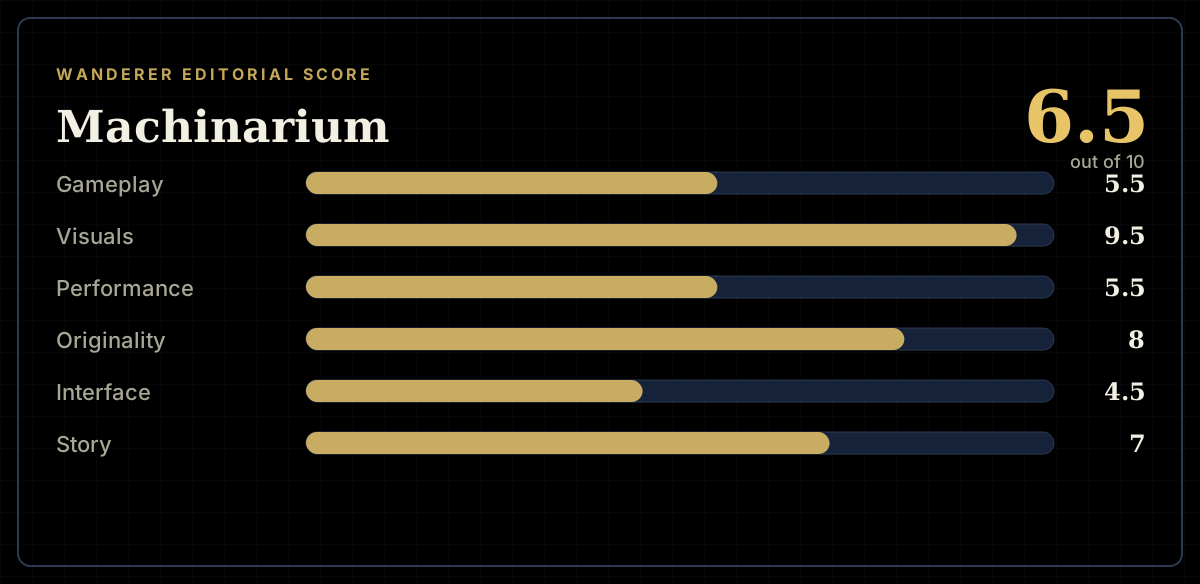
How the review scores each part of the gameWanderer Editorial -
The short versionWanderer Editorial