
Game review
Lunacid
7.5 / 10
- Developer
- KIRA LLC
- Publisher
- CRITICAL REFLEX
- Released
- 30 October 2023
- Platforms
- Windows
- Genre
- Dark Fantasy First-Person Dungeon Crawler
- Monetisation
- One-time premium purchase; a free paid-adjacent expansion (Tears of Moon) and ongoing free content patches followed launch
- Players
- Single-player only; no online, co-op or PvP modes
The short version
Lunacid is an explicit homage to From Software's early first-person dungeon crawlers, King's Field and Shadow Tower, and reviewers who grew up on those largely-abandoned games describe Lunacid as the spiritual successor they'd stopped expecting anyone to make. Its surreal atmosphere, layered environmental design, and sound work draw the most consistent praise in the review base, alongside genuine appreciation for a developer willing to make something this specifically retro rather than chasing the more commercially safe soulslike template.
The reception isn't uniformly glowing, and this review's research confirms specific, real gaps behind the praise: combat draws consistent criticism as underdeveloped relative to the game's exploration and atmosphere, some late-game secrets and alternate endings are described as requiring genuinely obtuse, easy-to-miss steps, and a launch-week controversy over an added character- creation option drew a notable share of negative reviews, one the developer addressed directly and at length in a public post rather than staying silent.
Biggest strengths
- A genuinely rare, well-executed homage to King's Field and Shadow Tower, filling a niche reviewers say almost nobody else currently serves
- Consistently praised surreal atmosphere and sound design, with multiple reviewers naming exploration itself as the game's standout strength
- A distinctive, sometimes deliberately obtuse world design that rewards close attention and experimentation, in the tradition of the games it's inspired by
Biggest weaknesses
- Combat is consistently described as mediocre relative to the game's other strengths, functional rather than a genuine highlight of the experience
- Some post-launch reviewers describe late-game secrets and alternate-ending requirements as overly obtuse, with satisfaction souring the further into the game's more demanding content they got
- A launch-week character-creation option drew a specific wave of negative reviews; the developer addressed the controversy directly and personally in a lengthy public statement rather than ignoring it
Who it's for: Fans of old-school, exploration-heavy first-person dungeon crawlers who value atmosphere and genuine mystery over combat depth or modern quality-of-life conveniences.
Our recommendation: A genuine must-play for anyone who misses King's Field-style dungeon crawling, and a worthwhile curiosity for soulslike fans wanting to see where the genre's roots actually are — though combat-focused players may find the fighting itself underwhelming.
7.5 / 10
Lunacid drops you into a surreal underground world with little more than a starting weapon and the implicit promise that almost everything you find will be dangerous, obscure, or both. It's an unabashed homage to From Software's King's Field and Shadow Tower games — first-person dungeon crawlers largely left behind by the genre's shift toward third-person soulslikes — and reviewers who remember those originals describe Lunacid as filling a gap they'd genuinely stopped expecting anyone to fill.
A genre niche reviewers say almost nobody else serves
The most consistent, enthusiastic praise in the review base centers on what Lunacid actually is rather than how well it executes any single system: a first-person, exploration-driven dungeon crawler with real atmosphere, built for players who want obscure secrets and a genuinely disorienting world rather than clearly signposted objectives. Multiple reviewers frame this as a direct rebuke to the soulslike genre's current homogeneity, explicitly asking for more games willing to be this specific rather than another entry chasing a more commercially safe formula. The surreal aesthetic and sound design — voice work, ambient audio, and a soundtrack reviewers describe as genuinely haunting — draw praise even from reviewers otherwise critical of the game's combat.
Combat reviewers call the weak link
Set against that praise, combat draws the most consistent specific criticism: reviewers describe it as functional rather than a genuine strength, lacking the depth or feedback that would let it stand alongside the game's atmosphere and exploration. That's a notable gap for a first-person action RPG, though it's also consistent with the King's Field games this title draws from, whose combat was never their main draw either — reviewers familiar with the source material tend to treat this as a faithful inheritance rather than a unique flaw.
Real late-game friction behind the four endings
Lunacid offers four distinct endings and meaningful build variety, giving reviewers real reason to replay beyond a single credits roll. That structure comes with a specific, repeated complaint: one detailed review describes their opinion of the game souring over its final hours, as secrets and ending requirements grew more obtuse and less clearly signposted than the earlier game's more generous mystery. Other reviewers frame the same obscurity as a deliberate, appreciated callback to the genre's roots, making this one of the more genuinely divisive specific complaints in the review base rather than a near-universal one.
A launch controversy the developer addressed personally
A specific, notable share of negative reviews at launch concerned a pronoun option added to character creation in the version 1.0 patch, which drew backlash from some players. This review's research confirms the developer responded directly and at length in a public post rather than staying silent, explaining candidly that the feature originated partly as a reaction to unrelated industry controversy, and offering a personal, first-person account of why the option ultimately felt right to include. Whatever a given player's view of that debate, it's a case of transparent, direct developer communication rather than corporate silence — worth noting for readers weighing why some of the negative review total exists.
What was and wasn't fixed at launch
One frequently-cited launch complaint — the absence of key rebinding — is directly contradicted by this review's research: the version 1.0 patch notes explicitly list "Added Key Rebinding" among that update's changes, meaning the feature was present from the 1.0 release itself rather than a gap left unaddressed. Other quality-of-life and technical issues reported around launch were addressed more gradually across a dense patch history — the game received sustained support through 2024 and 2025, including a substantial "Tears of Moon" content release in April 2026 and a further patch as recently as August 2026, nearly three years after the full release.
What the achievement data shows
Global achievement percentages, though the names are not human-readable via Steam's public endpoint, still show a meaningful shape: the most commonly-earned achievement sits at roughly 65% of the playerbase, falling to around 11% for the least-common one sampled among the game's earlier milestones. That's a real but not extreme drop-off for an exploration-driven RPG without heavy combat gating, broadly consistent with a game whose main barrier to progress is knowledge and persistence rather than raw difficulty — though without readable achievement names, this review treats that shape as a general indicator rather than a precise map of where players actually stop.
An early access run reviewers say paid off
Lunacid spent roughly a year and a half in Early Access before its October 2023 full release, and the patch history across that period shows steady, incremental content growth — a Boiling Grotto content update, a full Castle area added mid-development, and dozens of smaller bug and balance patches — rather than a long silence followed by a rushed 1.0. Reviewers who followed the game through Early Access describe the finished product as a clear improvement over its earlier builds, and the version 1.0 patch notes themselves list new endings, achievements, and balance changes on top of the key rebinding feature already noted above, suggesting the studio used its Early Access period for genuine iteration rather than as an extended pre-order window.
Where it lands
Lunacid earns its Very Positive reception by being something genuinely uncommon: a first-person dungeon crawler willing to prioritize atmosphere, mystery and genre authenticity over the combat depth and quality-of-life conveniences modern players often expect by default. Its combat weaknesses and late-game obscurity are real, specifically documented complaints rather than exaggerations, and its launch-week controversy was met with direct, personal developer communication rather than silence. For anyone who remembers King's Field fondly, or wants to see where the soulslike genre actually came from, this is a distinctive, worthwhile recommendation.
Pros and cons
Pros
- A genuinely rare, well-executed homage to King's Field and Shadow Tower, filling a niche reviewers say almost nobody else currently serves
- Consistently praised surreal atmosphere and sound design, with multiple reviewers naming exploration itself as the game's standout strength
- A distinctive, sometimes deliberately obtuse world design that rewards close attention and experimentation, in the tradition of the games it's inspired by
- Four distinct endings and substantial build variety, giving completionist players real reason to replay beyond a single playthrough
- Key rebinding, a commonly-requested feature, was confirmed added directly in the version 1.0 patch notes rather than left unaddressed at launch
Cons
- Combat is consistently described as mediocre relative to the game's other strengths, functional rather than a genuine highlight of the experience
- Some post-launch reviewers describe late-game secrets and alternate-ending requirements as overly obtuse, with satisfaction souring the further into the game's more demanding content they got
- A launch-week character-creation option drew a specific wave of negative reviews; the developer addressed the controversy directly and personally in a lengthy public statement rather than ignoring it
- Technical issues and a general lack of quality-of-life polish are reported at launch, some but not all addressed across the extensive post-launch patch history
- The gap in power between early-game and end-game items is described by experienced reviewers as colossal, with knowledgeable players able to trivialize sections unintentionally
Screenshots
-

LunacidImage: KIRA LLC via Steam -

LunacidImage: KIRA LLC via Steam -

LunacidImage: KIRA LLC via Steam -
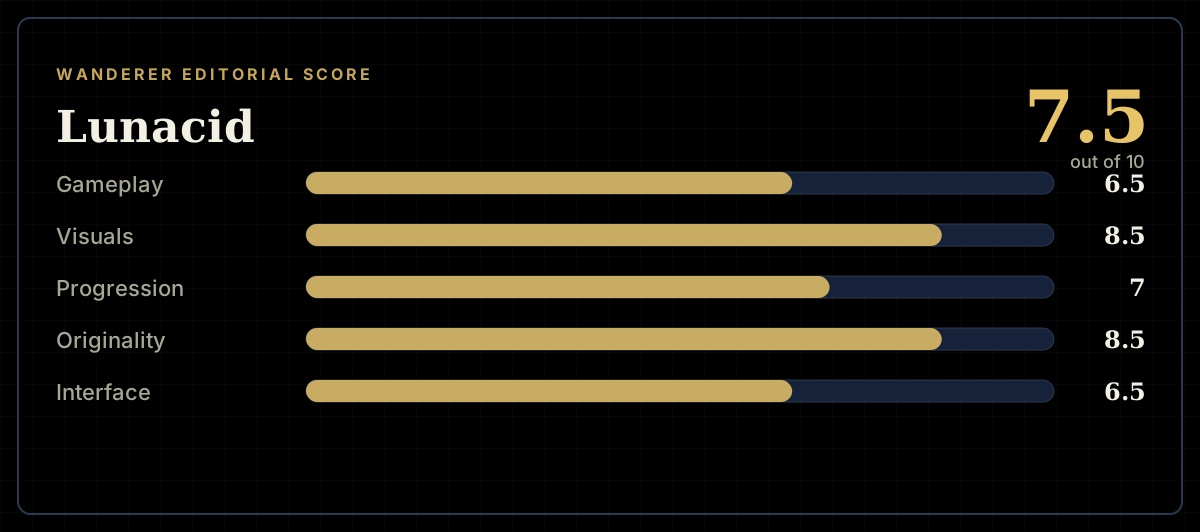
How the review scores each part of the gameWanderer Editorial -
The short versionWanderer Editorial