Game review
Lowmoor Idle RPG: An Adventurer's Chronicle Review
6.5 / 10
- Developer
- LilChill Games
- Publisher
- LilChill Games
- Released
- 7 August 2026
- Platforms
- ["Windows", "Mac", "Linux"]
- Genre
- RPG
Progress Quest's Grandchild, Taken Very Seriously
Lowmoor Idle RPG wears its inspiration on its sleeve: it's a spiritual heir to 2002's Progress Quest, the game that invented the joke of an RPG that plays entirely by itself. Developer LilChill Games leans into that lineage rather than hiding from it — reviewers call it "Progress Quest 2.0" and "a 1000x better Progress Quest" — but where the original was a minimalist gag, Lowmoor builds an enormous, sincere RPG chassis underneath the same zero-input premise. Your adventurer hunts, levels, casts spells, sells loot, and re-equips gear entirely on its own; the player's real job is planning builds and reading the combat log, not clicking anything. One reviewer's summary captures the tone better than any marketing copy could: "Great game I don't understand anything," followed up 160 hours later with, "the great thing is that I still don't understand anything but I have 7 choices now waiting for me so I just select whatever. 10/10."
Released free on Steam on 7 August 2026 with no in-game purchases of any kind, Lowmoor has pulled in a Very Positive score across its review base — a strong result for a title several of its own fans openly describe as unfinished.
An Absurd Amount of Content for a Game About Not Playing
The scale of what's on offer here is genuinely startling for a free idle title. Character creation alone offers 12 folk, 12 trades, and 12 origins to combine, each with a signature ability and its own resettable talent tree. Sitting above that is the Long Charter, an eight-branch skill tree spanning 2,111 individual skills, 160 major nodes, eight masteries, and a choice of one of eight oaths — deep enough that the game offers to auto-allocate it for players who'd rather just watch. Combat resolves with actual d20 rolls: attack rolls, damage dice, and saving throws, modified by gear and skills, playing out automatically across eight spell schools. A bestiary of 207 illustrated monsters, six equipment rarity tiers, twenty material tiers, and a Progress-Quest-style dry, module-flavoured text log round out a presentation reviewers describe as "dense but evocative" — a "combination of ESL and imitating old school RPG modules" that some find charming and at least one reviewer found "completely incomprehensible," calling it "like a bad joke." Reactions to the writing style are clearly split, which is worth knowing going in.
Structurally, the game is built around three complete campaigns — the thirty-floor Maw, the Mourning Vale, and The Last Anchorage, a sea voyage that unlocks after finishing the Maw and logging 200 hours across all of a player's adventurers — with eight endings between them, after which play continues in repeatable seasons and patrols. Progress carries across characters via a prestige system, alongside persistent achievements, monster mastery, and a Trophy Case, so a "run" ending isn't really a reset so much as a fresh attempt with accumulated advantages. A dedicated Companion Mode — LilChill Games calls it "Fold" — shrinks the whole game down to a narrow always-on-top strip showing HP, MP, gold, and the latest log line, explicitly designed to sit beside other work rather than compete for a whole monitor; multiple reviewers single this out as one of the best-executed parts of the package, alongside a choice of retro desktop skins (Windows 98, GNOME 1, and Mac OS 8 themes).
A Game Its Own Fans Call Unfinished
The most substantial criticism in the review sample is specific and credible rather than a vague "needs polish" complaint. One detailed negative review — the most-upvoted critical review in the sample — argues that most of the underlying RPG systems don't actually matter yet: "the only stats that matter is speed and gold gen," classes "all feel the same," mana sits at "completely full all the time or completely empty," and HP/CON stats are functionally pointless because a character auto-heals before it can die — "there is no way to die." The same reviewer flags the UI as unreliable, with buttons that only register clicks on their edges and window-resizing that misbehaves, and notes the developer removed the ability to name your own character in a recent update, a small but pointed complaint in a game with few other player choices to begin with.
A separate, well-upvoted review describes a specific update souring what had been the game's core appeal: the previously "fast progress bar" and satisfying gold trickle got slowed down by a new Infirmary mechanic and a "Speed" nerf, stretching some later chapters past 12 hours to clear even after a follow-up fix — "the recent update ruined it," in that reviewer's words, though a different reviewer reports the opposite experience after a still-later patch, saying "the dev has recaptured the feel of earlier builds." Read together, the pattern is a small team actively iterating on balance in full public view, with reviewers split on whether recent changes have been improvements — a reasonable state for a one-month-old free release, but one prospective players should know about rather than assume away.
The AI Art Question
A second, more pointed criticism recurs across multiple reviews: several of the bestiary's monster illustrations are AI-generated placeholder art, and reviewers have noticed. One calls the results "child-like MS Paint tier drawings," while another asks bluntly, "in what world would you need to ai gen assets for a progress quest clone." To the developer's apparent credit, reviewers report these are being replaced with player-made or commissioned art over time — but the practice drew skepticism in the review sample about how much of the rest of the game's presentation might be similarly generated, and it's the kind of detail some readers will specifically want flagged before downloading, even on a free game.
Verdict
Lowmoor Idle RPG is an enormous, sincere expansion of a twenty-year-old joke, and the sheer volume of systems on offer — a 2,111-node skill tree, d20 combat, three full campaigns, a genuinely useful desktop-companion mode — makes it easy to see why it's pulled a Very Positive score at zero cost to players. But "free" doesn't mean "finished": a credible, detailed critical thread in its own review section argues several of its core stats don't meaningfully do anything yet, its UI has real usability bugs, and its handling of AI-generated bestiary art has drawn specific, repeated criticism. For anyone who enjoyed Progress Quest's premise and wanted an actual game built on top of it, Lowmoor is a remarkably generous free download; for anyone hoping for a tightly-balanced RPG on day one, it's fairer to treat this as an ambitious work in progress that happens to already be very playable.
Screenshots
-
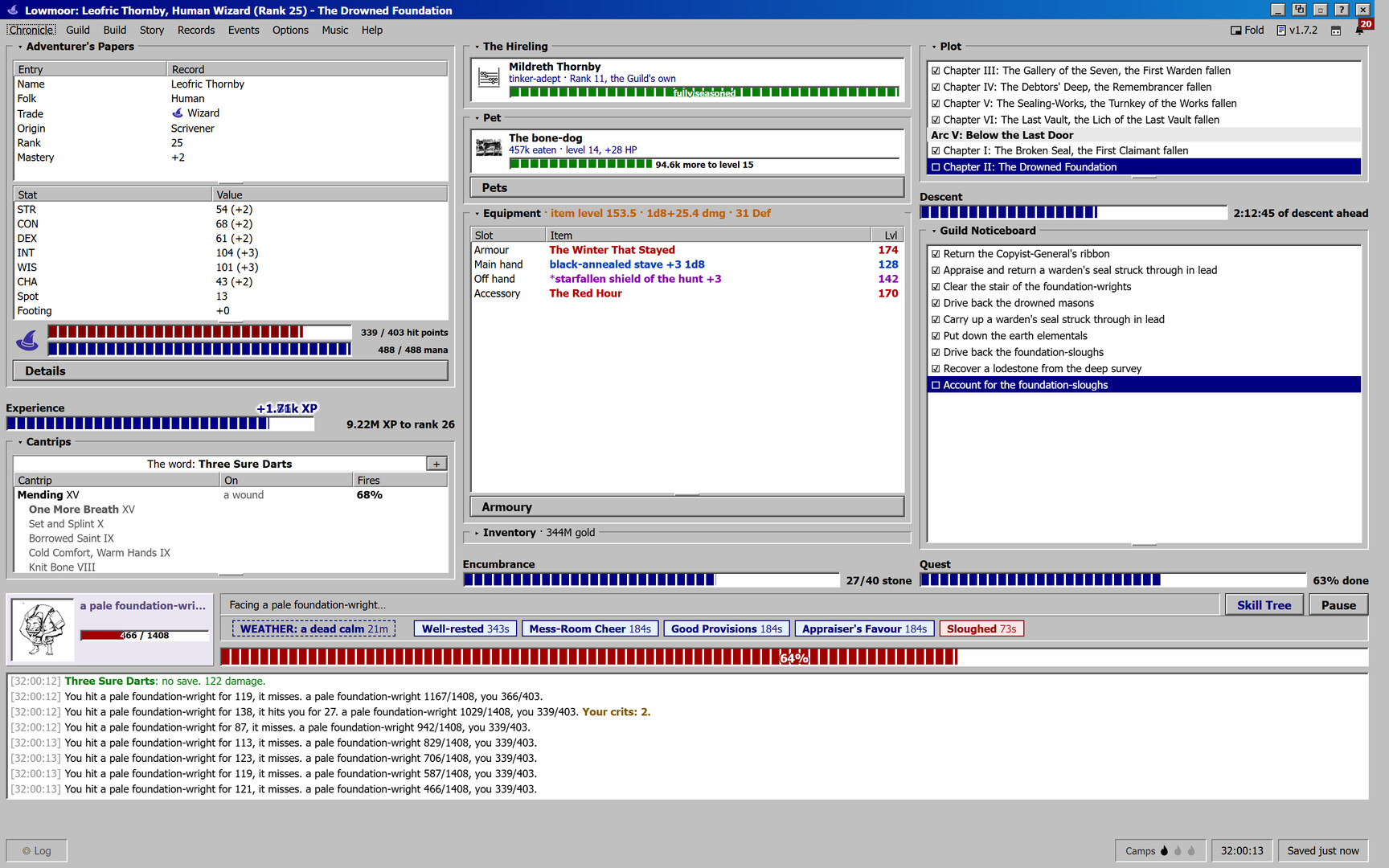
The main window in full — stats, equipment, hireling, pet progress, plot checklist, and a live d20 combat log, all updating on their ownImage: LilChill Games via Steam -
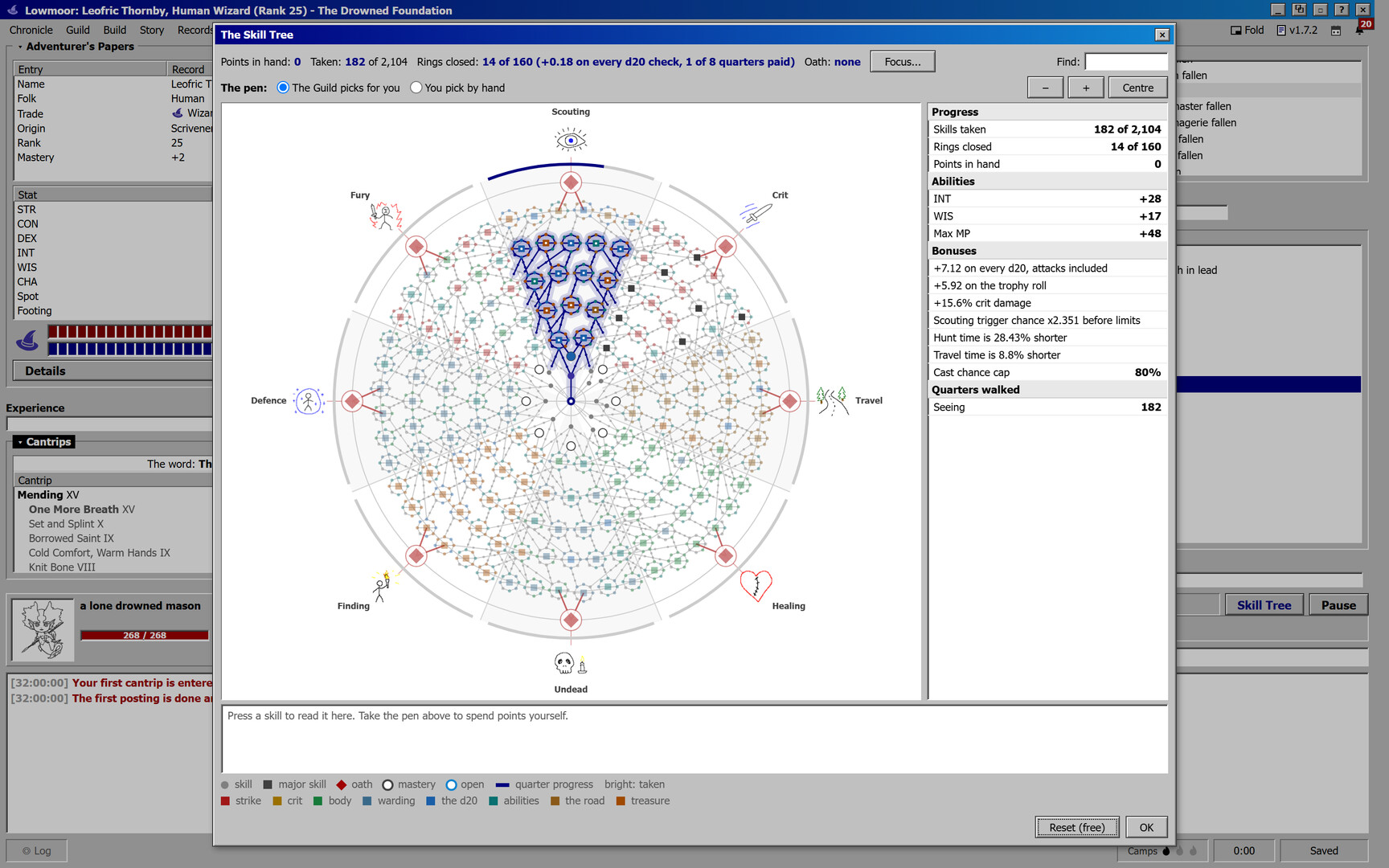
The Long Charter skill tree — 182 of 2,104 skills taken so far, branching out toward oaths like Scouting, Fury, Defence, and HealingImage: LilChill Games via Steam -
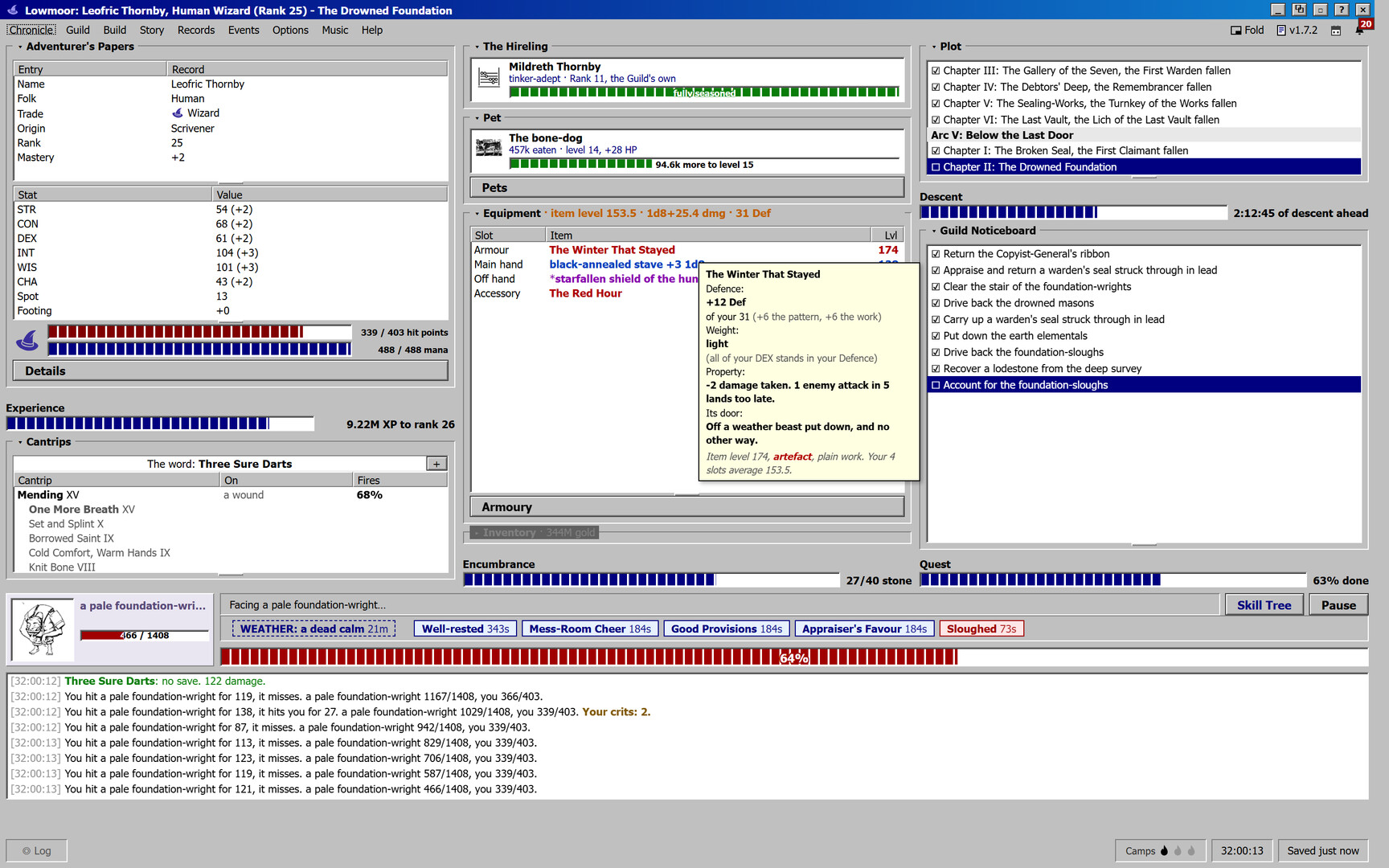
An equipment tooltip for "The Winter That Stayed," showing the module-flavoured item lore that gives the log its distinctive voiceImage: LilChill Games via Steam