
Game review
Dungeon Companion Review
7 / 10
- Developer
- BVT Last Night Games, Vaalz
- Publisher
- BVT Last Night Games
- Released
- 17 February 2026
- Platforms
- ["Windows"]
- Genre
- RPG
A Dungeon That Runs on Your Real Keystrokes
Dungeon Companion's hook is unusual even by idle-genre standards: it turns real-world typing and clicking, measured as an APM count, into in-game gold bonuses, resource boosts, and temporary buffs, on the theory that the game should reward players for doing their actual work rather than pulling their attention away from it. The developer is explicit that this tracking only counts input frequency, not content — no keys or text are logged, and the game works fully offline. Reviewers who've used it for genuine work sessions back up the pitch directly: one describes using it "while studying some coding," taking "a moment to improve my stats or check out the unlocked relics" between tasks, and specifically enjoying watching "the APM counter go up while I focused on other tasks, knowing that multiplier was crucial for progressing in the forge." Another calls it "a good companion that provides entertainment while you doing other activities," and a third, writing in Spanish, calls it "a very original idea for studying or working" ("Una idea muy original para estudiar o trabajar").
An Auto-Battler Built Around Gambits, Not Grinding
Beyond the productivity hook, combat itself runs on a conditional rule system reviewers repeatedly compare to Final Fantasy XII's gambit mechanic: players set rules like "if HP < 30%, use potion" or "if enemy is burning, use fire skill," and combat then resolves automatically according to those conditions rather than needing constant manual input. One reviewer calls this system "awesome," explaining they've "always wanted an auto-battler that actually lets you influence combat more directly," and gives a concrete example — setting a hero to hit poison-weak enemies with a specific attack for bonus damage. A second reviewer makes a similar comparison unprompted, noting the gambit system "instantly reminded me of FFXII, which I believe inspired this game" and adding they haven't "seen another game with that mechanic" in the idle space. On top of the gambit rules, players collect permanent relics (one reviewer highlights "a wand that lets you revive if you die") and guild upgrades that persist between runs, giving the loop a light roguelite-adjacent meta-progression layer.
Light, Unobtrusive, and Built to Sit in a Corner of the Screen
Reviewers consistently praise how little Dungeon Companion asks of the player's attention. One describes being able to run "a little (resizable) game in the corner of your screen, that can even be made transparent," adding it "can also be minimized like any other game" and is "not nearly the distraction that most idle games are." Another likes the retro pixel art and describes a simple daily rhythm: "just hit start and keep working and from time to time when I need a little break... come back to the game and check the progress, add some powerups and stats and then go back to work." At NZ$2.99 with no further purchases mentioned in any review, and with the developer described by multiple reviewers as "quick to respond to feedback on their Discord," the entry cost and studio responsiveness both come through as clear positives in the sample.
The store page pitches the game specifically at "developers, writers, students, remote workers," and the reviews back that framing up with real use cases rather than marketing copy: reviewers describe running it during coding sessions, online classes, and general work, not just as a standalone idle game. A shorter review sums up the appeal in a single line — "a good companion that provides entertainment while you doing other activities, highly recommended!" — while another simply calls it "a nice background game that keeps me stimulated." That consistency across otherwise very different reviewers, each describing the same core use case in their own words, is a reasonably strong signal that the productivity-companion pitch is landing as intended rather than just being unusual store-page copy.
Real Complaints: Difficulty Curve, UI Clarity, and One Serious Storefront Accusation
Not every account is glowing. One reviewer who logged over 9,500 minutes says they "hit the max" relatively quickly — "I just one-shot everything pretty much, I have all the relics, even though my runes are still super low" — and specifically flags the difficulty curve as needing work, though they frame that as reasonable for an Early Access build rather than a fundamental flaw. A separate detailed review raises smaller but concrete usability gaps: no clear way to track available resources in the Rune system, relics that "feel a little too easy to get," and a wish for a monster-collection log similar to a bestiary.
The one clearly negative review in the sample is far harsher, and raises a specific allegation worth flagging directly: calling the game "UNITY hobby crap" made in "basically a 4-hour afternoon project," the reviewer also states "Warning Dishonest Storepage with blurred/polished AI video & screenshots," implying the store page's promotional media oversells the actual in-game presentation using AI-generated or AI-enhanced assets. That's a serious claim from a single named reviewer rather than something independently confirmed, and it sits in sharp contrast to the nine other reviews in the sample, several of which specifically praise the pixel art and animation as "well done and nicely detailed" — but it's a pointed enough accusation about the store page's honesty that prospective buyers should weigh it before purchasing.
Verdict
Dungeon Companion pairs a genuinely novel hook — converting real productivity into idle-game progress, with privacy-respecting local-only input tracking — with a surprisingly deep FFXII-style gambit combat system that reviewers who've engaged with it are enthusiastic about. At NZ$2.99 with no monetisation complaints anywhere in the sample and a developer reviewers describe as actively responsive, it's a low-risk pickup for anyone who wants an idle RPG that runs quietly in the background of a work session rather than competing for attention. The main open questions are a difficulty curve that at least one long-session player found trivial past the early hours, some rough interface edges around resource tracking, and one reviewer's serious, unconfirmed accusation that the store page's promotional media doesn't honestly represent the game — worth checking for yourself against the actual screenshots before buying.
Screenshots
-
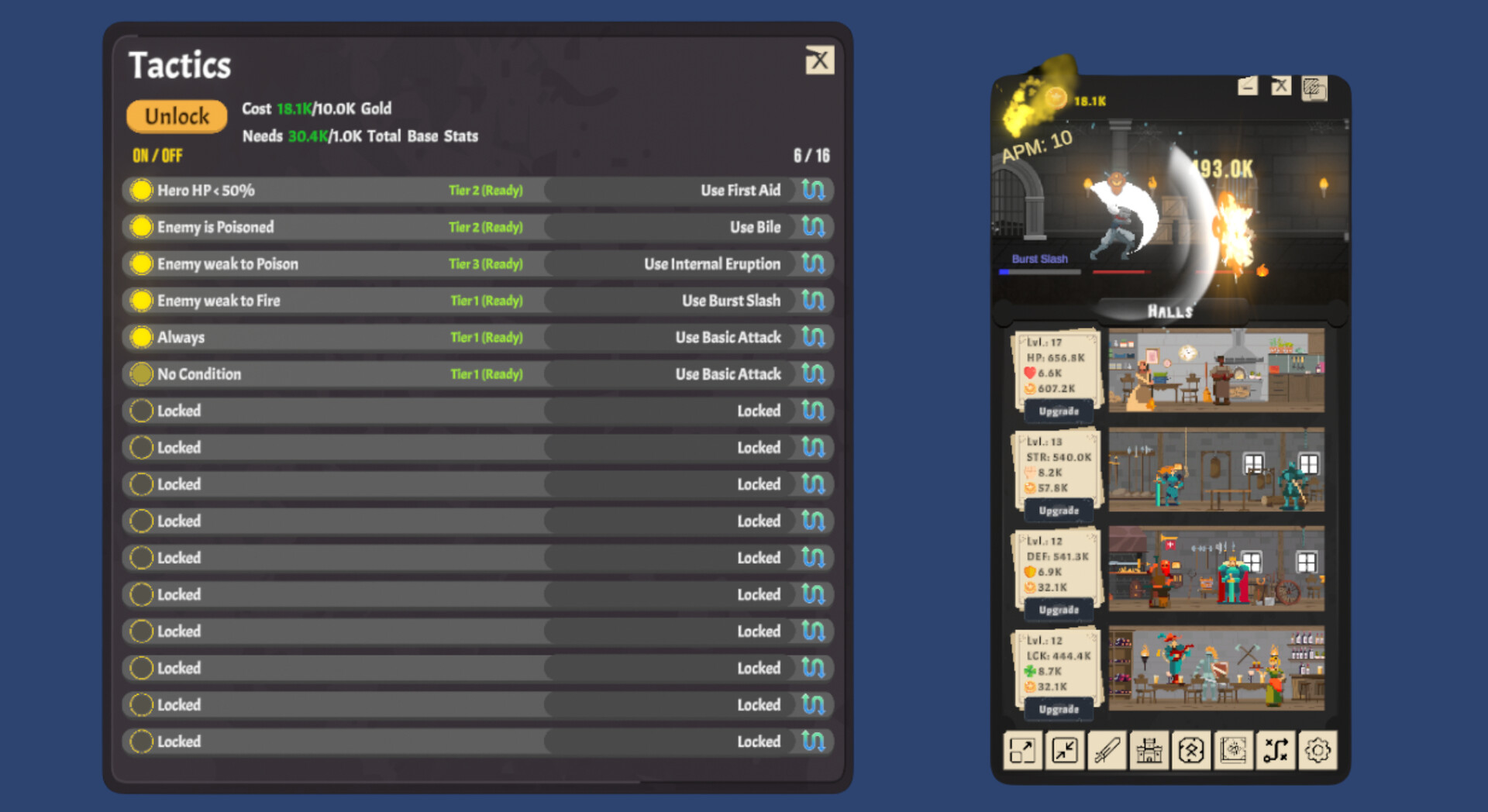
The gambit-style Tactics menu, where players set conditional rules like "Enemy weak to Poison → Use Internal Eruption" for fully automatic combat.Image: BVT Last Night Games via Steam -

The game's small resizable widget, shown here running in the corner of the screen during an unrelated video call — the "background companion" pitch in action.Image: BVT Last Night Games via Steam -
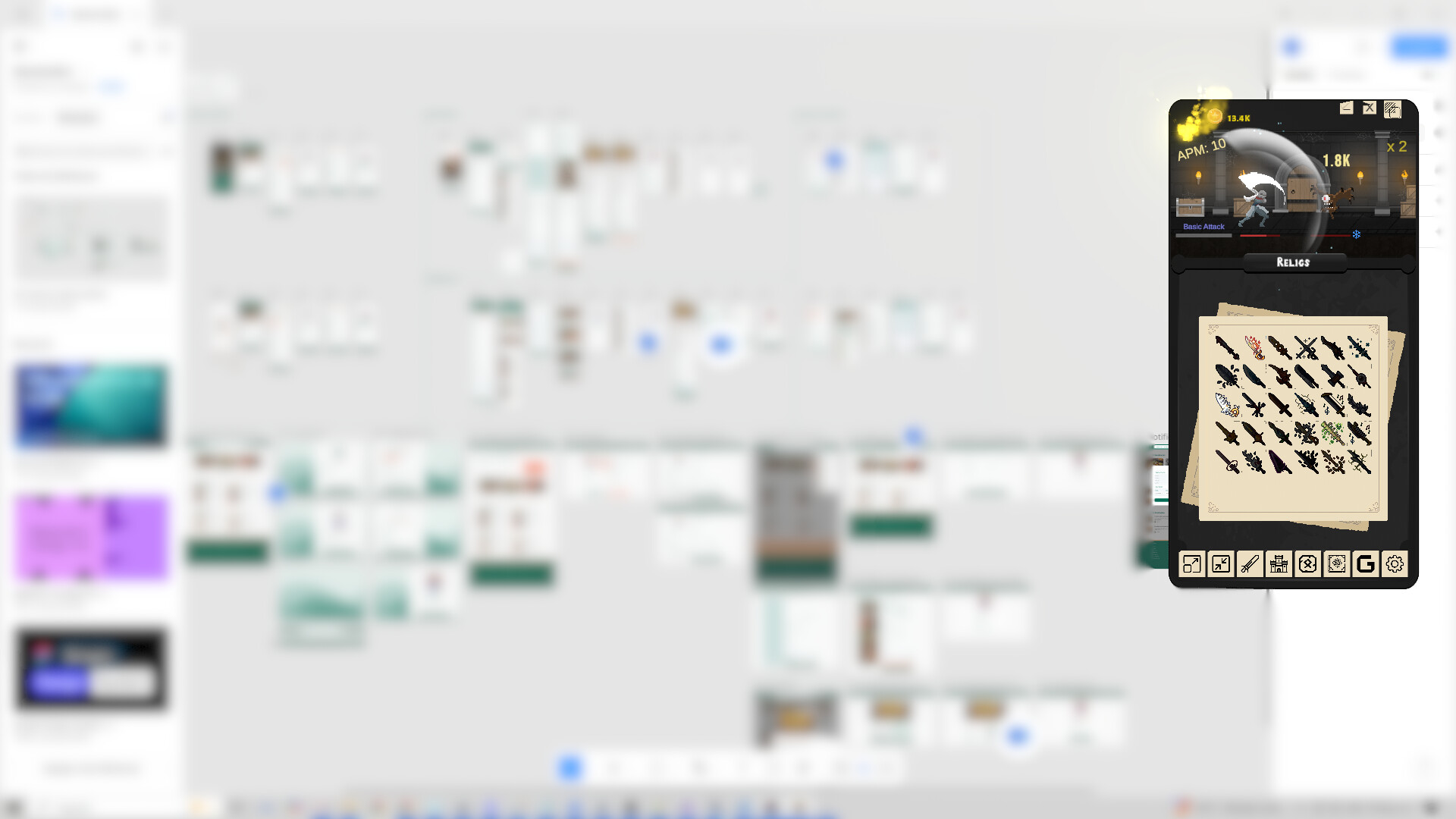
The Relics collection, largely still locked here, shown docked in the corner while other work fills the rest of the screen.Image: BVT Last Night Games via Steam