
Game review
Cindervale Idle Review
6 / 10
- Developer
- Smolder Studios
- Publisher
- Smolder Studios
- Released
- 7 August 2026
- Platforms
- ["Windows"]
- Genre
- RPG
A One-Person Melvor Idle, Built in the Open
Cindervale Idle is a solo-developed fantasy skilling idler, and it wears that comparison openly rather than dodging it — one returning reviewer sums it up as "essentially just a watered-down Melvor Idle clone with a bunch of extras that Melvor needed mods for," and says it without much rancour, since the extras are the point. Thirteen skills split across five gathering disciplines (Woodcutting, Mining, Fishing, Foraging, Farming), six making disciplines (Smithing, Cooking, Alchemy, Firemaking, Jeweler, Crafting) and two that are neither (Agility, Thieving) sit behind a 98-point passive tree apiece, feeding into twelve combat zones running from the Rat Warrens up to a Demon Sanctum, four raid gauntlets with no retreat, and a full naval side-game — build a ship, hire a crew, and send it off across twenty-six islands on a real-world clock that keeps ticking whether Cindervale Idle is open or not.
It's a one-purchase, no-microtransaction game — a single Windows Early Access build, currently at just six total Steam reviews (five positive, one negative), too few for Steam to display a percentage score. That's a genuinely small sample to draw on, and everything below is scoped to what that handful of detailed accounts actually says, not a broader consensus.
Ten Guilds and a Fence That Pays Full Price
What separates Cindervale Idle from being merely "Melvor with different names" is the guild layer sitting on top of the thirteen skills — one guild per skill, each handing out three rerollable daily jobs (gather this, kill that, bring back so many) that build toward six reputation ranks, and each rank is a real, permanent bonus to that skill rather than a cosmetic title. A guild you've ranked up changes how the underlying skill plays for good, which gives the daily-job structure more long-term weight than the "just log in and clear the board" busywork this format can fall into elsewhere. The Nightmarket does something similar for the game's economy: it's a fence that buys stolen goods, paying poorly at first and closer to full value the further a player climbs its ranks — a small, specific twist that at least one returning reviewer's account of the game's steady stream of updates suggests is typical of how Smolder Studios approaches expanding the systems already in place.
That update cadence is the strongest thread running through the review sample. Multiple reviewers, across entries spanning several weeks, describe a developer who responds quickly in the game's Discord and ships fixes fast — one wrote that "any bugs seem to be fixed almost the next day," and another edited an initially critical review after "dev response was detailed and addressed my technical function concerns," upgrading their recommendation as a direct result.
The Marketing Promises Idle. Combat and Sailing Don't Quite Deliver It.
The store page's pitch is that "there is no energy bar and nothing to sit and wait for" and that the game runs the same whether you're at the keyboard for ten minutes or three hours. Reviewers who've put real time in complicate that picture: one notes plainly that "fighting can't be afk'd, it has to be real timed," and that "sailing seems useless or just require active time the same as fighting" — a direct tension with the hands-off promise the skilling side of the game otherwise delivers on. That same reviewer later updated their account after a patch made offline combat XP work as intended and added an AFK-combat option for loot (with item names sometimes displaying as "undefined," a rough edge they flag but don't treat as a dealbreaker), which brought their recommendation from lukewarm to positive. It's a useful reminder that this is a fast-moving Early Access build rather than a finished product, and that specific complaints from even a few weeks ago may already be out of date.
Presentation gets more consistent pushback: reviewers describe the UI as "pretty overcluttered," and one specifically flags "low-contrast text and textures" as hard on the eyes, on top of what they call a practically nonexistent tutorial — "less than a paragraph, basically just says 'hey, here's where you can see the different walls of text and icons, have fun.'" For a game built around thirteen interlocking skill screens and 735 items, throwing new players in with minimal onboarding is a real cost, even from reviewers who otherwise came away positive.
One Scary Technical Report, Resolved by the Developer
The most alarming single complaint in the sample also has the clearest resolution: one reviewer reported that Cindervale Idle runs three separate instances in Task Manager simultaneously, including one that reopens itself after being force-closed and consumed roughly two-thirds of total CPU usage as a stuck whitescreen — understandably enough, they flagged it as a potential red flag before assuming it was simply bad optimisation. That reviewer later updated their review to say the developer's response was "detailed" and addressed the concern directly, revising their score to positive and specifically noting the game "certainly isn't some weird malware." It's worth surfacing plainly for anyone considering an early purchase — not because it looks like an ongoing problem, but because a report that specific deserves to be named rather than smoothed over, even after it appears to have been addressed.
Verdict
Cindervale Idle is an ambitious amount of solo-developed system — thirteen skills, ten guilds, twelve zones, four raids and a full sailing game — sold once for under eight dollars with no further purchases of any kind, and the handful of detailed reviews available describe a developer who patches fast and listens to feedback. Against that, it's an Early Access build with real rough edges: a UI reviewers call overcluttered and low-contrast, a near-absent tutorial for a genuinely complex set of systems, and combat and sailing that don't yet deliver on the "always idle" promise the marketing makes. The review base is far too small — six total — to call any of this settled, and at least one specific technical scare in that small sample was already resolved by the time its author updated their review. For genre fans willing to tolerate an actively-changing early build at a low price, there's clearly something here; for anyone wanting the polish of Melvor Idle's decade of iteration, this isn't there yet.
Screenshots
-

A character-select screen shows just how deep a single save can go — Total Lv 668 after 3 days 15 hours.Image: Smolder Studios via Steam -
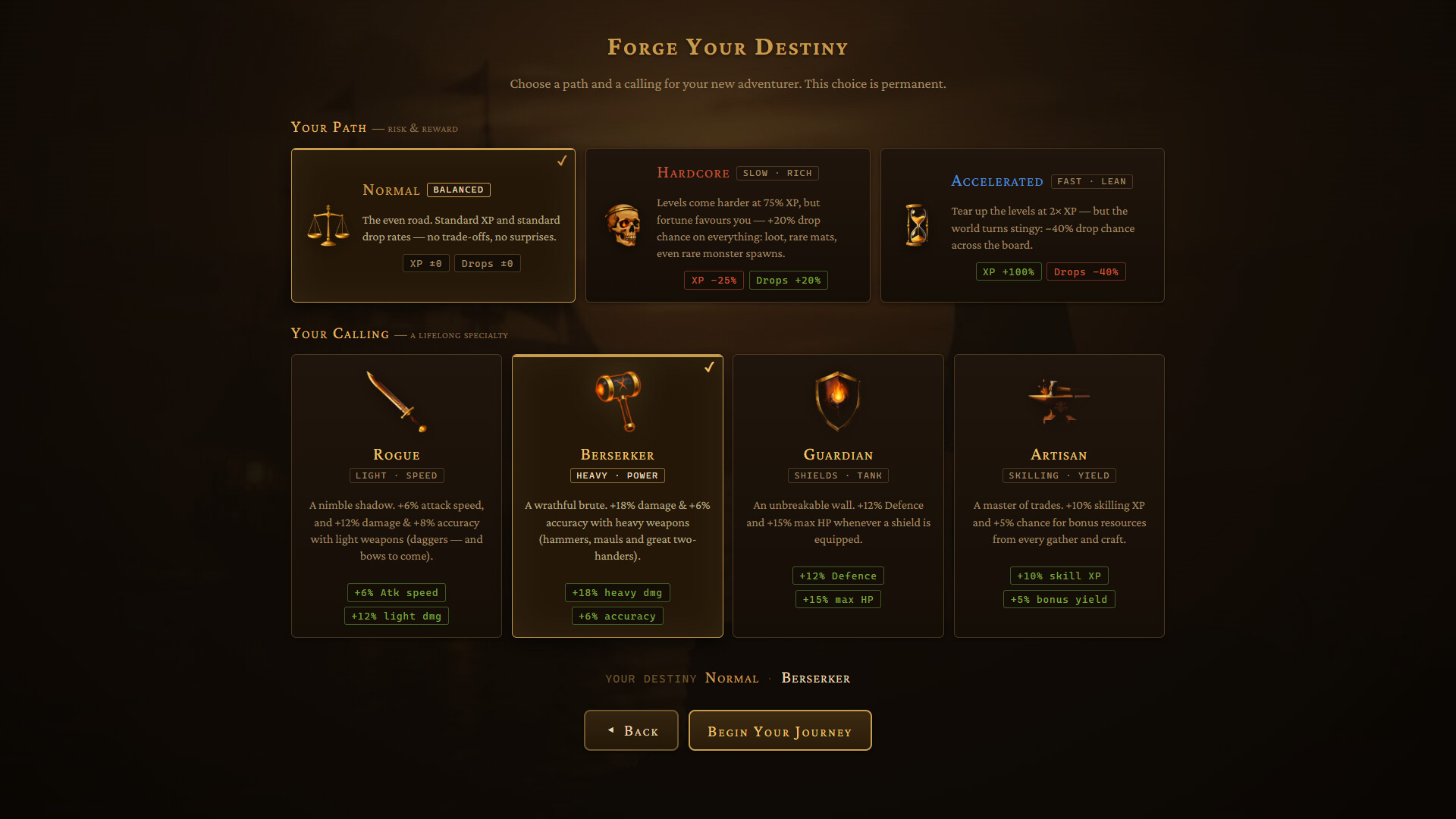
New characters lock in a permanent Path (risk/reward pacing) and Calling (combat specialty) before their first action.Image: Smolder Studios via Steam -
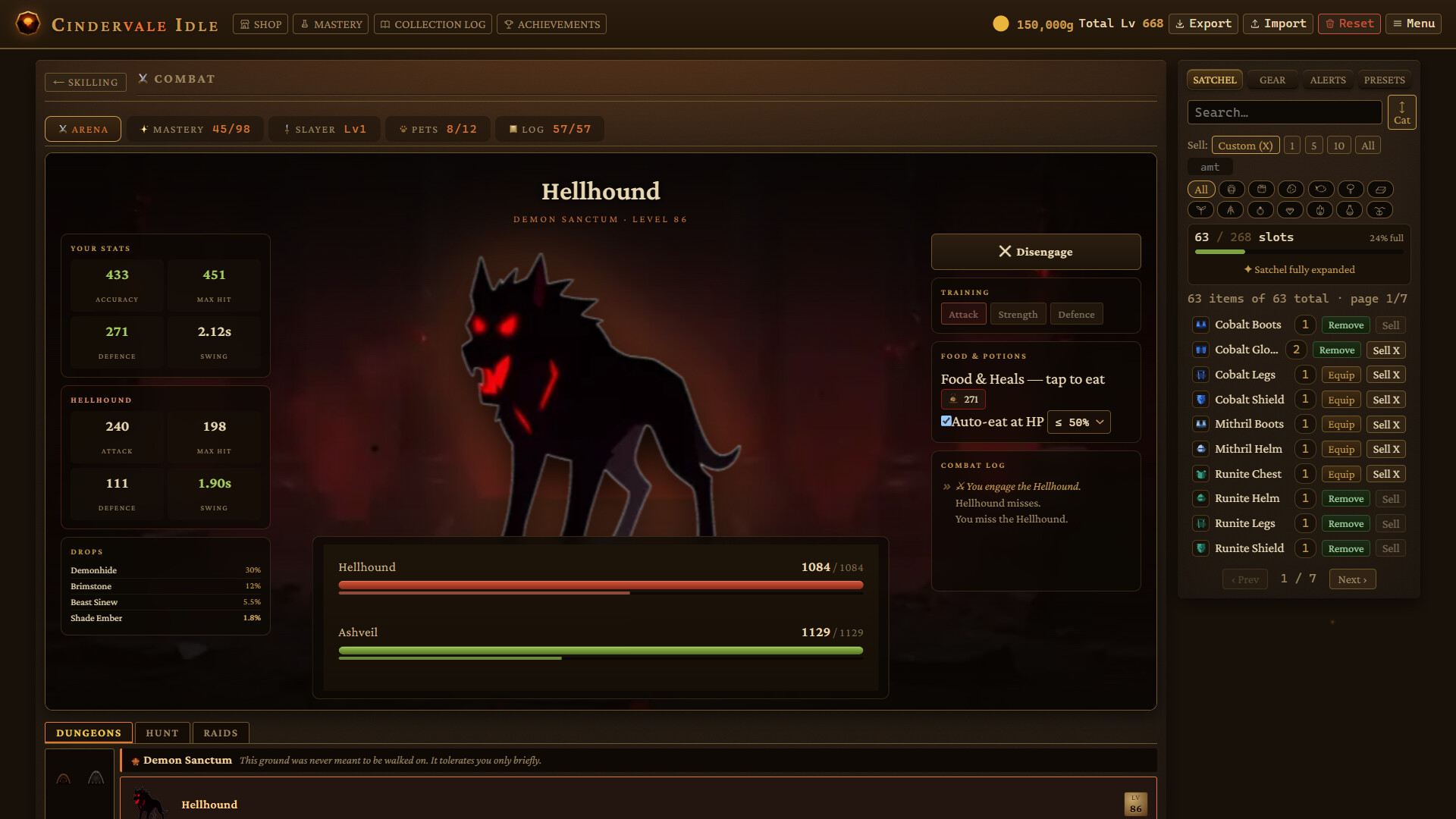
Mid-fight against a level 86 Hellhound — the auto-eat toggle reviewers credit, next to the satchel UI some call overcluttered.Image: Smolder Studios via Steam