
Game review
Beast Market Review
5 / 10
- Developer
- ShiningStar Inc.
- Publisher
- ShiningStar Inc.
- Released
- 28 August 2026
- Platforms
- ["Windows"]
- Genre
- RPG
An Idle Hunter With a Real Market Attached
Beast Market's pitch is simple on the surface: your hunter goes out and fights beasts automatically, even while the game is closed, and comes home with materials and "Hunting Cores" to crack open for gear components. That much is standard idle-RPG furniture. What makes Beast Market different is the loop bolted onto the side of it — a subset of the materials you collect can be listed and traded on the actual Steam Community Market, and the game gives you a dedicated "Market Terminal" to read 24-hour, 7-day, and 30-day price charts, track a watchlist, and decide whether a material is worth selling now or stockpiling. It's an idle game that occasionally asks you to think like a very small-scale commodities trader.
Developer ShiningStar Inc. leans into that framing directly, describing the loop as Idle → Collect → Craft → Hunt Again, with the market-reading layered on top rather than replacing it. Beasts are hunted automatically once you've picked a hunting ground, chosen based on a beast's known weaknesses and drop table; combat itself is not something you control directly, it resolves in the background while you decide what to do with what comes back.
The Hunting and Crafting Loop
Season 0 ships with 30 beasts, each available in Normal, Enhanced, and Apex variants, six weapon types, and a mix of part-breaking, capturing, and Hunting Core mechanics layered on top of straightforward kills. One reviewer with over 190 hours logged described the appeal well, contrasting it with looser idle games: "this is definitely a different animal compared to other idler game[s]... progression is based more on luck and time, with not many flexibility and strategy behind. Beast Market on the other hand, is lot more complex than your normal idler game, players have to strategies which monster they want to farm, what weapon+armor build they want to go for, to spend gold on expanding ur farm or buying runes." That reviewer's read is that the game asks for more deliberate planning than the average automatic-combat idler, even though none of the actual fighting is something you touch.
A second detailed review backs that read up, describing the loop as "unusual" for an idle RPG specifically because of the crafting-and-market layer: "My hunter keeps working while I am away, then I come back to see what I collected and decide what I want to do next... I liked how the game makes me think about what I actually need." Both reviewers frame the hunting itself as the least interesting part of the game and the resource-allocation decisions — what to craft, what to sell, where to send the hunter next — as the actual game.
Offline Progress Is Capped, and the DLC Knows It
Offline progress accumulates for up to 8 hours at 50% production by default. A paid DLC called "Hunter's Sleeping Bag" extends that ceiling to 24 hours, alongside separate paid add-ons for expanded Hunting Core storage ("Large Warehouse," raising the cap from 100 to 240), more detailed combat information ("Tactical Computer"), and expanded farm plots ("Frontier Permit"). None of it buys combat power directly — the store page is explicit that there's no premium currency, no paid gacha, and no way to directly purchase strength — but the specific choice to gate the offline-time extension behind a purchase is exactly the kind of design one critical reviewer singled out: "AI slop with its QoL upgrade DLCs that should be in the game already." That's a harsher framing than the game's own "Fair Free-to-Play" pitch, and it's worth noting the "AI slop" accusation specifically was not substantiated with evidence in the reviews sampled — it reads as a reaction to the DLC structure more than a documented claim about how the game was built. A more measured negative review made a related but calmer point, calling it a "predatory cash shop" while still recommending the game overall "because it's a working free-to-play game with a lot of content."
A Real-Money Angle That Reviewers Are Split On
The Steam Community Market tie-in is the feature most likely to define how a given player feels about Beast Market. For some, it's the whole appeal — an idle game where the materials you passively accumulate have an actual, checkable market value, and where reading that market is presented as gameplay rather than a side menu. For others, the framing reads closer to a real-money trading scheme wearing a hunting-RPG skin, and at least one review dismissed it in those terms outright, tying it to the era of NFT-adjacent games Steam has since banned. Neither position is unreasonable: the mechanic is genuinely new territory for an idle RPG, and Steam Community Market trading always carries the caveat that Steam takes a cut and that Wallet funds from sales can't be withdrawn as cash, which is worth knowing going in regardless of which side of the debate you land on.
The Market Terminal itself goes further than a simple price list — a given material's chart comes with SMA, Bollinger Band, RSI, and MACD overlays, the same toolkit a real stock-charting app would offer, alongside a live "Market Pulse" feed of price-move alerts. That panel is also unusually candid about its own limits: one alert notes outright that "Steam does not expose an app-wide execution feed, so transfers are never labelled as sales," meaning the game is inferring market activity rather than reading it directly from Valve. It's a level of financial-tool fidelity that's genuinely surprising to find bolted onto an idle hunting game, whatever you make of the underlying real-money hook.
Rough Edges Early On
Beyond the DLC framing, the more conventional complaints are about a game that's still finding its feet. One reviewer with a long play session reported the game "brings my system to a crawl," and a dev-praising review — genuinely positive about update speed and Discord responsiveness — still opened by acknowledging "the current stage of the game is still pretty early." Mixed reviews in this window are common for a title barely a month old with a live-service structure layered onto a genre that usually ships as a finished, static loop, and the pattern here — strong core-loop praise from players who've put in real hours, offset by performance and pricing complaints from shorter sessions — tracks with a game still being actively patched rather than one that's fundamentally broken.
Verdict
Beast Market's central idea — an idle hunting RPG that hands you a genuine market terminal instead of a vestigial currency counter — is the most interesting thing about it, and the reviewers who've stuck around seem to agree the strategic layer holds up. But the paid DLC structure sits awkwardly next to the "Fair Free-to-Play" promise on the store page, performance complaints are still showing up from players a month after launch, and the real-money trading hook will read as either a selling point or a dealbreaker depending on what you're looking for from an idle game. Worth a look if the Market Terminal concept appeals to you specifically; less compelling if you just want beasts to fight themselves while you do something else.
Screenshots
-
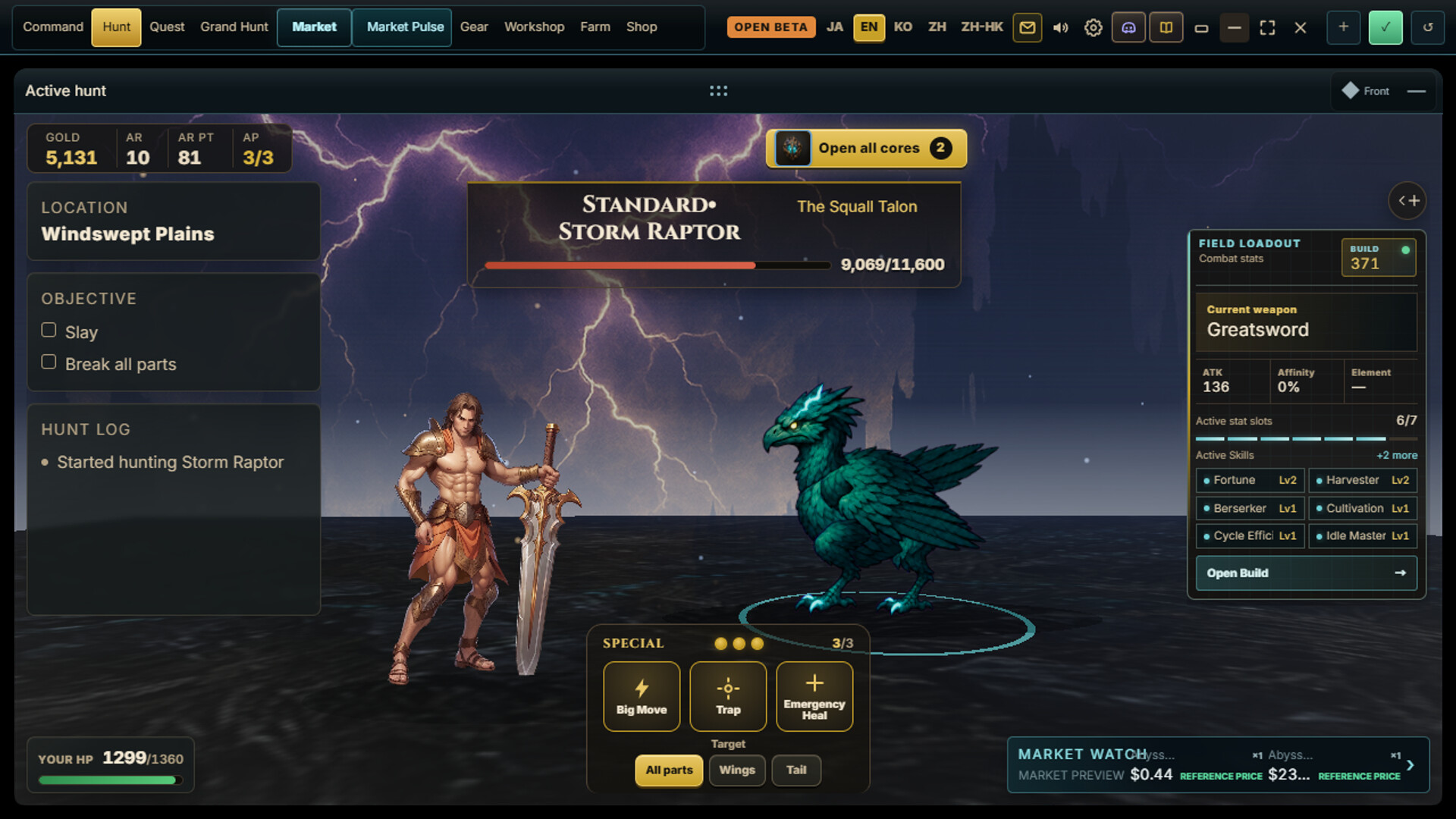
An active hunt in progress — the hunter and Storm Raptor fight automatically while menus track gold, objectives, and buildImage: ShiningStar Inc. via Steam -
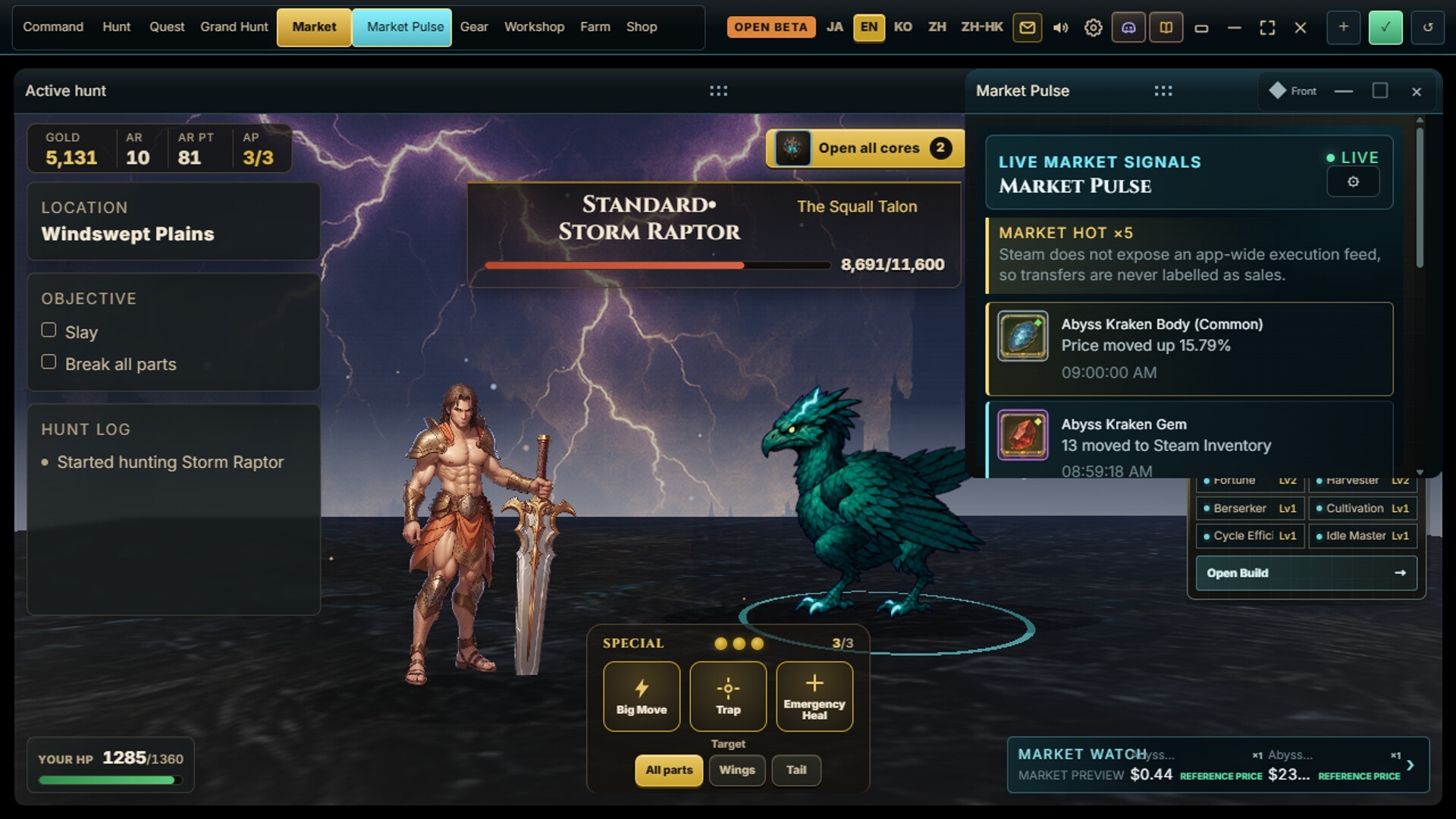
The Market Pulse overlay, surfacing real-time price-move alerts for materials while a hunt runs in the backgroundImage: ShiningStar Inc. via Steam -
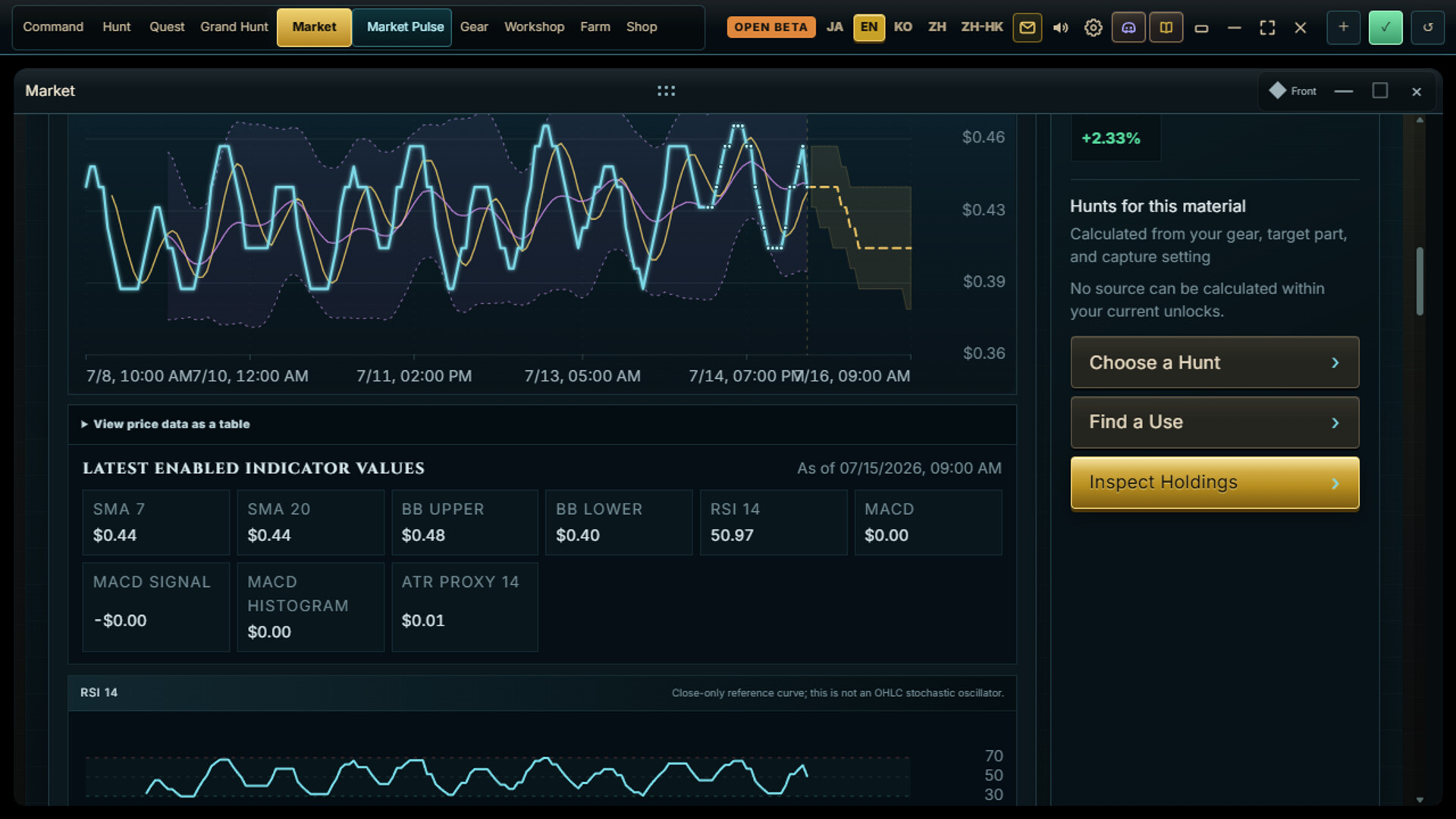
The Market Terminal's price chart, with SMA, Bollinger Bands, RSI, and MACD indicators for a single materialImage: ShiningStar Inc. via Steam