
Game review
Load Factor Review
7.5 / 10
- Developer
- FlyWithTom
- Publisher
- FlyWithTom
- Released
- 6 September 2026
- Platforms
- ["Windows"]
- Genre
- Strategy
Five Decisions, One Honest Market
Load Factor strips airline management down to its bones and dares you to master the result. There's no terminal construction, no runway-laying, no sprawling menus of cosmetic busywork — just five decisions that have made and broken real carriers for a century: which aircraft to fly, which routes to serve, what time of day to fly them, how many frequencies to run, and what fare to charge. Get that combination right across a network of over 3,100 real-world airports and a hub-and-spoke system emerges organically, passengers routing through your connections because the underlying demand model rewards it, not because a designer scripted a bonus for building one. Get it wrong, and empty seats quietly burn cash on every leg until the spreadsheet catches up with you.
A Simulation That Means It
What sets Load Factor apart from lighter airline-tycoon games is how seriously it takes the economics underneath the fun. Nearly 40 aircraft types are modeled on real payload-range physics, meaning a heavy widebody genuinely can't operate off a short regional runway and a nimble narrowbody can thread routes a jumbo never could — the wrong plane on the right route still loses money, and the game won't bail you out. Live-market fuel prices, a full breakdown of crew, maintenance, airport fees, and distribution costs, and a weekly route profit-and-loss report that ranks every leg by contribution combine to make this feel less like a tycoon game and more like an actual operations spreadsheet with a globe attached. Demand itself is fog-of-war: routes have to be researched to reveal their real potential before committing aircraft to them, and cabins mature over time, starting leisure-heavy on a fresh route and developing premium demand only as the route earns a reputation. It's the kind of granular, unforgiving systems design that will either click immediately for aviation-obsessed players or feel like homework to anyone hoping for a more arcade-y ride.
Rough Around the Edges, By Design and Otherwise
Being barely two weeks into Early Access at the time of writing, Load Factor understandably still shows some seams, and its own early reviewers are candid about where those seams sit. One player, generally enthusiastic about the "empire from scratch" premise, notes that the game "does the game explain enough? Not really" — there's a real learning cliff, with several mechanics requiring trial-and-error rather than clear in-game guidance, a fair complaint for a genre this dense with interlocking systems. That reviewer also draws a comparison to Factorio's slow-but-rewarding opening hours, which seems apt: this is a game that asks for patience before it pays off. A German-language reviewer, more effusive, calls it "really impressive for a one-man project" and specifically praises how much is already on offer at the current price and Early Access stage, singling out the core loop of building an airline, choosing aircraft, planning routes, and managing schedules as already working well despite the project's youth. Another reviewer, writing a review explicitly early after the launch, credits the solo developer with a genuinely polished first impression — no breaking bugs encountered in the opening thirty minutes, a consistently designed and visually pleasing UI — while allowing that plenty of improvement potential remains.
Nine Patches in Nine Days
If there's one thing that should reassure prospective buyers wary of Early Access abandonment, it's the sheer cadence of FlyWithTom's post-launch support. In the roughly two weeks since Load Factor's September 6th debut, the solo developer has shipped a career mode with certifications and lifetime stats, an overhaul that gives each airline its own running timetable, adjustments to how busy flights fill seats and how often weather causes cancellations, a public roadmap, and multiple point releases in between — an unusually aggressive update rhythm for a single-developer project barely out of the gate. That kind of visible momentum matters enormously for a genre where players are effectively betting that a small team will keep refining a deep simulation rather than letting it stagnate, and so far FlyWithTom is delivering exactly the signal buyers should want to see.
A Niche Built for the Fine-Print Crowd
Load Factor's own marketing is refreshingly upfront about who it's for: players who've traced a great-circle route with a finger, argued about slot times, or felt a quiet thrill at the phrase "load factor" itself. That's a narrow target, and it's the right call — trying to broaden this into a more casual tycoon experience would undercut exactly what makes it interesting to the audience it's chasing. The tradeoff is real, though: a demand model this honest and an economic simulation this granular will frustrate anyone expecting a gentler on-ramp, and the current lack of in-game explanation for some systems only sharpens that learning curve in the early build. For the right player, though, few games in the genre currently offer this much fidelity to how an actual airline network behaves, down to weather-driven cancellations and route-level profit accounting that hides nothing.
Verdict
Load Factor is an ambitious, economically honest airline simulation from a solo developer who's already shipping updates at a remarkable pace just two weeks into Early Access. The learning curve is steep and the in-game guidance is thin for now, but the underlying systems, real payload-range aircraft physics, a genuine demand model, and unflinching route-level financials, are exactly what aviation and economic-strategy fans have been asking for. It's not a game for players who want an easy tycoon fantasy, but for those who do want the fine print, Load Factor already delivers an unusually deep and promising foundation at a fair price, with every sign of getting better from here.
Screenshots
-
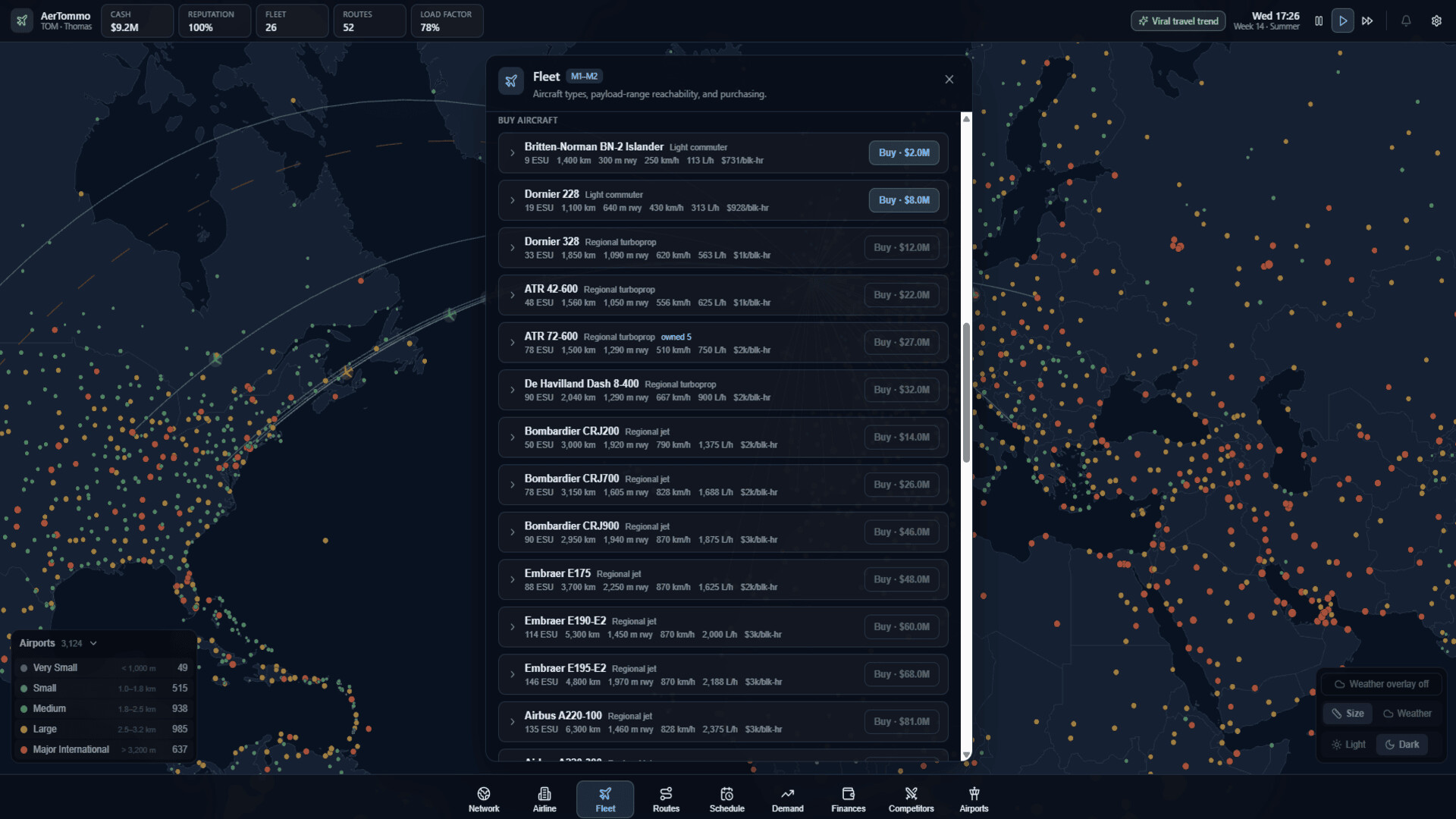
The fleet screen lists real aircraft with real payload-range specs — a Dash 8-400 and a CRJ900 aren't interchangeable, and the numbers make that plain.Image: FlyWithTom via Steam -
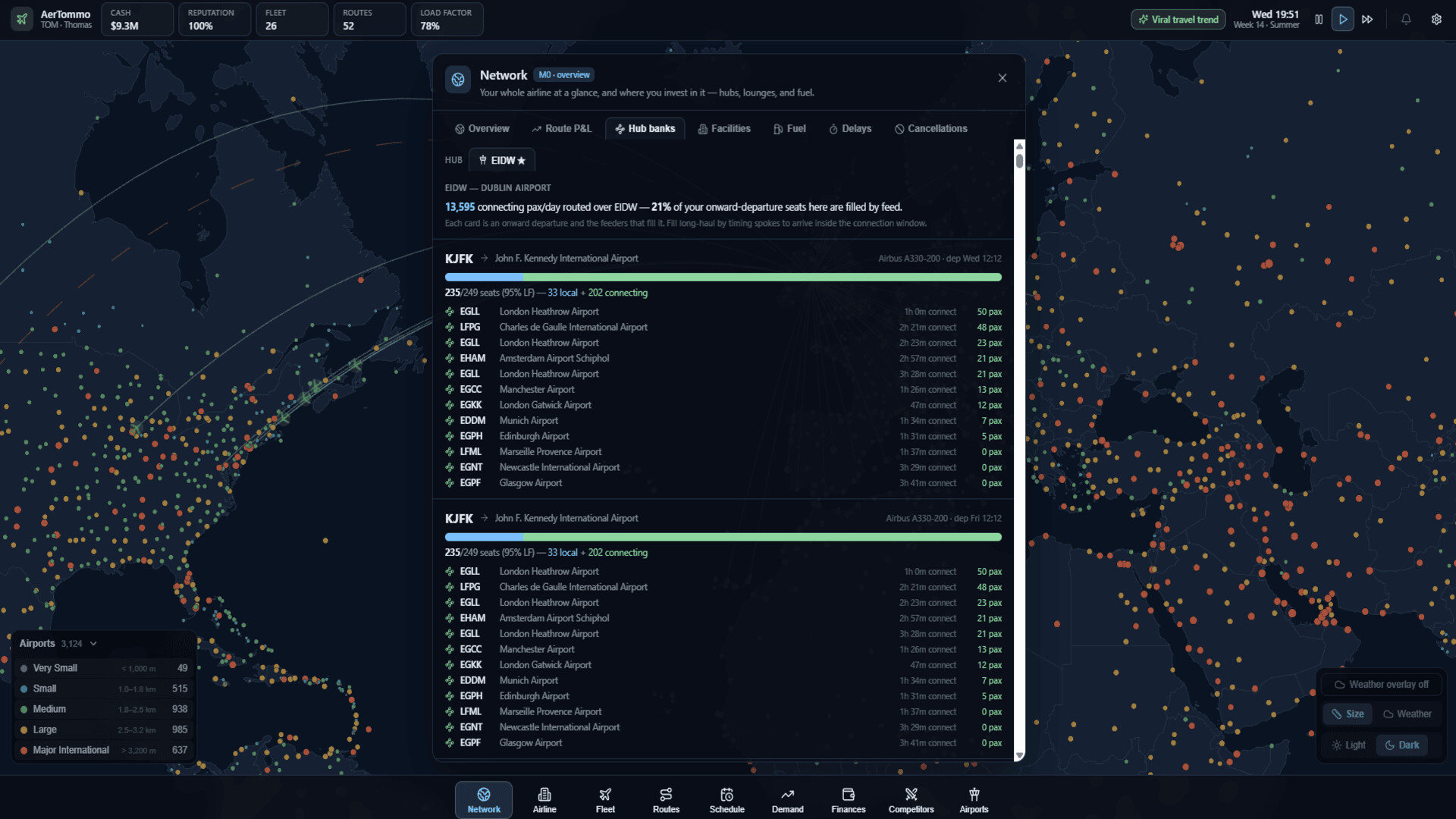
A hub bank view breaks down exactly which feeder routes are filling a long-haul flight, down to individual passenger counts.Image: FlyWithTom via Steam -
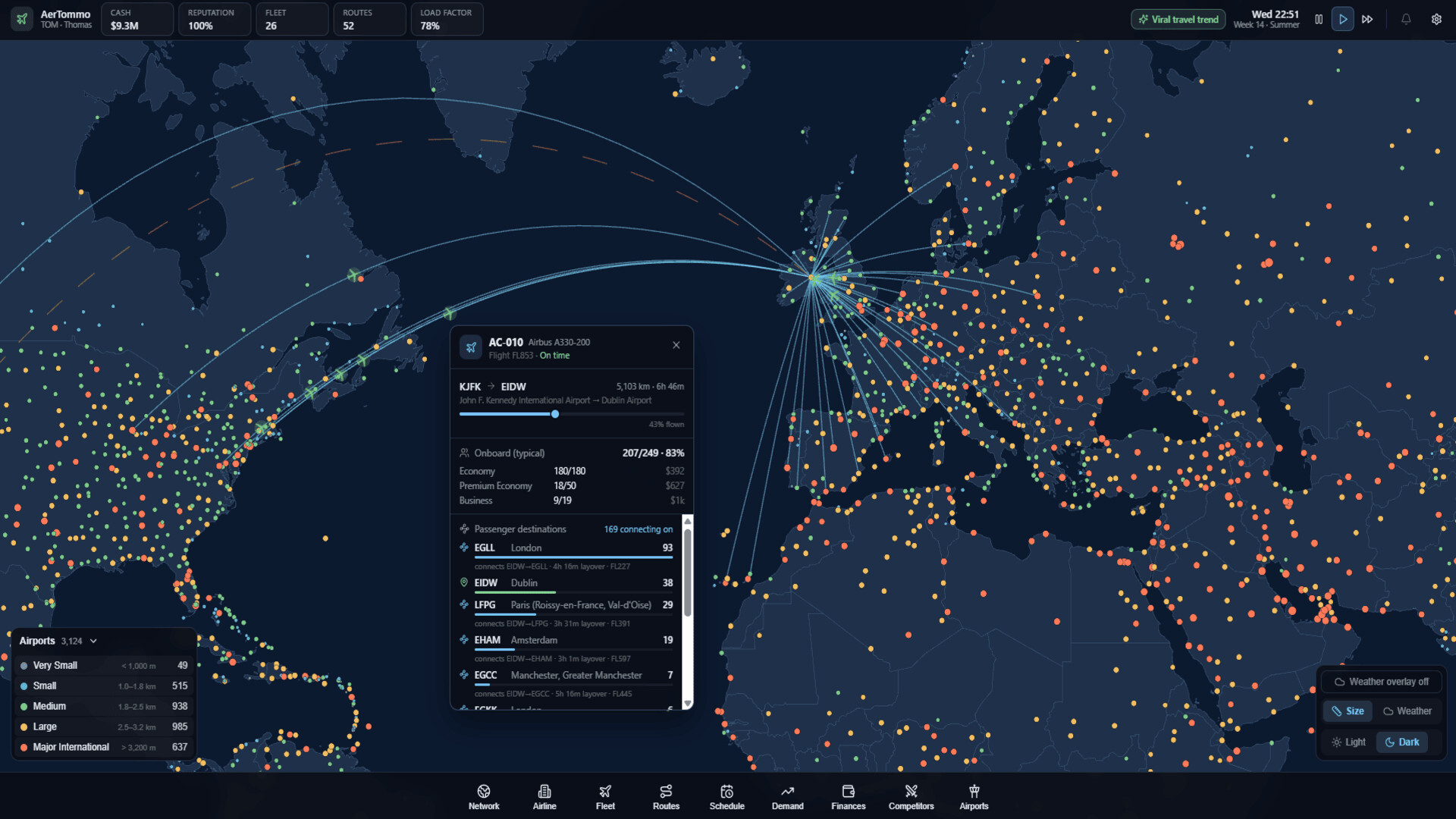
Mid-flight, a JFK–Dublin A330 shows its full cabin breakdown and where its connecting passengers are ultimately headed.Image: FlyWithTom via Steam