Game review
Lifestream - A Haunting Text Adventure
6.8 / 10
- Developer
- Storycentric Worlds
- Publisher
- Unimatrix Productions
- Released
- 19 September 2016
- Platforms
- Windows
- Genre
- Text Adventure / Interactive Fiction
- Monetisation
- One-time purchase, no in-app purchases
- Players
- Single-player only
The short version
Lifestream dresses a choice-driven, parser-free text adventure in the skin of an early-1990s interface — compass wheel, item pages, a journal that fills in as you go — and pours a 78,000-word supernatural mystery through it. Two protagonists, father and son, alternate between present and past, and the two threads are built to collide. It is unmistakably a small, older, single-language indie title: no voice acting, static "3D stills" standing in for cutscenes, and a discovery problem that has left it with only 23 Steam reviews ten years on. But every one of those reviews recommends it, the achievement curve shows most starters finishing rather than bouncing off, and at under four New Zealand dollars for an eight-hour novel's worth of story, the arithmetic is generous even before the writing gets any credit.
Biggest strengths
- Every one of its 23 Steam reviews is positive, a rare unanimous record even accounting for the small sample
- A genuinely substantial amount of prose for the price — around 78,000 words, comparable to a short novel, across roughly 8 or more hours
- The father/son, present/past structure gives the mystery two entry points and pays off with an intersection reviewers describe as a genuine surprise
Biggest weaknesses
- Development stopped after this and two sibling episodes; a planned longer series (Stonewall Penitentiary, Summit of the Wolf) has not materialised
- The opening hour is slow going — several reviewers admit to nearly giving up on the "text Catholic-priest simulator" first act before the mystery opens up
- Visuals are static illustrated stills rather than animation, and the presentation reads as dated even for 2016
Who it's for: Readers first, gamers second — people who want Zork's structure and Gabriel Knight's mood without Zork's parser or Gabriel Knight's budget. Good for anyone who likes gamebooks, gothic mystery paperbacks, or the idea of an interactive novel more than the idea of a game with reflexes in it.
Our recommendation: Buy it at this price without much hesitation if the pitch — a GUI text adventure about a missing priest, two timelines, one long mystery — appeals at all. Do not go in expecting modern production values; the artwork is static and the interface is a deliberate throwback, not a limitation reviewers had to forgive quietly.
6.8 / 10
Introduction
Some genres never really left, they just stopped being called by their old name. Lifestream - A Haunting Text Adventure is a 2016 release from Storycentric Worlds, published by Unimatrix Productions, and it is exactly what the subtitle says: a text adventure, rebuilt with a graphical shell so a player never has to type a verb and hope the parser understood it. Underneath the compass wheel and the multiple-choice menus is the structure of a classic 1980s interactive fiction game — rooms, an inventory, puzzles gating progress — wrapped around a ghost story about a Catholic priest who goes missing and the son who has to find him without involving the police, because a scandal would ruin what is left of his father's reputation.
It's a small game from a small studio, ten years old, sitting on 23 Steam reviews at the time of writing. All 23 are positive. That is the headline fact worth sitting with before anything else: a unanimous record is unusual even for a beloved AAA release, and considerably more unusual for an indie text adventure nobody has heard of. This review works from Storycentric Worlds' own store description, the press quotes it carries from Just Adventure, GameSkinny and Adventure Gamers, the full run of Steam user reviews, and Steam's global achievement-completion data, to work out what that unanimity is actually recording.
Story and structure
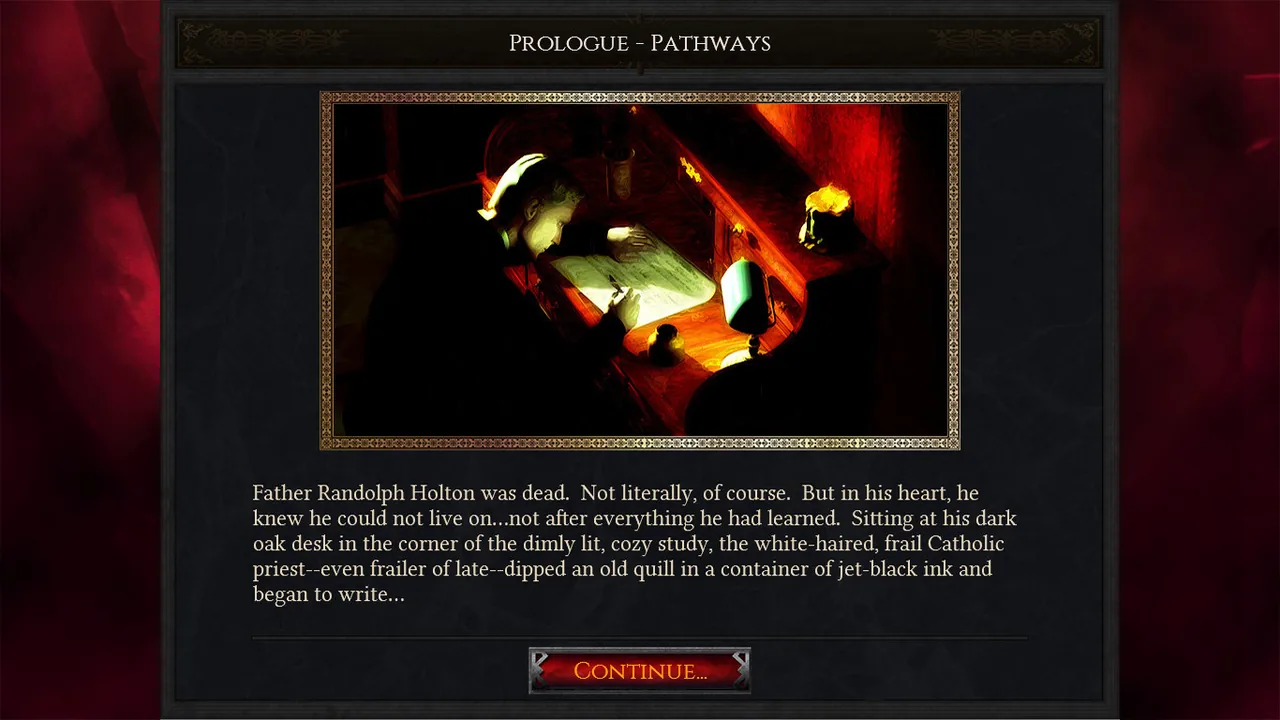
The pitch is direct: Randolph Holton, a priest, disappears. His son John can't go to the police, because even asking would tarnish a celibate priest's reputation, so John investigates himself. The game alternates between John's present-day search and flashbacks to Randolph's own mystery in the lead-up to his disappearance — the "mysterious realm" and "enigmatic brotherhood" the store page gestures at without spoiling. Each protagonist gets his own locations, his own inventory, his own puzzles, and the two threads are explicitly built to intersect by the end.
That structure is doing real work. A single unbroken present-day investigation risks going flat across eight hours; alternating between father and son gives the mystery two different tones — a son's search has urgency, a priest's slow unraveling has dread — and reviewers consistently single out the moment the two timelines connect as the game's best beat. One reviewer, who had also played Storycentric Worlds' original 2004 point-and-click Lifestream the text version remakes, called this version a "step backwards" on paper but reversed that opinion within minutes of actual play, which is about as strong an endorsement of the writing as a review can offer without meaning to.
The reception isn't purely religious-mystery fans, either — Adventure Gamers drew a direct comparison to Gabriel Knight's Southern gothic mood, and more than one Steam reviewer name-checked Infocom classics like Zork and Enchanter as the tradition this is consciously working in. The weak point, echoed by several reviewers independently, is the opening hour: the game starts slow, reads at first like what one reviewer bluntly called a "text Catholic-priest simulator," and asks for patience before the mystery opens up. Multiple reviews admit they nearly gave up in that first act. None of them actually did.
Interface and gameplay
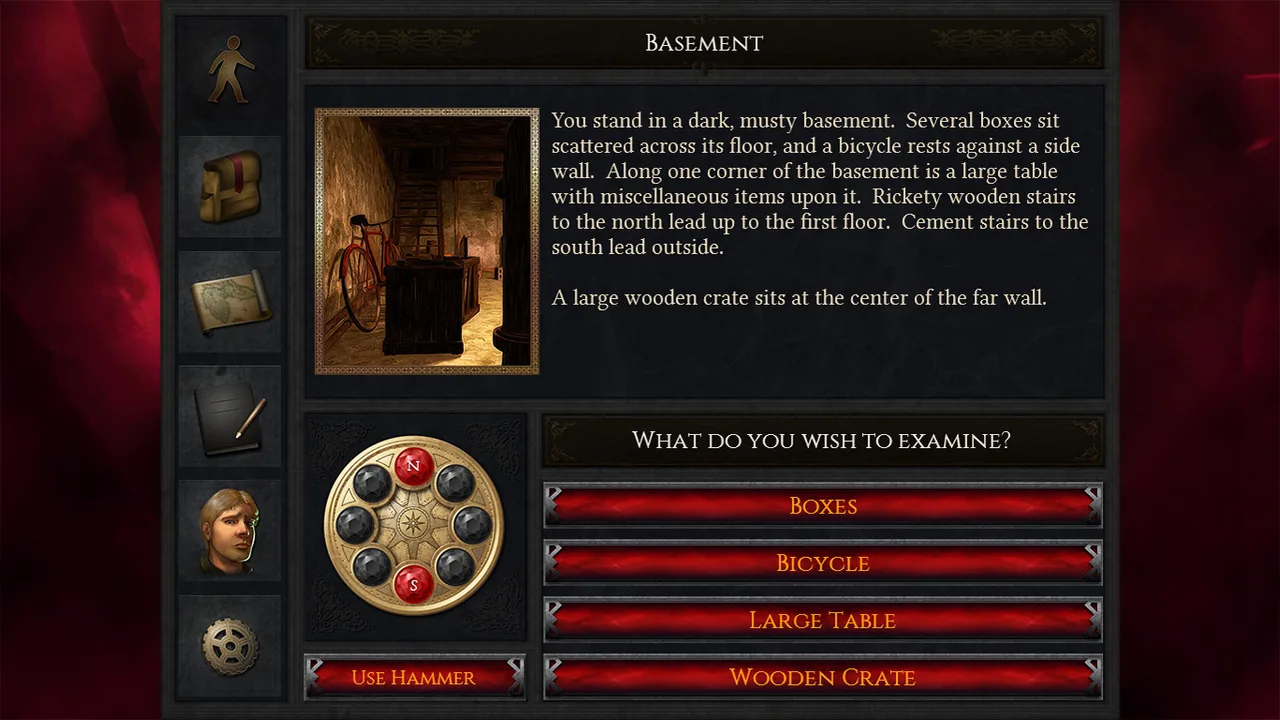
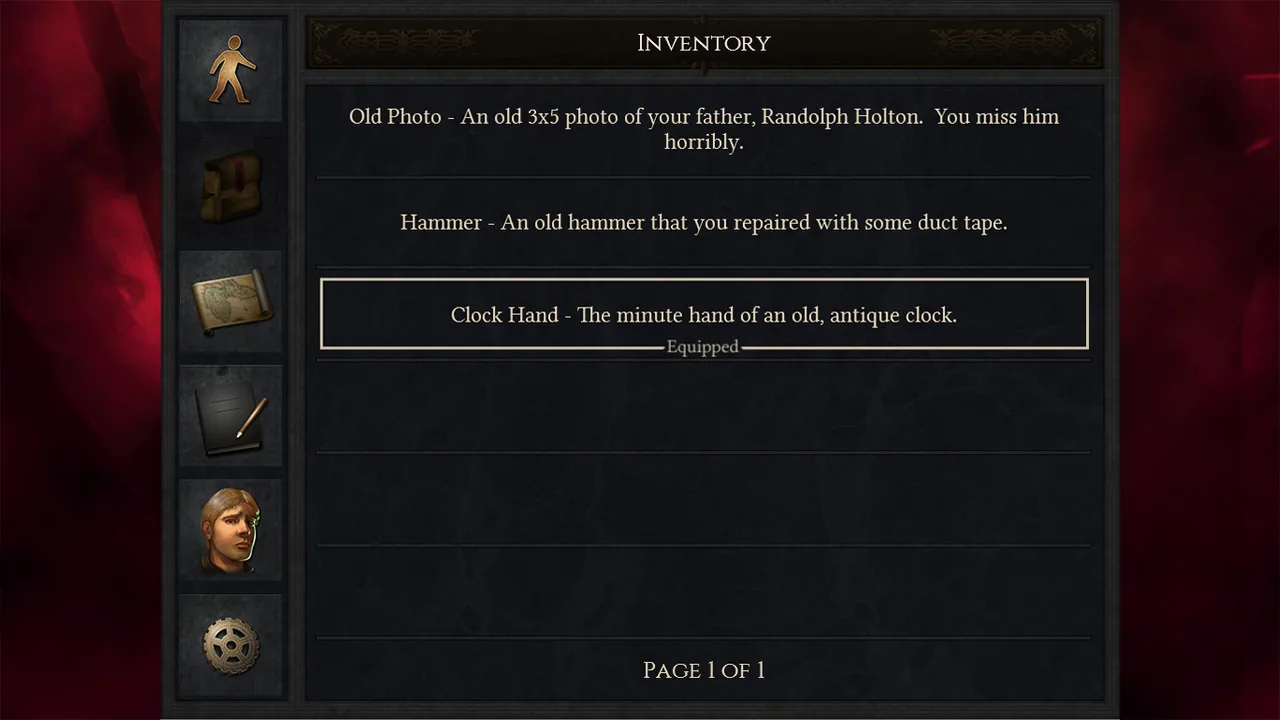
The whole design premise is solving the parser problem without abandoning the parser genre. In place of typing commands, the game offers a context-specific menu of actions — never more than a handful at a time — plus a compass for room-to-room movement and dedicated screens for inventory, map, journal and character information, each a button press away. It's the interface equivalent of a well-organised gamebook: you're never guessing at phrasing, only at which of the visible options moves the story forward.
That trade cuts both ways. It removes the single biggest frustration of classic text adventures — the moment you know exactly what you want to do and can't find the words the game accepts — but it also removes the open-endedness that made those games feel like a real conversation with the world. Several reviewers frame this explicitly as "advanced gamebook" territory rather than a true adventure game, and that's an accurate read: item pickups, use-on-object puzzles and character interaction are all present, but the multiple-choice framing keeps the difficulty gentle by design. One review calls the puzzles "decent, albeit simple," and that assessment matches the pattern across the whole set — nobody reports being stuck for long, and the one puzzle several reviewers flag as the exception is treated as a known landmark rather than a real complaint ("you'll know which one").
At roughly 78,000 words across 8-plus hours, the prose-to-playtime ratio sits closer to reading a novel than to playing a typical game, and reviewers who came in as genre newcomers ("I've never played a text adventure of any kind before") consistently describe adapting to the navigation and menu logic within about ten minutes.
Presentation
Lifestream commits to an early-1990s text-adventure look on purpose — over 150 pieces of static illustrated artwork standing in for what a modern game would render as full scenes or cutscenes, paired with an hour-long original score the store page and several reviewers both call out as a highlight. One review describes the visuals as "semi ugly 3D stills" that nonetheless "charm you" because the game "never winks and nods" about its own datedness — it isn't pretending to be something more expensive than it is, which reads as more honest than embarrassing. The interface itself, rather than the illustrations, is where reviewers consistently say the presentation budget actually paid off: multiple reviews independently praise how "well done" and "polished" the GUI feels for a project this size.
Value and completion
At NZ$3.59, the value case barely needs arguing. Reviewers land on figures from about 3.5 hours to 8-plus hours depending on reading speed and completionism, against a price that would be unremarkable for a couple of hours of most other genres. Steam's global achievement data backs up what the reviews describe about pacing: the two most-earned achievements sit around 21% and 19% of all owners, consistent with a game whose early hours are the hardest to get past, and completion drops off gradually rather than falling off a cliff, bottoming out around 5% for the rarest achievements — a shape that reads as "most people who push through the slow opening finish the game" rather than "most people bounce off early." Thirty achievements are earnable in a single playthrough with no combinatorial grinding, which multiple reviewers flag as an unusually friendly design for anyone chasing 100%.
The game is also explicitly episode one of an intended longer series. One detailed review lays out the family tree: Lifestream, then Shady Brook and The Filmmaker as loosely connected follow-ups, with Stonewall Penitentiary and Summit of the Wolf announced as episodes four and five. Whether that full series ever materialised is a separate question from this review, but it's worth knowing going in that Lifestream was conceived as the opening chapter of something larger, not a standalone curiosity.
Final verdict
Lifestream - A Haunting Text Adventure is a small, unfashionable, and quietly well-made game that almost nobody has reviewed and every single person who has recommends. The GUI-over-parser design solves the genre's oldest usability complaint without losing what made text adventures worth returning to — a large, considered mystery told mostly through prose, structured cleverly enough that two separate timelines earn their eventual collision. It asks for patience in its first hour, its visuals are static and dated by design, and it's the kind of game that will simply not register for anyone who needs mechanical challenge or modern production values to stay engaged. For readers who miss Infocom and gamebooks, or who are curious what a text adventure looks like with the rough edges filed off, it's a very easy way to spend under four dollars and an evening or two.
Pros and cons
Pros
- Every one of its 23 Steam reviews is positive, a rare unanimous record even accounting for the small sample
- A genuinely substantial amount of prose for the price — around 78,000 words, comparable to a short novel, across roughly 8 or more hours
- The father/son, present/past structure gives the mystery two entry points and pays off with an intersection reviewers describe as a genuine surprise
- The GUI-driven interface (compass wheel, contextual choice lists, separate inventory/map/ journal/character screens) solves the classic parser-adventure problem of guessing the verb
- 30 achievements are reachable in a single playthrough with no combinatorial grinding, which reviewers specifically call out as achievement-hunter friendly
Cons
- Development stopped after this and two sibling episodes; a planned longer series (Stonewall Penitentiary, Summit of the Wolf) has not materialised
- The opening hour is slow going — several reviewers admit to nearly giving up on the "text Catholic-priest simulator" first act before the mystery opens up
- Visuals are static illustrated stills rather than animation, and the presentation reads as dated even for 2016
- English only, which caps its reach regardless of quality
- At least one reviewer hit a save-corrupting bug that needed direct developer intervention to fix, though it was resolved
Screenshots
-
Lifestream - A Haunting Text AdventureImage: Unimatrix Productions via Steam -
Lifestream - A Haunting Text AdventureImage: Unimatrix Productions via Steam -
Lifestream - A Haunting Text AdventureImage: Unimatrix Productions via Steam -
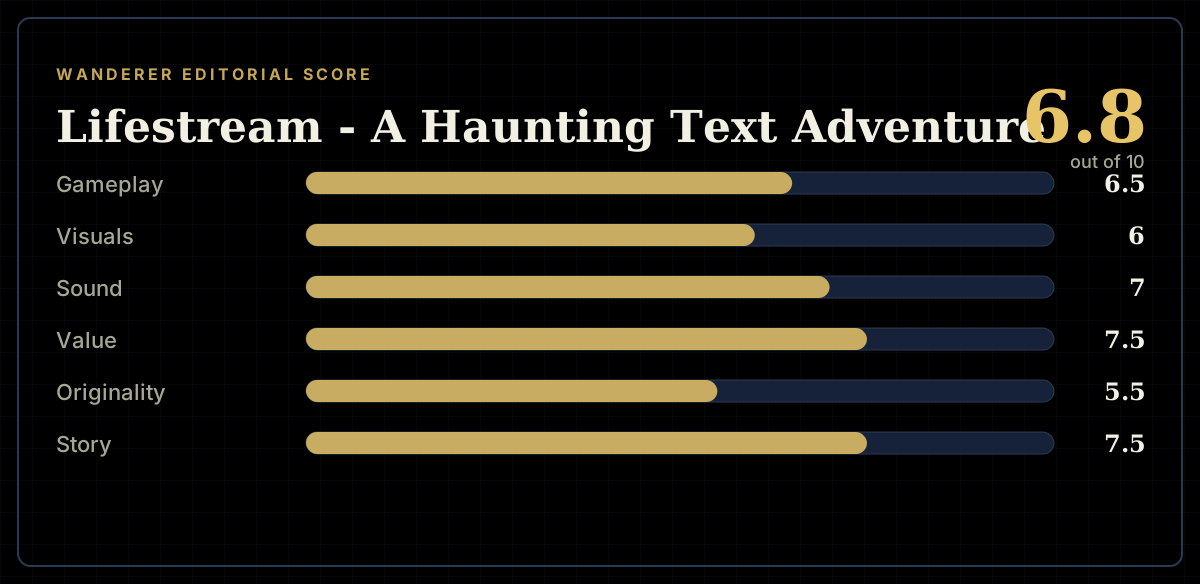
Wanderer's category scorecard for this review. -
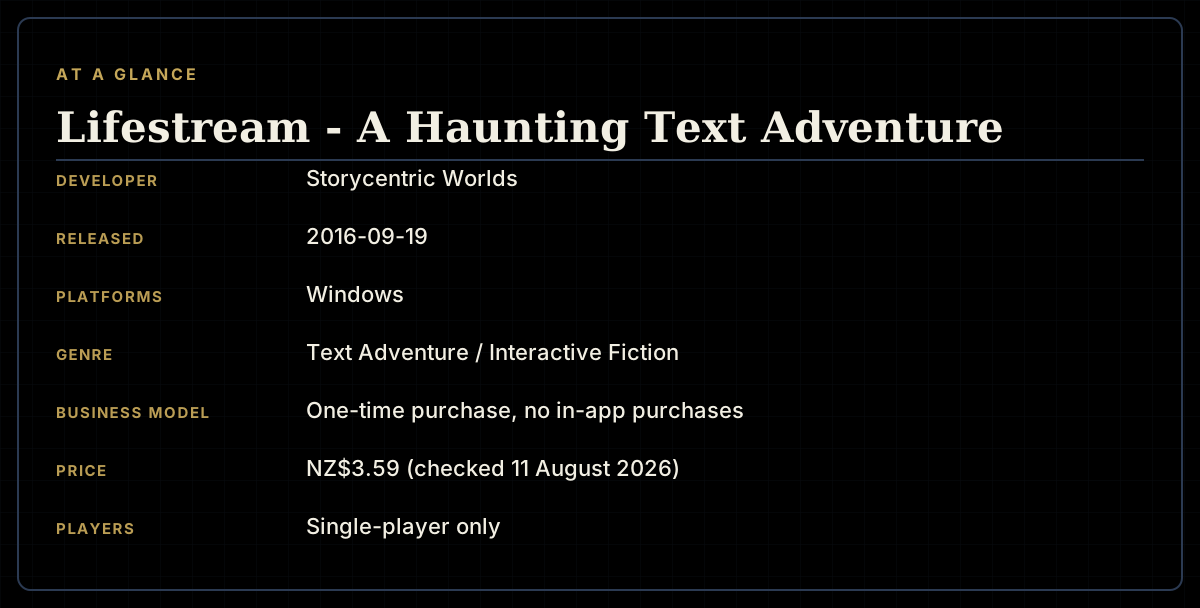
At a glance. -
Wanderer's verdict.