Game review
The Filmmaker - A Text Adventure
7 / 10
- Developer
- Storycentric Worlds
- Publisher
- Unimatrix Productions
- Released
- 7 March 2017
- Platforms
- Windows
- Genre
- Adventure
- Monetisation
- One-time purchase (NZ$3.69); no in-game store, no IAP, no DLC
- Players
- None; fully single-player
The short version
The Filmmaker - A Text Adventure sends B-movie fan Brianna back into a haunted theater and, from there, inside five distinct black-and-white films-within-the-game — a film noir detective story, a vampire horror, a cartoonish creature feature, a Martian sci-fi epic and a man-eating-predator thriller. It's the third entry in Storycentric Worlds' loosely connected interactive-fiction series, following Lifestream and Shady Brook, and it swaps the old black-screen text-parser format for a graphic, context-menu interface with a compass, a map, a journal and over 400 pieces of original artwork.
This is a small, cheap, nine-year-old title with barely any review coverage — 18 Steam reviews in total — so I read every one of them, positive and negative, rather than sampling. The verdict they converge on is a genuinely well-written mystery with real puzzle variety, let down in places by a menu system that a couple of players report actively misbehaving, and by the kind of guess-the-verb puzzle logic that has always been the genre's weak spot.
Biggest strengths
- A genuinely well-regarded mystery plot, praised repeatedly for its writing, its characters and its atmosphere, with an official Just Adventure review quoted on the store page grading it "A"
- Five distinct in-universe B-movies (noir, vampire horror, cartoon, sci-fi, action-thriller) give real tonal and visual variety inside what is structurally a single story
- Over 400 pieces of original hand-drawn artwork and an hour-long original soundtrack that multiple reviewers single out specifically
Biggest weaknesses
- The context-menu interaction system is reported outright broken by at least one player: options that wouldn't select, a stuck "examine" prompt, and no way to back out of a dialogue choice without forcing a wrong answer through first
- Puzzle logic leans on old-school pixel-hunting — one detailed negative review describes being stuck for hours on a single fetch-the-water puzzle with no clear way to identify the right container or interaction
- Even several positive reviews flag the menus as "a little clunky" as a caveat rather than a dealbreaker
Who it's for: Fans of old-school text and graphic adventures, gamebooks and choice-driven interactive fiction who want a self-contained, story-first mystery rather than a modern point-and-click with hint systems and forgiving puzzle design.
Our recommendation: Worth the asking price for genre fans going in with era-appropriate expectations — don't expect modern puzzle-design conveniences, and be ready to back out of a stuck menu screen by trial and error if the interaction system glitches.
7 / 10
The Filmmaker - A Text Adventure opens on an invitation nobody living should have sent. Brianna, a young B-movie buff who spent her childhood at the Carson Stiles Gateway Theater with her recently-passed father, gets a letter inviting her back to its grand re-opening — months after the place closed following a string of gruesome murders. It's a tidy horror-mystery hook, and it's the third release in Storycentric Worlds' loosely connected interactive-fiction series, after Lifestream and Shady Brook, continuing what one long-time player calls the studio's "Supernatural/ Dark Mysteries" line. Nine years after its March 2017 launch, the game has drawn only 18 Steam reviews — small enough that this review reads all of them, not a sample, and small enough that the honest framing is a niche, well-loved title most of its own owners never finished, rather than a consensus pick.
A graphic text adventure, not a parser game
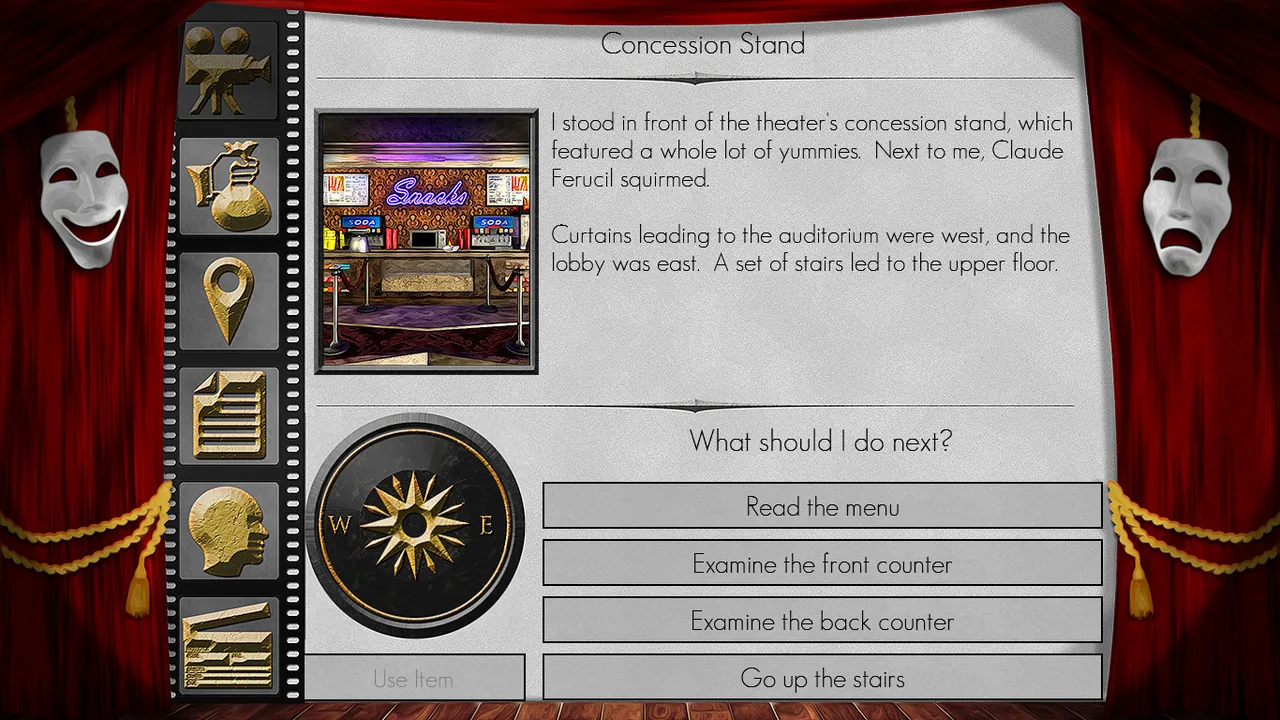
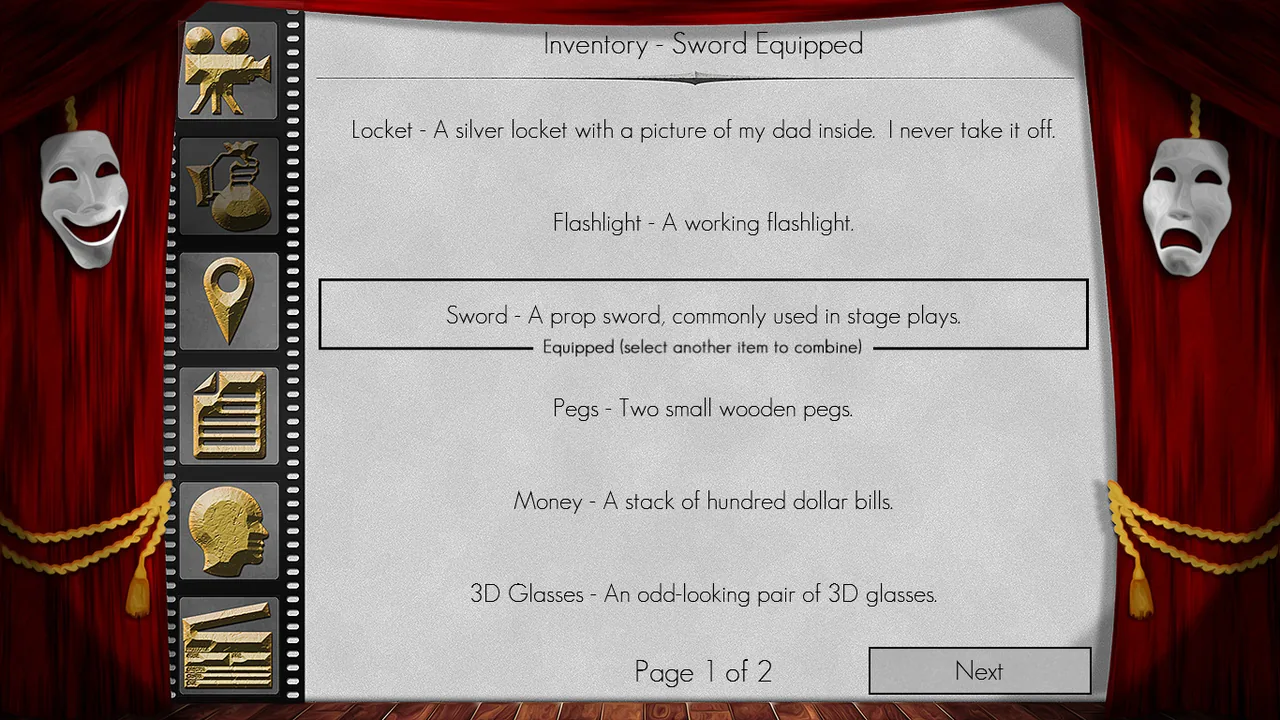
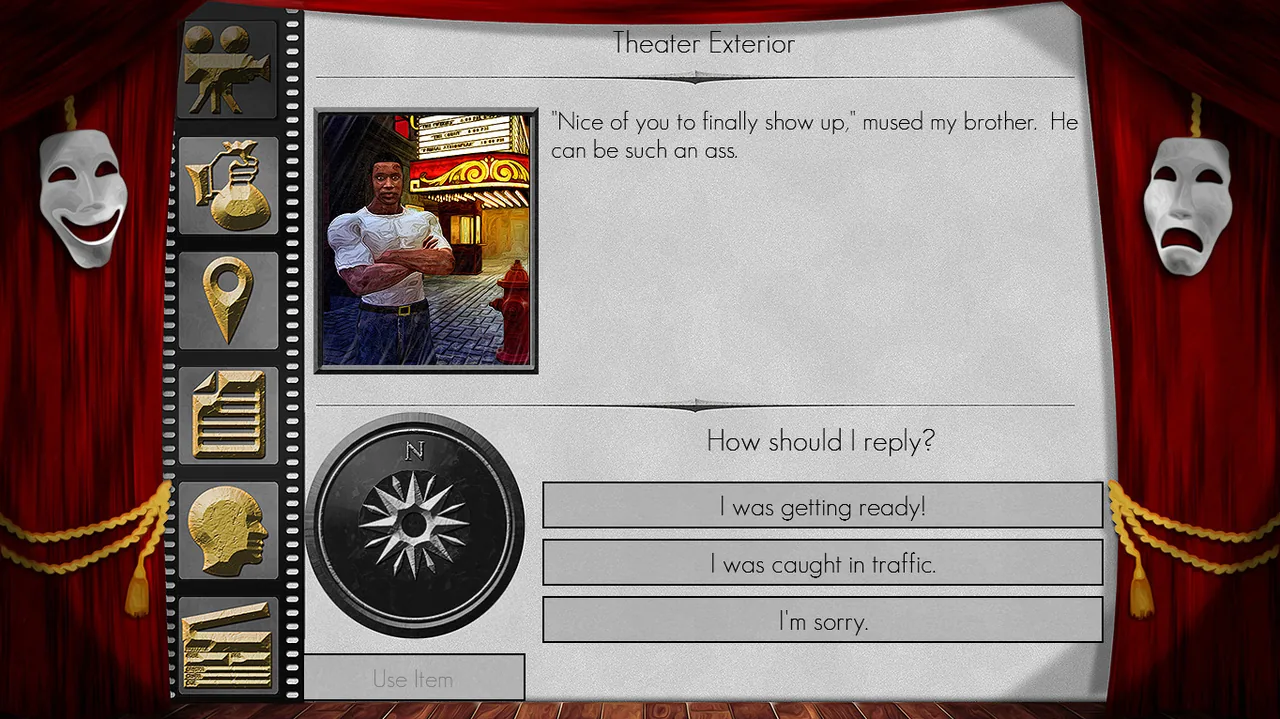
Storycentric Worlds' pitch is specifically about interface, not just story. Where a classic text adventure puts a blinking cursor after "WHAT DO YOU DO?", The Filmmaker replaces the parser with a context-specific multiple-choice menu, a compass for moving between locations, and separate inventory, map, journal and character screens reachable at a button press. It's closer to a gamebook or a visual novel with adventure-game trappings than to a Zork descendant — the store page calls it a blend of "interactive fiction, visual novels, and gamebooks," and the reviews bear that framing out, several explicitly comparing it to a modernized take on early-1990s text adventures rather than to a modern point-and-click. One reviewer, self-described as not having played a text adventure "in many years," specifically credits the game with going "beyond the black screen with white/gray texts" as the reason they got back into the genre at all.
Five films, one theater
The structural hook is what elevates this above a single haunted-house mystery: exploring the theater eventually sends Brianna inside five distinct black-and-white B-movies, each with its own setting, cast and puzzles — a film noir detective story, a vampire-horror tale called The Count, a cartoonish creature feature about rabbit-like "Fuzzies," a Martian invasion thriller and a man-eating-predator action piece. Reviewers who finished the game consistently cite this as the strongest structural idea in it, praising the variety it buys within what is otherwise a single continuous narrative, and citing "well developed characters" and a "heroic quest" across the theater-frame story and the films-within-it alike. The official pull-quote Storycentric Worlds runs on its own store page — an "A" grade from Just Adventure, praising dialogue that "flows naturally" and characters a reader can't help caring about — lines up with what unpaid Steam reviewers say independently, which is a better signal for a game this under-covered than the marketing quote on its own would be.
Two different endings and 25 Steam achievements, one of which unlocks a post-game bonus scene, give the completionist audience something to chase, and reviewers who mention the achievements note that a handful are easy to miss on a first playthrough even while clearing "90% of the game."
Where the interface lets the story down
The praise for the writing is consistent enough to trust, but the two negative reviews in the sample — both of the only two in eighteen — are worth taking seriously precisely because they're so specific rather than generically unhappy. One describes the context-menu system actively misbehaving: options that simply wouldn't register a selection, a code-entry prompt for a cash register that couldn't be backed out of once opened, and posters that couldn't be examined until an unrelated prior action had been completed first, with no in-game signal that anything was gating them. That's a substantially more specific complaint than "the UI is clunky," and several of the positive reviews independently flag menu clunkiness in passing even while recommending the game overall — a pattern that suggests real, if survivable, rough edges rather than one player's bad luck.
The second negative review is a pure puzzle-design complaint, and it's the more familiar failure mode for the genre: stuck trying to get water to a toilet, with the sink interaction locked to "washing hands" no matter what, no container discoverable to carry water, and no way to open the toilet's lid to use the water already there. It's a classic old-adventure-game pixel hunt — the kind of puzzle that either delights players who grew up on this exact genre of trial-and-error logic or drives away everyone else, and this review is a clean data point for the "everyone else" side of that split. Notably, even some positive reviews hedge in the same direction, describing the back half of the game as "a bit exhausting and long-winded" even while recommending it.
What the achievement data suggests
Steam's global achievement percentages tell a story the review count alone can't. Only 14.6% of owners have earned the very first achievement, and the curve falls gently rather than cliffing — down to 5.2% for the rarest one, with most of the 25 achievements clustered in the high single digits. Read against 18 total reviews for a game nine years old, that reads less like a divisive game and more like a cheap, low-visibility title a lot of owners picked up — in a bundle, on a deep sale, or as part of exploring the developer's small catalogue — and never actually launched. The people who did engage with it, judging from the review text itself, tend to have engaged seriously: playtimes in the sample run from a couple of hours up past nine, with the longest sessions coming from reviewers who explicitly finished the story and, in a couple of cases, went looking for the developer's other games afterward.
Final verdict
The Filmmaker - A Text Adventure is a small, sincere, well-written mystery that does something genuinely clever with its five-films-in-one-theater structure, built on an interface that mostly delivers on its promise to modernize the text-adventure format without losing what made the genre work. Sixteen of its eighteen Steam reviews recommend it, and the praise for its writing, characters and atmosphere is specific enough, and consistent enough with the developer's own pull-quotes, to trust. But the two dissenting reviews aren't noise — a menu system that can genuinely misbehave, and puzzle logic that can strand a player on a single interaction for hours, are real risks for a genre that lives or dies on exactly those two things going smoothly.
At NZ$3.69 for what reviewers estimate as 6-plus hours, this is an easy recommendation for anyone who already knows they like old-school text and graphic adventures, and a much shakier one for anyone hoping for a gentler, more modern take on the genre's puzzle design.
Pros and cons
Pros
- A genuinely well-regarded mystery plot, praised repeatedly for its writing, its characters and its atmosphere, with an official Just Adventure review quoted on the store page grading it "A"
- Five distinct in-universe B-movies (noir, vampire horror, cartoon, sci-fi, action-thriller) give real tonal and visual variety inside what is structurally a single story
- Over 400 pieces of original hand-drawn artwork and an hour-long original soundtrack that multiple reviewers single out specifically
- Two different endings and 25 Steam achievements, including a post-game bonus scene for completionists
- Cheap even by indie standards at NZ$3.69, for a game reviewers estimate at 6+ hours
Cons
- The context-menu interaction system is reported outright broken by at least one player: options that wouldn't select, a stuck "examine" prompt, and no way to back out of a dialogue choice without forcing a wrong answer through first
- Puzzle logic leans on old-school pixel-hunting — one detailed negative review describes being stuck for hours on a single fetch-the-water puzzle with no clear way to identify the right container or interaction
- Even several positive reviews flag the menus as "a little clunky" as a caveat rather than a dealbreaker
- Windows-only, with no listed controller support — this is a mouse-and-menu game start to finish
- Steam's own achievement data shows only 14.6% of owners ever earn the very first achievement, a steep early drop-off typical of a cheap, low-visibility niche title
Screenshots
-
The Filmmaker - A Text AdventureImage: Unimatrix Productions via Steam -
The Filmmaker - A Text AdventureImage: Unimatrix Productions via Steam -
The Filmmaker - A Text AdventureImage: Unimatrix Productions via Steam -
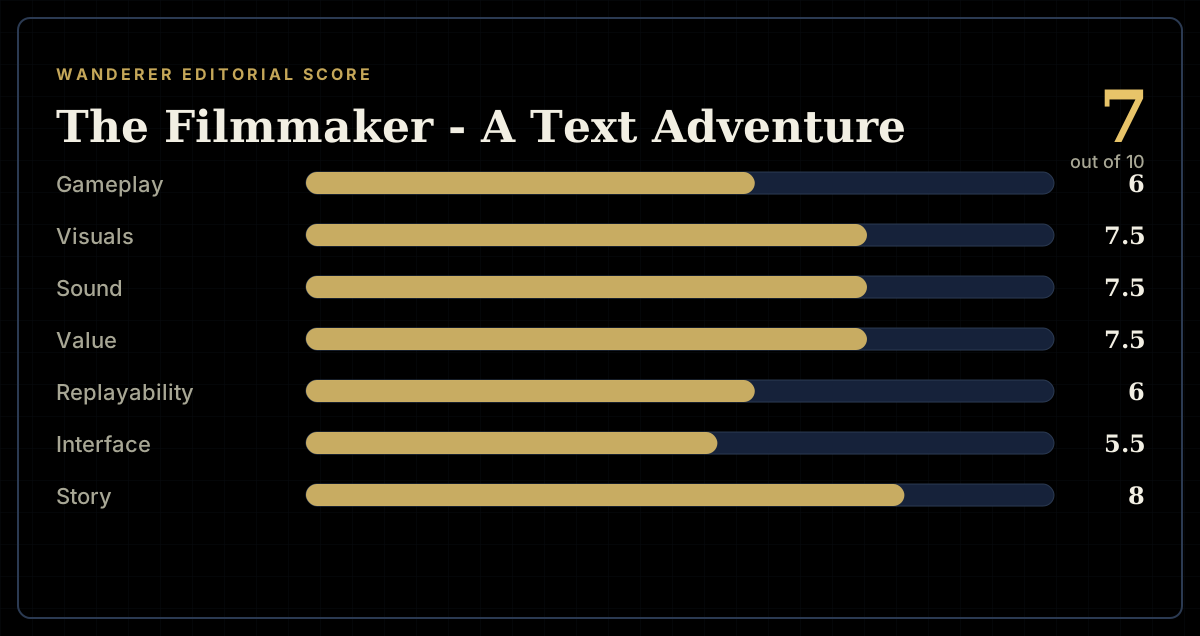
How the review scores each part of the gameWanderer Editorial -
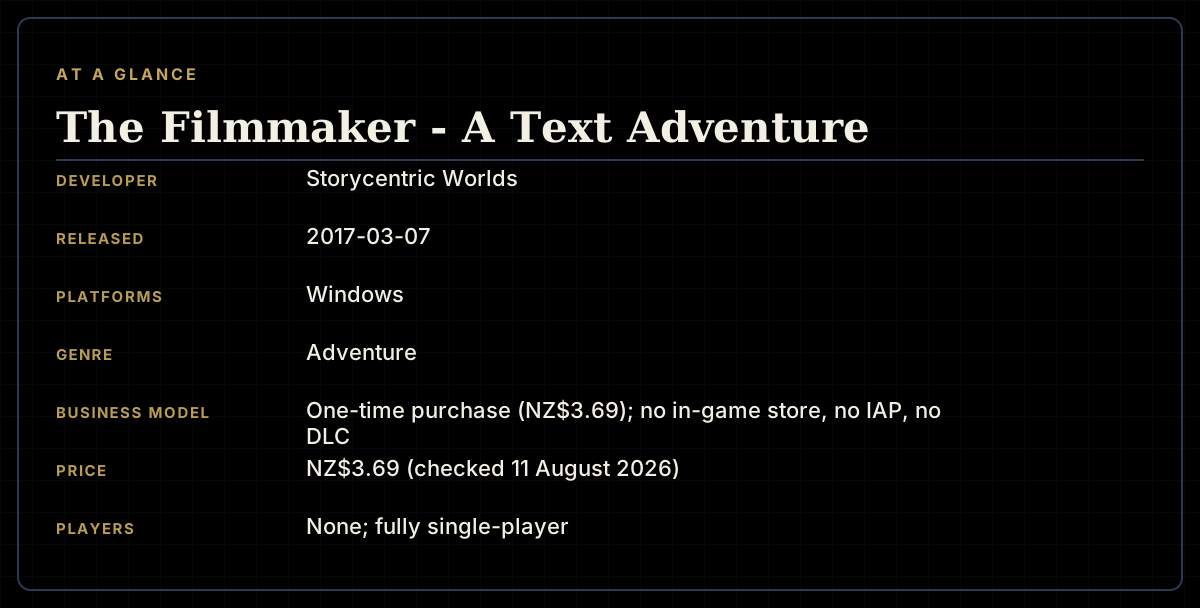
The game at a glanceWanderer Editorial -
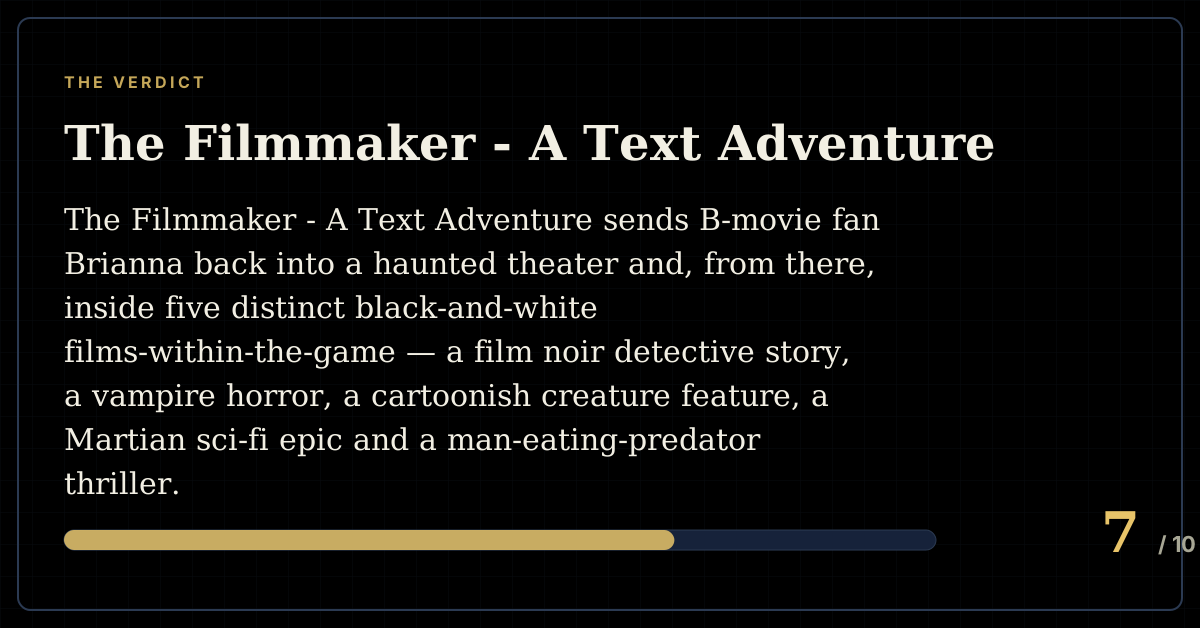
The short versionWanderer Editorial