
Game review
Librarian: Tidy Up the Arcane Library! Review
6.6 / 10
- Developer
- ArtRising
- Publisher
- ArtRising
- Released
- 30 April 2026
- Platforms
- Windows
- Genre
- Simulation
- Monetisation
- Premium
- Players
- Single-player only
The short version
Librarian: Tidy Up the Arcane Library! finds something genuinely soothing in the act of putting things where they belong, and its 3,072-book library is a lovingly designed puzzle box for anyone who enjoys sorting for its own sake. The trouble is that its own reward systems keep trying to talk players out of the very thing that makes it work, trading a satisfying grind for a set of spells that finish the job before the player really gets to.
Biggest strengths
- A genuinely inventive premise executed with real craft in its book covers, titles, and library design
- The manual, no-magic approach to sorting is unexpectedly meditative and rewarding
- Cheap for the hours it offers, with achievements that reward multiple playstyles
Biggest weaknesses
- The magic/spell system is slow to unlock and then trivialises the entire back half of the game
- Only one library and one scenario, with no structural variety beyond replaying the same room
- Colour-coded sorting with no colourblind accommodation shuts a chunk of the potential audience out
Who it's for: Fans of chore-sims and low-stakes puzzle games who find satisfaction in sorting, cleaning, or organising virtual spaces, and who don't mind a short, single-scenario experience.
Our recommendation: Recommended, with the caveat that the appeal is narrow and the progression system is worth ignoring rather than leaning on.
6.6 / 10
A Mischievous Fairy and 3,072 Books
The setup for Librarian: Tidy Up the Arcane Library! is almost embarrassingly slight, and that turns out to be exactly the point. A fairy has scattered every book in a once-orderly magical archive, the head librarian has locked the doors, and the only way out is to put every last one of the 3,072 volumes back on its correct shelf. There is no combat, no real narrative beyond that opening premise, and no antagonist to defeat beyond the sheer scale of the mess. It is, structurally, a first-person job simulator in the vein of Unpacking or PowerWash Simulator: a single, finite task, presented without urgency, that either clicks with a player's brain or doesn't.
For the audience it clicks with, it clicks hard. Reviewers describe multi-hour, single-sitting sessions spent quietly working through shelf after shelf, several explicitly comparing the feeling to solving a very large jigsaw puzzle or losing an afternoon to alphabetising a real bookshelf. One of the more detailed player accounts on Steam puts total time somewhere between five hours (using every efficiency tool on offer) and around twenty-five hours for a deliberately unassisted, shelve-everything-by-hand run — numbers that line up closely with what shows up across the wider review sample, where playtimes swing from under ten hours to well over thirty depending entirely on how much a player leans on the game's optional shortcuts.
That range says a lot about what this game actually is. It isn't really a puzzle to be solved once; it's closer to a chore that's been dressed up beautifully enough that people want to do it anyway. Whether that sounds appealing or baffling is probably the single best predictor of how much value anyone will get out of it.
The Mechanics of Meaningful Tidying
The moment-to-moment loop is straightforward: walk the library in first person (keyboard and mouse or a controller, both well supported), pick books up off the floor or out of misplaced stacks, and carry them to the correct section. Each of the library's floors covers a different organising principle — colour, shape, naming convention, subject matter — and each shelf holds books in matched sets of three, five, or ten, so a completed shelf isn't just "close enough," it's precisely correct. Getting there means reading spines and covers for genre and thematic clues; a book called Rules and Regulations for a Multi-Classed Adventurer's Party belongs in one section, while Everyone's Dwarvish: Common Introductions belongs in another entirely, and figuring out which is which is most of the actual gameplay.
Held books can be shuffled and re-stacked in the player's hands before shelving, though the underlying order they go up in is first-in-first-out rather than fully freeform, which a few reviewers flagged as a missed opportunity — there's room here for a more granular "arrange this shelf exactly how you like it" mode that the current build doesn't quite offer. What it does offer is texture: the covers and titles are genuinely well written, often funny, frequently gorgeous as objects even though the game never lets a player open one and actually read it. More than one reviewer singled this out as the game's biggest missed swing — a title this committed to book-as-object design feels like it's one feature away from something considerably richer, and "let me read a page or two" is a specific, recurring, and reasonable request in the review sample.
Built on Unreal Engine, the library itself earns its keep visually. A day/night lighting cycle can be toggled on or off, ambient lamps warm up the room in a way multiple reviewers called genuinely cosy, and the ambient soundtrack stays out of the way rather than looping something grating. Navigation is mostly clean, though there are a handful of invisible-wall snags around the map's edges that players have learned to route around rather than the game ever really addressing. None of this is complicated, and none of it needs to be — the whole appeal rests on the tactile satisfaction of a repetitive, achievable task done at a comfortable pace, and on that level the game delivers exactly what it promises.
Magic That Undercuts Its Own Appeal
Where the design runs into real trouble is the progression system layered on top of that loop, and it's worth spending real space on because it's the single most consistent complaint in the review base — not from players who dislike the core concept, but from players who love it and feel the game keeps getting in its own way.
Completing shelves earns experience, which unlocks "major" and "minor" magic: abilities that range from simple traversal aids like sprinting and jumping, up to spells that highlight a book's correct location, summon books to the player's hand from a distance, or — at the top end — teleport every remaining book of a given type directly into the player's hands and auto-shelve it on a short cooldown. Early on, that curve is backwards: multiple reviewers report spending three to four hours before unlocking any meaningful magic at all, then suddenly gaining several levels in a rush once the pace of completed shelves picks up. That front-loaded slog isn't fatal on its own — plenty of players enjoy the unassisted crawl regardless — but it means the systems meant to smooth the experience arrive well after the point where most players have already decided whether they like the core loop or not.
The bigger problem is what happens once those top-tier spells are unlocked. Reviewers who tried them describe the effect in almost identical terms: the two most powerful abilities are so far beyond anything else on offer that using them stops feeling like a shortcut and starts feeling like the game finishing itself. One detailed critique put it bluntly — once those spells are available, "you end up just standing there spamming the spells because they're much faster than anything else you could possibly do," and even the earned satisfaction of a slower, manual approach curdles a little in hindsight once a one-button alternative is sitting right there. It's a strange, almost self-defeating design choice for a game whose entire pitch is the meditative value of doing the work by hand: the reward for engaging with that work is a tool that makes doing the work pointless.
Some of the achievement design pushes against this — there's a specific achievement for completing the library entirely without magic, which at least formally acknowledges that the manual approach is the "real" way to experience the game — but that's a workaround for a balance problem rather than a fix for it. A more graceful curve, weaker but earlier magic, or simply removing the two most overpowered spells in favour of smaller conveniences (a sorting assist for books already in hand, a wider pickup radius, a longer-range toss) would likely serve the game's own stated appeal far better than what's currently on offer. As it stands, the progression system feels bolted onto a game that didn't especially need one.
The Book Covers, and a Quiet Debate About How They Got There
Part of what makes the library feel so alive is the sheer variety of the 3,072 books passing through a player's hands: distinct titles, distinct cover art, distinct genre conventions that have to be learned and recognised on sight. It's a huge amount of content for a game this size, and it's also, by the account of at least one detailed reviewer, clearly assembled with the help of generative AI tools for both the invented titles and the differentiated cover art. That reviewer's take is worth summarising because it captures a tension that's likely to shape how different players receive the game: the results are executed competently enough that nothing here reads as an outright asset-flip, and there's no indication of any single work being lifted or imitated directly, but the sheer volume of unique-feeling content is difficult to imagine being hand-authored at this price point and team size any other way. For players who find that an acceptable trade-off in service of a genuinely large, varied library, it doesn't dent the experience at all. For players who weigh that decision more heavily, it's a legitimate reason to sit this one out, and it's the kind of thing worth knowing going in rather than discovering three hours into a purchase.
It also sharpens the earlier point about wanting to actually read these books rather than just shelve them. A library built for browsing rather than just sorting — even just a line of cover-jacket text per title — would go a long way toward making the collection feel authored rather than generated, and toward answering the AI-content question with craft rather than argument.
One Library, No Second Visit
There is also, simply, not very much game here in terms of structural variety. The 3,072 books are spread across a single library with no second map, no randomisation of book placement between playthroughs, and no scenario beyond the one opening premise. That's a defensible choice for a game this focused — several reviewers explicitly said they wouldn't want the format diluted across multiple locations, or randomised in a way that undercuts the careful, hand-placed feel of the current layout — but it does mean the experience has a hard ceiling. Once the library is sorted, whether that took five hours or thirty, there's genuinely nothing left to do beyond starting over, and starting over against a game whose most powerful tools now trivialise the challenge is a much less appealing prospect than the first run.
Priced at under ten New Zealand dollars, that ceiling is easier to accept than it would be at a higher price point — several reviewers specifically called the game a bargain for the number of hours it kept them occupied, and the low ask matches the scope on offer honestly rather than pretending to be bigger than it is. It's worth noting the save file structure reportedly includes fields suggesting future "stages" or additional content, which would meaningfully change this calculation if it materialises, but as released, this is a one-and-done experience rather than something built for repeat visits.
The achievement list does a reasonable job of manufacturing a bit of extra replay value out of that single library, and it's smarter than it first looks. Beyond the standard completion achievement, there's a specific reward for finishing entirely without using magic, and another for the opposite extreme — shelving every book at random with no regard for correct placement at all, which one reviewer clocked at under an hour and treated as a deliberate, sanctioned way to "lose" on purpose after already completing a proper run. That's a good piece of design: it gives the chaos-inclined a legitimate reason to touch the game a second time without pretending the underlying content has actually changed. What it can't do is manufacture new content, and players expecting the kind of open-ended, replayable loop found in ongoing simulation games — a farming sim, a mechanic sim, anything with procedural or rotating content — should adjust expectations accordingly. This is closer in spirit to a single, well-made puzzle than to a sim built for dozens of return visits.
Small Frictions: Colour, Controls, and Closed Books
A handful of smaller issues round out the picture, and they're worth flagging because they affect who this game is realistically for. Several of the library's organisational systems lean on colour-coding to help players sort quickly, and there's no colourblind-accessibility option to compensate — a real barrier for a meaningful slice of the potential audience in a game that's otherwise almost aggressively low-stress and welcoming. Simple, achievable accommodations like pattern overlays or shape-based secondary cues on top of the existing colour system would go a long way here and are a conspicuous omission for a 2026 release.
Control-wise, the basics are solid: full controller support including DualSense and DualShock input, custom volume controls, and a pace that never punishes players for taking their time, including support for playing without timed input at all. Smaller quality-of-life requests recur across the review sample, though — the ability to simply set a book down instead of always tossing it, examining a held book from multiple angles rather than only guessing its orientation, and remapping pickup to a different input than the default. None of these are dealbreakers, but they're the kind of small friction that adds up over a ten-or-more-hour session, and they're the sort of thing a patch could realistically smooth out.
Verdict
Librarian: Tidy Up the Arcane Library! understands its core appeal extremely well — there's real, considered craft in how satisfying it feels to walk a quiet, warmly lit library and put things exactly where they belong, and the book design alone shows more care than the premise strictly demanded. Where it stumbles is in trusting that appeal enough to leave it alone: a progression system that spends its first few hours making players wait and its back half making the entire task trivial works against the very quality that earned this game its audience in the first place. For under ten dollars, and for the right kind of player, there's still a genuinely relaxing few hours here — just one best enjoyed with the most powerful spells left firmly on the shelf.
Pros and cons
Pros
- A genuinely inventive premise executed with real craft in its book covers, titles, and library design
- The manual, no-magic approach to sorting is unexpectedly meditative and rewarding
- Cheap for the hours it offers, with achievements that reward multiple playstyles
- Full controller support and an unhurried pace that never punishes slow play
Cons
- The magic/spell system is slow to unlock and then trivialises the entire back half of the game
- Only one library and one scenario, with no structural variety beyond replaying the same room
- Colour-coded sorting with no colourblind accommodation shuts a chunk of the potential audience out
- No way to actually read or examine the books beyond their spines and covers
Screenshots
-
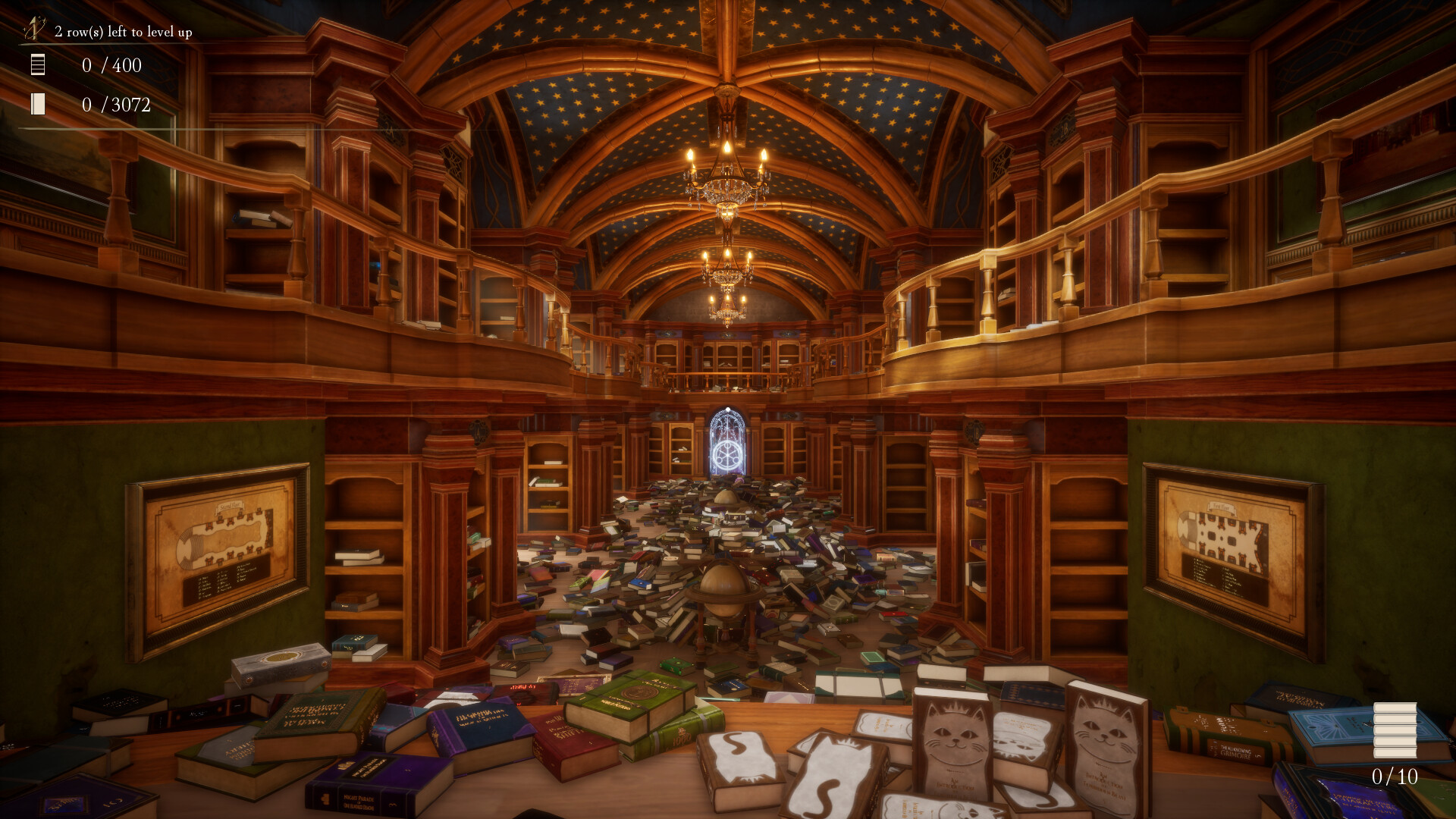
The opening mess — every one of the library's 3,072 books starts on the floor, waiting to be sorted back to its shelfArtRising -
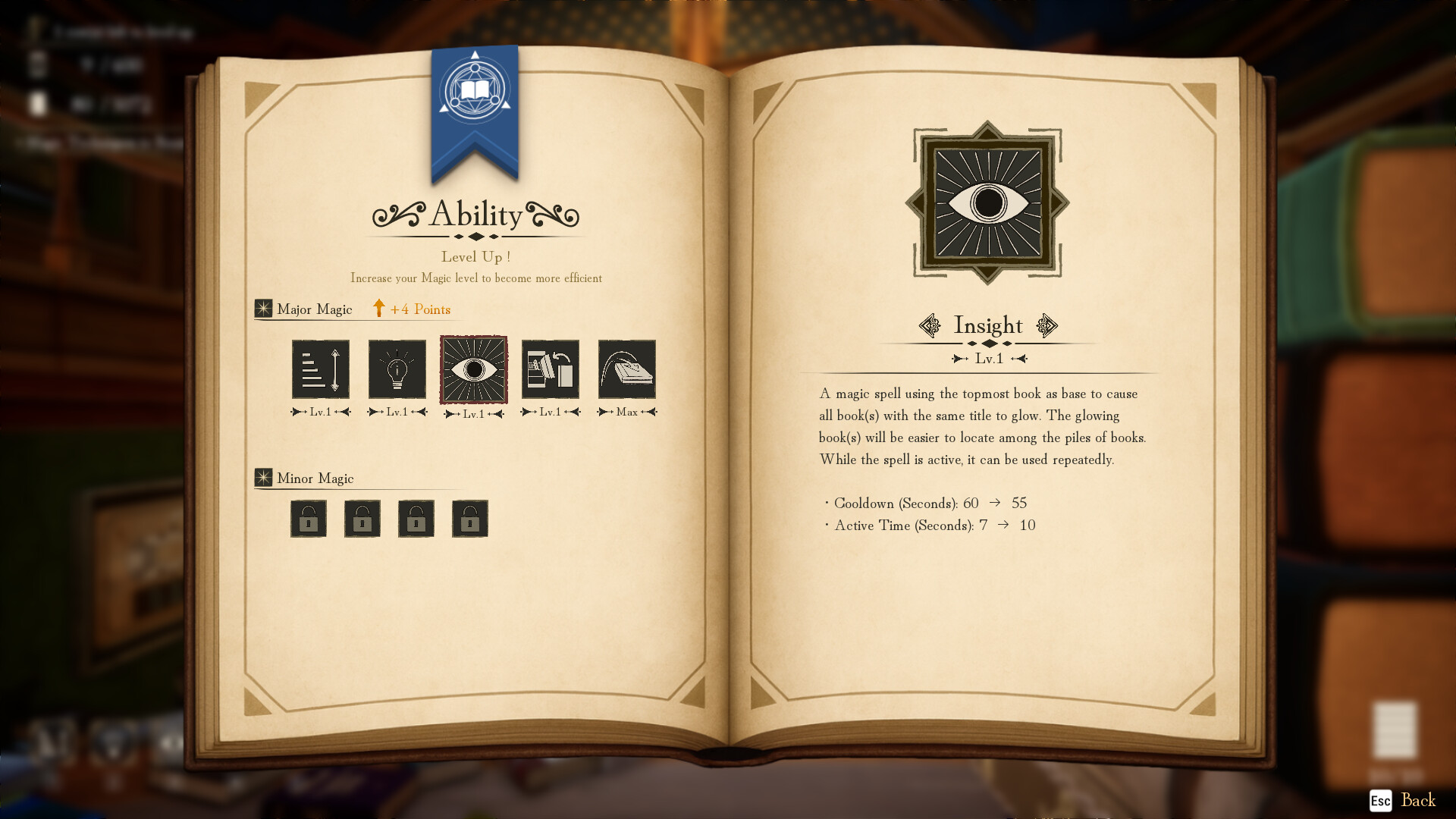
The magic system that speeds up sorting — powerful once unlocked, but slow to open up and criticised for trivialising the late gameArtRising -
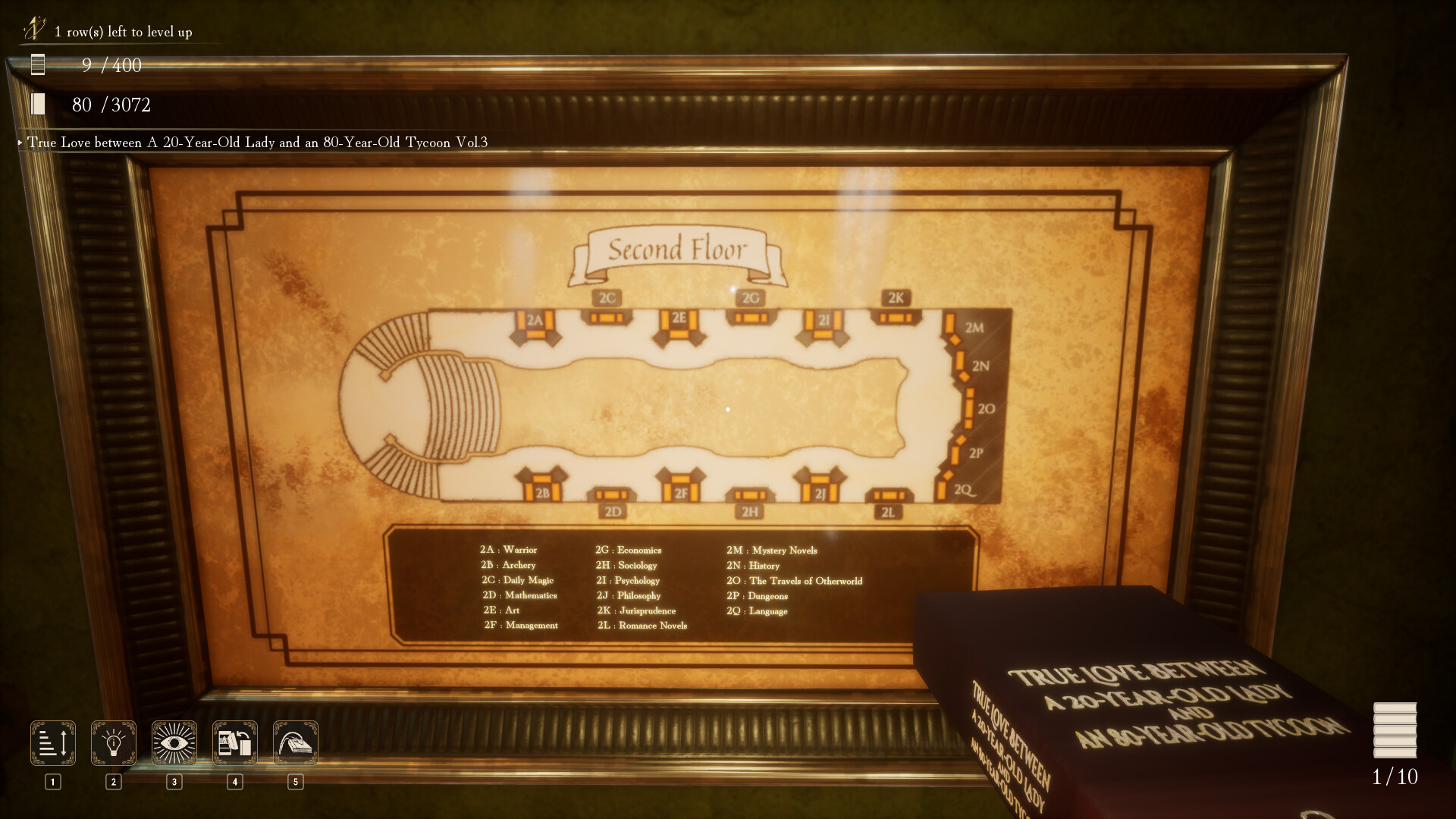
Genre sections have to be learned by sight — invented titles like this one are part of the game's considerable, and debated, book-generation workArtRising -
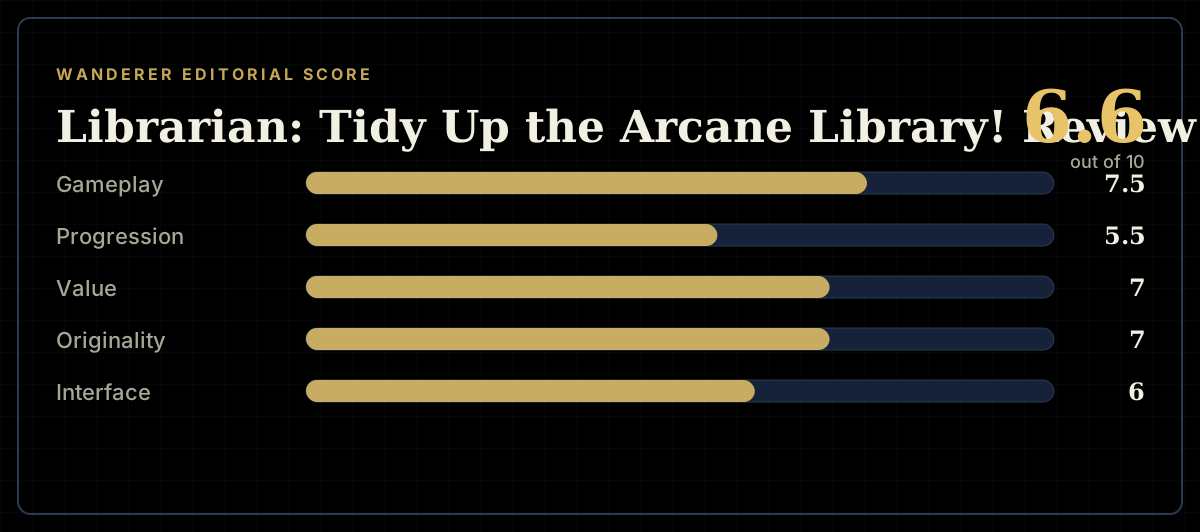
How the review scores each part of the gameWanderer Editorial -
The short versionWanderer Editorial