
Game review
Legends of Amberland: The Forgotten Crown
6.5 / 10
- Developer
- Silver Lemur Games
- Publisher
- Silver Lemur Games
- Released
- 1 August 2019
- Platforms
- Windows
- Genre
- RPG
- Monetisation
- Paid, no in-app purchases found
- Players
- false
The short version
Legends of Amberland deliberately recreates the first-person, grid-based, seven-person-party dungeon crawling of Might & Magic and Wizardry, with modernised controls and a lighter, more forgiving difficulty curve than its inspirations. Most reviewers who grew up on those games, or wanted an easier entry point into that style, love it for exactly that reason. But the genre's most detailed critical voice makes a specific, hard-to-dismiss case that the resemblance stops at the surface: empty dungeons, static enemies with no real AI, and a narrow equipment and spell system underneath the nostalgic dressing.
Biggest strengths
- Faithfully recreates the specific feel of 90s first-person grid-based dungeon crawlers (Might & Magic, Wizardry) with a seven-person party, while modernising controls to remove much of the old genre's friction
- Deliberately lower difficulty and shorter length than its inspirations make it an accessible, less punishing entry point for players who bounced off the harder classics
- Well regarded across a large majority of its review corpus (229 of 238 positive), with many reviewers citing genuine nostalgia and comfort-food satisfaction
Biggest weaknesses
- A detailed, heavily-upvoted dissenting review argues the Might & Magic resemblance is only skin-deep: area descriptions add little, dungeons are large but largely empty, and there's "nothing interesting" to actually find while exploring
- The same review reports enemies have no functional AI, moving randomly rather than pursuing the party — making it possible to walk past and loot a boss encounter without ever triggering a fight
- Equipment and spell variety are reported as narrow enough that optimal choices are often obvious rather than meaningfully debated
Who it's for: Fans of classic first-person blobber RPGs (Might & Magic, Wizardry) who want a short, accessible, lower-difficulty take on the format, or newcomers curious about the genre without its usual brutal learning curve.
Our recommendation: A solid, well-liked comfort-food pick for the right audience, but go in expecting a light, streamlined take on the genre rather than a substantive modern successor to its inspirations.
6.5 / 10
What it is
Legends of Amberland: The Forgotten Crown is explicit about its lineage: a first-person, grid-based dungeon crawler modelled directly on the Might & Magic and Wizardry games of the 1990s, right down to the seven-character party, turn-based combat triggered only on contact with enemies, and an overworld map connecting town hubs to dungeons. The developer's own description frames the goal plainly — recreating a "light, fairy tale, epic, heroic, slightly humorous" take on that formula "without the need of endless grind to progress," positioning the game as an easier, friendlier version of a notoriously demanding genre rather than a harder or more ambitious one.
It released on 1 August 2019 at NZD 28.99, the first entry in what became the Amberland trilogy from solo-leaning developer Silver Lemur Games. Thirteen Steam achievements track a fairly standard set of RPG milestones — reaching level 50, slaying a dragon, finishing on Hard difficulty — and the game carries full controller support alongside confirmed Steam Deck compatibility, per direct reviewer testimony. Its review corpus is substantial for a small indie RPG at 238 reviews, and overwhelmingly positive at 229 to 9.
What wins reviewers over
The dominant thread running through the positive corpus is nostalgia paired with genuine accessibility. Multiple reviewers compare the experience directly and warmly to specific childhood memories of playing Might & Magic titles like Isles of Terra and the Xeen games late into the night, and several describe Amberland specifically as a way to recapture that feeling without the brutal, often obtuse difficulty of the originals — one reviewer calls it "Might and Magic light," praising the seven-person party as generous and appreciating that it "helps cut down on class decisions," while noting the absence of autosaving cost them real progress on more than one occasion. Others frame it explicitly as a good entry point for players who've never tried the "blobber" RPG subgenre before, precisely because it strips out the puzzle-heavy, secret-door-hunting friction that makes the genre's classics so demanding.
That accessibility is presented consistently as a deliberate trade-off rather than a shortfall: this is a shorter, gentler game than its inspirations by design, and reviewers who came in wanting exactly that report being satisfied, several explicitly wishing only that it had run longer before ending.
The detailed case against it
Set against that broad approval is one specific, unusually thorough negative review that argues the whole nostalgic pitch doesn't hold up under scrutiny, and it deserves attention precisely because of how concrete its complaints are rather than a vague dismissal. It argues Amberland "manages" its Might & Magic resemblance "only in the most superficial ways": area descriptions exist but add nothing beyond a line or two of flavour text where the games it emulates offered dense, "mostly useless, but cool" world-building; the world is large but has "nothing to find" in it; food and resting exist as systems but a free overworld warp lets players restock trivially, removing any resource-management tension. Most seriously, the review reports that enemies have no functional pursuit AI and "move completely randomly," to the point that it's "completely possible to walk past a boss and loot their treasure without them ever stumbling into the party."
The same review flags a technical limitation with real design consequences: the engine reportedly "appears incapable of zero thickness walls," meaning dungeon corridors are stretched out wider than they need to be, which the reviewer argues makes already-sparse level design read as even emptier. It closes by naming a specific point of comparison — Swords of Xeen, an older Might & Magic mod — and arguing that despite being similarly minimal in places, it offers more variety in spells, quests, and visual presentation. That's a strong, specific claim from someone who clearly knows the genre's history well, and it's worth weighing seriously precisely because it comes from an obvious fan of the source material rather than someone unfamiliar with what Amberland is trying to be.
Reconciling the two accounts
These aren't necessarily contradictory readings so much as two different standards being applied. Reviewers judging Amberland as comfort food — a short, low-friction, nostalgic palate cleanser for players who don't want the genre's usual brutal difficulty — largely find it delivers exactly that. The detailed dissenting review is judging it against the actual substance of the genre's classics, and finds the comparison doesn't hold once you look past matching UI conventions and party size. Both things can be true: it's a pleasant, accessible short RPG, and it's also a mechanically thin one once examined closely against the games it's explicitly trying to evoke.
Where the price sits against the pitch
At NZD 28.99, Amberland asks a genuinely premium-adjacent price for what its own supporters consistently describe as a short game — several positive reviews explicitly wish it had run longer, and one reviewer frames the whole experience as "a tiny bit of fun" and "a simplified sketch of a 90s 'blobber,'" recommending it mainly as a bite-sized starting point for newcomers rather than a substantial adventure in its own right. That combination — a short runtime, a premium price, and a design brief that openly prioritises accessibility over depth — means the value calculation here depends heavily on what a buyer actually wants from it. Someone chasing a specific, focused nostalgia hit for a weekend is likely to find that fair; someone expecting a full-length, systems-rich RPG at that price point, matching the scope of the classics it's citing, is more likely to land closer to the detailed dissenting review's disappointment.
It's also worth noting the game found a second life as a franchise starter rather than a one-off: it became the first of three Amberland titles from the same small studio, which suggests the format found enough of an audience commercially to justify sequels, even with the mechanical thinness some reviewers describe. Whether those sequels addressed the specific complaints raised here — deeper world content, functional enemy AI, wider equipment variety — isn't something this review can verify without examining them directly, but it's a reasonable question for anyone considering the series as a whole rather than just this entry.
Verdict
Legends of Amberland: The Forgotten Crown succeeds at its stated, modest goal — a lighter, friendlier, shorter riff on 90s first-person dungeon crawling that a large majority of players who've tried it recommend warmly. Veterans of the genre looking for real depth behind the nostalgic surface should weigh the detailed counter-argument seriously before buying at full price; newcomers or players specifically seeking an easy way into the "blobber" format will likely find exactly what they're looking for.
Pros and cons
Pros
- Faithfully recreates the specific feel of 90s first-person grid-based dungeon crawlers (Might & Magic, Wizardry) with a seven-person party, while modernising controls to remove much of the old genre's friction
- Deliberately lower difficulty and shorter length than its inspirations make it an accessible, less punishing entry point for players who bounced off the harder classics
- Well regarded across a large majority of its review corpus (229 of 238 positive), with many reviewers citing genuine nostalgia and comfort-food satisfaction
- Full controller support and confirmed to run well on Steam Deck per reviewer testimony
Cons
- A detailed, heavily-upvoted dissenting review argues the Might & Magic resemblance is only skin-deep: area descriptions add little, dungeons are large but largely empty, and there's "nothing interesting" to actually find while exploring
- The same review reports enemies have no functional AI, moving randomly rather than pursuing the party — making it possible to walk past and loot a boss encounter without ever triggering a fight
- Equipment and spell variety are reported as narrow enough that optimal choices are often obvious rather than meaningfully debated
- No autosave feature; manual saving is always available, but at least one reviewer lost over an hour of progress by forgetting to use it
- Several reviewers, even positive ones, describe the game as short and simple enough that veteran genre fans may find it unsatisfying compared to the classics it emulates
Screenshots
-

Legends of Amberland: The Forgotten CrownImage: Silver Lemur Games via Steam -

Legends of Amberland: The Forgotten CrownImage: Silver Lemur Games via Steam -

Legends of Amberland: The Forgotten CrownImage: Silver Lemur Games via Steam -
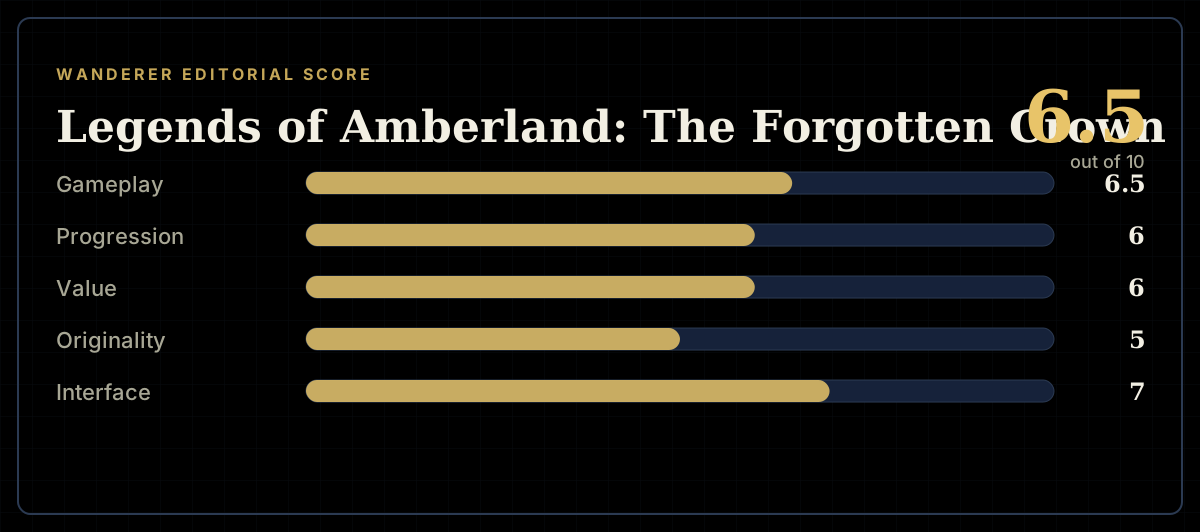
How the review scores each part of the gameWanderer Editorial -
The short versionWanderer Editorial