
Game review
Book of Demons
6.5 / 10
- Developer
- Thing Trunk
- Publisher
- Thing Trunk
- Released
- 13 December 2018
- Platforms
- Windows, macOS
- Genre
- Action RPG, Hack and Slash
- Monetisation
- One-time purchase, paid content DLC available
- Players
- Single-player
The short version
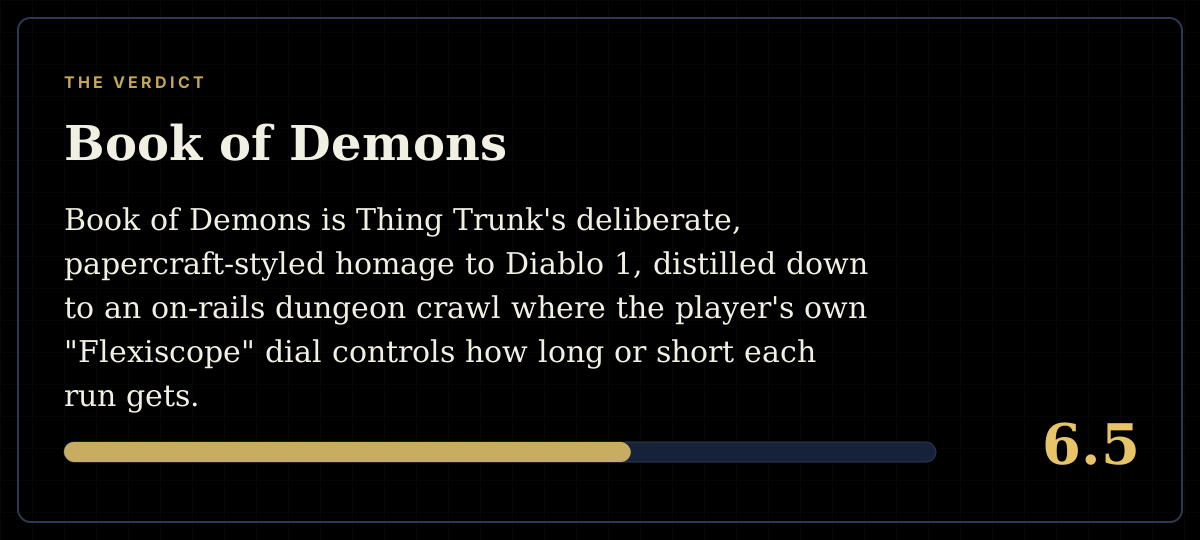
Book of Demons is Thing Trunk's deliberate, papercraft-styled homage to Diablo 1, distilled down to an on-rails dungeon crawl where the player's own "Flexiscope" dial controls how long or short each run gets. Ninety percent of its nearly 4,000 reviewers recommend it, many describing the art style and the concept itself as genuinely inventive. The consistent minority who don't tend to land on the same specific complaint: the card system marketed as a hack-and-slash/deckbuilding hybrid is, on closer inspection, mostly reskinned gear and single-button spellcasting, and the fixed-path movement wears its novelty off well before an eleven-hour campaign is over.
Biggest strengths
- The papercraft-diorama art style is distinctive and consistently praised, including by reviewers who are otherwise critical of the game's depth
- The "Flexiscope" system, letting players dial a dungeon's length up or down before entering, is a genuinely novel solution to the genre's usual all-or-nothing session length, and multiple reviewers specifically credit it as ideal for short, mobile-style play sessions
- Full controller support, including DualSense and DualShock input plus Steam Input API support, makes it comfortable well beyond a mouse-only setup
Biggest weaknesses
- The core "cards" are consistently described by critical reviewers as reskinned equipment and single-target spells rather than anything resembling real deckbuilding, several arguing the marketing overstates the hybrid genre it claims to be
- Movement along fixed paths rather than free exploration draws repeated frustration, particularly from reviewers coming in expecting a traditional isometric dungeon crawler
- Several detailed reviews describe completing the entire campaign using one or two repeated abilities, arguing build variety is much shallower than the visible skill tree suggests
Who it's for: Diablo 1 nostalgists who want a shorter, stylistically distinct tribute they can genuinely finish in a weekend, and players who specifically want a hack-and-slash they can dip into for fifteen minutes at a time thanks to the adjustable dungeon-length dial, are the audience this delivers for best. Players expecting real deckbuilding depth, or a combat system that expands meaningfully over a full campaign, should read the specific complaints below first.
Our recommendation: Worth it for the art style and the specific comfort of an ARPG built around short, controllable sessions, at its best played in the shorter bursts it was actually designed for rather than a single long sitting. Go in expecting a stylish diorama rather than a deep deckbuilder and the gap between the marketing and the mechanics won't catch you off guard the way it did several detailed reviewers.
6.5 / 10
A love letter with a very specific shape
Book of Demons wears its inspiration on its sleeve from the opening frame: a town square above a cathedral, a warrior, rogue or mage descending through familiar-feeling dungeon levels toward an Archdemon at the bottom, rendered entirely as if built from cardboard cutouts and paper dioramas. Reviewers who grew up on Diablo 1 recognise the tribute immediately and warmly — one self-described veteran of "3,000-plus hours" in the genre calls it exactly that, a heartfelt homage rather than a cynical cash-in, and the papercraft art style earns close to unanimous praise even from otherwise critical reviews. It's a legitimately distinctive visual identity in a genre that mostly reaches for grim realism, and it gives Book of Demons a personality none of its mechanical criticisms manage to erase.
The game's other real innovation is structural rather than visual: before entering any dungeon, a dial called the Flexiscope lets the player set exactly how long that run will be, trading length for reward density. Several reviewers single this out as solving a real problem — the traditional hack-and-slash's demand for long, uninterrupted sessions — and describe using it specifically to fit fifteen-minute play windows around other commitments. For a genre historically unfriendly to short sessions, that's a genuinely useful piece of design, not just a curiosity.
What "deckbuilding" actually means here
The specific complaint that recurs across a large share of this game's critical reviews concerns exactly what its "cards" do. Thing Trunk markets Book of Demons as a hack-and-slash and deckbuilding hybrid, but multiple detailed reviews push back on that framing directly, arguing the cards function as reskinned equipment slots and mana-gated spells rather than anything resembling a real deck of interacting effects. One reviewer states it plainly: "it's not a card game... they are just equipment and spells." That's a specific, falsifiable disagreement with the store page's own pitch, not a vague complaint about difficulty, and it's repeated often enough across independent reviews to treat as a real pattern rather than one player's pedantry.
Layered on top of that is a build-variety complaint from several long-time players: more than one review describes completing the entire roughly eleven-hour campaign using a single repeated ability, arguing the visible skill tree promises more strategic depth than the actual combat rewards using. Combined with the fixed-path movement — walking forward and back along a rail rather than exploring a room freely — several reviewers who came in expecting a traditional isometric crawler describe the resulting loop as closer to a shooting-gallery than a dungeon crawler, which is a fair characterisation of a real design choice rather than a bug.
A cross-promotion complaint worth naming
One specific irritation shows up often enough in the review corpus to be worth stating plainly rather than treating as a minor gripe: multiple reviewers report the game's boot sequence promoting Thing Trunk's other titles before letting them into the game they paid for. For a full-price release with no free-to-play component, that's an unusual choice, and it's the kind of small, avoidable friction that costs goodwill disproportionate to how little screen time it actually occupies — several reviewers mention it specifically, unprompted, as souring an otherwise positive first impression before the papercraft charm gets a chance to land.
On the other side of that same relationship, the developer's ongoing community support draws real, specific credit. One detailed review describes reporting a minor bug that blocked full level completion and receiving quick, direct engagement from the studio in response — the kind of small-scale responsiveness that's easy to take for granted in a well-supported game and conspicuously absent in several other small studios this library has covered. Between the DLC content packs Thing Trunk has continued releasing and that direct support, Book of Demons reads as an actively maintained project rather than a launch-and-abandon release, which is worth crediting on its own terms.
Replayability and value
With three pieces of DLC now available — cosmetic and additional-content packs rather than gameplay-gating purchases — Book of Demons has had a longer active life than its initial eleven-hour campaign length suggests, and the Flexiscope system means a second or third playthrough with a different class can be compressed into much shorter sessions than the first run required. That's a real point in its favour for replayability, even though several reviewers are clear that the underlying combat doesn't change meaningfully between classes beyond surface-level ability swaps. Steam Leaderboards and Stats tracking give completionist players something to chase beyond the story itself, for those who find the loop enjoyable enough to want more of it.
At NZ$30.99, reviewers weighing cost against the eleven-hour campaign length generally land on "reasonable, better on sale" rather than either extreme — nobody in the sampled corpus calls it an outright ripoff, but several specifically recommend waiting for a discount given how much of the game's second half repeats mechanics established in the first.
Verdict
Book of Demons succeeds completely at being a stylish, short, warmly nostalgic Diablo 1 tribute with a genuinely clever session-length dial, and the 90% of reviewers who recommend it are responding to something real rather than the art style alone. It's less successful at the specific hybrid genre its own marketing claims to be — the card system is shallower than "deckbuilding" implies, and the combat's depth doesn't expand much across its short campaign. Buy it for the papercraft charm and the convenience of the Flexiscope, in short sessions rather than one long sitting, and set your deckbuilding expectations closer to "reskinned loot" than "Slay the Spire with a sword" going in.
Pros and cons
Pros
- The papercraft-diorama art style is distinctive and consistently praised, including by reviewers who are otherwise critical of the game's depth
- The "Flexiscope" system, letting players dial a dungeon's length up or down before entering, is a genuinely novel solution to the genre's usual all-or-nothing session length, and multiple reviewers specifically credit it as ideal for short, mobile-style play sessions
- Full controller support, including DualSense and DualShock input plus Steam Input API support, makes it comfortable well beyond a mouse-only setup
- Community support from the developer draws specific, unprompted praise — one reviewer describes reporting a minor completion-blocking issue and receiving fast, direct engagement from the studio
Cons
- The core "cards" are consistently described by critical reviewers as reskinned equipment and single-target spells rather than anything resembling real deckbuilding, several arguing the marketing overstates the hybrid genre it claims to be
- Movement along fixed paths rather than free exploration draws repeated frustration, particularly from reviewers coming in expecting a traditional isometric dungeon crawler
- Several detailed reviews describe completing the entire campaign using one or two repeated abilities, arguing build variety is much shallower than the visible skill tree suggests
- More than one reviewer reports the game's boot sequence promoting the studio's other titles, an unusual and unwelcome inclusion for a full-price release
- The most detailed critical reviews warn the free demo doesn't represent the difficulty or pacing of the full campaign accurately, leaving some buyers feeling misled about what they were purchasing
Screenshots
-

Book of DemonsImage: Thing Trunk via Steam -

Book of DemonsImage: Thing Trunk via Steam -

Book of DemonsImage: Thing Trunk via Steam -
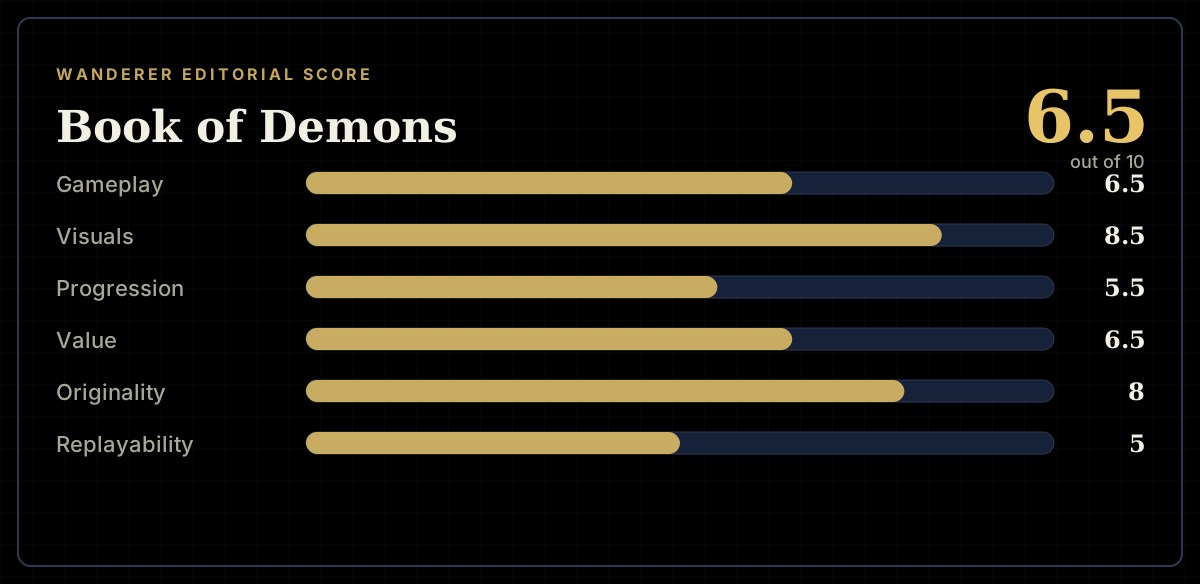
How the review scores each part of the gameWanderer Editorial -
The short versionWanderer Editorial