
Game review
Knights And Bikes
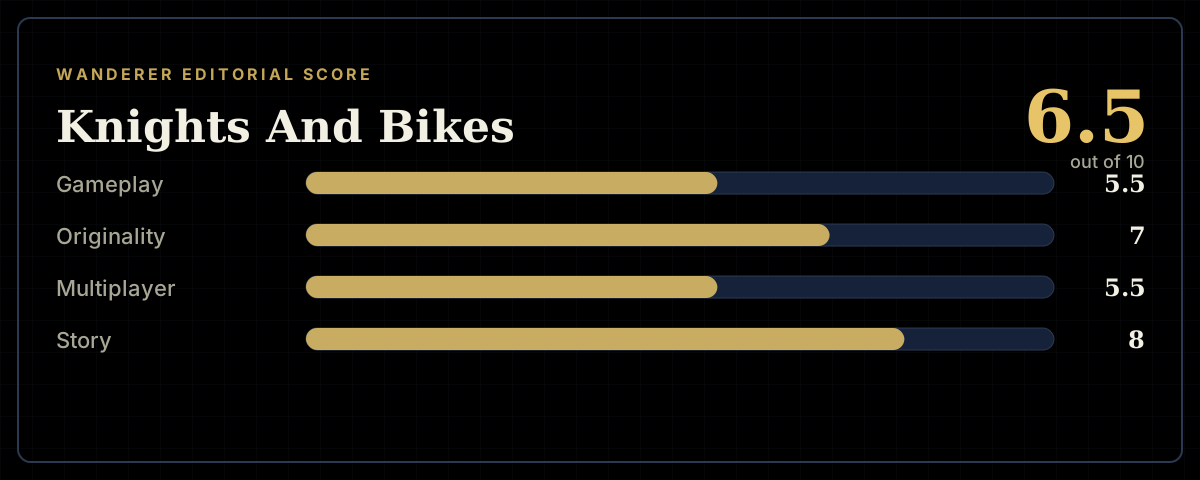
6.5 / 10
- Developer
- Foam Sword
- Publisher
- Foam Sword, PLAYISM
- Released
- 26 August 2019
- Platforms
- Windows
- Genre
- Adventure
- Monetisation
- Paid, no in-app purchases found
- Players
- true
The short version
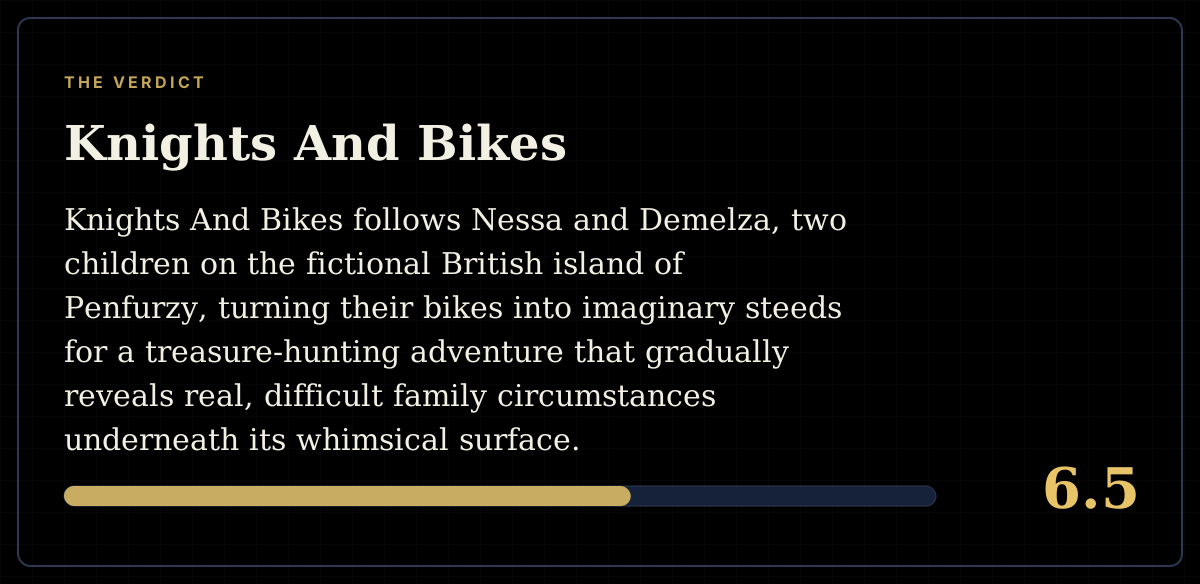
Knights And Bikes follows Nessa and Demelza, two children on the fictional British island of Penfurzy, turning their bikes into imaginary steeds for a treasure-hunting adventure that gradually reveals real, difficult family circumstances underneath its whimsical surface. Its warmth, humour and emotional honesty draw some of the most personally affectionate praise this lane has documented, but a real, detailed minority argues the core gameplay — navigation, light combat, puzzles — doesn't hold up on its own terms, and co-op players specifically report a string of bugs that can force solo workarounds through supposedly two-player content.
Biggest strengths
- A genuinely strong, emotionally honest narrative about childhood imagination as a coping mechanism for real family hardship, praised consistently and specifically across the review corpus
- Distinctive, detailed charm in its writing and world-building, down to specific touches like a real usable scone recipe and considerate handling of a vegetarian character's perspective
- Accessible, asymmetric co-op design that works well for mixed-skill pairs, such as an adult playing alongside a young child, since one player can take over both characters when needed
Biggest weaknesses
- A detailed, specific critical review argues the core second-to-second gameplay simply isn't fun, describing navigation as "mundane" and the world as "somber, empty feeling" despite loving the narrative ambition surrounding it
- Multiple reviewers report real, repeated co-op-specific bugs, including segments that became "100% broken in co-op" and required falling back to solo control or reloading from an earlier save
- The moment-to-moment combat and puzzle-solving are consistently described as simple rather than deep, meaning the experience leans almost entirely on its story and presentation to carry it
Who it's for: Parents and kids playing together, or any co-op pair looking for a shorter, story-forward adventure with real emotional weight beneath its playful surface.
Our recommendation: A strong pick for co-op pairs who prioritise story and charm over tight, demanding gameplay — just go in aware of documented co-op bugs and keep saves handy.
6.5 / 10
What it is
Knights And Bikes follows Nessa and Demelza, two children on the fictional, faded British seaside island of Penfurzy, who turn their bicycles into imaginary steeds and set off on a treasure hunt across the island's beaches, junkyards and abandoned theme parks. Beneath that whimsical framing, the game gradually reveals real, difficult circumstances in both girls' family lives, using childhood imagination as a lens for processing hardship rather than escaping it entirely. It's a small studio's work — developed by Foam Sword and published by Foam Sword alongside PLAYISM — and at least one reviewer in the corpus documents an understandable but incorrect assumption that Double Fine was involved given surface similarities to Costume Quest; that mix-up is worth correcting plainly, since the game's actual creative pedigree is a smaller, more independent team.
It released on 26 August 2019 at NZD 24.79, designed from the ground up as a two-player co-op experience, though playable solo with one player controlling both characters. Its 274-review English corpus sits at a strong Very Positive (243 to 31), and reading through it reveals writing this genre rarely inspires — reviewers describing the game in terms of genuine personal and emotional impact rather than simple enjoyment.
The heart at the center
The narrative draws consistently specific, affectionate praise. "The actual gameplay is quite basic but the game has a very strong and cohesive narrative which is generally the driving point of the experience," writes one reviewer, describing dialogue and character interaction as exceptionally well realized. Another calls it "one of the most magical, wonderful experiences I've had with a video game in a long time," specifically praising its accessibility "for anyone of almost any age." The small, specific details reviewers choose to highlight say a lot about the game's craft: one reviewer credits it as the first game to teach them how to properly make a scone; another describes being moved by a moment where a character's vegetarian perspective is given genuine narrative weight rather than being played for a joke, calling the writing team's care "shocking" in the best sense. Several reviewers specifically describe playing through the story with their own children, reporting real shared enjoyment across generations rather than one party humouring the other.
Whether the gameplay holds up
Set against that warmth, the most detailed critical review in the corpus makes a specific, uncomfortable argument worth taking seriously rather than dismissing as nitpicking: that the game, for all its narrative ambition, simply "is not fun" moment to moment. That reviewer, playing with their sister, describes the open world as "remarkably somber, empty feeling," core navigation as "mundane, perhaps even a drag," and pacing as slow "as molasses" — a genuinely difficult review to write, by their own admission, given how much they otherwise admire the game's ambitions as "one of the most impassioned love letters to video games ever devised." That's a meaningful distinction worth preserving rather than averaging away: this is a case where narrative ambition and moment-to- moment engagement pull in different directions for at least some players, even among people who clearly understand and respect what the game is trying to do.
Co-op bugs worth knowing about
A separate, more concrete complaint concerns technical reliability in co-op specifically. One reviewer reports "many game-breaking bugs" encountered while playing through with a partner, including "at least three occasions" where a segment was "100% broken in co-op," forcing the group to either reload from an earlier save or have one player push through the section solo controlling both characters. That's a real, specific reliability concern for a game whose entire structural identity is built around shared two-player play, and it's worth factoring into expectations for anyone planning a full co-op playthrough rather than assuming smooth sailing throughout.
What the achievement data suggests about engagement
The completion curve across Knights And Bikes's 36 achievements offers a useful window into how far most players actually get. Story-progression milestones like completing the first in-game day sit high, at 84.9%, before dropping fairly steeply — 52.4% for the second day, 44.1% for unlocking the bikes themselves as a traversal mechanic. That decline, while not unusual for any game, is somewhat steeper than titles in this lane with a smoother, more sustained completion curve, and is at least consistent with reports that the middle stretch of the game — the "mundane" navigation the detailed critical reviewer specifically flagged — may be where some players' engagement starts to wane before the story's emotional payoff arrives. Optional treasure-hunting content, meanwhile, sits far lower still, mostly under 1.5%, confirming that the vast majority of players experience this as a narrative-first game to be finished once rather than a world to fully explore and re-explore.
A shorter, more focused experience than its ambitions might suggest
It's worth noting that several of the most positive reviews describe finishing the game in a handful of sessions — one reviewer specifically mentions completing it "over the course of" a short stretch of time with a partner, framing that brevity as a feature rather than a limitation for a game meant to be experienced together in a manageable number of sittings. That's a useful expectation to set clearly: Knights And Bikes isn't positioning itself as a lengthy, systems-deep adventure, but as a focused, story-forward experience sized to fit a handful of co-op evenings rather than dozens of hours, which context makes both the achievement completion curve and the "basic gameplay" criticism easier to weigh fairly against what the game is actually trying to be.
Verdict
Knights And Bikes tells a genuinely warm, emotionally honest story with real specificity and care in its writing, and it clearly succeeds at what the majority of its audience came for — a shared, memorable experience to play through with a partner or a child. Real doubts about whether its underlying gameplay holds up on pure moment-to-moment terms, plus documented co-op reliability issues, are worth weighing seriously rather than dismissing given how consistently and specifically they're reported. For players prioritising heart and story over mechanical depth, this remains an easy recommendation; for those who need the gameplay itself to carry equal weight, it's worth going in with tempered expectations.
Pros and cons
Pros
- A genuinely strong, emotionally honest narrative about childhood imagination as a coping mechanism for real family hardship, praised consistently and specifically across the review corpus
- Distinctive, detailed charm in its writing and world-building, down to specific touches like a real usable scone recipe and considerate handling of a vegetarian character's perspective
- Accessible, asymmetric co-op design that works well for mixed-skill pairs, such as an adult playing alongside a young child, since one player can take over both characters when needed
- Strong art direction and music that reviewers consistently credit alongside the writing as core to the experience's emotional impact
Cons
- A detailed, specific critical review argues the core second-to-second gameplay simply isn't fun, describing navigation as "mundane" and the world as "somber, empty feeling" despite loving the narrative ambition surrounding it
- Multiple reviewers report real, repeated co-op-specific bugs, including segments that became "100% broken in co-op" and required falling back to solo control or reloading from an earlier save
- The moment-to-moment combat and puzzle-solving are consistently described as simple rather than deep, meaning the experience leans almost entirely on its story and presentation to carry it
- Achievement data shows a very low completion rate for optional treasure-hunting content (under 1.5% for several late-game achievements), suggesting most players engage with the main story only and don't return for full exploration
Screenshots
-

Knights And BikesImage: Foam Sword via Steam -

Knights And BikesImage: Foam Sword via Steam -

Knights And BikesImage: Foam Sword via Steam -
How the review scores each part of the gameWanderer Editorial -
The short versionWanderer Editorial