
Game review
The Dark Pictures Anthology: Man of Medan
5.5 / 10
- Developer
- Supermassive Games
- Publisher
- BANDAI NAMCO Entertainment Europe
- Released
- 29 August 2019
- Platforms
- Windows
- Genre
- Adventure
- Monetisation
- Paid, no in-app purchases found
- Players
- true
The short version
Man of Medan sends five characters aboard a WWII-era ghost ship in a choice-driven horror adventure clearly built on the template of Supermassive's earlier hit Until Dawn, with real atmosphere, strong lighting and sound design, and branching decisions that meaningfully affect who lives, dies, or falls out with each other. But a widely repeated complaint argues the horror leans on cheap jump scares rather than sustained dread, and two concrete, verifiable problems compound the writing concerns: a documented late-game bug that can halt progress entirely, and a prominently advertised free multiplayer 'Friend Pass' that reviewers confirm no longer functions.
Biggest strengths
- Strong atmosphere, lighting and sound design that multiple reviewers compare favourably to classic survival-horror camera work from the original Resident Evil and Silent Hill
- Genuinely meaningful branching choices that affect character relationships and survival outcomes, giving real weight to decisions throughout
- A detailed, well-argued defence in the corpus pushes back on reflexive dismissals, arguing the game deserves the same patience critics extended to similarly structured, multi-perspective narrative games
Biggest weaknesses
- A dominant, widely repeated complaint that the horror relies on cheap jump scares — "an ugly face appearing in a doorframe, accompanied by a loud noise" — rather than the sustained dread the studio's earlier work built a reputation on
- Multiple reviewers state directly that the writing and pacing fall well short of Until Dawn's quality, describing the game as noticeably slower without matching that game's tighter plotting
- A specific, documented bug causes an infinite loading screen roughly 75% through the story, forcing a full restart; multiple reviewers report this recurring even after a patch the developer claimed had resolved it
Who it's for: Fans of choice-driven horror anthologies and Until Dawn specifically, tempered with realistic expectations about jump-scare-heavy pacing and some real technical risk.
Our recommendation: Worth it on sale for the atmosphere and branching structure, but confirm the Friend Pass situation and check for the loading-screen bug before planning a co-op playthrough around it.
5.5 / 10
What it is
The Dark Pictures Anthology: Man of Medan is the first entry in Supermassive Games' anthology horror series, following five characters — playable solo or shared across a small group of friends — whose diving expedition goes wrong aboard a WWII-era ghost ship, the SS Ourang Medan. Structurally it's a direct continuation of the template Supermassive built with Until Dawn: branching dialogue and quick-time-event choices that shift character relationships and determine who survives to the credits, with the game explicitly designed to produce a different story on every playthrough depending on the choices made. It released on 29 August 2019 at NZD 34.99, published by Bandai Namco.
Its review corpus, 3,542 in English, sits at a Mostly Positive 74.7% (2,647 to 895) — solid, but notably softer than the acclaim Until Dawn received, and reading through the reviews in depth makes clear that comparison is doing a lot of the work in shaping how this specific game gets judged.
Living in Until Dawn's shadow
The single most consistent framing across the corpus, positive and negative alike, measures Man of Medan directly against its spiritual predecessor. "I really liked Until Dawn and therefore was looking forward to play the games in this series," writes one reviewer, before concluding plainly that "it isn't near the quality and writing of Until Dawn," citing a noticeably slower pace as a specific, shared weakness across the wider anthology. That comparison isn't limited to critics — even reviewers recommending Man of Medan tend to do so with real caveats attached, describing "some flaws" alongside genuine praise for atmosphere and presentation.
The horror execution draws the most specific criticism. "Two words: Jump Scares," writes one detailed review, arguing that "an ugly face appearing in a doorframe, accompanied by a loud noise" is the game's primary scare tactic, and that this approach never produced "a real sense of dread" the way sustained atmospheric horror can. A separate reviewer makes a similar point more bluntly, describing the tone as closer to "a Nancy Drew book or a campfire scary story" than genuine psychological horror, while still crediting the game as reasonably competent for what it is rather than calling it outright bad.
Two concrete, documented problems
Beyond matters of taste, this review needs to flag two specific, verifiable issues independently confirmed by multiple reviewers rather than a single complaint. The first is a story-breaking bug: several reviews describe the game entering an infinite loading screen at roughly the 75% mark, forcing players to restart the entire story from the beginning. One reviewer notes a patch was claimed to fix this "in December," but reports the exact same bug recurring for their own group over a year later, concluding sharply that "the developer apparently just didn't care about fixing their game." A second player independently reports the identical experience — a stuck cutscene during a co-op session — and notes finding other reports of the same issue online dating back over a year.
The second issue concerns marketing accuracy rather than gameplay. Man of Medan launched with a "Friend Pass" feature letting one owner invite a non-owning friend into a co-op session for free — the same system Until Dawn offered. Multiple reviewers confirm this feature stopped working or was discontinued, and specifically object to the store page continuing to feature an announcement advertising it as available well after that point. One reviewer describes the direct financial consequence: having purchased the game specifically to play with a partner via the advertised Friend Pass, following all the necessary steps, only to be told a second copy was required — an outcome they attribute directly to "old, but featured advertising" with an expiration detail "relegated to the very end of the last paragraph" rather than stated clearly upfront.
A defence worth hearing
Not every account of the game is critical, and one detailed, thoughtful review explicitly pushes back against what its author sees as unfair community piling-on, drawing a comparison to critics who reviewed Resident Evil 2's remake based only on one character's campaign without playing the other. That reviewer argues Man of Medan deserves to be judged on its own structural ambitions — multiple playable perspectives, genuine branching consequence — rather than dismissed reflexively for not matching Until Dawn beat for beat. It's a fair point that the game's harshest critics sometimes elide: real atmosphere, real choice-consequence design, and real replay value exist here, even if the writing and horror execution don't reach the same heights as the game that inspired it.
What the achievement data adds
Man of Medan's 30 tracked achievements show a distinctive split worth reading alongside the reviewer complaints above. Achievements tied to relationship outcomes and general story beats — "RELATIONSHIP_ALEX_JULIA," "COMBAT_TRAINING," a quick-time-event streak — sit in a fairly consistent 40-51% band, suggesting a solid core of players complete at least one full playthrough and engage with its central relationship-tracking systems. But achievements tied to full completionist behaviour — finding every hidden picture, every secret, or picking a specific narrative "head" or "heart" choice path — all cluster tightly around 1.5-1.8%. That's a steeper drop than this lane has seen in games with a more sustained, escalating difficulty curve, and it points to a different explanation than pure difficulty: a branching narrative game's completionist achievements require multiple full playthroughs to see every path, and a meaningful number of players who finish once apparently don't return for the additional runs needed to unlock everything else. That's consistent with reports of the game feeling slower and less immediately compelling to replay than Until Dawn, even among players who finished a single run without hitting the story-breaking bug described above.
Weighing the Friend Pass complaint fairly
It's worth being precise about how serious the Friend Pass issue actually is, since it's a real marketing-accuracy problem rather than a subjective quality complaint. A promotional feature that worked at launch, quietly stopped functioning, and then remained advertised in a "Major update" announcement on the store page well past its stated (and vaguely worded) expiration is a legitimate, checkable failure of clear communication — not a case of a player misreading normal marketing language. For anyone specifically buying this game to share with a friend who doesn't already own it, verifying the current state of that feature directly, rather than trusting the store page's own announcements, is a reasonable precaution this review recommends taking before purchase.
Verdict
Man of Medan is a reasonably competent, atmospheric choice-driven horror game weighed down by comparison to its own predecessor's stronger writing, an over-reliance on jump scares that several reviewers find genuinely disappointing, and two specific, well-documented problems — a progress-halting bug and an inaccurately advertised co-op feature — that go beyond matters of taste into real, avoidable quality control issues. Worth a discounted purchase for horror-anthology and Until Dawn fans with tempered expectations, but confirm current patch status and the real state of multiplayer support before committing to a group playthrough built around it.
Pros and cons
Pros
- Strong atmosphere, lighting and sound design that multiple reviewers compare favourably to classic survival-horror camera work from the original Resident Evil and Silent Hill
- Genuinely meaningful branching choices that affect character relationships and survival outcomes, giving real weight to decisions throughout
- A detailed, well-argued defence in the corpus pushes back on reflexive dismissals, arguing the game deserves the same patience critics extended to similarly structured, multi-perspective narrative games
- Supports both solo play and small-group multiplayer sessions, with reviewers who played it as intended (with friends) generally reporting a more positive experience
Cons
- A dominant, widely repeated complaint that the horror relies on cheap jump scares — "an ugly face appearing in a doorframe, accompanied by a loud noise" — rather than the sustained dread the studio's earlier work built a reputation on
- Multiple reviewers state directly that the writing and pacing fall well short of Until Dawn's quality, describing the game as noticeably slower without matching that game's tighter plotting
- A specific, documented bug causes an infinite loading screen roughly 75% through the story, forcing a full restart; multiple reviewers report this recurring even after a patch the developer claimed had resolved it
- The game's own storefront prominently continued advertising a free "Friend Pass" co-op feature for playing with a non-owning friend well after that promotion had actually expired and stopped functioning, leading at least one reviewer to pay for a second copy unexpectedly as a direct result
Screenshots
-

The Dark Pictures Anthology: Man of MedanImage: BANDAI NAMCO Entertainment Europe via Steam -

The Dark Pictures Anthology: Man of MedanImage: BANDAI NAMCO Entertainment Europe via Steam -

The Dark Pictures Anthology: Man of MedanImage: BANDAI NAMCO Entertainment Europe via Steam -
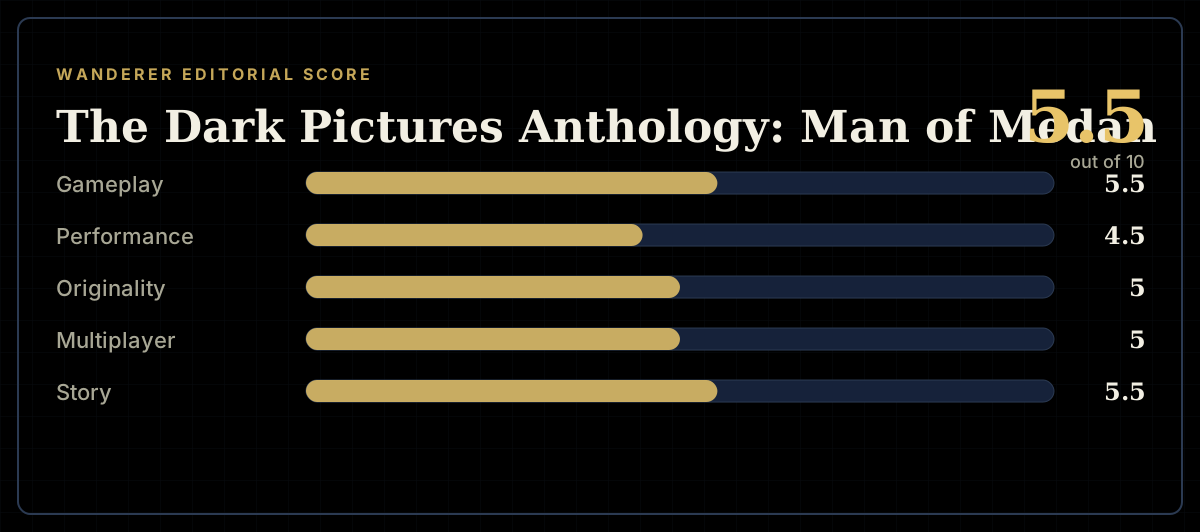
How the review scores each part of the gameWanderer Editorial -
The short versionWanderer Editorial