
Game review
BodyRecords
5 / 10
- Developer
- MIROWIN
- Publisher
- MIROWIN
- Released
- 17 April 2025
- Platforms
- Windows
- Genre
- Action, Adventure, Indie
- Players
- Co-op
The short version
Biggest strengths
- A genuinely distinctive core mechanic — the game reacts to players' actual real-world voice volume through their microphone, making staying quiet an active, stressful part of survival
- Reviewers consistently describe the scares as unpredictable and legitimately effective rather than relying on cheap, scripted jumpscares
- Solid bodycam-style atmosphere and presentation that multiple reviewers credit as genuinely tense when played carefully and quietly with a group
Biggest weaknesses
- Content is widely reported as exhausted within roughly two hours, with the game abruptly ending on an explicit "thanks for playing early access" message
- A reported game-breaking progression bug requires a full restart to continue in at least some cases
- Walkie-talkies, a core communication tool given the game's voice-based design, are reported as non-functional by multiple reviewers
5 / 10
Your own voice is the difficulty slider
BodyRecords builds its entire co-op horror experience around a genuinely distinctive hook: the game listens to players' real microphone input and reacts to how loud they actually are, turning the ordinary act of talking to your friends into an active survival mechanic. Based on the available English-language review sample of 393 reviews — 334 positive, 59 negative, landing at an overall Very Positive rating — that single idea is doing most of the heavy lifting in winning players over, and reviewers describe its effect in strikingly consistent, personal terms. "I thought I was being quiet until the game disagreed. Suddenly everyone is whispering like it actually matters, and it somehow does. Made me laugh and panic at the same time," one reviewer writes, capturing exactly the blend of comedy and genuine stress the mechanic is designed to produce. A separate reviewer frames the same dynamic even more directly: "Played with friends and realized my voice is the real difficulty setting. Simple idea, weirdly stressful, and way more fun than I expected at 2 a.m."
That voice-reactive design sits inside a bodycam-style presentation that reviewers consistently credit for restraint. "Honestly, this is actually a solid start for EA. It's rough, but it gets the job done. No cheap jump scares, just pure dread. Looking forward to see what else they add because the foundation is definitely there," one reviewer writes, a sentiment echoed by a separate reviewer's account of the game rewarding patience specifically: "A slow and tense co-op horror that really works when everyone takes it seriously. The atmosphere does most of the work and keeps you on edge without constant action. Best played quietly and carefully. Not a game for rushing."
A rough, self-aware Early Access build
Multiple reviewers explicitly frame their positive assessments through the lens of Early Access expectations rather than judging the game as a finished product, and it's worth reporting that framing directly because it shapes how much weight to put on the current state. "The game is so raw that even the names of the developers are still in development. I recommend it only because of the potential the project has," one reviewer writes, an unusually candid way of separating enthusiasm for the underlying idea from satisfaction with its current execution. A separate reviewer offers a similarly qualified, "in general norms" assessment: "A good game with great potential, there are certainly problems, but in general norms" — hedged praise that recurs often enough across the positive sample to suggest most of the game's fans are buying into its trajectory as much as its current content.
A hard content wall, hit fast
The single most consistent and pointed criticism concerns just how little content currently exists, and how abruptly the game acknowledges that limitation. "The game has just enough content and bugs to make you play for 2 hours so you can't ask for a refund anymore including a game-breaking bug that doesn't let you progress further until you restart your game, among I'm sure countless others that my friend and I didn't encounter. The game just ends abruptly saying 'thanks for playing early access,' which is like 'lol thanks for the money,'" one detailed reviewer writes. That's a specific, dateable complaint — not vague dissatisfaction with length, but a precise account of the game explicitly telling players they've reached its current end, which reads very differently depending on whether a buyer expected a finished loop or understood going in that this was a genuinely early preview build. A separate reviewer's blunter framing captures the same underlying frustration: "potentially a good game but asking money for it at the current state is just messed up, should be a free demo instead."
Specific technical complaints compound the content concerns. "Walkie talkies dont work" is flagged directly by one critical reviewer, a notable gap for a game whose entire hook depends on voice-based interaction and coordination. A separate reviewer reports broader multiplayer reliability problems: "This game runs terribly in multiplayer and my friend and I had constant desync issues where he couldn't see what host sees. Also the FPS tanks on the comm relay parkour. A lot of this game is just very gimmicky and feels held together with duct tape and a dream" — a specific, memorable framing that captures the gap between the mechanic's genuine cleverness and its current technical execution.
An unverified but specific accusation worth reporting plainly
One reviewer makes a serious, specific claim that deserves direct, careful handling rather than either amplification or silent omission: "dont buy the developer paid for good review! trust me!" That's a single reviewer's unverified accusation, stated without supporting evidence, and this review has no independent way to confirm or refute it. It's included here attributively, as one account among the 393 reviews sampled, specifically because burying a serious claim like this would leave an incomplete picture — but readers should weigh it as exactly what it is: one unverified allegation, not an established fact about how this game's review base was assembled. The overwhelming majority of the positive review sample offers specific, detailed, individually-voiced reasons for their recommendation, which is not the pattern typically associated with manufactured review activity.
Notably, BodyRecords currently has no Steam achievement system at all — a genuine structural gap for a co-op horror game that could otherwise use achievements to signal content scope and give players concrete goals across a limited early-access build. Its absence here means players have no external marker for how much of the current game they've actually seen, compounding the uncertainty several reviewers already express about the two-hour content ceiling.
Where this leaves it
BodyRecords centers on a genuinely clever, distinctive idea — a horror game that reacts to your actual voice — and delivers real, memorable tension when that mechanic lands as intended. What currently holds it back is everything Early Access implies at its roughest: a hard content wall around two hours, a reported game-breaking bug, non-functional walkie-talkies undermining the game's own core communication premise, and persistent multiplayer reliability issues. Reviewers who recommend it overwhelmingly do so on the strength of its potential and its central hook rather than its current polish, and that's a fair, honestly-earned distinction worth carrying into any purchase decision. Worth trying only if you're specifically drawn to the voice-reactive concept and comfortable paying to support an early, unfinished build rather than expecting a complete game today.
Pros and cons
Pros
- A genuinely distinctive core mechanic — the game reacts to players' actual real-world voice volume through their microphone, making staying quiet an active, stressful part of survival
- Reviewers consistently describe the scares as unpredictable and legitimately effective rather than relying on cheap, scripted jumpscares
- Solid bodycam-style atmosphere and presentation that multiple reviewers credit as genuinely tense when played carefully and quietly with a group
- Honest acknowledgment from many reviewers that this is a rough but promising early-stage foundation worth watching rather than a finished product
Cons
- Content is widely reported as exhausted within roughly two hours, with the game abruptly ending on an explicit "thanks for playing early access" message
- A reported game-breaking progression bug requires a full restart to continue in at least some cases
- Walkie-talkies, a core communication tool given the game's voice-based design, are reported as non-functional by multiple reviewers
- Persistent multiplayer desync issues and frame-rate drops during a specific parkour sequence undermine co-op reliability
- No Steam achievement system exists at all, leaving no structural markers of progress or content scope
- One reviewer makes an unverified, single-source accusation that the developer paid for positive reviews, reported here attributively rather than as an established fact
Screenshots
-

BodyRecordsImage: MIROWIN via Steam -

BodyRecordsImage: MIROWIN via Steam -

BodyRecordsImage: MIROWIN via Steam -
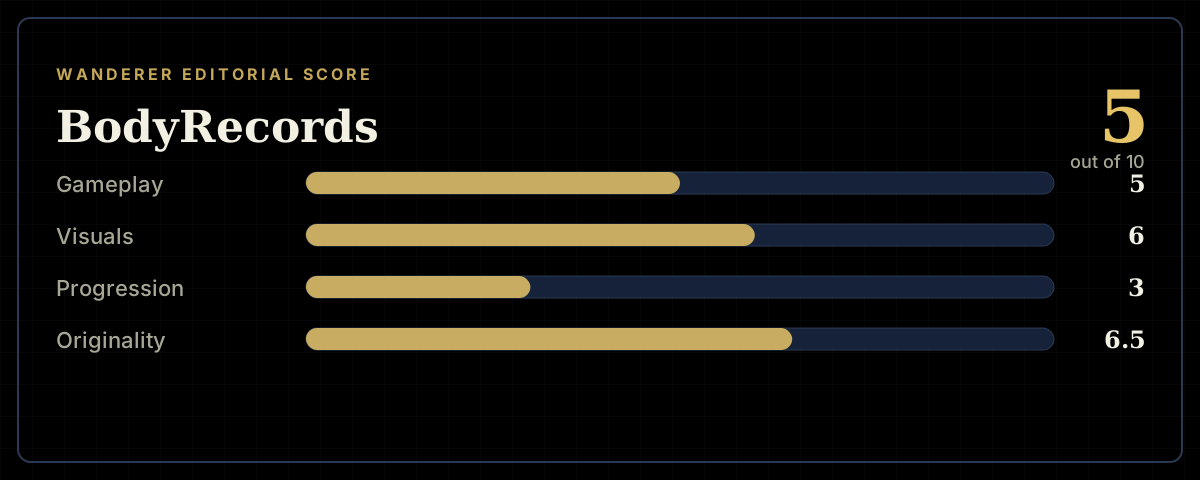
How the review scores each part of the gameWanderer Editorial -
The short versionWanderer Editorial