
Game review
Kaya's Prophecy
5.5 / 10
- Developer
- Jérémie & Thibaut
- Publisher
- Yogscast Games
- Released
- 10 April 2025
- Platforms
- Windows
- Genre
- Casual, Strategy
- Players
- Single-player
The short version
Biggest strengths
- Distinctive, colourful art direction and card design that draws consistent praise even from the game's harshest critics
- A genuinely creative, free-form village layout system that several reviewers specifically enjoy for its lack of rigid grid-based rules
- A developer who directly and publicly engaged with detailed critical feedback and shipped at least partial fixes in response
Biggest weaknesses
- Card combat is widely described as too easy and shallow, with decks that barely evolve and encounters offering little meaningful strategic depth
- The village-building resource and recipe-discovery loop is reported as unclear and occasionally soft-locking, leaving players unsure how to progress
- A specific, widely-cited late-game frustration where a resource-consuming villager type eats items mid-construction, undermining progress on buildings that were nearly complete
5.5 / 10
Two beloved formulas, fused into one card-based village
Kaya's Prophecy sets out to combine two distinct, well-regarded genres into a single package: the free-form, card-based resource management of Stacklands, and the deckbuilding combat of Slay the Spire. You gather resources, discover recipes, and construct a village by placing cards on an open board, then periodically head off into short card-combat campaigns to earn your god's favour. It's an ambitious pitch, and based on the available English-language review sample of 68 reviews — 44 positive, 24 negative, landing at an overall Mixed rating — the reception reflects exactly the risk inherent in that kind of genre fusion: reviewers who love one or both source games consistently measure Kaya's Prophecy against them, and just as consistently find it coming up short of either.
"Basically a cheap mash-up of Stacklands and Slay the Spire that does both worse and adds nothing," one reviewer states bluntly, a sentiment echoed almost word for word by a separate reviewer: "Game tries to be a mix of Stacklands and Slay the Spire and falls a bit short in comparison to either one." That comparison recurs so consistently across the negative review sample — named explicitly, by title, in review after review — that it's clearly the primary lens through which this game's target audience is evaluating it, for better or worse.
Where the fusion falls short: shallow combat, unclear building
The card-combat half draws the most specific and consistent criticism. "The gameplay loop is trivially easy and kind of boring. I kept playing hoping I'd find it interesting but every fight is basic and easy, no real customization just get the next item you are told to build," the most heavily upvoted negative review states. A separate reviewer frames the same shortfall by direct comparison to the genre's best-known examples, describing the fun of card-based roguelites like Balatro and Slay the Spire as coming from trying to break the game and customize a deck in a way that feels unique, before concluding that Kaya's Prophecy doesn't offer that same depth — identifying the specific quality, build-crafting freedom, that the genre's strongest entries rely on and that this reviewer found largely absent.
The village-building half draws a related but distinct complaint: unclear systems that can actively block progress rather than merely feeling shallow. "In the city builder loop the resource management and vision (recipe discovery) mechanic makes it entirely possible for you to be unable to proceed," one detailed reviewer notes, describing a genuinely serious design risk for a management game — a state where the player has no clear path forward through no fault of their own. A separate reviewer's frustration is even more pointed and specific, describing a particular villager type whose behaviour actively undoes progress: "The design choice of making Kalades eat items in use, even though there is plenty of other foods RUINS the game. It's almost impossible to get hives built, because if you don't get the bee early in the day, Kalades will eat the bee from the 'building project' that are 90% done!" That's a precise, reproducible complaint about a specific mechanic actively working against the player's stated goals, and it's the kind of detail that argues for a real design or balance oversight rather than simple genre mismatch.
A developer who showed up, at least partially
One of the more notable threads in this review sample is a direct, documented exchange between a detailed critical reviewer and the developer. The reviewer's original complaint listed a specific set of grievances — cards shaking and disarranging the board, permadeath mechanics, and several other structural issues — and later added an edit acknowledging a real, if partial, response: "The dev left a comment that they had addressed my complaints. They addressed cards shaking everywhere and the board getting disarranged. Arguably addressed permadeath, except they made it a buyable that I have still not seen even once in trying to give this a second chance. They addressed none of the rest." That's a genuinely useful data point: real, specific engagement from the developer, but also a genuine gap between what was promised and what was fully delivered by the reviewer's account, which is worth reporting plainly in both directions rather than only crediting the responsiveness or only dwelling on the shortfall.
A separate, more satisfied reviewer specifically frames a broader post-patch improvement: "Since the recent patch, I consider the latter half of the experience to be robust, and the game to be a satisfactory submission to its niche" — suggesting whatever fixes did ship meaningfully improved at least some players' experience, even if not comprehensively for every critic.
What genuinely works
Set against all of that, the game's presentation draws essentially unanimous praise across the entire review sample, positive and negative alike. "Good art, but boring gameplay," the top negative review concludes, a pattern repeated by the second-most-upvoted negative review, which states directly: "The only redeeming facet of this game is the art direction, but even that is implemented in a way that leads to poor UX" — crediting the art while still finding a way to criticize its execution. On the positive side, reviewers specifically enjoy the freedom the village-layout system offers relative to more rigid genre peers: "I appreciate that I can repeatedly organize the cards on a large 'map' and customize the village according to my tactics. The game allows for a free and creative approach, which is great for players who are fed up from the 'routine.'"
One especially detailed positive review offers a useful completionist's counterpoint to the "boring and shallow" framing, describing roughly ten hours of play (or five if rushed) reaching approximately 85% achievement completion and landing on a measured, generally positive verdict: "A creative blend with a few rough edges." That account is consistent with the achievement data itself, which shows a real spread from 90.1% for an early milestone down to 0.8% for the hardest late-game goal across 22 total achievements — evidence of genuine structural depth beyond the core loop's rough opening impression, even if several reviewers found that depth insufficiently rewarding to justify pushing through the early tedium.
Where this leaves it
Kaya's Prophecy is an ambitious genre fusion that most of its own review base judges against the two much stronger games it borrows from, and finds falling short of both: combat that's widely described as too easy and static, and a village-building loop capable of leaving players stuck without clear direction, compounded by at least one specific, reproducible mechanic (villagers eating near-finished building materials) that actively works against the player rather than merely under-challenging them. The developer has shown real, direct engagement with detailed feedback, addressing some issues fully and others only partially by the account of at least one detailed critic, and a meaningful minority of the review sample reports a genuinely satisfying experience once the initial friction passes. Worth a look for genre fans specifically drawn to the art direction and the free-form village layout, at a price that several critics feel doesn't yet match the depth on offer; a harder sell for anyone hoping for the strategic depth of either Stacklands or Slay the Spire specifically.
Pros and cons
Pros
- Distinctive, colourful art direction and card design that draws consistent praise even from the game's harshest critics
- A genuinely creative, free-form village layout system that several reviewers specifically enjoy for its lack of rigid grid-based rules
- A developer who directly and publicly engaged with detailed critical feedback and shipped at least partial fixes in response
- A wide, 22-achievement completion spread (90.1% down to 0.8%) that supports a real difficulty tail for players who push into the late game
Cons
- Card combat is widely described as too easy and shallow, with decks that barely evolve and encounters offering little meaningful strategic depth
- The village-building resource and recipe-discovery loop is reported as unclear and occasionally soft-locking, leaving players unsure how to progress
- A specific, widely-cited late-game frustration where a resource-consuming villager type eats items mid-construction, undermining progress on buildings that were nearly complete
- Directly and repeatedly compared unfavourably to both Stacklands and Slay the Spire, the two well-loved games it most closely borrows its structure from, with reviewers saying it falls short of each
- Some reviewers report the fix response to their detailed complaints was only partial, leaving several structural issues unaddressed
Screenshots
-

Kaya's ProphecyImage: Yogscast Games via Steam -

Kaya's ProphecyImage: Yogscast Games via Steam -

Kaya's ProphecyImage: Yogscast Games via Steam -
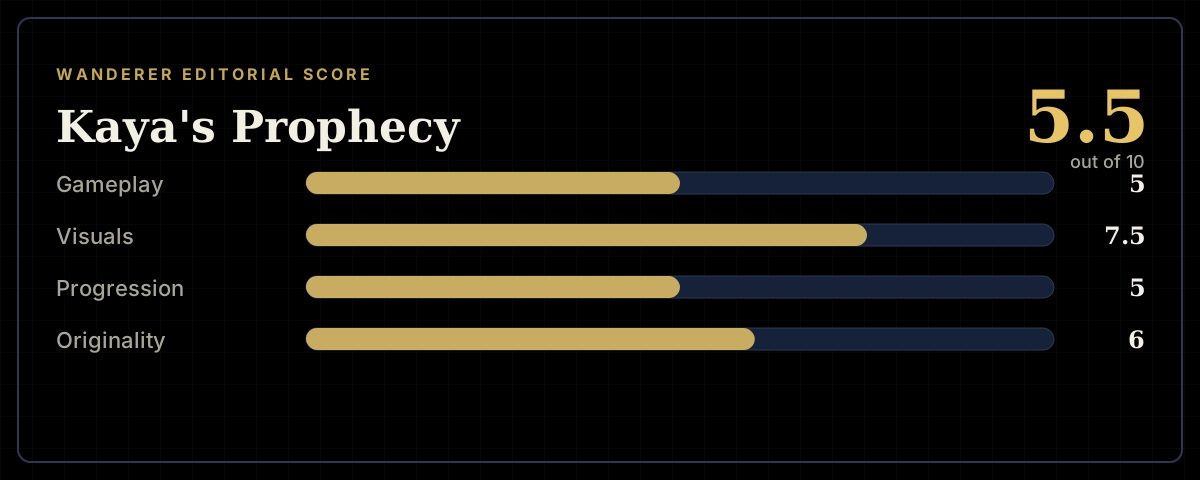
How the review scores each part of the gameWanderer Editorial -
The short versionWanderer Editorial