
Game review
Idle RPG
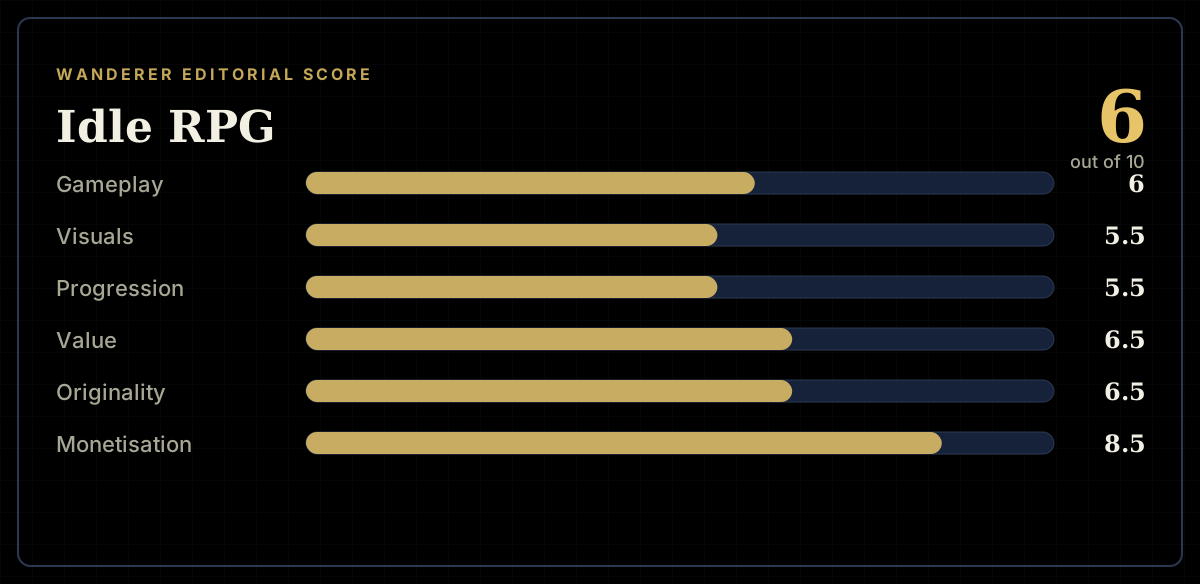
6 / 10
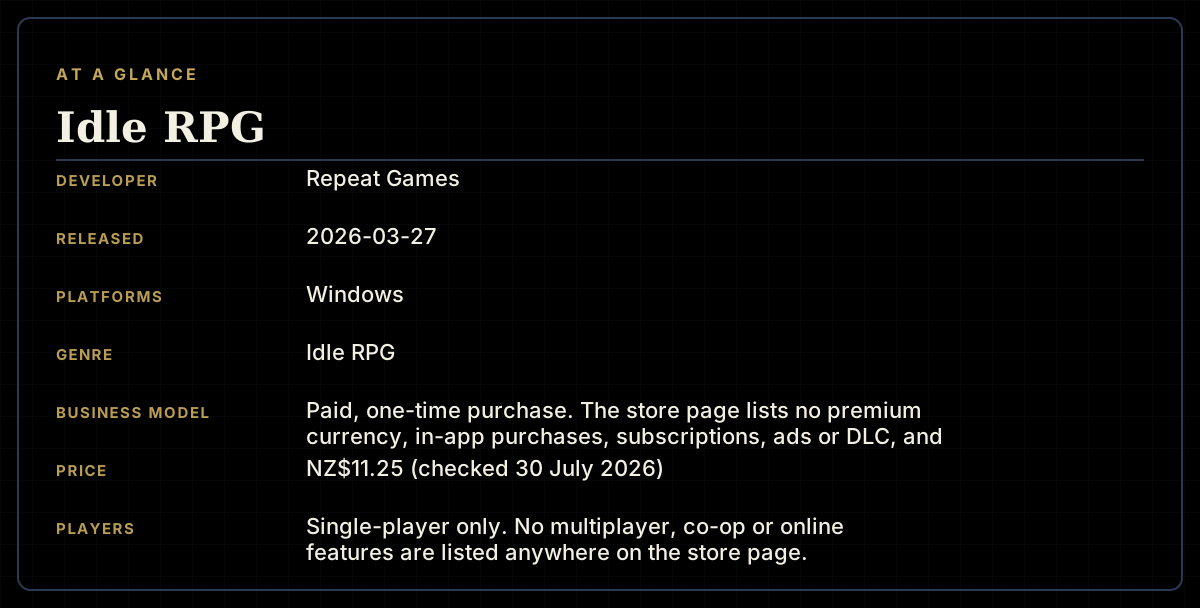
- Developer
- Repeat Games
- Publisher
- Repeat Games
- Released
- 27 March 2026
- Platforms
- Windows
- Genre
- Idle RPG
- Monetisation
- Paid, one-time purchase. The store page lists no premium currency, in-app purchases, subscriptions, ads or DLC, and the full store description makes no mention of any purchase beyond the base price.
- Players
- Single-player only. No multiplayer, co-op or online features are listed anywhere on the store page.
The short version
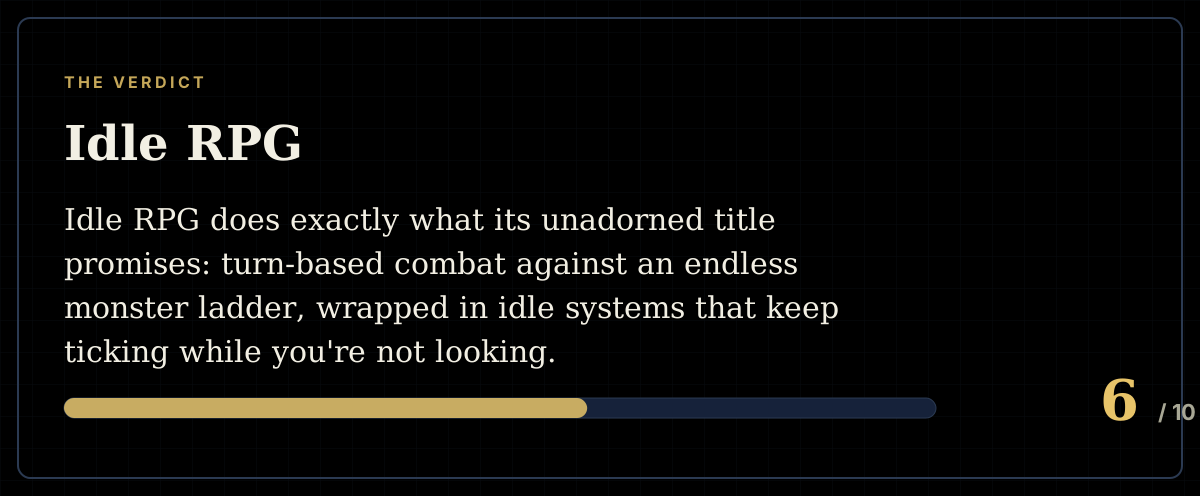
Idle RPG does exactly what its unadorned title promises: turn-based combat against an endless monster ladder, wrapped in idle systems that keep ticking while you're not looking. Its best idea is also its most distinctive one — every enemy you beat can be hired afterward, either as a passive damage source or a gold-generating worker, which gives the idle half of the game a direct, visible link back to the fights you actually chose. Layered on top of that is a genuine risk-and-reward decision: deliberately empower an enemy before the fight for a bigger payout, and pay for it if the gamble doesn't land.
The trouble is that none of this is dressed up to look like more than it is. The interface is two columns of decimal-heavy stat rows flanking a small pixel-art hero and monster, closer to a spreadsheet than a game screen, and the small handful of Steam reviews the game has attracted months after launch include a specific, detailed account of the prestige system working against itself rather than for the player.
Biggest strengths
- Hiring defeated enemies as either a passive-damage assistant or a gold-generating worker gives the idle side of the loop a direct payoff for fights you actually chose to take
- Deliberately empowering an enemy before a fight for a bigger reward is a real risk-versus-reward decision rather than combat simply getting harder as numbers climb
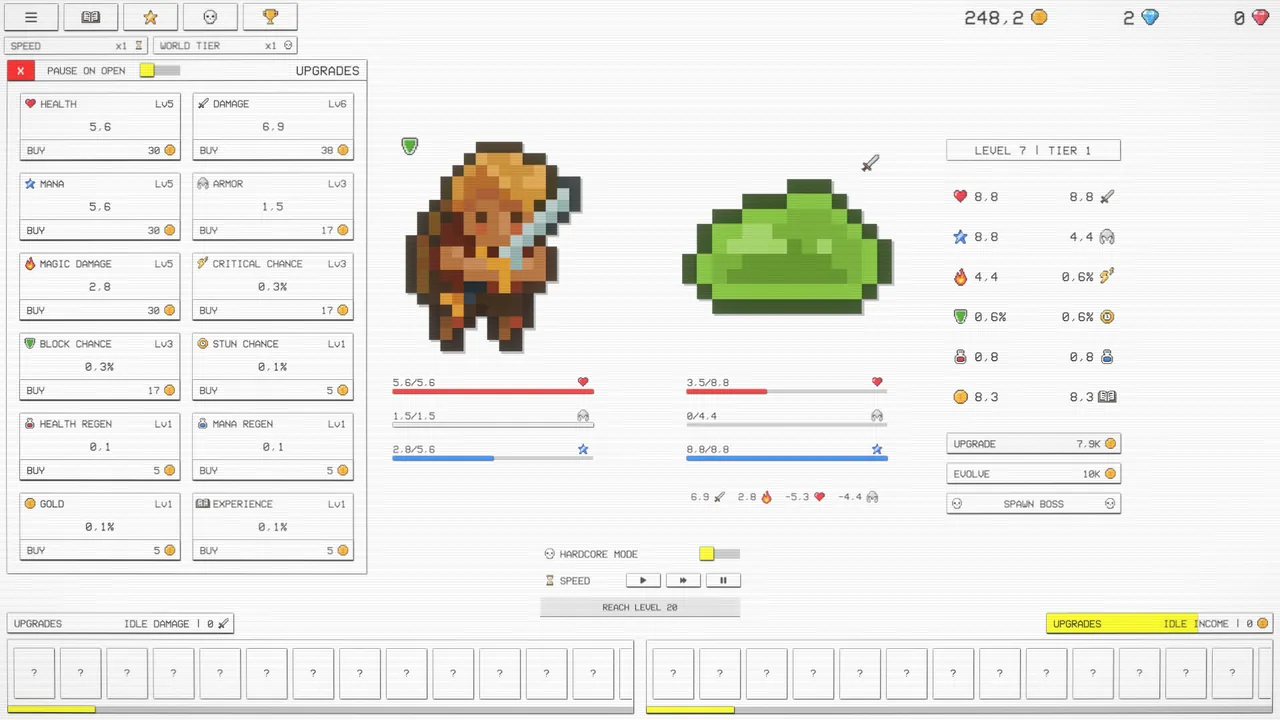
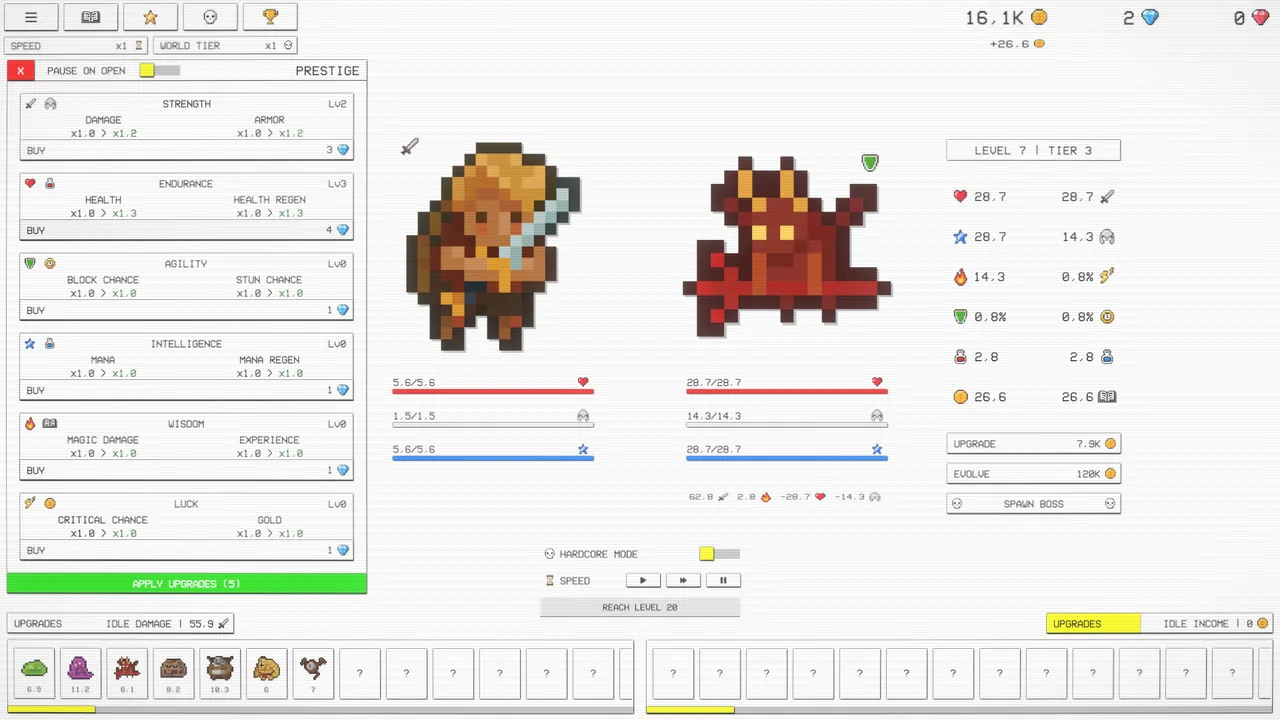
- Splitting upgrades across two currencies — gold for twelve base stats, Prestige Points for six permanent multipliers — gives the prestige reset a clearer purpose than a blank slate
Biggest weaknesses
- One detailed player account describes the prestige reset lowering the hero's own stats while enemy strength keeps climbing unchanged, calling further progress "unachievable" past a certain point — worth flagging even though it comes from a single review rather than a confirmed pattern
- The game's own achievement list, one of its two headline completionist hooks alongside Hardcore mode, is reported as bugged by the one Steam review that recommends the game
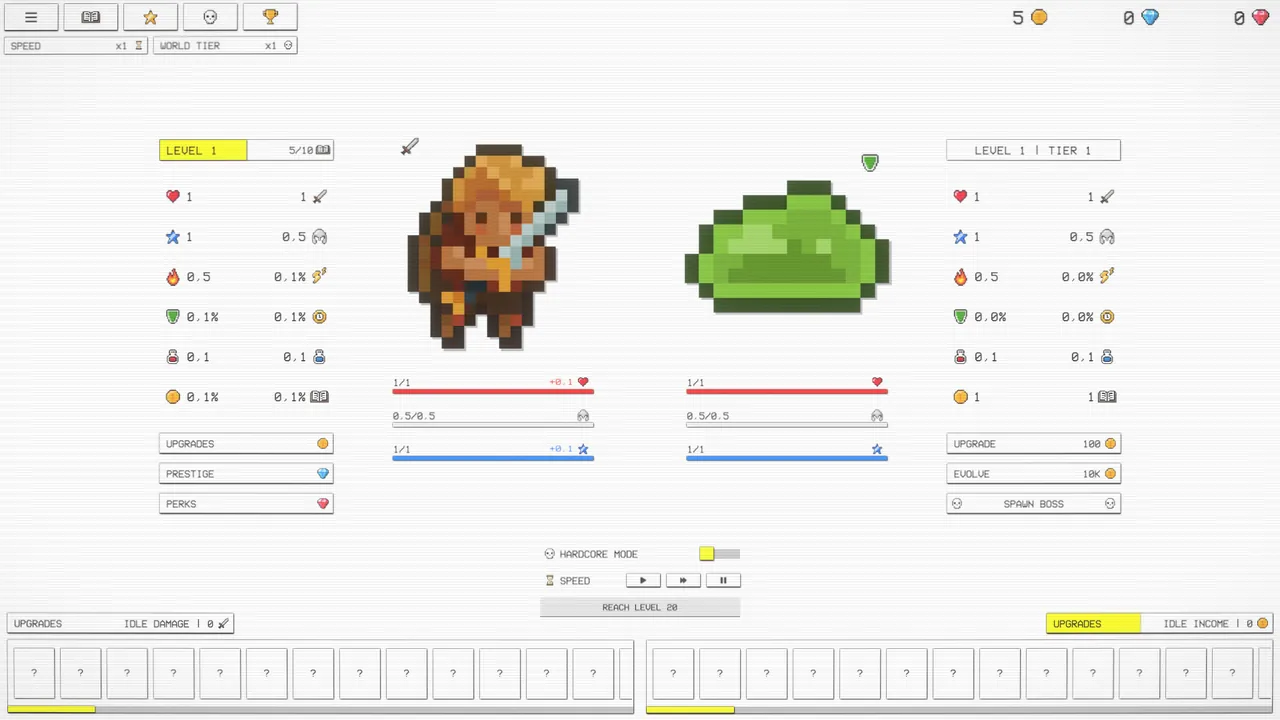
- Screenshots on the store page show a dense pair of scrolling, decimal-percentage stat columns either side of a small hero-and-monster sprite, reading more like a ledger than a game screen
Who it's for: Genre veterans who specifically want a turn-based idle RPG's numbers-and-menus structure over the tap-to-attack style more common in the space, and who don't need flashy presentation to enjoy pushing a stat ladder upward.
Our recommendation: A fair one-time purchase for anyone who wants exactly what the store page describes and doesn't mind that Repeat Games hasn't dressed the concept up further. Buyers who want polish, an active community, or reassurance from a large player base should treat this as an unproven, largely unreviewed release rather than a safe bet.
6 / 10
Repeat Games named its idle RPG "Idle RPG," and there's something almost disarming about a small developer refusing to dress up what the game actually is. No subtitle, no faux-epic fantasy name — just the genre, stated plainly, for NZ$11.25. What's underneath the blunt title turns out to be more interesting than the branding suggests: a turn-based idle grinder whose best mechanic ties its active and idle halves together in a way a lot of genre neighbours don't bother with.
Fight it, then hire it
The core loop is straightforward on paper. You control a hero in endless turn-based battles against a scaling line of monsters, earning gold and experience for every win, with tougher fights and boss encounters gating further progress. What sets it apart is what happens to the things you beat: Idle RPG lets you hire defeated enemies afterward, assigning them either to deal passive damage or to generate a steady trickle of gold while you're away. It's a small design choice, but it changes what "idle progress" means here — instead of a detached passive-income number sitting next to the active game, your idle output is literally built from monsters you fought and beat yourself. The store page's screenshots show two rows of assistant slots along the bottom of the screen, most locked behind a "?" icon waiting to be filled, which frames hiring as its own visible progression track running alongside levelling.
Layered over that is the game's other genuinely good idea: risk and reward that isn't just "the next monster hits harder." The store description is explicit that you can empower an enemy before a fight for a larger payout if you win, with real consequences if you lose. That's a meaningful decision point in a genre that too often reduces itself to a single "is my number bigger than their number yet" check, and it's the kind of system that rewards a player who's paying attention over one who's just leaving the screen open.
Two currencies, one reset
Progression splits across two separate resources. Gold buys twelve base stats — health, damage, armor, critical chance, block chance, stun chance, regen rates, gold and experience gain among them — while a prestige reset converts accumulated progress into Prestige Points, spent on six permanent multipliers: Strength, Endurance, Agility, Intelligence, Wisdom and Luck, each nudging a pair of related base stats upward for good. On paper, that's a sensible shape for a prestige system — sacrifice your current run's numbers for a smaller, permanent edge on the next one — and it's a structure genre veterans will recognise instantly from games like Melvor Idle or Idle Champions.
The one piece of outside testimony available on this system is not reassuring. A single detailed Steam review describes prestiging lowering the hero's own stats as expected, while the enemies scaling alongside World Tier keep climbing without a matching reset, which the reviewer says makes further progress "unachievable" past a certain point. That's one account rather than a confirmed, widespread pattern, and it shouldn't be read as the final word on the system — but it's specific enough, and describes exactly the kind of asymmetric-reset bug that idle-RPG prestige systems are prone to, that it's worth taking at face value rather than dismissing outright.
The interface, at a glance
Repeat Games' own screenshots show exactly what kind of game this is on screen: a small pixel-art hero on the left of a combat arena, a similarly small monster sprite on the right, and two dense columns of upgrade rows running down either side of the screen, most of them expressed in decimals and percentages down to a tenth of a point. World Tier and Speed toggles sit top-left, gold, gem and heart currency counters sit top-right, and a Hardcore Mode switch and playback controls run along the bottom of the arena. It's a functional layout that clearly communicates what everything does, but it reads closer to a spreadsheet with sprites pasted on than a game screen designed to be looked at for long stretches — there's little here to hold attention beyond the numbers themselves, and nothing that distinguishes Idle RPG visually from a dozen other browser-adjacent idle games using the same UI conventions.
Monetisation and reception
On monetisation there's genuinely nothing to complain about. The full store description makes no mention of a premium currency, energy system, battle pass, ads or DLC — it's a single NZ$11.25 purchase with 100 Steam achievements and Steam Cloud saves attached, and nothing in the listing suggests any further transaction exists. That's worth stating plainly in a genre where "idle" often comes bundled with a paywall somewhere past the opening hour.
Where the picture gets harder to read is reception. Four months after a full release, Idle RPG has attracted exactly four Steam reviews — one positive, three negative — which is too small a sample to draw any real conclusion from about quality, and shouldn't be read as one. What it does say clearly is that almost nobody has found this game yet. Two of the three negative reviews mention buying at a steep discount and still felt the asking price didn't match what they got, one raises the prestige-scaling issue described above, and the single positive review flags the achievement list itself as buggy. None of that amounts to a pattern with four data points, but none of it should be waved away either — it's simply what's actually on the record for a release this quiet.
Verdict
Idle RPG earns real credit for two ideas that a lot of pricier idle RPGs don't bother with: turning defeated enemies into a visible part of your idle income rather than an abstract number, and giving players an actual risk-reward lever to pull before a fight instead of just watching numbers climb. Combined with clean, ad-free, DLC-free monetisation at a fair one-time price, that's a legitimate foundation.
It settles at 6.0 rather than higher because the foundation is where the ambition stops. The interface does nothing to make the spreadsheet underneath it more inviting to look at, a detailed account of the prestige system undermining its own progression is concrete enough to flag even from a single source, and the game's own achievement system — one of its two stated endgame hooks — is reported broken by the one review that otherwise likes it. Add a release that's gone almost entirely unnoticed months after launch, and Idle RPG reads as a competent, honestly-priced idea that hasn't had the follow-through, or the audience, to prove itself yet.
Players who want their idle progression built around a persistent world and characters rather than a menu of stat rows might also want to look at Wanderer.
Pros and cons
Pros
- Hiring defeated enemies as either a passive-damage assistant or a gold-generating worker gives the idle side of the loop a direct payoff for fights you actually chose to take
- Deliberately empowering an enemy before a fight for a bigger reward is a real risk-versus-reward decision rather than combat simply getting harder as numbers climb
- Splitting upgrades across two currencies — gold for twelve base stats, Prestige Points for six permanent multipliers — gives the prestige reset a clearer purpose than a blank slate
- A one-time NZ$11.25 price with no premium currency, ads, subscriptions or DLC listed anywhere on the store page
- Hardcore mode and 100 Steam achievements give completionists a reason to keep going once the core stat grind has been seen once
Cons
- One detailed player account describes the prestige reset lowering the hero's own stats while enemy strength keeps climbing unchanged, calling further progress "unachievable" past a certain point — worth flagging even though it comes from a single review rather than a confirmed pattern
- The game's own achievement list, one of its two headline completionist hooks alongside Hardcore mode, is reported as bugged by the one Steam review that recommends the game
- Screenshots on the store page show a dense pair of scrolling, decimal-percentage stat columns either side of a small hero-and-monster sprite, reading more like a ledger than a game screen
- Steam's user review count sits at just four, several months after a full release, with three of those four negative and at least two describing the price as too high for what the game delivers
- No official website, press coverage or visible developer community exists beyond the Steam page itself, leaving buyers with little outside signal to weigh against the store description
Screenshots
-
Idle RPGImage: Repeat Games via Steam -
Idle RPGImage: Repeat Games via Steam -
Idle RPGImage: Repeat Games via Steam -
How the review scores each part of the gameWanderer Editorial -
The game at a glanceWanderer Editorial -
The short versionWanderer Editorial