
Game review
Idle Crown
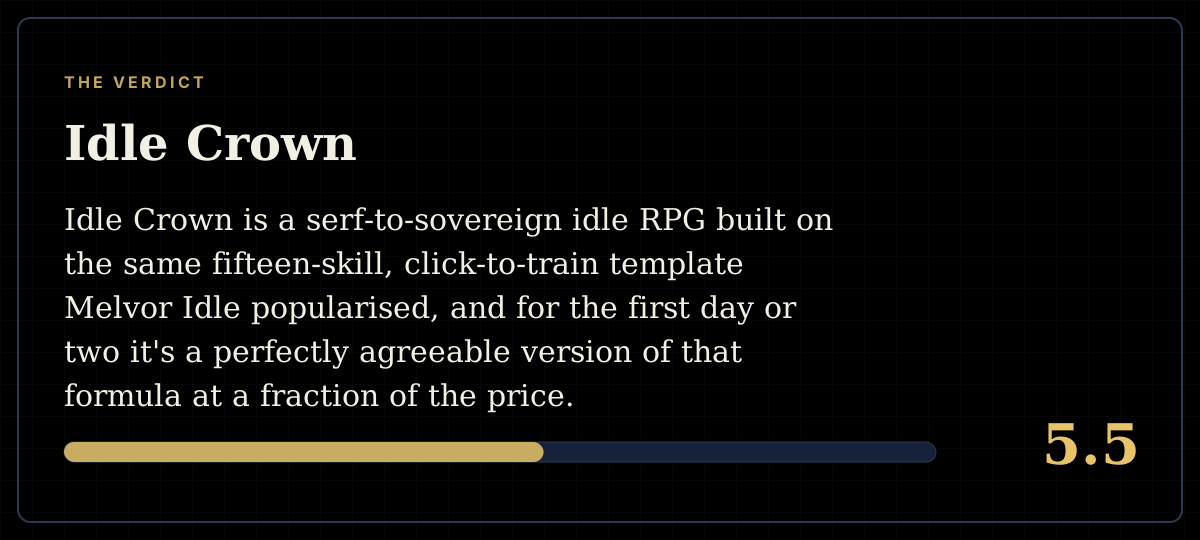
5.5 / 10
- Developer
- Idle Crown
- Publisher
- Idle Crown
- Released
- 23 June 2026
- Platforms
- Windows
- Genre
- Idle RPG
- Monetisation
- Paid, one-time purchase. No premium currency, no energy bars and no ads; the store page and player reviews agree there is nothing further to buy after the initial price.
- Players
- Single-player, with 39 Steam leaderboards and friend Rich Presence for comparing progress against other players
The short version
Idle Crown is a serf-to-sovereign idle RPG built on the same fifteen-skill, click-to-train template Melvor Idle popularised, and for the first day or two it's a perfectly agreeable version of that formula at a fraction of the price. The worker-automation system, which lets you delegate skills to hired hands rather than babysitting one grind at a time, is a genuinely good idea and the one thing recurring player feedback agrees on regardless of overall score.
The trouble starts once the honeymoon period ends. Speed and yield bonuses stack additively rather than multiplicatively, so the rate of progress falls off a cliff a few dozen levels in, turning what should be a slow-burn long game into a wall. Several players, independently and without prompting from each other, single out the same detail: achievement text, flavour writing and tutorial copy that reads as machine-generated rather than hand-written, in a genre where that kind of texture is usually part of the appeal.
Biggest strengths
- The worker system lets you delegate skills to hired hands so several resources train in parallel, and it's the one mechanic praised across both positive and negative reviews alike
- No premium currency, no energy system and no ads at any price point — what the store page promises about monetisation matches what players report finding
- A 20x20 Holding with twelve buildings gives the idle loop a visible, permanent thing to build toward rather than just a number going up
Biggest weaknesses
- Speed and yield bonuses stack additively instead of multiplicatively, so the pace of levelling collapses sharply once the early skills are behind you, turning a "long game" into a wait
- Multiple players independently describe achievement text, flavour writing and tutorial copy as reading like AI-generated filler, which undercuts a genre that usually leans on that kind of handwritten texture to justify a grind
- Leaderboards are one of the game's headline features, but recurring reports describe them sitting visibly full of uncontested cheaters, which hollows out the reason to chase a rank
Who it's for: Idle-RPG fans who want a cheap, no-nonsense Melvor-alike to run on a second monitor and don't mind a game that runs out of things to say after the first few sessions.
Our recommendation: Worth the asking price purely as a low-stakes background grind — there's no predatory monetisation and the worker system earns its keep. Anyone expecting Melvor-level depth, a builder's Holding that stays interesting to fill in, or a leaderboard worth chasing should wait and watch whether the scaling and cheating issues get patched.
5.5 / 10
Every idle RPG released since Melvor Idle blew up has to answer the same question: what does your game do that the free one everybody already knows doesn't? Idle Crown's answer is workers — hire them, assign them to a skill, and watch your Holding train several resources in parallel instead of one grind at a time. It's a smart, low-friction twist on a very familiar template, and it shows up as the one thing nearly every player, happy or not, singles out for praise.
The problem is that a good idea surrounded by thin execution is still a thin game. Idle Crown ships fifteen skills, a buildable 20x20 Holding, a rank ladder from Serf to King, and 100 achievements for NZ$6.39, which on paper reads like a lot of idle RPG for very little money. Steam's own user score — 22 positive against 28 negative out of 50 reviews, landing squarely in "Mixed" territory — tells a more complicated story, and reading through the actual reviews behind that number, the complaints are specific enough to take seriously rather than write off as noise.
The loop, and where it runs out of road
The core structure will be instantly familiar to anyone who's put time into Melvor Idle, RuneScape's skilling loop, or any of the dozen click-to-train idle RPGs that have followed in their wake. Chop wood, mine ore, forge it into gear; fish, hunt and cook; level Combat, Piety and Stewardship as passive multipliers that bend the other skills. Levels climb through a curve the store page frames as deliberately patient — quick early, "measured in days" by the endgame — and Mastery branches (Yield, Pace, Fortune) open past level 99 for players who stick around that long.
Patient pacing is a legitimate design choice for the genre. The issue player feedback keeps landing on isn't that Idle Crown is slow — it's that the way it gets slow feels like a math problem rather than a deliberate curve. Speed and yield upgrades stack additively instead of multiplicatively, and several independent accounts describe the same consequence: a smooth-enough first forty or fifty levels followed by a wall, where the exponential XP requirement keeps climbing but the linear bonus stack stops keeping pace with it. One detailed account describes needing one to two real days per level in the mid-game, with resource-gating that occasionally requires a skill level you can't actually reach yet without a resource gated behind a higher level than the one you're trying to hit — a genuine design knot rather than a difficulty spike.
That's a different problem than "the grind is long," which is a fair thing to ask of an idle RPG. It's specifically that the numbers underneath the grind don't scale the way players expect them to once they've internalised the game's own systems, and it shows up as a recurring, specific complaint rather than a vague one.
Workers, the Holding, and what actually lands
Credit where it's due: the worker system is a legitimately good idea, well-implemented enough that it survives contact with players who otherwise rated the game negatively. Climbing the rank ladder — Serf, Freeman, Yeoman, King — unlocks hired hands who train skills alongside you, and at higher ranks they reportedly outpace what the player character can manage solo. Piling several workers onto one resource to push through a stubborn level, rather than being stuck watching a single progress bar, is exactly the kind of quality-of-life idea this genre should be stealing more often, and it's the one mechanic that shows up as a positive in reviews that are otherwise scoring the game two stars.
The 20x20 Holding sits next to it as the game's other structural pillar — twelve buildings, upgrade tiers running from pine planks to voidstone, each granting a permanent speed bonus. It's a sensible answer to the genre's usual "numbers on a spreadsheet" presentation problem, giving players something spatial and visible to point at. Where it comes up short, per recurring player accounts, is depth per building: the loop of assigning workers and waiting for tier-up thresholds doesn't introduce much new decision-making once the pattern is established, and more than one review describes having "seen everything" the game offers within two or three hours, even while acknowledging the worker system and Renown meta-progression shop as genuine bright spots within that short window.
The AI-writing complaints, and the trust problem underneath them
The most unusual recurring thread in Idle Crown's negative reviews isn't a bug report or a balance complaint — it's a stylistic one. Multiple players, independently of each other, describe the achievement text, flavour writing and tutorial copy as reading like AI-generated filler rather than handwritten content, in a genre where achievement names and flavour text are usually one of the cheaper, more personal ways a small developer signals craft. Whether or not every line in the game was actually machine-assisted isn't something a review can verify from the outside, but the pattern itself is worth reporting honestly: enough separate reviewers landed on the same specific observation, unprompted, that it reads as a real perception problem for the game rather than one disgruntled voice. For a store page that leans specifically on "100 achievements, written like a chronicle" as a selling point, that's a credibility gap worth knowing about before buying.
A second trust issue shows up around the leaderboards, which the store page also promotes as a headline feature — 39 boards spanning speedrun times, per-skill XP, Mastery progress, lifetime XP and streaks. Recurring reports describe those boards sitting visibly populated by uncontested cheaters, which is a much more concrete complaint than "some players didn't like the leaderboards" — it's a specific, repeated claim that the competitive layer the game advertises isn't currently policed. Reports about developer responsiveness are mixed rather than uniformly bad: one long-time player noted the developer's Discord had gone quiet with no channels and no reply to messages, but the same review later logged a follow-up update in early July acknowledging a "mini update" had landed, so this reads as inconsistent support rather than total abandonment.
Monetisation and value
There's no ambiguity here, and it's worth stating plainly: Idle Crown is a one-time NZ$6.39 purchase with no premium currency, no energy system and no advertising, and player feedback consistently backs up the store page's claim that this is the whole transaction. Compared to the genre's other paid entries — Idle Regenerator at NZ$15.75, or Idle Iktah's free base game gated by a real offline- cap paywall — Idle Crown is priced to be a low-risk purchase, and on pure cost-to-content math it's hard to call it a bad deal even accounting for its thin midgame. The honest caveat is that "cheap and fair" isn't the same as "worth returning to," and several of the same reviews praising the price also describe running out of reasons to keep playing well before the endgame the store page promises.
Verdict
Idle Crown gets the fundamentals of a budget idle RPG right — an honest price, no predatory monetisation, and one genuinely well-designed system in the worker-delegation mechanic that other games in this genre would do well to copy. That's enough to keep it out of "avoid" territory.
It settles at 5.5 because the problems raised by its own player base are specific rather than vague: additive scaling that turns a deliberately slow curve into an arbitrary wall, a leaderboard system undermined by unaddressed cheating, and a skilling loop several players describe as fully exhausted within a couple of hours despite the promise of a hundred-plus-hour Holding to build. The AI-writing complaints are impossible to verify from outside the game, but the fact that several unconnected players raised the same specific concern is itself a data point worth passing on. For six dollars, Idle Crown is a defensible way to spend a lazy weekend with an idle RPG running in the background. It isn't, in its current state, a strong argument for a genre that already has better-scaling alternatives at a similar price.
Players who want a persistent RPG world with progression that keeps moving while they're away — without an additive-scaling wall waiting a few dozen levels in — might also want to look at Wanderer.
Pros and cons
Pros
- The worker system lets you delegate skills to hired hands so several resources train in parallel, and it's the one mechanic praised across both positive and negative reviews alike
- No premium currency, no energy system and no ads at any price point — what the store page promises about monetisation matches what players report finding
- A 20x20 Holding with twelve buildings gives the idle loop a visible, permanent thing to build toward rather than just a number going up
- Achievement icons are hand-rendered gold-on-parchment plates rather than generic stock badges
- NZ$6.39 is a low bar to clear next to genre neighbours charging two to three times as much
Cons
- Speed and yield bonuses stack additively instead of multiplicatively, so the pace of levelling collapses sharply once the early skills are behind you, turning a "long game" into a wait
- Multiple players independently describe achievement text, flavour writing and tutorial copy as reading like AI-generated filler, which undercuts a genre that usually leans on that kind of handwritten texture to justify a grind
- Leaderboards are one of the game's headline features, but recurring reports describe them sitting visibly full of uncontested cheaters, which hollows out the reason to chase a rank
- Skill design frequently reduces to a single obvious input-to-output conversion with no real decision behind it, and more than one review describes seeing everything the game offers within two or three hours
- A workday-length offline cap is a stated feature, but at least one detailed report describes the game losing hours of progress to crashes when left running unattended for long stretches
Screenshots
-
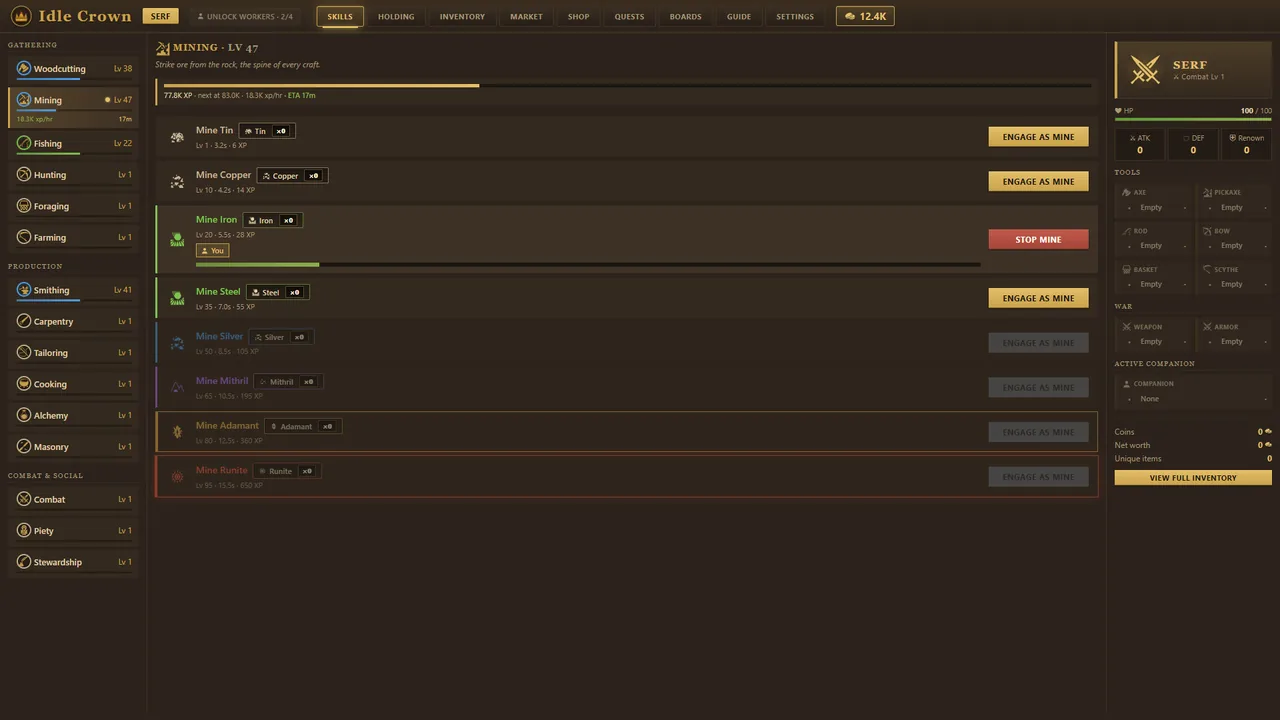
Idle CrownImage: Idle Crown via Steam -
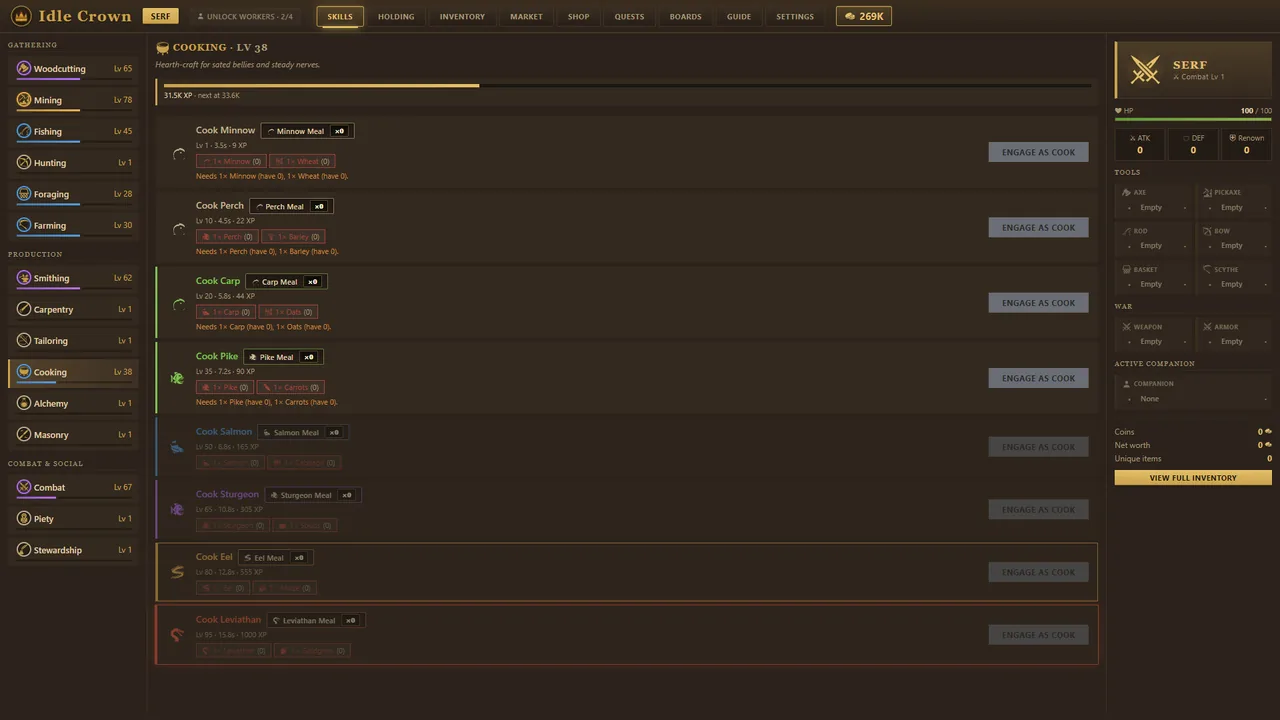
Idle CrownImage: Idle Crown via Steam -
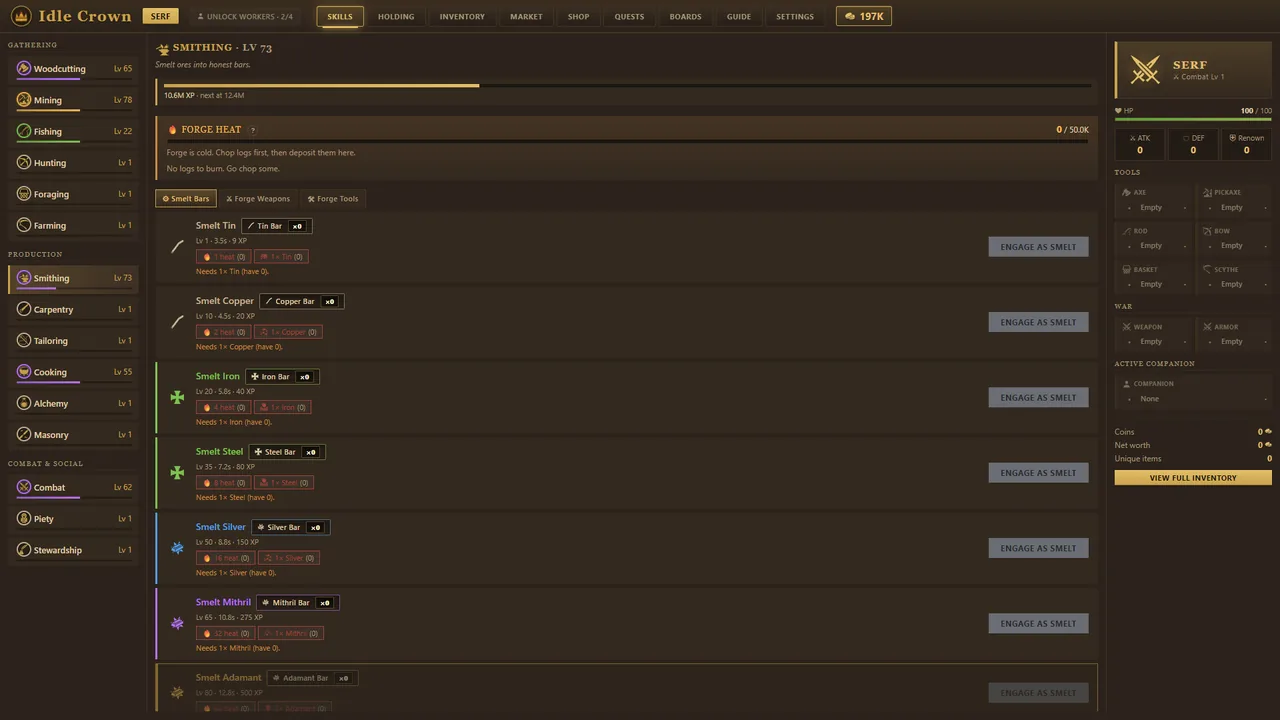
Idle CrownImage: Idle Crown via Steam -
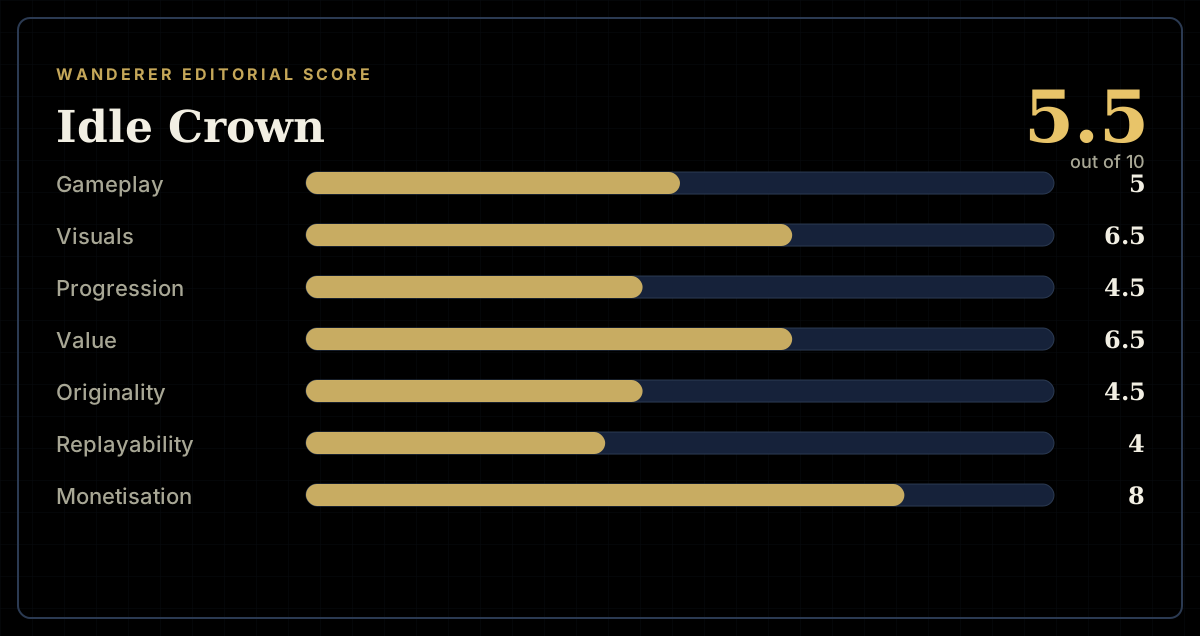
How the review scores each part of the gameWanderer Editorial -

The game at a glanceWanderer Editorial -
The short versionWanderer Editorial