Game review
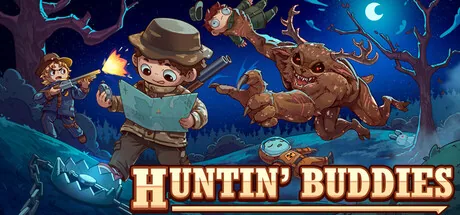
Huntin' Buddies
6.5 / 10
- Developer
- Huntin' Buddies Wildlife Management
- Publisher
- Huntin' Buddies Wildlife Management
- Released
- 24 July 2026
- Platforms
- Windows
- Genre
- Co-op Horror
- Monetisation
- Premium, one-off purchase — no in-game purchases
- Players
- Online co-op, up to four players; playable solo
The short version
Huntin' Buddies puts a contract hunter's night shift inside a national park where the wildlife has gone quietly, horribly wrong — deer with both eyes on one side of the skull, rabbits that scream, goats that mutter Latin. You take the job, meet the quota, and drag the evidence back to the truck before whatever's hunting you gets close enough to matter. Play it with three friends and it's a genuinely great time: equal parts slapstick and dread, in the tradition of the quota-extraction games that made that combination popular.
What holds it back from the genre's best is a single system doing outsized damage. Carcasses can overstretch and explode for reasons that aren't always visible to the player dragging them, death wipes the whole night's contract with no permanent upgrades to soften the next attempt, and the achievement data backs up what several reviewers already say in writing — most players who buy this never see its third and final location.
Biggest strengths
- The horror-comedy tone actually lands — uncanny wildlife played completely straight against absurd, panicked physics comedy
- Dragging a carcass as a group creates the same shared tension-then-laughter loop that built the quota-extraction genre in the first place
- Three distinct hunting grounds, each visibly harder than the last, give real structure to a escalating fifteen-night contract list
Biggest weaknesses
- The carcass-overstretch mechanic punishes players for snags that aren't always visible or predictable, and detonates a kill they may have already carried most of the way to the truck
- Dying restarts the entire contract with no permanent stamina, speed or gear upgrades carried forward, so a bad night and a good night look identical at the start
- Global achievement data shows a steep cliff after the first location — only a small fraction of players ever reach the swamp, the third and final map
Who it's for: Squads of two to four who already like Lethal Company or R.E.P.O. and want the same loop with a hunting-trip setting. Solo horror fans should expect a noticeably harder, lonelier version of the same game.
Our recommendation: Worth the asking price for a group willing to laugh through a few wasted nights while the mechanics settle. Wait for a patch or two if restarting an entire contract because a deer got stuck on a rock sounds like it would wear thin fast — because for a meaningful slice of the audience, it already has.
6.5 / 10
The pager buzzes, the contract lists a weight quota and a named animal, and the first instinct in Huntin' Buddies is to treat it like a job. Walk out, find the deer, take the shot, drag it to the truck, collect the pay. The second instinct, usually arriving somewhere around the first rabbit that screams instead of bolting, is to wonder exactly what kind of park this is and why nobody mentioned the goats speak Latin.
That gap between "contract hunter simulator" and "something is deeply wrong with this forest" is the whole pitch, and for a squad of friends on voice chat it mostly works. Where it doesn't is a handful of systems that punish the player for things they didn't do wrong, in a genre built almost entirely on making failure feel earned.
The job
Structurally, Huntin' Buddies belongs to the same family as Lethal Company and R.E.P.O.: a small crew takes contracts against an escalating difficulty curve, ventures into a hostile space to retrieve something specific, and either extracts together or doesn't extract at all. Here the something is wildlife rather than scrap or valuables, and the retrieval method is a shotgun with limited ammunition rather than a scanner and a bag.
Fifteen contract nights run across three locations — Pine Valley, Granger Farms and Blackmire Swamp — with named quotas that get more specific and more dangerous as the list progresses. Early nights ask for one or two of an obvious, mostly harmless species. Later ones name creatures that are actively hunting the hunters, and the difference between a five-minute contract and a twenty-minute one stops being subtle.
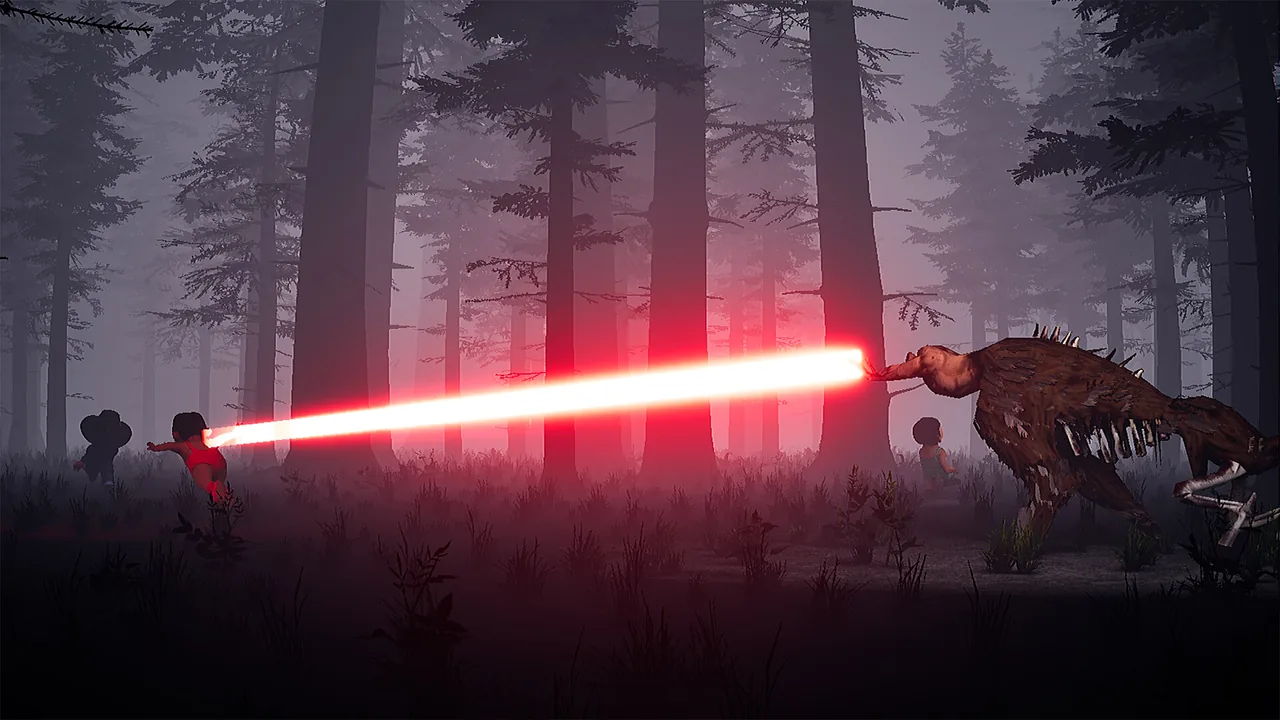
One-shot kills keep every encounter tense rather than attritional — miss, and you're reloading in the open with something that noticed you. It's a good rule for a horror game to commit to, and it does the heavy lifting for the tension that the atmosphere alone doesn't quite manage.
Contract progress is shared across the whole squad rather than tracked per player, which matters more than it sounds like it should. It means a four-person group can specialise — one person on the shotgun, one scouting ahead, two on carcass duty — without anyone feeling like they're not contributing to the quota. It's a small structural decision, but it's the right one for a game this dependent on people actually talking to each other over voice chat.
Carrying the evidence
Killing the animal is the easy half. Getting it back to the truck is where Huntin' Buddies finds its best co-op moment and its worst design decision in the same mechanic.
Carcasses are dragged, not carried, and dragging one solo is slow enough that the game is clearly nudging a squad to split the job — one player pulling, one watching the treeline. Doing it with a friend, hauling a moose-sized problem across open ground while trying not to laugh loud enough to attract something, is the game at its absolute best. It's the kind of emergent, unscripted moment the genre exists to produce.
Limited ammunition sharpens the same moment into something closer to actual risk management. A missed shot or a wasted round on the wrong animal means fewer bullets for whatever's stalking the truck route home, so the decision to take a risky shot at range versus wait for a cleaner angle carries real weight rather than being a formality before the drag begins. It's a small piece of design, but it's the reason a hunt still feels tense even once a squad has learned a location well enough that the wildlife itself stops being much of a threat.
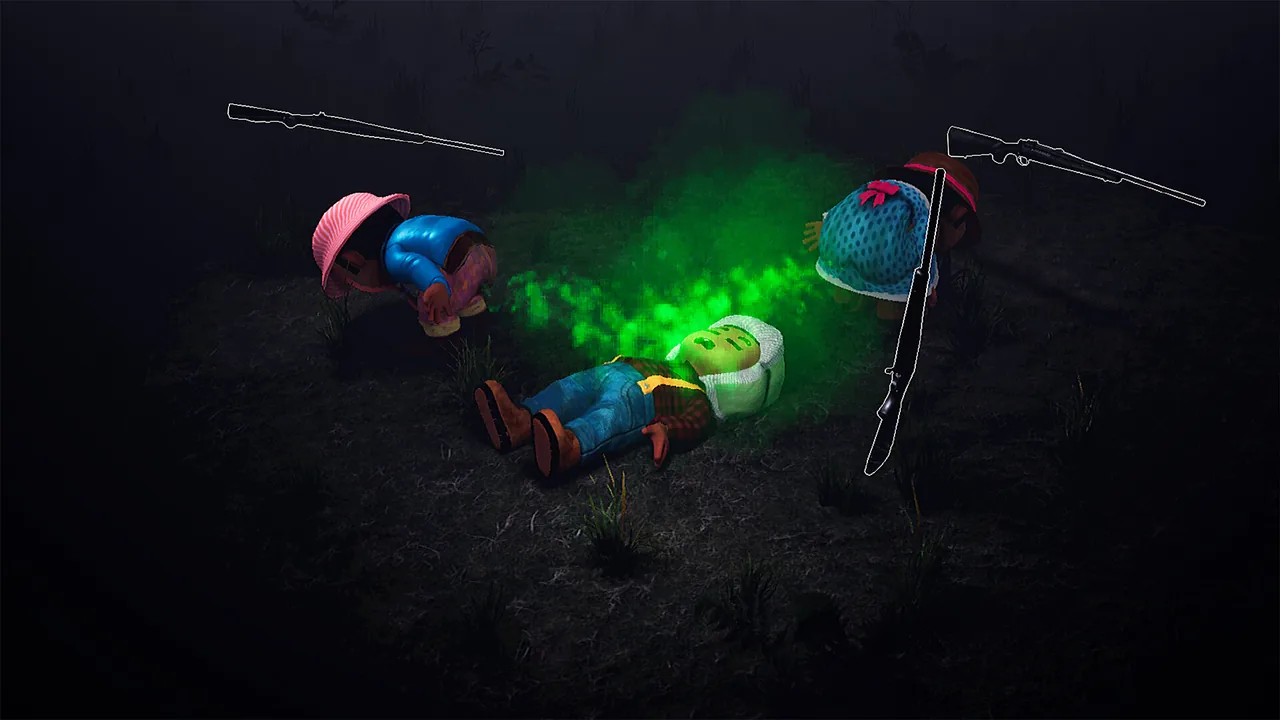
Then there's overstretching. Drag a carcass too far from whoever's helping, or catch it on something the game considers an obstruction, and it can simply explode — quota kill gone, contract progress with it. Multiple players report the trigger being inconsistent: getting caught on terrain that looks perfectly clear, or overstretching while walking in a straight line with no snag visible at all. One reviewer, otherwise positive about the demo, returned the finished game specifically over this, writing that a kill can detonate "but it gets caught on nothing." When a system exists to punish carelessness, it needs to be legible enough that players can see the mistake coming. Right now, several can't.
No safety net
The bigger structural problem sits underneath that one. Die on a contract night — and with limited ammo, one-shot enemies and creatures that can close distance fast, dying happens — and the whole night resets. No stamina upgrade, no speed boost, no unlockable gear carries forward between attempts. The contract itself doesn't change either, so a second try at the same night is mechanically identical to the first, minus whatever the squad happened to learn.
That's a defensible design choice in isolation — plenty of extraction horror games treat every run as a fresh roll of the dice — but it compounds badly with the overstretch problem above. A carcass that explodes for an unclear reason doesn't just cost the kill, it can cost the entire session's progress, and the next attempt starts from exactly zero rather than from a slightly better-equipped hunter. One review flags a second version of the same issue: teammates disconnecting mid-contract forces the whole squad back to the start, with the developer's own recent patch notes reportedly hinting at persistent progress as a fix still in the works.
The global achievement numbers make the shape of that problem visible without needing to take anyone's word for it. The early, forest-based achievements — friendly fire, first rabbit kill, helping a downed teammate, surviving an overstretch — sit between roughly 42% and 84% of the player base. Cross into the farm and the numbers fall off a cliff: 17% and 16% for the farm-specific achievements. Reach the swamp, the third and final location, and it's under 5%. The two hardest achievements, tied to expert-level and legendary hunts, sit at 0.4% and 0.3%. Whatever combination of difficulty spike and restart-from-zero is responsible, the overwhelming majority of buyers never see two-thirds of the game's advertised content.
Rough edges beyond the big one
The overstretch mechanic is the most-cited complaint, but it isn't the only friction reported. One low-playtime negative review, framed as impressions rather than a verdict, lists an interface that reads as unfinished, a moment where a weapon reportedly failed to fire, and visibility issues at night — the kind of list that's worth taking seriously precisely because it comes from someone who bounced off within minutes rather than someone still invested hundreds of hours in. Set against that is a much larger volume of players who logged multiple hours across several nights and didn't raise the same issues, which suggests inconsistency rather than a universal problem — some sessions and some hardware configurations are clearly rougher than others two weeks after launch.
None of it amounts to a stability crisis. The developer is visibly active — several reviewers mention them dropping into community livestreams to talk through fixes directly, and the patch cadence since launch has been frequent enough that at least one reviewer explicitly says they're waiting for the game to settle before forming a final opinion. That's a reasonable position for a buyer to take too.
The uncanny part
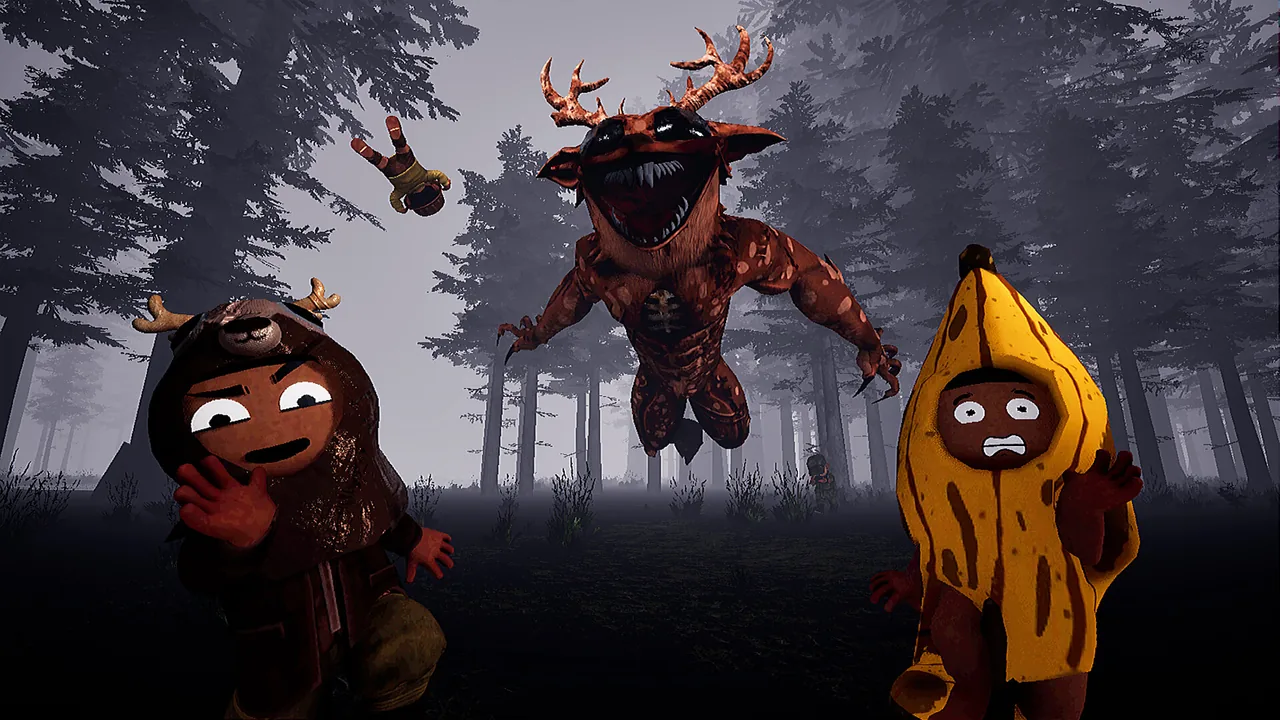
Credit where it's earned: the horror concept itself is genuinely well-judged. Huntin' Buddies doesn't lean on jump scares so much as on the accumulating wrongness of animals that look almost right — the store page's own line about eyes on the same side of a deer's head is a fair description of the whole approach. It's unsettling in the way a slightly-off photograph is unsettling, and it earns its comedy by refusing to explain itself. Nobody in the game stops to tell you why the goats are quoting Latin. You're a contract hunter; that's somebody else's problem.
That restraint is also why it works so well as a co-op game specifically. A solo player creeping through Blackmire Swamp alone gets a straightforward horror experience, competently built but not remarkable next to the genre's best. A four-player squad gets the comedy layer too — someone insisting a rabbit didn't actually scream, someone else refusing to go near the goats, the whole group management collapsing into panic the moment something starts hunting back. The positive reviews consistently single out exactly this: a night that's mostly laughter until it very suddenly isn't.
Money and access
There's not much to litigate on monetisation, which is itself worth stating plainly for readers weighing this against a genre that's full of season passes and cosmetic shops. Huntin' Buddies is a single premium purchase with no in-game store, no currency and no battle pass — the price on the box is the price of the whole game. At its current NZ$9.99, discounted 20% from NZ$12.49, that's inexpensive enough that a squad of four is looking at well under three dollars a head to try it together, which lowers the stakes on a game still working through the rough edges above considerably. A free demo was also available ahead of the full release, sharing the same build's appid family on Steam, and several of the most detailed positive reviews are from players who played that demo first and came back specifically because they liked what they tried.
Where it sits
Huntin' Buddies launched at the very end of July, two weeks before this review, with 54 reviews logged and a Very Positive rating built almost entirely on English-language feedback — no distorting cluster from a single region skewing the number either direction. Read in full, the negative reviews aren't really arguing the concept is broken; they're arguing that the systems built to punish failure currently punish players for things outside their control, and that the lack of any persistent progress makes repeat attempts feel identical rather than earned. The positive reviews, several written by people who tried the free demo months earlier, describe a game that delivered more of exactly what the demo promised, bugs and all, and credit the developer for showing up in players' own streams to talk through fixes.
Both things can be true at once. The demo-to-launch trajectory here reads like a small team that nailed the hook early and is still working out the punishment layer wrapped around it — a familiar shape for this corner of the genre, and one Lethal Company and R.E.P.O. both eventually smoothed out with patches after their own rough opening months.
The verdict
Huntin' Buddies earns a 6.5. The premise is sharp, the co-op loop built around dragging something that shouldn't exist while listening for whatever's stalking you is genuinely fun with the right group, and three escalating locations give the fifteen-night contract list real shape. It doesn't score higher because the game currently punishes players in ways that feel arbitrary rather than fair — an overstretch mechanic that can trigger without a visible cause, and a total-restart penalty with nothing to show for a failed attempt — and the achievement data confirms that most buyers bounce off well before the third map.
At roughly ten dollars, discounted, it's an easy recommendation for a squad of three or four who already know they like this genre and are willing to ride out a rough patch or two while restart mechanics get tuned. Solo players and anyone allergic to losing a night's progress to an invisible snag should give it a patch cycle first. Readers who want the same haul-it-back-to-the-truck tension with the sharpest version of the physics-comedy layer should also look at R.E.P.O., and anyone who wants the genre's most-refined take on quota extraction still has Lethal Company two years and several patches ahead of it.
Pros and cons
Pros
- The horror-comedy tone actually lands — uncanny wildlife played completely straight against absurd, panicked physics comedy
- Dragging a carcass as a group creates the same shared tension-then-laughter loop that built the quota-extraction genre in the first place
- Three distinct hunting grounds, each visibly harder than the last, give real structure to a escalating fifteen-night contract list
- A public demo let players test the exact hook before buying, and demo fans largely say the full release delivers more of what they liked
- Cheap enough, especially on its current discount, for a full squad to commit to on a whim
Cons
- The carcass-overstretch mechanic punishes players for snags that aren't always visible or predictable, and detonates a kill they may have already carried most of the way to the truck
- Dying restarts the entire contract with no permanent stamina, speed or gear upgrades carried forward, so a bad night and a good night look identical at the start
- Global achievement data shows a steep cliff after the first location — only a small fraction of players ever reach the swamp, the third and final map
- A disconnecting teammate can force the whole squad back to the beginning, compounding the lack of saved progress
- Solo play is supported but visibly not the intended way to experience it — both the horror and the two-person carcass-hauling are built around a full squad
Screenshots
-
Huntin' BuddiesImage: Huntin' Buddies Wildlife Management via Steam -
Huntin' BuddiesImage: Huntin' Buddies Wildlife Management via Steam -
Huntin' BuddiesImage: Huntin' Buddies Wildlife Management via Steam -
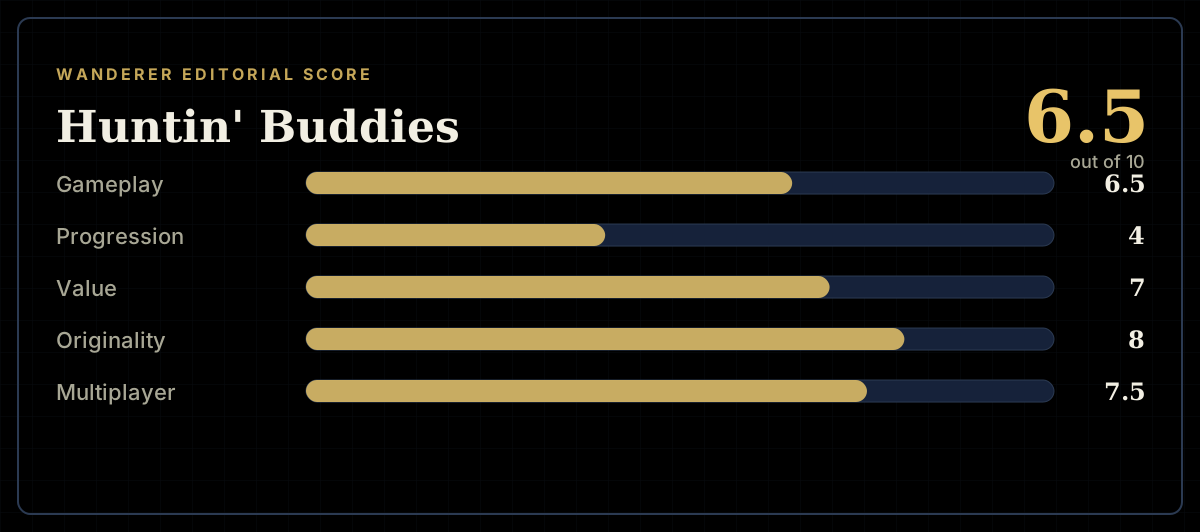
How the review scores each part of the gameWanderer Editorial -
The short versionWanderer Editorial